


Stivarga 40 mg comprimidos recubiertos con película

Prescription review online
A doctor will review your case and decide whether a prescription is medically appropriate.

Talk to a doctor about this medicine
Discuss your symptoms and possible next steps in a quick online consultation.



How to use STIVARGA 40 mg FILM-COATED TABLETS
Contents of the leaflet
- Introduction
- What is Stivarga and what is it used for
- What you need to know before you take Stivarga
- How to take Stivarga
- Possible Adverse Effects
- Storage of Stivarga
- Keep this medicine out of the sight and reach of children.
- Package contents and additional information
Introduction
Package Leaflet: Information for the User
Stivarga 40 mg film-coated tablets
regorafenib
Read all of this leaflet carefully before you start taking this medicine because it contains important information for you.
- Keep this leaflet, you may need to read it again.
- If you have any further questions, ask your doctor or pharmacist.
- This medicine has been prescribed for you only. Do not pass it on to others. It may harm them, even if their signs of illness are the same as yours.
- If you get any side effects, talk to your doctor or pharmacist. This includes any possible side effects not listed in this leaflet. See section 4.
Contents of the pack
- What is Stivarga and what is it used for
- What you need to know before you take Stivarga
- How to take Stivarga
- Possible side effects
- Storing Stivarga
- Contents of the pack and other information
1. What is Stivarga and what is it used for
Stivarga contains the active substance regorafenib. It is a medicine that is used to treat cancer and works by slowing down the growth and spread of cancer cells and cutting off the blood supply that allows them to grow.
Stivarga is used to treat:
- colon or rectal cancer that has spread to other parts of the body in adult patients who have received other treatments or who cannot receive treatment with other medicines (fluoropyrimidine-based chemotherapy, anti-VEGF therapy, and anti-EGFR therapy)
- gastrointestinal stromal tumors (GIST), a type of stomach and intestine cancer, that has spread to other parts of the body or cannot be treated with surgery, in adult patients who have received prior treatment with other cancer medicines (imatinib and sunitinib)
- adult patients with liver cancer who have been previously treated with another cancer medicine (sorafenib)
If you have any questions about how Stivarga works or why you have been prescribed this medicine, ask your doctor.

Not sure if this medicine is right for you?
Discuss your symptoms and treatment with a doctor online.
2. What you need to know before you take Stivarga
Do not take Stivarga
- if you are allergic to regorafenib or any of the other ingredients of this medicine (listed in section 6).
Warnings and precautions
Talk to your doctor or pharmacist before taking Stivarga.
Be careful with Stivarga
If you are in any of these situations, tell your doctorbefore taking Stivarga. It may be necessary to treat them, as well as perform additional tests (see also section 4 "Possible side effects").
Children and adolescents
The use of Stivarga in children and adolescents for the indication of colon or rectal cancer that has spread to other parts of the body is not relevant.
The safety and efficacy of Stivarga in children and adolescents for the indication of gastrointestinal stromal tumors (GIST) have not been established. No data are available.
The use of Stivarga in children and adolescents for the indication of liver cancer is not relevant.
Other medicines and Stivarga
Tell your doctor or pharmacistif you are taking, have recently taken, or might take any other medicines. This includes medicines obtained without a prescription, such as vitamins, dietary supplements, or herbal medicines. Some medicines may affect how Stivarga works or Stivarga may affect how these medicines work and cause serious side effects. Tell your doctor in particular if you are taking any of the following medicines or any other medicine:
- certain medicines for treating fungal infections (e.g., ketoconazole, itraconazole, posaconazole, and voriconazole)
- certain medicines for treating pain (e.g., mefenamic acid, diflunisal, and nifluramic acid)
- certain medicines for treating bacterial infections (e.g., rifampicin, clarithromycin, telithromycin)
- medicines commonly used to treat epilepsy (seizures) (e.g., phenytoin, carbamazepine, or phenobarbital)
- methotrexate, a medicine commonly used to treat cancer
- rosuvastatin, fluvastatin, atorvastatin, medicines commonly used to treat high cholesterol
- warfarin or phenprocoumon, medicines commonly used to make your blood thinner
- St. John's Wort (also obtained without a prescription), a herbal treatment for depression
Talk to your doctor or pharmacist before taking any medicine.
Taking Stivarga with food and drinks
Avoid drinking grapefruit juice while taking Stivarga, as it may affect how Stivarga works.
Pregnancy, breast-feeding, and fertility
Tell your doctor if you are pregnant, think you may be pregnant, or plan to become pregnant,as Stivarga should not be used during pregnancy unless clearly necessary. Your doctor will discuss with you the potential risks of taking Stivarga during pregnancy.
Avoid becoming pregnant while taking Stivarga, as this medicine may harm your unborn baby.
Both men and women of childbearing ageshould use effective contraception during treatment and for at least 8 weeks after finishing treatment.
Do not breast-feed your baby while taking Stivarga, as this medicine may interfere with your baby's growth and development. Tell your doctor if you are breast-feeding or plan to breast-feed.
Stivarga may reduce fertility in both men and women. Talk to your doctor before taking Stivarga.
Driving and using machines
It is not known whether Stivarga affects the ability to drive and use machines. Do not drive or use tools or machines if you experience symptoms related to treatment that affect your ability to concentrate and react.
Important information about some of the ingredients of Stivarga
This medicine contains 56.06 mg of sodium (main component of cooking/table salt) in each daily dose (4 tablets). This is equivalent to 3% of the maximum recommended daily intake of sodium for an adult.
This medicine contains 1.68 mg of lecithin(derived from soy) per daily dose (4 tablets).
3. How to take Stivarga
Take this medicine exactly as your doctor has told you. If you are not sure, ask your doctor or pharmacist.
The recommended daily dosein adults is 4 tablets of Stivarga 40 mg (160 mg of regorafenib). Your doctor may change your dose. Take the dose of Stivarga that your doctor has prescribed for you. In general, your doctor will ask you to take Stivarga for 3 weeks and then stop taking it for 1 week. This is 1 treatment cycle.
Take Stivarga at the same time every day, after a low-fat meal. Take the tablet whole with water after a low-fat meal with less than 30% fat content. An example of a low-fat meal includes 1 serving of cereal (about 30 g), 1 glass of skimmed milk, 1 toast with jam, 1 glass of apple juice, and 1 cup of coffee or tea (520 calories, 2 g of fat). Do not take Stivarga with grapefruit juice (see also the section "Taking Stivarga with food and drinks").
If you vomit after taking regorafenib, do not take an additional tablet and inform your doctor.
Your doctor may need to reduce your dose or decide to interrupt or permanently stop treatment, if necessary. In general, you will take Stivarga as long as you are benefiting from treatment and not experiencing unacceptable side effects.
No dose adjustment is necessary if you have mild liver impairment. If you have mild or moderate liver impairment while being treated with Stivarga, your doctor should closely monitor you. If you have severe liver impairment, you should not receive treatment with Stivarga, as there is no data available on the use of Stivarga in patients with severe liver impairment.
No dose adjustment is necessary if you have mild, moderate, or severe kidney impairment.
If you take more Stivarga than you should
Tell your doctor immediately if you have taken a dose higher than the one prescribed for you. You may need medical attention, and your doctor may tell you to stop taking Stivarga.
Taking too much Stivarga may increase the chance of getting some side effects or make them more severe, especially:
- skin reactions (rash, blisters, redness, pain, swelling, itching, or peeling of the skin)
- changes in your voice or hoarseness (dysphonia)
- frequent or loose bowel movements (diarrhea)
- mouth sores (mucositis)
- dry mouth
- decreased appetite
- high blood pressure (hypertension)
- excessive tiredness (fatigue)
If you forget to take Stivarga
If you forget a dose, take it as soon as you remember on the same day. Do not take a double dose on the same day to make up for forgotten doses the day before. Inform your doctor of any dose you have missed.

Started taking the medicine and have questions?
Discuss your symptoms and treatment with a doctor online.
4. Possible Adverse Effects
Like all medicines, this medicine can cause adverse effects, although not all people suffer from them. This medicine can also alter the results of some blood tests.
The most serious adverse effects,for which a fatal outcome has been observed, are:
- Severe liver problems (including liver failure), bleeding, gastrointestinal perforation, and infection.
Inform your doctor immediatelyif you experience any of the following symptoms:
Liver problems
Treatment with Stivarga may increase the risk of severe liver problems. Seek medical help immediately if you experience the following symptoms:
- Yellowing of the skin and the whites of the eyes
- Dark urine
- Confusion and/or disorientation
These may be signs of severe liver damage.
Bleeding
Stivarga may cause severe bleeding in the digestive tract, such as in the stomach, throat, rectum, or intestine, or in the lungs, kidneys, mouth, vagina, and/or brain. Seek medical help immediately if you experience the following symptoms:
- Presence of blood in the stool or black stool
- Presence of blood in the urine
- Stomach pain
- Coughing up/vomiting blood
These may be signs of bleeding.
Severe gastric and intestinal problems (perforation or gastrointestinal fistula)
Seek medical help immediately if you experience the following symptoms:
- Severe stomach (abdominal) pain or stomach pain that does not disappear
- Vomiting blood
- Red or black stool
These may be signs of severe gastric or intestinal problems.
Infection
Treatment with Stivarga may increase the risk of infections, especially of the urinary tract, nose, throat, and lung. Treatment with Stivarga may also increase the risk of fungal infections in the mucous membrane, skin, or body. You should seek medical attention immediately if you experience any of these symptoms:
- High fever
- Severe cough with or without increased mucus production
- Severe sore throat
- Difficulty breathing
- Burning/pain when urinating
- Unusual vaginal irritation or discharge
- Redness, swelling, and/or pain in any part of the body.
These may be signs of an infection.
Other adverse effects of Stivarga indicated by frequency:
Very common adverse effects(may affect more than 1 in 10 users)
- Reduction in the number of platelets in the blood, characterized by easy bruising or bleeding (thrombocytopenia)
- Reduction in the number of red blood cells in the blood (anemia)
- Decreased appetite and food intake
- High blood pressure (hypertension)
- Changes in voice or hoarseness (dysphonia)
- Frequent or loose bowel movements (diarrhea)
- Dryness or pain in the mouth, pain in the tongue, mouth sores (stomatitis and/or mucositis)
- Feeling of dizziness (nausea)
- Vomiting
- Elevated blood levels of bilirubin, a substance produced by the liver (hyperbilirubinemia)
- Changes in liver enzymes, which may indicate liver damage (increased transaminases).
- Redness, pain, blisters, and swelling of the palms of the hands or the soles of the feet (hand-foot skin reaction)
- Rash
- Weakness, lack of strength and energy, excessive fatigue, and unusual sleepiness (asthenia/fatigue)
- Pain (including abdominal pain and back pain)
- Constipation
- Fever
- Weight loss
Common adverse effects(may affect up to 1 in 10 users)
- Decrease in the number of white blood cells (leukopenia)
- Decreased activity of the thyroid gland (hypothyroidism)
- Low blood levels of potassium, phosphate, calcium, sodium, or magnesium (hypokalemia, hypophosphatemia, hypocalcemia, hyponatremia, and hypomagnesemia)
- Elevated blood levels of uric acid (hyperuricemia)
- Loss of body fluids (dehydration)
- Headache
- Tremor
- Nerve damage that can cause a change in sensitivity, such as numbness, tingling, weakness, or pain (peripheral neuropathy)
- Taste disorders
- Dry mouth
- Heartburn (gastroesophageal reflux)
- Infection or irritation of the stomach and intestines (gastroenteritis)
- Hair loss (alopecia)
- Dry skin
- Scaly or flaky skin rash (exfoliative rash)
- Sudden, involuntary muscle contractions (muscle spasms)
- Protein in the urine (proteinuria)
- Elevated levels of certain digestive enzymes (increased amylase and lipase)
- Abnormal blood clotting (abnormal INR)
Uncommon adverse effects(may affect up to 1 in 100 users)
- Signs/symptoms of an allergic reaction that could include a severe generalized rash, dizziness, fever, shortness of breath, jaundice, changes in liver chemicals (hypersensitivity reaction).
- Heart attack, chest pain (myocardial infarction and myocardial ischemia)
- Severely elevated blood pressure that causes headache, confusion, blurred vision, nausea, vomiting, and fainting (hypertensive crisis)
- Pancreatitis, characterized by stomach pain, nausea, vomiting, and fever
- Nail disorders (changes in nails such as ridging and/or brittle nails)
- Multiple skin rashes (erythema multiforme)
Rare adverse effects(may affect up to 1 in 1,000 users)
- Blood clots in small blood vessels (thrombotic microangiopathy)
- Certain skin cancers (keratoacanthoma/squamous cell carcinoma)
- Headache, confusion, seizures, and vision loss associated with or without high blood pressure (posterior reversible encephalopathy syndrome/PRES)
- Severe skin and/or mucous membrane reactions, including painful blisters and fever, including widespread skin peeling (Stevens-Johnson syndrome and toxic epidermal necrolysis)
Frequency not known(frequency cannot be estimated from available data)
- Increased and weakened blood vessel wall or tear in the blood vessel wall (aneurysms and arterial dissections).
- Lack of energy, confusion, sleepiness, tremors, altered consciousness: these symptoms may be signs of brain toxicity caused by high levels of ammonia in the blood (hyperammonemic encephalopathy).
Reporting adverse effects
If you experience any adverse effects, consult your doctor or pharmacist, even if it is a possible adverse effect not listed in this leaflet. You can also report them directly through the national reporting system included in Appendix V. By reporting adverse effects, you can help provide more information on the safety of this medicine.
5. Storage of Stivarga
Keep this medicine out of the sight and reach of children.
Do not use this medicine after the expiration date stated on the carton and label of the bottle after "EXP" or "CAD". The expiration date is the last day of the month indicated.
Store in the original packaging to protect from moisture.
Keep the bottle tightly closed.
Once the bottle is opened, the medicine must be discarded after 7 weeks.
Medicines should not be disposed of via wastewater or household waste. Ask your pharmacist how to dispose of the packaging and any unused medicine. This will help protect the environment.
6. Package contents and additional information
Composition of Stivarga
- The active ingredientis regorafenib. Each film-coated tablet contains 40 mg of regorafenib.
- The otheringredients are: microcrystalline cellulose, sodium croscarmellose, magnesium stearate, povidone (K-25), anhydrous colloidal silica, red iron oxide (E172), yellow iron oxide (E172), soybean lecithin, macrogol 3350, partially hydrolyzed polyvinyl alcohol, talc, and titanium dioxide (E171) (see also the section "Important information about some of the ingredients of Stivarga").
Appearance and package contents
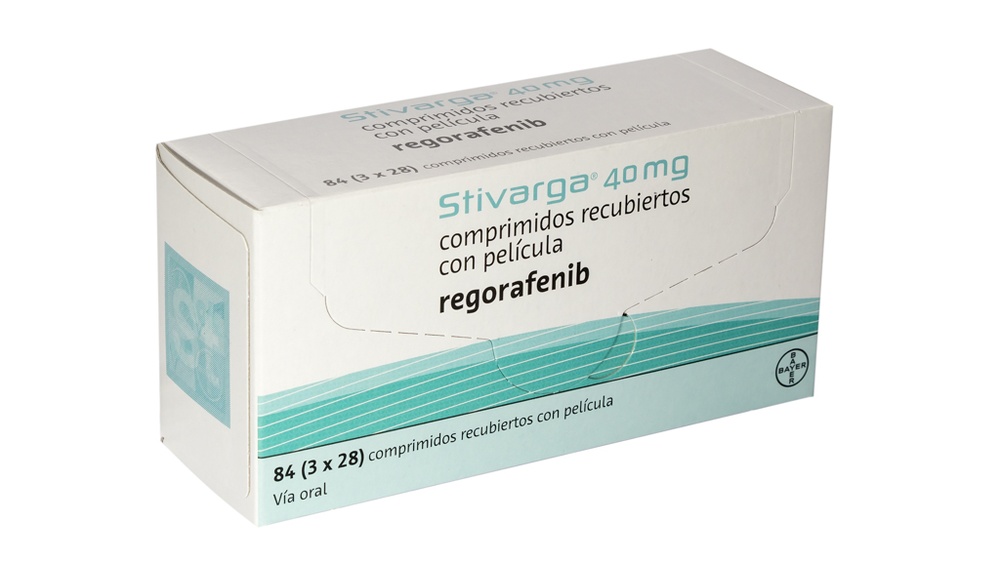
Stivarga 40 mg film-coated tablets are light pink and oval in shape, marked with "BAYER" on one side and "40" on the other.
Each bottle contains 28 film-coated tablets.
Stivarga 40 mg film-coated tablets are available in packs of one bottle or three bottles.
Not all pack sizes may be marketed.
Keep the desiccant in the bottle. The desiccant is a moisture-absorbing material introduced into a small container that protects the tablets from moisture.
Marketing authorization holder
Bayer AG
51368 Leverkusen
Germany
Manufacturer
Bayer AG
Kaiser-Wilhelm-Allee
51368 Leverkusen
Germany
You can obtain further information on this medicine by contacting the local representative of the marketing authorization holder:
België / Belgique / Belgien Bayer SA-NV Tel: +32-(0)2-535 63 11 | Lietuva UAB Bayer Tel: +370 5 23 36 868 |
| Luxembourg / Luxemburg Bayer SA-NV Tel: +32-(0)2-535 63 11 |
Ceská republika Bayer s.r.o. Tel: +420 266 101 111 | Magyarország Bayer Hungária Kft. Tel: +36-14 87-41 00 |
Danmark Bayer A/S Tel: +45-45 23 50 00 | Malta Alfred Gera and Sons Ltd. Tel: +356-21 44 62 05 |
Deutschland Bayer Vital GmbH Tel: +49-(0)214-30 513 48 | Nederland Bayer B.V. Tel: +31-(0)297-28 06 66 |
Eesti Bayer OÜ Tel: +372 655 85 65 | Norge Bayer AS Tel: +47 23 13 05 00 |
Ελλάδα Bayer Ελλάς ΑΒΕΕ Tel: +30 210 618 75 00 | Österreich Bayer Austria Ges. m. b. H. Tel: +43-(0)1-711 46-0 |
España Bayer Hispania S.L. Tel: +34-93-495 65 00 | Polska Bayer Sp. z o.o. Tel: +48-22-572 35 00 |
France Bayer HealthCare Tel: +33-(0)800 87 54 54 | Portugal Bayer Portugal, Lda. Tel: +351-21-416 42 00 |
Hrvatska Bayer d.o.o. Tel: +385-(0)1-6599 900 | România SC Bayer SRL Tel: +40 21 528 59 00 |
Ireland Bayer Limited Tel: +353 1 216 3300 | Slovenija Bayer d. o. o. Tel: +386-(0)1-58 14 400 |
Ísland Icepharma hf. Tel: +354 540 80 00 | Slovenská republika Bayer, spol. s r.o. Tel: +421 2 59 21 31 11 |
Italia Bayer S.p.A. Tel: +39-02-397 81 | Suomi/Finland Bayer Oy Tel: +358-20 785 21 |
Κύπρος NOVAGEM Limited Tel: +357 22 48 38 58 | Sverige Bayer AB Tel: +46-(0)8-580 223 00 |
Latvija SIA Bayer Tel: +371 67 84 55 63 |
Date of last revision of this leaflet:
Other sources of information
Detailed information on this medicine is available on the European Medicines Agency (EMA) website: https://www.ema.europa.eu
- Country of registration
- Dosage formTABLET, 40 mg
- ATC codeL01EX05
- Active substance
- Prescription requiredYes
- Manufacturer
- CompositionCROSCARMELOSA SODICA (154 mg mg), LECITINA DE SOJA (0,42 mg mg)
- This information is for reference only and does not constitute medical advice. Always consult a doctor before taking any medication. Oladoctor is not responsible for medical decisions based on this content.
- Alternatives to STIVARGA 40 mg FILM-COATED TABLETSDosage form: TABLET, 100 mgActive substance: avapritinibManufacturer: Blueprint Medicines (Netherlands) B.V.Prescription requiredDosage form: TABLET, 200 mgActive substance: avapritinibManufacturer: Blueprint Medicines (Netherlands) B.V.Prescription requiredDosage form: TABLET, 25 mgActive substance: avapritinibManufacturer: Blueprint Medicines (Netherlands) B.V.Prescription required
Online doctors for STIVARGA 40 mg FILM-COATED TABLETS
Discuss questions about STIVARGA 40 mg FILM-COATED TABLETS, including use, safety considerations and prescription review, subject to medical assessment and local regulations.
Frequently Asked Questions
STIVARGA 40 mg FILM-COATED TABLETS requires a prescription in Spain. You can check with a doctor online whether this medicine may be appropriate for your situation.
The active ingredient in STIVARGA 40 mg FILM-COATED TABLETS is regorafenib. This information helps identify medicines with the same composition but different brand names.
STIVARGA 40 mg FILM-COATED TABLETS is manufactured by Bayer Ag. Pharmacy brands and packaging may differ depending on the distributor.
Doctors such as Family doctors, Psychiatrists, Dermatologists, Cardiologists, Endocrinologists, Gastroenterologists, Pulmonologists, Nephrologists, Rheumatologists, Hematologists, Infectious disease physicians, Allergists, Geriatricians, Paediatricians, Oncologists may assess whether STIVARGA 40 mg FILM-COATED TABLETS is appropriate, depending on your situation and local regulations. You can book an online consultation to discuss your symptoms and possible next steps.
The prescription is issued by a doctor after assessing your health. In Spain, STIVARGA 40 mg FILM-COATED TABLETS is then dispensed in pharmacies with that prescription. An online consultation does not guarantee that a prescription will be issued: the decision always rests with the doctor.
To request a review, you can use Oladoctor:
Other medicines with the same active substance (regorafenib) include AYVAKYT 100 mg FILM-COATED TABLETS, AYVAKYT 200 mg FILM-COATED TABLETS, AYVAKYT 25 mg FILM-COATED TABLETS. These may have different brand names or formulations but contain the same therapeutic ingredient. Always consult a doctor before switching or starting a new medicine.
