



SPINRAZA 12 mg Injectable Solution

Prescription review online
A doctor will review your case and decide whether a prescription is medically appropriate.

Talk to a doctor about this medicine
Discuss your symptoms and possible next steps in a quick online consultation.



How to use SPINRAZA 12 mg INJECTABLE SOLUTION
Contents of the leaflet
- Introduction
- What is Spinraza and what is it used for
- What you need to know before you or your child is given Spinraza
- How Spinraza is given
- Possible side effects
- Storage of Spinraza
- Contents of the pack and other information
Introduction
Package Leaflet: Information for the User
Spinraza 12 mg solution for injection
nusinersen
Read all of this leaflet carefully before you or your child receives this medicine, because it contains important information for you.
- Keep this leaflet, you may need to read it again.
- If you have any further questions, ask your doctor or nurse.
- If you or your child experiences any side effects, talk to your doctor or nurse, even if it is not listed in this leaflet. See section 4.
Contents of the pack
- What is Spinraza and what is it used for
- What you need to know before you or your child is given Spinraza
- How Spinraza is given
- Possible side effects
- Storage of Spinraza
- Contents of the pack and other information
1. What is Spinraza and what is it used for
Spinraza contains the active substance nusinersen, which belongs to a group of medicines called antisense oligonucleotides. Spinraza is used to treat a genetic disease called spinal muscular atrophy (SMA).
The cause of spinal muscular atrophy is a lack of a protein called survival motor neuron (SMN) in the body. This deficiency leads to the loss of neurons in the spinal cord, resulting in muscle weakness in the shoulders, hips, thighs, and upper back. It can also weaken the muscles used for breathing and swallowing.
Spinraza helps the body produce more SMN protein that is lacking in people with SMA. This reduces the loss of neurons and can improve muscle strength.

Not sure if this medicine is right for you?
Discuss your symptoms and treatment with a doctor online.
2. What you need to know before you or your child is given Spinraza
You or your child should not be given Spinraza
- if you or your child is allergic to nusinersen or any of the other ingredients of this medicine (listed in section 6).
If you are unsure, consult your doctor or nurse before you or your child receives Spinraza.
Warnings and precautions
There is a risk of side effects associated with the lumbar puncture procedure while administering Spinraza or after administration. These side effects can include headaches, vomiting, and back pain. There can also be difficulties in administering the medicine using this method in very young patients and patients with scoliosis (deviation and curvature of the spine).
It has been shown that other medicines in the same class as Spinraza can affect the blood cells that help with blood clotting. Before you or your child is given Spinraza, your doctor may decide to perform a blood test to check that your blood or your child's blood can clot properly. This test may not be necessary every time you or your child is given Spinraza.
It has been shown that other medicines in the same class as Spinraza can affect the kidneys. Before you are given Spinraza, your doctor may decide to perform a urine test to check that your kidneys are working properly. This test may not be necessary every time you or your child is given Spinraza.
A small number of cases of patients who developed hydrocephalus (accumulation of too much fluid around the brain) after receiving Spinraza have been reported. Some of these patients required the placement of a device called a ventriculoperitoneal shunt to treat the hydrocephalus. If you notice any symptoms such as increased head size, decreased level of consciousness, nausea, vomiting, or persistent headache or other symptoms that concern you, inform your doctor or your child's doctor to receive the necessary treatment. Currently, the risks and benefits of continuing treatment with Spinraza in patients with a ventriculoperitoneal shunt are unknown.
Consult your doctor before you or your child is given Spinraza.
Other medicines and Spinraza
Tell your doctor if you or your child is taking, has recently taken, or might take any other medicines in the future.
Pregnancy and breastfeeding
If you are pregnant or breastfeeding, think you may be pregnant, or plan to become pregnant, consult your doctor before you are given this medicine. It is recommended to avoid the use of Spinraza during pregnancy and breastfeeding.
Driving and using machines
The influence of Spinraza on the ability to drive and use machines is negligible or non-existent.
Spinraza contains a small amount of sodium
This medicine contains less than 1 mmol of sodium (23 mg) per 5 ml vial; this is essentially "sodium-free" and can be used in people with low-sodium diets.
Spinraza contains a small amount of potassium
This medicine contains less than 1 mmol of potassium (39 mg) per 5 ml vial, making it essentially "potassium-free".
3. How Spinraza is given
The usual dose of Spinraza is 12 mg.
Spinraza is given:
- On the first day of treatment, day 0.
- Then around day 14, day 28, and day 63.
- Then once every 4 months.
Spinraza is given by injection into the lower back. This injection, called a lumbar puncture, is performed by inserting a needle into the space surrounding the spinal cord. A doctor with experience in lumbar punctures will administer the injections. You or your child may also be given a medicine to help you relax or fall asleep during the procedure.
For how long Spinraza should be used
Your doctor will tell you for how long you or your child needs to be given Spinraza. Do not stop treatment with Spinraza unless your doctor tells you to.
If you or your child misses an injection
If you or your child misses a dose of Spinraza, talk to your doctor so that you can be given Spinraza as soon as possible.
If you have any questions about how Spinraza is given, ask your doctor.

Started taking the medicine and have questions?
Discuss your symptoms and treatment with a doctor online.
4. Possible side effects
Like all medicines, this medicine can cause side effects, although not everybody gets them.
Side effects can occur associated with the lumbar puncture procedure while Spinraza is being administered or after administration. Most of these side effects are reported within 72 hours after the procedure.
Very common (may affect more than 1 in 10 people)
- Back pain.
- Headache.
- Vomiting.
Frequency not known (cannot be estimated from the available data)
- Severe infection associated with the lumbar puncture (e.g., meningitis).
- Hydrocephalus (accumulation of too much fluid around the brain).
- Non-infectious meningitis (inflammation of the membrane surrounding the spinal cord and brain, which can present as stiffness of the neck, headache, fever, nausea, and vomiting).
- Hypersensitivity (an allergic reaction or allergic-like reaction that can include swelling of the face, lips, or tongue, skin rash, or itching).
- Arachnoiditis (inflammation of a membrane that surrounds the brain and spinal cord), which can cause pain in the lower back, or pain, numbness, or weakness in the legs.
Reporting of side effects
If you or your child experiences any side effects, talk to your doctor or nurse,even if it is not listed in this leaflet. You can also report side effects directly via the national reporting system listed in Appendix V. By reporting side effects, you can help provide more information on the safety of this medicine.
5. Storage of Spinraza
Keep this medicine out of the sight and reach of children.
Do not use this medicine after the expiry date which is stated on the vial and carton after "EXP". The expiry date is the last day of the month stated.
Store in a refrigerator (between 2°C and 8°C). Do not freeze.
Keep the vial in the outer packaging to protect it from light.
If it is not possible to store it in a refrigerator, Spinraza can be stored in the original carton, protected from light or at a temperature not above 30°C for a maximum of 14 days.
Unopened vials of Spinraza can be removed from and returned to the refrigerator as needed. If removed from the carton, the total time the medicine is out of the refrigerator should not exceed 30 hours at a temperature not above 25°C.
6. Contents of the pack and other information
What Spinraza contains
- The active substance is nusinersen.
- Each 5 ml vial contains nusinersen sodium equivalent to 12 mg of nusinersen.
- Each ml contains 2.4 mg of nusinersen.
- The other ingredients are sodium dihydrogen phosphate dihydrate, disodium phosphate, sodium chloride (see section 2 "Spinraza contains a small amount of sodium"), potassium chloride (see section 2 "Spinraza contains a small amount of potassium"), calcium chloride dihydrate, magnesium chloride hexahydrate, sodium hydroxide, hydrochloric acid, water for injections.
Appearance and packaging
Spinraza is a clear and colorless solution for injection.
Each carton of Spinraza contains one vial.
Each vial is for single use only.
Marketing authorisation holder and manufacturer
Biogen Netherlands B.V.
Prins Mauritslaan 13
1171 LP Badhoevedorp
Netherlands
You can get more information on this medicine by contacting the local representative of the marketing authorisation holder:
België/Belgique/Belgien Biogen Belgium N.V./S.A. Tél/Tel: +32 2 219 12 18 | Lietuva Biogen Lithuania UAB Tel: +370 5 259 6176 |
| Luxembourg/Luxemburg Biogen Belgium N.V./S.A. Tél/Tel: +32 2 219 12 18 |
Ceská republika Biogen (Czech Republic) s.r.o. Tel: +420 255 706 200 | Magyarország Biogen Hungary Kft. Tel.: +36 1 899 9880 |
Danmark Biogen (Denmark) A/S Tlf.: +45 77 41 57 57 | Malta Pharma MT limited Tel: +356 213 37008/9 |
Deutschland Biogen GmbH Tel: +49 (0) 89 99 6170 | Nederland Biogen Netherlands B.V. Tel: +31 20 542 2000 |
Eesti Biogen Estonia OÜ Tel: + 372 618 9551 | Norge Biogen Norway AS Tlf: +47 23 40 01 00 |
Ελλ?δα Genesis Pharma SA Τηλ: +30 210 8771500 | Österreich Biogen Austria GmbH Tel: +43 1 484 46 13 |
España Biogen Spain SL Tel: +34 91 310 7110 | Polska Biogen Poland Sp. z o.o. Tel.: +48 22 351 51 00 |
France Biogen France SAS Tél: +33 (0)1 41 37 95 95 | Portugal Biogen Portugal Tel.: +351 21 318 8450 |
Hrvatska Biogen Pharma d.o.o. Tel: +385 (0) 1 775 73 22 | România Ewopharma România SRL Tel: + 40 21 260 13 44 |
Ireland Biogen Idec (Ireland) Ltd. Tel: +353 (0)1 463 7799 | Slovenija Biogen Pharma d.o.o. Tel.: +386 1 511 02 90 |
Ísland Icepharma hf Sími: +354 540 8000 | Slovenská republika Biogen Slovakia s.r.o. Tel.: +421 2 323 340 08 |
Italia Biogen Italia s.r.l. Tel: +39 02 584 9901 | Suomi/Finland Biogen Finland Oy Puh/Tel: +358 207 401 200 |
Κ?προς Genesis Pharma Cyprus Ltd Τηλ: +357 22765715 | Sverige Biogen Sweden AB Tel: +46 8 594 113 60 |
Latvija Biogen Latvia SIA Tel: + 371 68 688 158 |
Date of last revision of this leaflet:
Other sources of information
Detailed information on this medicine is available on the European Medicines Agency website: https://www.ema.europa.eu.
-------------------------------------------------------------------------------------------------------------------
This information is intended only for healthcare professionals:
- The Spinraza vial should be visually inspected for particles before administration. If particles are observed and/or the liquid in the vial is not clear and colorless, the vial should not be used.
- Aseptic technique should be used when preparing the Spinraza solution for intrathecal administration.
- Before administration, the vial should be removed from the refrigerator and allowed to reach room temperature (25°C), without using external heat sources.
- If the vial remains unopened and the solution has not been used, it should be returned to the refrigerator.
- Just before administration, remove the plastic cap and insert the needle of the syringe into the vial through the center of the seal to withdraw the required volume. Do not dilute Spinraza. External filters are not necessary.
- Spinraza is administered by intrathecal bolus injection over 1 to 3 minutes, using a spinal anesthesia needle.
- The injection should not be administered in areas of the skin with signs of infection or inflammation.
- It is recommended to withdraw a volume of cerebrospinal fluid equivalent to the volume of Spinraza to be injected before administering Spinraza.
- Once the solution is drawn into the syringe, if it is not used within 6 hours, it should be discarded.
- Disposal of unused medicine and all materials that have come into contact with it should be done in accordance with local regulations.
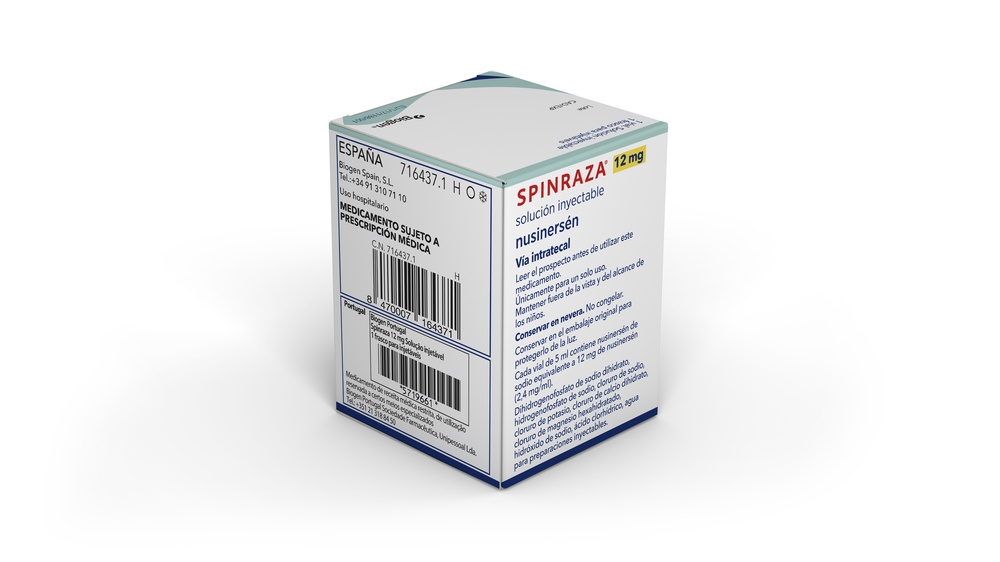
- Country of registration
- Dosage formINJECTABLE, 12 mg
- ATC codeM09AX07
- Active substance
- Prescription requiredYes
- Manufacturer
- CompositionDIHIDROGENOFOSFATO DE SODIO DIHIDRATO (0.05 mg mg), HIDROGENO FOSFATO DE DISODIO ANHIDRO (0.10 mg mg), CLORURO DE SODIO (8.77 mg mg), CLORURO POTASICO (0.22 mg mg), ACIDO CLORHIDRICO/HIDROXIDO DE SODIO (C.S. mg mg)
- This information is for reference only and does not constitute medical advice. Always consult a doctor before taking any medication. Oladoctor is not responsible for medical decisions based on this content.
- Alternatives to SPINRAZA 12 mg INJECTABLE SOLUTIONDosage form: ORAL SOLUTION/SUSPENSION, 8.86 mg/mlActive substance: givinostatManufacturer: Italfarmaco S.P.A.Prescription requiredDosage form: ORAL SOLUTION/SUSPENSION, 0.75 mg/mlActive substance: risdiplamManufacturer: Roche Registration GmbhPrescription requiredDosage form: TABLET, 5 mgActive substance: risdiplamManufacturer: Roche Registration GmbhPrescription required
Online doctors for SPINRAZA 12 mg INJECTABLE SOLUTION
Discuss questions about SPINRAZA 12 mg INJECTABLE SOLUTION, including use, safety considerations and prescription review, subject to medical assessment and local regulations.
Get SPINRAZA 12 mg INJECTABLE SOLUTION Prescription Online
Fill in a 2-min form
Tell us your symptoms, history, and what medicine you're requesting.
Pick a doctor or let us assign
Choose a specialist or we'll match you with the next available doctor.
Doctor reviews your case
Usually within 30 minutes. They may ask follow-up questions via chat.
Collect from any pharmacy
Electronic prescription sent to your email — valid across Spain.
Frequently Asked Questions
SPINRAZA 12 mg INJECTABLE SOLUTION requires a prescription in Spain. You can check with a doctor online whether this medicine may be appropriate for your situation.
The active ingredient in SPINRAZA 12 mg INJECTABLE SOLUTION is nusinersen. This information helps identify medicines with the same composition but different brand names.
SPINRAZA 12 mg INJECTABLE SOLUTION is manufactured by Biogen Netherlands B.V.. Pharmacy brands and packaging may differ depending on the distributor.
Doctors such as Family doctors, Psychiatrists, Dermatologists, Cardiologists, Endocrinologists, Gastroenterologists, Pulmonologists, Nephrologists, Rheumatologists, Hematologists, Infectious disease physicians, Allergists, Geriatricians, Paediatricians, Oncologists may assess whether SPINRAZA 12 mg INJECTABLE SOLUTION is appropriate, depending on your situation and local regulations. You can book an online consultation to discuss your symptoms and possible next steps.
Spain has a well-developed healthcare infrastructure across major cities such as Madrid, Barcelona, Valencia, and Seville. Pharmacies are widely available and operate under strict regulations, ensuring access to prescribed medications.
You can buy SPINRAZA 12 mg INJECTABLE SOLUTION in Madrid, Barcelona, Seville, or Valencia at any local pharmacy with a valid prescription.
To obtain a prescription, you can use Oladoctor:
Other medicines with the same active substance (nusinersen) include DUVYZAT 8.86 mg/mL ORAL SUSPENSION, EVRYSDI 0.75 mg/ml ORAL SOLUTION POWDER, EVRYSDI 5 mg FILM-COATED TABLETS. These may have different brand names or formulations but contain the same therapeutic ingredient. Always consult a doctor before switching or starting a new medicine.
