


Spectracef 200 mg comprimidos recubiertos con película

Prescription review online
A doctor will review your case and decide whether a prescription is medically appropriate.

Talk to a doctor about this medicine
Discuss your symptoms and possible next steps in a quick online consultation.



How to use SPECTRACEF 200 mg FILM-COATED TABLETS
Contents of the leaflet
- Introduction
- What SPECTRACEF 200 mg film-coated tablets are and what they are used for
- What you need to know before taking SPECTRACEF 200 mg film-coated tablets
- Pregnancy and lactation
- How to take SPECTRACEF 200 mg film-coated tablets
- Possible side effects
- Storage of SPECTRACEF 200 mg film-coated tablets
- Package contents and additional information
Introduction
Leaflet: Information for the user
SPECTRACEF 200 mg film-coated tablets
Cefditoren
Read this leaflet carefully before starting to take this medicine, as it contains important information for you.
- Keep this leaflet, as you may need to read it again.
- If you have any doubts, consult your doctor or pharmacist.
- This medicine has been prescribed to you only, and you should not give it to others, even if they have the same symptoms as you, as it may harm them.
- If you experience side effects, consult your doctor or pharmacist, even if they are not listed in this leaflet. See section 4.
Contents of the leaflet
- What SPECTRACEF 200 mg film-coated tablets are and what they are used for
- What you need to know before taking SPECTRACEF 200 mg film-coated tablets
- How to take SPECTRACEF 200 mg film-coated tablets
- Possible side effects
- Storage of SPECTRACEF 200 mg film-coated tablets
- Package contents and additional information
1. What SPECTRACEF 200 mg film-coated tablets are and what they are used for
SPECTRACEF belongs to a group of antibiotics called cephalosporins, which work by inhibiting the synthesis of the bacterial cell wall.
Antibiotics are used to treat bacterial infections and are not effective against viral infections such as the flu or common cold.
It is essential to follow the instructions regarding dosage, administration interval, and treatment duration indicated by your doctor.
Do not store or reuse this medicine. If you have any leftover antibiotic after completing treatment, return it to the pharmacy for proper disposal. Do not throw medicines down the drain or in the trash.
SPECTRACEF is used in adult patients for the treatment of the following infections:
- Acute pharyngitis.
- Acute maxillary sinusitis.
- Acute exacerbation of chronic bronchitis.
- Community-acquired pneumonia, mild to moderate.
- Uncomplicated skin and soft tissue infections, such as cellulitis, infected wounds, abscesses, folliculitis, impetigo, and furunculosis.

Not sure if this medicine is right for you?
Discuss your symptoms and treatment with a doctor online.
2. What you need to know before taking SPECTRACEF 200 mg film-coated tablets
Do not take SPECTRACEF
- if you are allergic to antibiotics, particularly penicillin or other types of beta-lactam antibiotics, or to any of the other components of this medicine (listed in section 6)
- if you have a casein allergy, you should be aware that this medicine contains sodium caseinate
- if you have a disease called primary carnitine deficiency.
Warnings and precautions
Consult your doctor or pharmacist before starting to take SPECTRACEF
- if you have liver and/or kidney disease
- if you are receiving anticoagulant therapy
- if you have a history of gastrointestinal disease, particularly colitis
- if you are receiving treatment with nephrotoxic agents such as aminoglycoside antibiotics or potent diuretics (such as furosemide), as these combinations may have undesirable effects on renal function and have been associated with ototoxicity.
Consult your doctor if you experience any of the following effects during treatment:
- If during treatment you present any allergic reaction characterized by symptoms such as itching, redness, skin rash, swelling, or difficulty breathing.
- If you experience diarrhea while taking this medicine or after completing treatment.
As with other antibiotics, prolonged treatment with SPECTRACEF may lead to an overgrowth of non-susceptible microorganisms, which requires discontinuation of treatment and the establishment of suitable therapy.
Treatment with SPECTRACEF may interfere with the results of some analytical tests, which may lead to false positives in:
- The direct Coombs test.
- Glucose determination in urine.
And false negatives in:
- Glucose determination in blood or plasma.
Other medicines and SPECTRACEF
Inform your doctor or pharmacist if you are taking, have recently taken, or may need to take any other medicine.
Between the administration of antacids and SPECTRACEF, it is recommended to leave a period of at least two hours.
The concomitant administration of SPECTRACEF with probenecid increases the amount of cefditoren in the blood.
The concomitant administration of SPECTRACEF with intravenous famotidine is not recommended, as it may hinder the achievement of the necessary amount in the blood.
Pregnancy and lactation
If you are pregnant or breastfeeding, think you may be pregnant, or plan to become pregnant, consult your doctor or pharmacist before using this medicine. The administration of SPECTRACEF is not recommended during pregnancy or breastfeeding.
Driving and using machines
SPECTRACEF may cause dizziness and drowsiness, which may interfere with your ability to drive or operate any tool or machine.
SPECTRACEF 200 mg film-coated tablets contain sodium
This medicine contains less than 23 mg of sodium (1 mmol) per tablet; this is, essentially "sodium-free".

Started taking the medicine and have questions?
Discuss your symptoms and treatment with a doctor online.
3. How to take SPECTRACEF 200 mg film-coated tablets
Follow the administration instructions of this medicine indicated by your doctor or pharmacist exactly. In case of doubt, consult your doctor or pharmacist again. Remember to take your medicine. Your doctor will indicate the duration of treatment with SPECTRACEF.
Swallow the tablets whole, with a sufficient amount of liquid (a glass of water) during meals.
The recommended dose of this medicine and the frequency of administration are as follows:
Adults and adolescents (over 12 years)
- Acute pharyngitis: 1 tablet (200 mg of cefditoren) every 12 hours for 10 days.
- Acute maxillary sinusitis: 1 tablet (200 mg of cefditoren) every 12 hours for 10 days.
- Acute exacerbation of chronic bronchitis: 1 tablet (200 mg of cefditoren) every 12 hours for 5 days.
- Community-acquired pneumonia:
- Mild cases: 1 tablet (200 mg of cefditoren) every 12 hours for 14 days.
- Moderate cases: 2 tablets (400 mg of cefditoren) every 12 hours for 14 days.
- Uncomplicated skin and soft tissue infections: 1 tablet (200 mg of cefditoren) every 12 hours for 10 days.
Use in children under 12 years
The use of SPECTRACEF has not been studied in patients under 12 years, so its administration is not recommended.
Elderly patients
In elderly patients, no dose adjustments are necessary except in cases of advanced hepatic and/or renal impairment.
Patients with renal insufficiency
No dose adjustment is necessary in patients with mild renal impairment. In patients with moderate renal insufficiency, do not exceed the dose of 1 tablet (200 mg of cefditoren) every 12 hours. In patients with severe renal insufficiency, a single dose of 1 tablet (200 mg of cefditoren) per day is recommended. The appropriate dose has not been determined in patients undergoing dialysis.
Patients with hepatic insufficiency
In mild or moderate hepatic insufficiency, it is not necessary to modify the treatment regimen. In cases of severe hepatic insufficiency, there are no data available to make a dose recommendation.
If you take more SPECTRACEF than you should
If you have taken more SPECTRACEF than recommended, consult your doctor or pharmacist immediately, or call the Toxicology Information Service, phone 91 562 04 20, indicating the medicine and the amount taken. It is recommended to take the package and leaflet of the medicine to the healthcare professional.
If you forget to take SPECTRACEF
In case you have forgotten a dose, take another as soon as possible and continue with the usual schedule. Do not take a double dose to make up for forgotten doses.
If you stop treatment with SPECTRACEF
Do not stop treatment before the duration indicated by your doctor, as there is a risk of relapse of the disease.
4. Possible side effects
Like all medicines, this medicine can cause side effects, although not everybody gets them. Side effects may occur mainly of a gastrointestinal nature.
Very common (more than 1 in 10 people):
- diarrhea.
Common (1 to 10 in 100 people):
- headache, nausea, abdominal pain, feeling of indigestion, and vaginal infection.
Uncommon (1 to 10 in 1,000 people):
- fungal infection
- anorexia
- nervousness, dizziness, and sleep disorders
- pharyngitis, rhinitis, and sinusitis
- constipation, flatulence, vomiting, oral candidiasis, eructation, dry mouth, and loss of taste
- liver function alteration
- skin rash, itching, and urticaria
- vaginal inflammation and vaginal discharge
- fever, weakness, and sweating
- alterations in blood cell count (leukopenia and thrombocytosis), liver function test disorders (elevated ALT).
Rare (1 to 10 in 10,000 people):
- hemolytic anemia and lymph node alteration
- dehydration
- demence, depersonalization, emotional weakness, euphoria, hallucinations, and increased libido
- memory loss, discoordination, increased muscle tone, meningitis, and tremor
- photosensitivity, visual acuity loss, eye pain, and eyelid inflammation
- tinnitus
- heart rhythm disorders, heart failure, and fainting
- low blood pressure
- asthma
- oral ulcers, stomatitis, hemorrhagic colitis, ulcerative colitis, gastrointestinal bleeding, hiccups, tongue inflammation and discoloration, and diarrhea associated with Clostridium difficile
- acne, hair loss, eczema, exfoliative dermatitis (cracked and scaly skin), and herpes simplex
- muscle pain
- urination pain, kidney inflammation, urination frequency disorders, incontinence, and urinary tract infection
- breast pain, menstrual disorders, and erectile dysfunction
- body odor and chills
- alterations in blood cell count (eosinophilia, neutropenia, thrombocytopenia), coagulation disorders (prolongation of coagulation time, decrease in thromboplastin time, platelet alteration), liver function test disorders (increase in AST, alkaline phosphatase), or alterations in certain blood components (hyperglycemia, hypokalemia, bilirubinemia, increase in LDH, hypoproteinemia, increase in creatinine), or urine (albuminuria).
Frequency not known (cannot be estimated from available data):
- pneumonia
- Stevens-Johnson syndrome (blisters and erosion of the skin and mucous membranes)
- skin redness
- toxic epidermal necrolysis (severe form of Stevens-Johnson syndrome followed by skin pain and peeling of the upper layer of the skin)
- acute kidney failure
- anaphylactic shock
- serum sickness-like reaction (late allergic reaction of the skin)
- decrease in blood cells (agranulocytosis)
- decrease in carnitine levels in the blood
- cholestasis (obstruction of bile flow from the liver)
- aplastic anemia (decrease in blood cell count)
- liver damage
- hepatitis.
Reporting of side effects
If you experience any type of side effect, consult your doctor or pharmacist, even if it is a possible side effect not listed in this leaflet. You can also report them directly through the Spanish Medicines and Healthcare Products Agency's Pharmacovigilance System: https://www.notificaRAM.es. By reporting side effects, you can help provide more information on the safety of this medicine.
5. Storage of SPECTRACEF 200 mg film-coated tablets
Keep this medicine out of the sight and reach of children.
Store in the original packaging.
Do not store above 30°C.
Do not use SPECTRACEF after the expiration date stated on the packaging. The expiration date is the last day of the month indicated.
Medicines should not be disposed of via wastewater or household waste. Place the packaging and any unused medicines in the pharmacy's SIGRE collection point. If in doubt, ask your pharmacist how to dispose of the packaging and any unused medicines. This will help protect the environment.
6. Package contents and additional information
Composition of SPECTRACEF 200 mg film-coated tablets
- The active ingredient is cefditoren. Each tablet contains 200 mg of cefditoren (as cefditoren pivoxil).
- The other components are:
core: sodium caseinate, sodium croscarmellose, mannitol E421, sodium tripolyphosphate, and magnesium stearate.
coating: opadry Y-1-7000 (hypromellose, titanium dioxide E171, macrogol 400) and carnauba wax.
printing ink Opacode S-1-20986 blue: shellac, brilliant blue lacquer, titanium dioxide E171, propylene glycol, and concentrated ammonia solution.
Appearance of the product and package contents
SPECTRACEF 200 mg is presented in the form of film-coated tablets. Each package contains 16 or 20 tablets.
Only some pack sizes may be marketed.
Other presentations:
SPECTRACEF 400 mg film-coated tablets: each package contains 10 tablets.
Marketing authorization holder and manufacturer:
Meiji Pharma Spain, S.A.
Avda. de Madrid, 94.
28802 Alcalá de Henares, Madrid (Spain)
Date of the last revision of this leaflet:November 2020.
Detailed and updated information on this medicine is available on the website of the Spanish Agency for Medicines and Healthcare Products (AEMPS) http://www.aemps.gob.es
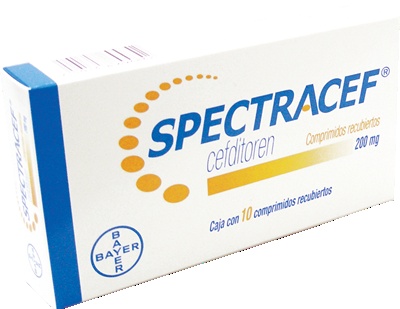
- Country of registration
- Dosage formTABLET, 200 mg
- ATC codeJ01DD16
- Average pharmacy price40.01 EUR
- Active substance
- Prescription requiredYes
- Manufacturer
- CompositionMANITOL (E-421) (c.s. C.S mg), CASEINATO SODICO (100 mg mg), CROSCARMELOSA SODICA (150 mg mg), TRIPOLIFOSFATO SODICO (4 mg mg), PROPILENGLICOL (2,91 PORCENTAJE mg)
- This information is for reference only and does not constitute medical advice. Always consult a doctor before taking any medication. Oladoctor is not responsible for medical decisions based on this content.
- Alternatives to SPECTRACEF 200 mg FILM-COATED TABLETSDosage form: TABLET, 200 mgActive substance: cefditorenManufacturer: Meiji Pharma Spain S.A.Prescription requiredDosage form: TABLET, 400 mgActive substance: cefditorenManufacturer: Meiji Pharma Spain S.A.Prescription requiredDosage form: TABLET, 400 mgActive substance: cefditorenManufacturer: Meiji Pharma Spain S.A.Prescription required
Online doctors for SPECTRACEF 200 mg FILM-COATED TABLETS
Discuss questions about SPECTRACEF 200 mg FILM-COATED TABLETS, including use, safety considerations and prescription review, subject to medical assessment and local regulations.









Frequently Asked Questions
SPECTRACEF 200 mg FILM-COATED TABLETS requires a prescription in Spain. You can check with a doctor online whether this medicine may be appropriate for your situation.
The active ingredient in SPECTRACEF 200 mg FILM-COATED TABLETS is cefditoren. This information helps identify medicines with the same composition but different brand names.
The average pharmacy price for SPECTRACEF 200 mg FILM-COATED TABLETS is around 40.01 EUR. Prices may vary depending on the manufacturer and dosage form.
SPECTRACEF 200 mg FILM-COATED TABLETS is manufactured by Meiji Pharma Spain S.A.. Pharmacy brands and packaging may differ depending on the distributor.
Doctors such as Family doctors, Psychiatrists, Dermatologists, Cardiologists, Endocrinologists, Gastroenterologists, Pulmonologists, Nephrologists, Rheumatologists, Hematologists, Infectious disease physicians, Allergists, Geriatricians, Paediatricians, Oncologists may assess whether SPECTRACEF 200 mg FILM-COATED TABLETS is appropriate, depending on your situation and local regulations. You can book an online consultation to discuss your symptoms and possible next steps.
The prescription is issued by a doctor after assessing your health. In Spain, SPECTRACEF 200 mg FILM-COATED TABLETS is then dispensed in pharmacies with that prescription. An online consultation does not guarantee that a prescription will be issued: the decision always rests with the doctor.
To request a review, you can use Oladoctor:
Other medicines with the same active substance (cefditoren) include MEIACT 200 mg FILM-COATED TABLETS, MEIACT 400 mg FILM-COATED TABLETS, SPECTRACEF 400 mg FILM-COATED TABLETS. These may have different brand names or formulations but contain the same therapeutic ingredient. Always consult a doctor before switching or starting a new medicine.
