



SOLINITRINA 1 mg /Ml Injectable Solution

Prescription review online
A doctor will review your case and decide whether a prescription is medically appropriate.

Talk to a doctor about this medicine
Discuss your symptoms and possible next steps in a quick online consultation.



How to use SOLINITRINA 1 mg/ml injectable solution
Contents of the leaflet
- Introduction
- What is SOLINITRINA and what is it used for
- Before using SOLINITRINA
- How to use SOLINITRINA
- Possible side effects
- Storage of SOLINITRINA INJECTABLE
- FURTHER INFORMATION
Introduction
Package Leaflet: Information for the User
Solinitrina 1 mg/ml Solution for Injection
Nitroglycerin
Read all of this leaflet carefully before you start taking this medicine.
- Keep this leaflet, you may need to read it again.
- If you have any further questions, ask your doctor or pharmacist.
- This medicine has been prescribed for you. Do not pass it on to others, as it may harm them, even if their symptoms are the same as yours.
- If you experience any serious side effects, or any side effects not mentioned in this leaflet, please tell your doctor or pharmacist.
Contents of the Package Leaflet:
- What is Solinitrina and what is it used for
- Before using Solinitrina
- How to use Solinitrina
- Possible side effects
- Storage of Solinitrina
- Further information
1. What is SOLINITRINA and what is it used for
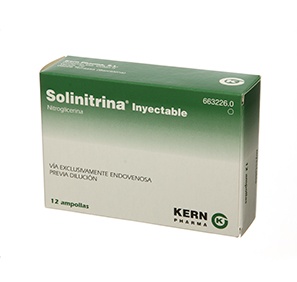
Solinitrina is a medicine that is administered as a solution for intravenous perfusion AFTER DILUTION and is presented in a package containing 12 ampoules.
The active ingredient, nitroglycerin, belongs to the group of drugs called nitrites and related substances.
This medicine is used in the following cases:
- Myocardial infarction (heart attack) in its acute phase.
- Refractory or resistant angina pectoris.
- Left ventricular congestive heart failure (inability of the heart to pump enough blood).
- Pulmonary edema (fluid accumulation in the lungs).
- Cardiac surgery (heart operations).

Not sure if this medicine is right for you?
Discuss your symptoms and treatment with a doctor online.
2. Before using SOLINITRINA
Do not use Solinitrina
- If you are allergic (hypersensitive) to nitroglycerin or any of the other components of Solinitrina.
- In case of anemia (decrease in red blood cells), cerebral hemorrhage (bleeding in the brain), or cranioencephalic trauma (head injury) with increased intracranial pressure.
- If you have uncorrected hypovolemia (decreased blood volume) or severe hypotension (low blood pressure).
- If you have an increase in intraocular pressure (increased pressure in the eyes).
- If you have a history of allergy to nitro derivatives.
- If you have been diagnosed with obstructive cardiomyopathy (heart disease), especially if associated with aortic or mitral stenosis (narrowing of the heart valves) or constrictive pericarditis (inflammation of the heart lining).
- If you are being treated with sildenafil or other similar drugs used for erectile dysfunction.
Be careful with Solinitrina
- If you have ischemic heart failure (inability of the heart to pump enough blood) or severe cerebral ischemia (lack of blood flow to the brain), as the decrease in oxygen supply could reduce the effect of nitroglycerin.
- If you have thyroid problems, malnutrition, severe kidney or liver disease, hypothermia (low body temperature), and if you are prone to closed-angle glaucoma (eye disease characterized by pain, halos around lights, increased eye pressure, and nausea and vomiting).
- If you have had a recent acute myocardial infarction (heart attack) or acute heart failure, as you may require careful clinical monitoring.
- In case of shock (a condition that occurs when the body is not receiving enough blood flow), drugs that increase cardiac tone should be administered simultaneously.
Consult your doctor, even if any of the above circumstances have occurred to you in the past.
Use of other medicines
Tell your doctor or pharmacist if you are using or have recently used any other medicines, including those obtained without a prescription.
- Avoid excessive alcohol consumption.
- It is recommended to take precautions if nitroglycerin is administered simultaneously with other drugs that act similarly to nitroglycerin (papaverine, ergotamine, vincamine, etc.) due to the possibility of an increased effect.
- Concomitant treatment with other medicines such as calcium antagonists, beta-blockers, diuretics, antihypertensives, tricyclic antidepressants, and major tranquilizers may enhance the hypotensive effect (decrease in blood pressure) of nitroglycerin.
- It cannot be excluded that the ingestion of acetylsalicylic acid and non-steroidal anti-inflammatory substances may reduce the response to nitroglycerin.
- The action of this medicine on the heart may be altered if used in conjunction with preparations containing sildenafil or other similar drugs used for erectile dysfunction.
Note that these instructions may also apply to medicines that have been taken/used before or may be taken/used after.
Pregnancy and breastfeeding
Pregnancy
If you are, or think you may be, pregnant, or if you plan to become pregnant, you should inform your doctor, who will decide whether or not to administer Solinitrina.
Consult your doctor or pharmacist before using any medicine.
Breastfeeding
It is unknown whether nitroglycerin is excreted in breast milk. The risk to newborns/children cannot be excluded.
Consult your doctor or pharmacist before using any medicine.
Driving and using machines
Solinitrina may cause flushing, dizziness, or decreased blood pressure, especially at the start of treatment. If you experience any of these effects, avoid driving or using machines.
The amount of alcohol in this medicine may impair your ability to drive or use machinery.
Important information about some of the components of Solinitrina
The presence of ethanol may be a risk factor in patients with liver disease, alcoholism, epilepsy, pregnant women, and children.
This medicine contains 100% (5 ml) of ethanol (alcohol), which corresponds to 4.135 g of ethanol per ampoule, approximately equivalent to 100 ml of beer or 50 ml of wine.
This medicine is harmful to people with alcoholism.
The alcohol content should be taken into account in pregnant or breastfeeding women, children, and high-risk populations, such as patients with liver disease or epilepsy.
The amount of alcohol in this medicine may alter the effects of other medicines.
The amount of alcohol in this medicine may impair your ability to drive or use machinery.
3. How to use SOLINITRINA
This medication should be administered by your doctor or nurse.
The average dose is 2 to 3 mg of nitroglycerin per hour, administered intravenously, diluted in serum.
The duration of administration may vary from a few hours to a few days (3 to 5 days). Continuous administration represents a daily dose of around 70 mg.
The minimum dose is 0.3 mg/hour and the maximum dose is 4.0 mg/hour, in subjects weighing around 70 kg.
Solinitrina 1 mg/ml Solution for Injection is a solution for intravenous perfusion, so the usual method of administration is to dilute one 5 ml ampoule of nitroglycerin solution in 250 to 500 ml of serum, saline, or glucose, which will contain 2 mg or 1 mg of nitroglycerin per 100 ml of serum to be administered.
In cases of extreme urgency, it can be injected directly into the vein after dilution to 10% (i.e., 0.1%), 1 to 3 mg of nitroglycerin over a period of 30 seconds.
If you think the action of Solinitrina is too strong or too weak, tell your doctor.
Your doctor will indicate the duration of your treatment with Solinitrina. Do not stop treatment before, as a possible withdrawal reaction may occur.
Administration guidelines
It should be noted that nitroglycerin is absorbed by many types of plastic, and therefore the solution should always be made in a GLASS CONTAINER. It is possible that certain plastic containers (polyethylene) are compatible with the solution, but containers made of polyvinyl chloride can absorb 40-80% of the nitroglycerin and should be avoided absolutely.
Since most infusion equipment is constructed using polyvinyl chloride tubing, there will be a variable degree of absorption, and the concentration in the vial will not match the one received by the patient. For this reason, it is essential to adjust the dosage according to the clinical response.
There are special infusion equipment on the market constructed from material that does not absorb nitroglycerin. If these devices are used, it should be taken into account that, since most clinical experience has been gained with standard polyvinyl chloride equipment, the application of standard dosage guidelines may result in excessively high responses. It is necessary to be extremely careful when adjusting the dose.
If you are given too much Solinitrina
The medicine should be administered by your doctor/nurse. In the unlikely event that you receive an excessive amount of nitroglycerin, you may experience some of the side effects listed below: flushing of the face and neck, dizziness, hypotension, tachycardia, and headache.
Your doctor/nurse will start symptomatic and supportive treatment.
In case of overdose or accidental ingestion, consult your doctor or pharmacist immediately or call the Toxicology Information Service, phone: 91 562 04 20, indicating the medicine and the amount injected.

Started taking the medicine and have questions?
Discuss your symptoms and treatment with a doctor online.
4. Possible side effects
Like all medicines, Solinitrina can have side effects, although not everyone will experience them.
It can cause headaches that usually disappear after a few days. This headache can be treated with analgesics, although it may be necessary to reduce the dose or interrupt treatment. Other side effects that may occur are flushing, nausea, dizziness, hypotension, and tachycardia. Vomiting and bluish discoloration of the skin have been occasionally reported.
If you think any of the side effects you are experiencing are serious, or if you notice any side effects not mentioned in this leaflet, tell your doctor or pharmacist.
Reporting of side effects
If you experience any type of side effect, consult your doctor, even if it is a possible side effect not mentioned in this leaflet. You can also report them directly through the Spanish Pharmacovigilance System for Human Use Medicines https://www.notificaram.es. By reporting side effects, you can help provide more information on the safety of this medicine.
5. Storage of SOLINITRINA INJECTABLE
Keep this medicine out of the sight and reach of children.
No special storage conditions are required.
The solvent is volatile, and precautions should be taken to avoid the formation of concentrated nitroglycerin. Do not leave open, unused ampoules. The contents should be discarded with plenty of running water. In case of ampoule breakage or accidental spillage of the contents, clean immediately with a cloth moistened with a slightly alkaline solution.
Do not use Solinitrina after the expiration date stated on the packaging after "EXP". The expiration date is the last day of the month indicated.
Medicines should not be disposed of via wastewater or household waste. Place the packaging and any unused medicines in the SIGRE collection point at your pharmacy. If in doubt, ask your pharmacist how to dispose of the packaging and any unused medicines. This will help protect the environment.
6. FURTHER INFORMATION
Composition of Solinitrina injectable
- The active ingredient of Solinitrina 1 mg/ml Solution for Injection is nitroglycerin. Each 5 ml ampoule of injectable solution contains 5 mg of nitroglycerin.
- The other components are: ethanol.
Appearance of the product and packaging contents
Package containing 12 amber glass ampoules of 5 ml.
Marketing authorization holder
Kern Pharma, S.L.
Venus, 72 - Pol. Ind. Colón II
08228 Terrassa - Barcelona
Spain
Manufacturer
Kern Pharma, S.L.
Venus, 72 - Pol. Ind. Colón II
08228 Terrassa - Barcelona
Spain
or
INDUSTRIAS FARMACEUTICAS ALMIRALL PRODESFARMA, S.L.
Ctra. Nacional II, Km. 593
Sant Andreu de la Barca 08740 Spain
or
- BRAUN MEDICAL, S.A.
Ronda de Los Olivares, parcela 11. Polígono Industrial Los Olivares.
23009 Jaén Spain
This leaflet was approved in June 2011.
Detailed and updated information on this medicine is available on the website of the Spanish Agency for Medicines and Health Products (AEMPS) http://www.aemps.gob.es
- Country of registration
- Dosage formINJECTABLE PERFUSION, 5 mg nitroglycerin/ampule
- ATC codeC01DA02
- Average pharmacy price15.92 EUR
- Active substance
- Prescription requiredYes
- Manufacturer
- CompositionALCOHOL ETILICO (ETANOL) (c.s.p. 5 ml mg)
- This information is for reference only and does not constitute medical advice. Always consult a doctor before taking any medication. Oladoctor is not responsible for medical decisions based on this content.
- Alternatives to SOLINITRINA 1 mg/ml injectable solutionDosage form: TRANSDERMAL PATCH, 37.4 mg nitroglycerinActive substance: glyceryl trinitrateManufacturer: Merus Labs Luxco Ii S.À.R.L.Prescription requiredDosage form: TRANSDERMAL PATCH, 18.7 mg nitroglycerinActive substance: glyceryl trinitrateManufacturer: Merus Labs Luxco Ii S.À.R.L.Prescription requiredDosage form: TRANSDERMAL PATCH, 31.37 mgActive substance: glyceryl trinitrateManufacturer: Casen Recordati S.L.Prescription required
Online doctors for SOLINITRINA 1 mg/ml injectable solution
Discuss questions about SOLINITRINA 1 mg/ml injectable solution, including use, safety considerations and prescription review, subject to medical assessment and local regulations.
Get SOLINITRINA 1 mg/ml injectable solution Prescription Online
Fill in a 2-min form
Tell us your symptoms, history, and what medicine you're requesting.
Pick a doctor or let us assign
Choose a specialist or we'll match you with the next available doctor.
Doctor reviews your case
Usually within 30 minutes. They may ask follow-up questions via chat.
Collect from any pharmacy
Electronic prescription sent to your email — valid across Spain.
Frequently Asked Questions
SOLINITRINA 1 mg/ml injectable solution requires a prescription in Spain. You can check with a doctor online whether this medicine may be appropriate for your situation.
The active ingredient in SOLINITRINA 1 mg/ml injectable solution is glyceryl trinitrate. This information helps identify medicines with the same composition but different brand names.
The average pharmacy price for SOLINITRINA 1 mg/ml injectable solution is around 15.92 EUR. Prices may vary depending on the manufacturer and dosage form.
SOLINITRINA 1 mg/ml injectable solution is manufactured by Kern Pharma S.L.. Pharmacy brands and packaging may differ depending on the distributor.
Doctors such as Family doctors, Psychiatrists, Dermatologists, Cardiologists, Endocrinologists, Gastroenterologists, Pulmonologists, Nephrologists, Rheumatologists, Hematologists, Infectious disease physicians, Allergists, Geriatricians, Paediatricians, Oncologists may assess whether SOLINITRINA 1 mg/ml injectable solution is appropriate, depending on your situation and local regulations. You can book an online consultation to discuss your symptoms and possible next steps.
Spain has a well-developed healthcare infrastructure across major cities such as Madrid, Barcelona, Valencia, and Seville. Pharmacies are widely available and operate under strict regulations, ensuring access to prescribed medications.
You can buy SOLINITRINA 1 mg/ml injectable solution in Madrid, Barcelona, Seville, or Valencia at any local pharmacy with a valid prescription.
To obtain a prescription, you can use Oladoctor:
Other medicines with the same active substance (glyceryl trinitrate) include CORDIPLAST 10 mg/24 h TRANSDERMAL PATCHES, CORDIPLAST 5 mg/24 h TRANSDERMAL PATCHES, DERMATRANS 10 mg/24 H TRANSDERMAL PATCH. These may have different brand names or formulations but contain the same therapeutic ingredient. Always consult a doctor before switching or starting a new medicine.
