



ROYEN 2.5 g Oral Suspension Powder

Prescription review online
A doctor will review your case and decide whether a prescription is medically appropriate.

Talk to a doctor about this medicine
Discuss your symptoms and possible next steps in a quick online consultation.



How to use ROYEN 2.5 g ORAL SUSPENSION POWDER
Contents of the leaflet
- Introduction
- What is Royen 2.5 g and what is it used for
- What you need to know before you take Royen 2.5 g
- How to take Royen 2.5 g
- Possible side effects
- Storage of Royen 2.5 g
- Contents of the pack and further information
Introduction
Package Leaflet: Information for the User
Royen 2.5 g Powder for Oral Suspension
Calcium Acetate
Read this package leaflet carefully before you start taking this medicine because it contains important information for you.
- Keep this package leaflet, you may need to read it again.
- If you have any further questions, ask your doctor or pharmacist.
- This medicine has been prescribed for you only. Do not pass it on to others. It may harm them, even if their symptoms are the same as yours.
- If you experience any side effects, talk to your doctor or pharmacist. This includes any possible side effects not listed in this package leaflet. See section 4.
Contents of the Package Leaflet:
- What is Royen 2.5 g and what is it used for
- What you need to know before you take Royen 2.5 g
- How to take Royen 2.5 g
- Possible side effects
- Storage of Royen 2.5 g
- Contents of the pack and further information
1. What is Royen 2.5 g and what is it used for
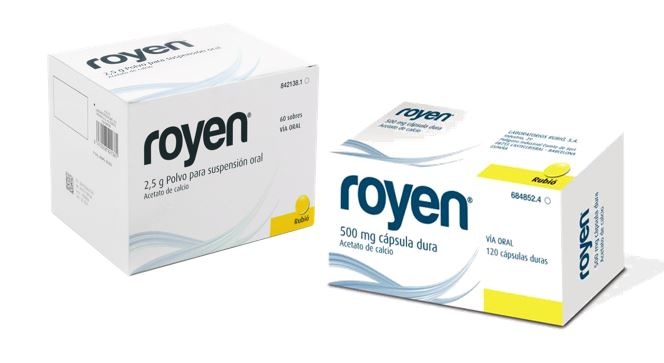
Royen 2.5 g is presented in the form of single-dose sachets for oral administration in packs containing 30 and 60 single-dose sachets.
Calcium acetate is a drug that belongs to the group of medicines called chelating agents. It combines with dietary phosphate and forms insoluble phosphates that are eliminated with the feces, which helps to control blood phosphate levels.
Royen 2.5 g is indicated in:
- Control of hyperphosphatemia (high levels of phosphate in the blood) in patients with advanced renal failure.

Not sure if this medicine is right for you?
Discuss your symptoms and treatment with a doctor online.
2. What you need to know before you take Royen 2.5 g
Do not take Royen 2.5 g
- If you are allergic to calcium acetate or any of the other ingredients of Royen 2.5 g (listed in section 6).
- If you have hypercalcemia (high levels of calcium in the blood) or hypercalciuria (excessive elimination of calcium in the urine).
Warnings and precautions
Consult your doctor or pharmacist before starting to take Royen 2.5 g.
Be particularly careful with Royen 2.5 g:
- At the start of treatment, as excessive dosing of Royen may cause an increase in blood calcium levels. Your doctor should determine your blood calcium levels twice a week. Phosphorus levels in the blood should also be determined periodically.
- If you are being treated with digitalis, as increased calcium levels in the blood may cause cardiac arrhythmias.
- Do not take other calcium supplements with Royen, as this may cause an overdose and an increase in blood calcium levels, which can be serious. For the same reason, it is essential to control your daily intake of calcium-rich foods, such as dairy products and similar products.
If you are on dialysis, reducing the concentration of calcium in the dialysate may reduce the incidence and severity of Royen-induced hypercalcemia.
Consult your doctor if any of the above circumstances have ever occurred to you.
Other medicines and Royen 2.5 g
Tell your doctor or pharmacist if you are using, have recently used, or might use any other medicines.
Tell your doctor if you are taking any of the following medicines, as they may interact with calcium acetate, and it may be necessary to adjust the dose or interrupt one of the treatments:
- Tetracyclines (a specific group of antibiotics).
- Zinc: zinc levels should be monitored, as Royen decreases intestinal zinc absorption.
- Antacids or other preparations containing high concentrations of calcium in their composition, which may contribute to increased blood calcium levels.
Pregnancy and breastfeeding
If you are pregnant or breastfeeding, think you may be pregnant, or plan to become pregnant, consult your doctor or pharmacist before using this medicine.
It is not known whether Royen can cause fetal harm when administered to pregnant women or affect reproductive capacity.
Royen should only be administered to pregnant or breastfeeding women in cases of strict necessity.
Driving and using machines
Royen has no influence on the ability to drive and use machines.
Royen 2.5 g contains sodium
This medicine contains less than 23 mg of sodium (1 mmol) per sachet; it is essentially "sodium-free".
3. How to take Royen 2.5 g
Follow your doctor's instructions for taking Royen 2.5 g exactly. If you are unsure, consult your doctor or pharmacist again.
Royen 2.5 g can be taken before or during meals. Dissolve the contents of one sachet in a glass of water and take immediately.
The normal dose is one sachet with each meal (breakfast, lunch, and dinner), as determined by your doctor.
Start treatment with Royen at a low dose. Do not increase the dose without first determining your blood calcium levels.
The dose of Royen should be adjusted based on your daily calcium intake. The recommended initial dose for a patient on dialysis is half a sachet at breakfast, lunch, and dinner. This dose may be gradually increased to achieve serum phosphorus levels below 6 mg/dl, while monitoring for increased blood calcium levels.
Your doctor will indicate the duration of your treatment with Royen. Do not stop treatment before this, as it may cause a sudden increase in blood phosphate levels. Similarly, do not use it for longer than indicated by your doctor.
If you think the effect of Royen is too strong or too weak, tell your doctor or pharmacist.
If you take more ROYEN than you should
If you have taken more Royen than you should, consult your doctor or pharmacist immediately, indicating the medicine and the amount taken.
The most frequent symptom in case of overdose is an increase in blood calcium levels. If the increase is mild, it can be easily controlled by reducing the dose of Royen or temporarily interrupting treatment. In case of severe hypercalcemia, hemodialysis should be performed, and treatment should be temporarily interrupted until your doctor indicates otherwise.
In case of overdose or accidental ingestion, consult your doctor or pharmacist immediately or call the Toxicology Information Service. Telephone 91 562 04 20, indicating the medicine and the amount taken.
If you forget to take Royen 2.5 g
Do not take a double dose to make up for forgotten doses.
If you stop taking Royen 2.5 g
Consult your doctor to indicate the dosage regimen to follow until you reach your maintenance dose.
If you have any further questions about the use of this medicine, ask your doctor or pharmacist.

Started taking the medicine and have questions?
Discuss your symptoms and treatment with a doctor online.
4. Possible side effects
Like all medicines, Royen can cause side effects, although not everybody gets them.
Rare (less than 1 in 1,000 but more than 1 in 10,000 patients treated):
- Nausea, vomiting, diarrhea, constipation, abdominal pain.
- Asthenia, fatigue.
- Mild increase in blood calcium levels.
- Severe increase in blood calcium levels that can cause confusion, delirium, stupor, and coma.
Very rare (less than 1 in 10,000 patients treated, including isolated reports):
- Itching that may be due to allergic reactions.
Reporting of side effects
If you experience any side effects, talk to your doctor or pharmacist. This includes any possible side effects not listed in this package leaflet.
You can also report side effects directly through the Spanish Medicines and Healthcare Products Agency's (AEMPS) website: https://www.notificaram.es. By reporting side effects, you can help provide more information on the safety of this medicine.
5. Storage of Royen 2.5 g
No special storage conditions are required.
Keep this medicine out of the sight and reach of children.
Do not use Royen after the expiration date stated on the pack. The expiration date is the last day of the month indicated.
Medicines should not be disposed of via wastewater or household waste. Ask your pharmacist how to dispose of medicines no longer required. This will help protect the environment.
6. Contents of the pack and further information
Composition of Royen 2.5 g:
The active substance of this medicine is calcium acetate.
Each single-dose sachet contains 2.5 g of calcium acetate (equivalent to 635 mg of calcium).
The other ingredients are: cornstarch, mannitol (E-421), sodium saccharin, sodium cyclamate, povidone, citric acid, and orange flavor.
Appearance of the product and pack contents:
Royen 2.5 g powder for oral suspension is presented in the form of single-dose sachets for oral administration in packs containing 30 and 60 single-dose sachets.
Marketing authorization holder and manufacturer:
LABORATORIOS RUBIÓ, S.A.
C/ Industria, 29
Polígono Industrial Comte de Sert
08755 Castellbisbal, Barcelona – Spain
Date of the last revision of this package leaflet:June 2012
Other sources of information
Detailed information on this medicine is available on the website of the Spanish Medicines and Healthcare Products Agency (AEMPS) (http://www.aemps.gob.es/.
- Country of registration
- Dosage formORAL SOLUTION/SUSPENSION, 2500 mg
- ATC codeV03AE07
- Average pharmacy price12.21 EUR
- Active substance
- Prescription requiredYes
- Manufacturer
- CompositionCICLAMATO DE SODIO (100 mg mg), SACARINA SODICA (10 mg mg), MANITOL (E-421) (830 mg mg)
- This information is for reference only and does not constitute medical advice. Always consult a doctor before taking any medication. Oladoctor is not responsible for medical decisions based on this content.
- Alternatives to ROYEN 2.5 g ORAL SUSPENSION POWDERDosage form: CAPSULE, 500 mgActive substance: calcium acetateManufacturer: Laboratorios Rubio S.A.Prescription requiredDosage form: TABLET, 800 mgActive substance: sevelamerManufacturer: Sanofi Winthrop IndustriePrescription requiredDosage form: ORAL SOLUTION/SUSPENSION, 2.4 gActive substance: sevelamerManufacturer: Laboratorios Rubio S.A.Prescription required
Online doctors for ROYEN 2.5 g ORAL SUSPENSION POWDER
Discuss questions about ROYEN 2.5 g ORAL SUSPENSION POWDER, including use, safety considerations and prescription review, subject to medical assessment and local regulations.









Get ROYEN 2.5 g ORAL SUSPENSION POWDER Prescription Online
Fill in a 2-min form
Tell us your symptoms, history, and what medicine you're requesting.
Pick a doctor or let us assign
Choose a specialist or we'll match you with the next available doctor.
Doctor reviews your case
Usually within 30 minutes. They may ask follow-up questions via chat.
Collect from any pharmacy
Electronic prescription sent to your email — valid across Spain.
Frequently Asked Questions
ROYEN 2.5 g ORAL SUSPENSION POWDER requires a prescription in Spain. You can check with a doctor online whether this medicine may be appropriate for your situation.
The active ingredient in ROYEN 2.5 g ORAL SUSPENSION POWDER is calcium acetate. This information helps identify medicines with the same composition but different brand names.
The average pharmacy price for ROYEN 2.5 g ORAL SUSPENSION POWDER is around 12.21 EUR. Prices may vary depending on the manufacturer and dosage form.
ROYEN 2.5 g ORAL SUSPENSION POWDER is manufactured by Laboratorios Rubio S.A.. Pharmacy brands and packaging may differ depending on the distributor.
Doctors such as Family doctors, Psychiatrists, Dermatologists, Cardiologists, Endocrinologists, Gastroenterologists, Pulmonologists, Nephrologists, Rheumatologists, Hematologists, Infectious disease physicians, Allergists, Geriatricians, Paediatricians, Oncologists may assess whether ROYEN 2.5 g ORAL SUSPENSION POWDER is appropriate, depending on your situation and local regulations. You can book an online consultation to discuss your symptoms and possible next steps.
Spain has a well-developed healthcare infrastructure across major cities such as Madrid, Barcelona, Valencia, and Seville. Pharmacies are widely available and operate under strict regulations, ensuring access to prescribed medications.
You can buy ROYEN 2.5 g ORAL SUSPENSION POWDER in Madrid, Barcelona, Seville, or Valencia at any local pharmacy with a valid prescription.
To obtain a prescription, you can use Oladoctor:
Other medicines with the same active substance (calcium acetate) include ROYEN 500 mg HARD CAPSULE, SEVELAMER CARBONATE WINTHROP 800 MG FILM-COATED TABLETS, FOSQUEL 2.4 g ORAL SUSPENSION POWDER. These may have different brand names or formulations but contain the same therapeutic ingredient. Always consult a doctor before switching or starting a new medicine.
