



RINGER 600 mg ; 40 Mg; 27 Mg; 329 Mg/ 100 Ml Injectable Perfusion

Prescription review online
A doctor will review your case and decide whether a prescription is medically appropriate.

Talk to a doctor about this medicine
Discuss your symptoms and possible next steps in a quick online consultation.



How to use RINGER LACTATE PHYSAN SOLUTION FOR INFUSION
Contents of the leaflet
- Introduction
- What is Ringer Lactate Physan and what is it used for
- What you need to know before you use Ringer Lactate Physan
- How to Use Ringer Lactate Physan
- Possible Side Effects
- Storage of Ringer Lactate Physan
- Container Content and Additional Information
Introduction
Package Leaflet: Information for the User
Ringer Lactate Physan Solution for Infusion
Sodium Chloride, Potassium Chloride, Calcium Chloride, Sodium Lactate
Read all of this leaflet carefully before you start using this medicine because it contains important information for you.
- Keep this leaflet, you may need to read it again.
- If you have any further questions, ask your doctor, pharmacist, or nurse.
- If you get any side effects, talk to your doctor, pharmacist, or nurse. This includes any possible side effects not listed in this leaflet. See section 4.
Contents of the Package Leaflet
- What is Ringer Lactate Physan and what is it used for
- What you need to know before you use Ringer Lactate Physan
- How to use Ringer Lactate Physan
- Possible side effects
- Storage of Ringer Lactate Physan
- Contents of the pack and other information
1. What is Ringer Lactate Physan and what is it used for
Ringer Lactate PHYSAN belongs to a group of medicines called Intravenous solutions that affect the electrolyte balance - Electrolytes.
Ringer Lactate PHYSAN is indicated in the following situations:
- Hydroelectrolytic replacement of extracellular fluid, such as in states of dehydration with loss of electrolytes or surgical operations.
- Short-term replacement of plasma volume in states of hypovolemic shock (hemorrhages, burns, and other problems that cause loss of circulating volume) or hypotension (decrease in blood pressure).
- States of mild or moderate metabolic acidosis (except lactic acidosis).
As a vehicle for the intravenous administration of compatible medicines.

Not sure if this medicine is right for you?
Discuss your symptoms and treatment with a doctor online.
2. What you need to know before you use Ringer Lactate Physan
It is recommended to monitor the hydroelectrolytic balance.
Do not use Ringer Lactate PHYSAN:
If you are allergic to Sodium Chloride, Potassium Chloride, Calcium Chloride, Sodium Lactate, or any of the other components of this medicine (listed in section 6).
In case of:
- Extracellular hyperhydration or hypervolemia.
- Severe renal failure with oliguria or anuria (kidney failure in which little or no urine is produced).
- Uncompensated heart failure (heart failure).
- Hyperkalemia (excess potassium)
- Hyponatremia (excess sodium)
- Hypercalcemia (excess calcium)
- Hyperchloremia (excess chloride)
- Metabolic alkalosis.
- Severe metabolic acidosis.
- Lactic acidosis.
- Severe hepatocellular failure or impaired lactate metabolism.
- General edema (fluid retention) or ascitic cirrhosis.
Warnings and Precautions
Consult your doctor or pharmacist or nurse before starting to use Ringer Lactate Physan.
- If your kidneys, heart, or lungs are not functioning properly. In these cases, the administration of large volumes of this solution should be performed under strict clinical control.
- It is recommended that you undergo regular checks of your clinical condition and laboratory tests (electrolytes in blood and urine, acid-base balance, hematocrit) during the administration of this solution. You should undergo particularly careful monitoring of potassium levels in serum if you are at risk of developing hyperkalemia.
- If you have hypertension (high blood pressure), heart failure (the heart does not function properly), peripheral or pulmonary edema (fluid retention in general or in the lungs), preeclampsia, aldosteronism, or have impaired renal function or other conditions associated with sodium retention. In these situations, the administration of the solution should be performed with caution since it contains sodium chloride.
- If you have heart disease or conditions that predispose to hyperkalemia, such as renal or adrenocortical insufficiency, acute dehydration, or massive tissue destruction, as occurs in large burns. In these situations, the administration of the solution should be performed with caution since it contains potassium salts.
- If you have severe potassium deficiency. Although the Ringer Lactate solution has a potassium concentration similar to that of plasma, it is insufficient to produce a beneficial effect in these situations.
- If you have impaired renal function or have had kidney stones or diseases associated with high levels of vitamin D, such as sarcoidosis. In these situations, the administration of the solution should be performed with caution since it contains calcium salts.
- If the Ringer Lactate solution is administered in large quantities, it can cause metabolic alkalosis due to the presence of lactate ions in the solution.
- If your liver is not functioning properly, the Ringer Lactate solution may not produce its effect, as lactate metabolism may be impaired.
- Special attention should be paid to elderly patients, as they may have impaired liver, kidney, and heart function.
- The solution Ringer Lactate should be administered with caution if you are at risk of developing cerebral edema or intracranial hypertension.
- If you are being treated with corticosteroids, adrenocorticotropic hormone, or digitalis medications, the administration of the Ringer Lactate solution should be performed with caution (see section Use with other medicines).
- Continuous administration at the same injection site should be avoided due to the risk of developing thrombophlebitis.
Use of Ringer Lactate Physan with other medicines:
Tell your doctor or pharmacist if you are using, have recently used, or might use any other medicine.
Certain medicines may interact with Ringer Lactate Physan. In this case, it may be necessary to change the dose or interrupt treatment with one of the medicines.
In general, it is recommended to avoid the concomitant administration of the Ringer Lactate solution with any medicine that may cause kidney toxicity, as it may cause fluid and electrolyte retention.
It is important to inform your doctor if you use any of the following medicines:
- Corticosteroids/steroids or adrenocorticotropic hormone (ACTH).
- Lithium carbonate.
- Potassium-sparing diuretics (amiloride, spironolactone, triamterene) alone or in combination.
- Angiotensin-converting enzyme inhibitors (ACE inhibitors) (captopril, enalapril) or angiotensin II receptor antagonists (candesartan, telmisartan, eprosartan, irbesartan, losartan, valsartan).
- Tacrolimus and cyclosporine (medicines with kidney toxicity).
- Cardiac glycosides (digoxin, methyldigoxin).
- Thiazide diuretics (hydrochlorothiazide, altizide, mebutizide, bendroflumethiazide) or vitamin D.
- Acidic medicines such as salicylates and/or barbiturates.
- Alkaline medicines such as sympathomimetics (ephedrine, pseudoephedrine) and/or stimulants (amphetamine, dextroamphetamine).
Medicines that potentiate the effect of vasopressin. The following medicines increase the effect of vasopressin, which reduces the renal excretion of water without electrolytes and increases the risk of hospital hyponatremia after receiving insufficiently balanced treatment with intravenous infusion solutions.
- Medicines that stimulate the release of vasopressin are, among others, the following: chlorpropamide, clofibrate, carbamazepine, vincristine, selective serotonin reuptake inhibitors, 3,4-methylenedioxymethamphetamine, ifosfamide, antipsychotics, narcotics.
- Medicines that potentiate the action of vasopressin are, among others, the following: chlorpropamide, nonsteroidal anti-inflammatory drugs, cyclophosphamide.
- Vasopressin analogs are, among others, the following: desmopressin, oxytocin, vasopressin, terlipressin.
Other medicines that are known to increase the risk of hyponatremia are diuretics in general and antiepileptics such as oxcarbazepine.
Pregnancy and Breastfeeding:
Ringer lactate Physan should be administered with special caution in pregnant women during childbirth, especially if administered in combination with oxytocin, due to the risk of hyponatremia.
If you are pregnant or breastfeeding, think you may be pregnant, or are planning to have a baby, ask your doctor or pharmacist for advice before taking this medicine.
If the administration of the Ringer Lactate solution is performed correctly and under control, no adverse effects are expected during pregnancy or breastfeeding.
During pregnancy and breastfeeding, the use of the Ringer Lactate solution as a vehicle for administering other medicines should be evaluated based on the nature of the medicines.
Driving and Using Machines:
There is no indication that Ringer Lactate PHYSAN may affect the ability to drive or use machines.
3. How to Use Ringer Lactate Physan
Ringer Lactate Physan is presented as a solution for intravenous administration and will be used in a hospital by the corresponding healthcare personnel (see section 6).
Your doctor will indicate the duration of your treatment with Ringer Lactate Physan.
The dose may vary according to medical criteria.
The amount of solution needed to restore normal blood volume is 3-4 times the volume of blood lost.
Recommended daily dose:
- Adults: between 500 and 3000 ml per day.
- Children: - up to 10 kg of weight: 100 ml per kg of weight and day.
- between 10 and 20 kg of weight: 1000 ml + 50 ml additional per kg that exceeds 10 kg of weight, per day.
- over 20 kg of weight: 1500 ml + 20 ml additional per kg that exceeds 20 kg of weight, per day.
The infusion rate should be adjusted to the patient's clinical needs based on age, weight, clinical condition, fluid balance, electrolytes, and acid-base balance.
When the solution is used as a vehicle for administering other medicines, the dose and infusion rate will be defined by the nature and dosage regimen of the prescribed medicine.
If you are given more Ringer Lactate Physan than you should:
Consult your doctor or pharmacist immediately.
In case of overdose or too rapid administration, the following symptoms may appear: hyperhydration (edema, hypervolemia), disorders of the electrolyte balance, and/or induction of metabolic alkalosis, especially in patients with impaired renal function. In these cases, administration will be decreased or suspended, and symptomatic treatment will be used. If renal function is compromised, dialysis may be necessary.
Overdose or too rapid administration can lead to an overload of water and sodium with a risk of edema, particularly when there is a defective renal excretion of sodium.
Excessive administration of potassium salts can lead to the development of hyperkalemia, especially in patients with impaired renal function. Symptoms include paresthesia of the extremities, muscle weakness, paralysis, cardiac arrhythmias, cardiac block, cardiac arrest, and mental confusion.
Excessive administration of calcium salts can lead to hypercalcemia. Symptoms of hypercalcemia may include anorexia, nausea, vomiting, constipation, abdominal pain, muscle weakness, mental changes, polydipsia, polyuria, nephrocalcinosis, kidney stones, and, in severe cases, cardiac arrhythmias and coma. Rapid intravenous injection of calcium salts can cause many of the symptoms of hypercalcemia, as well as a taste of calcium, burning, and peripheral vasodilation. Mild asymptomatic hypercalcemia will usually resolve by interrupting calcium administration and other contributing medicines such as vitamin D. If hypercalcemia is severe, urgent treatment is required (such as diuretic cycles, hemodialysis, calcitonin, bisphosphonates, disodium edetate).
Excessive administration of sodium lactate can lead to hypokalemia and metabolic alkalosis. Symptoms may include changes in character, fatigue, respiratory failure, muscle weakness, and irregular heartbeats. Hypertonicity, muscle spasms, and tetany may develop, especially in hypocalcemic patients. The treatment of metabolic alkalosis associated with bicarbonate overdose consists mainly of correcting fluid and electrolyte balance. Calcium, chloride, and potassium replacement may be especially important.
When the overdose is related to the medication added to the perfused solution, the signs and symptoms of overperfusion may be related to the nature of the medication used. In case of accidental overdose, treatment should be interrupted, and the patient should be observed for signs and symptoms related to the administered medication. If necessary, symptomatic and supportive measures should be taken.
In case of overdose or accidental ingestion, consult the Toxicology Information Service. Telephone: 915 620 420.

Started taking the medicine and have questions?
Discuss your symptoms and treatment with a doctor online.
4. Possible Side Effects
Like all medicines, this medicine can cause side effects, although not everybody gets them.
After the administration of a large volume of Ringer Lactate solution, there may be a risk of hyperhydration (mainly edema) and electrolyte disturbances.
Allergic reactions such as urticaria, skin rash, skin redness, itching, swelling, chest pain, alteration of heart rhythm, nasal congestion, cough, sneezing, and difficulty breathing have been reported during the administration of the Ringer Lactate solution.
Side effects associated with the administration technique may occur, including fever, infection at the injection site, local reaction or pain, venous thrombosis, or phlebitis.
When the Ringer Lactate solution is used as a vehicle for administering other medicines, side effects may be associated with the added medicines.
In case of side effects, the infusion should be interrupted.
If you notice any other reaction not mentioned in this leaflet, consult your doctor or pharmacist.
Adverse Reactions:
- Hospital hyponatremia*
- Acute hyponatremic encephalopathy*
*Hospital hyponatremia can cause irreversible brain damage and death due to the development of acute hyponatremic encephalopathy, frequency not known.
Reporting of Side Effects
If you experience any side effects, talk to your doctor, pharmacist, or nurse. This includes any possible side effects not listed in this leaflet. You can also report side effects directly through the Spanish Pharmacovigilance System for Human Use Medicines: www.notificaRAM.es. By reporting side effects, you can help provide more information on the safety of this medicine.
5. Storage of Ringer Lactate Physan
Keep this medicine out of the sight and reach of children.
No special storage conditions are required.
Once the container is opened, the solution should be used immediately (see section 6).
Do not use this medicine after the expiry date which is stated on the label after EXP. The expiry date is the last day of the month shown.
Do not use this medicine if you notice visible signs of deterioration.
Medicines should not be disposed of via wastewater or household waste. Ask your pharmacist how to dispose of medicines no longer required. This will help protect the environment.
6. Container Content and Additional Information
Composition ofRinger Lactato Physan
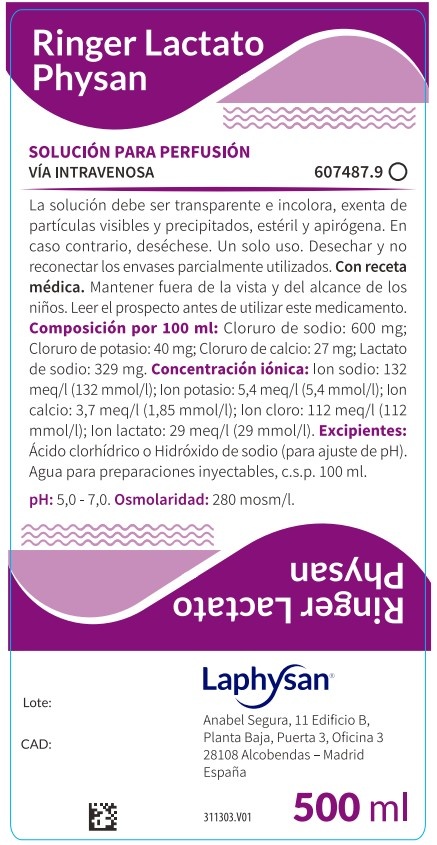
- The active ingredients are sodium chloride, potassium chloride, calcium chloride, and sodium lactate. Each 100 ml of solution contains 600 mg of sodium chloride, 40 mg of potassium chloride, 27 mg of calcium chloride (as dihydrate) and 329 mg of sodium lactate.
- The other components (excipients) are: hydrochloric acid or sodium hydroxide (for pH adjustment) and water for injectable preparations.
Appearance of the Product and Container Content
The solution must be transparent and not contain precipitates. Do not administer otherwise.
Ringer Lactato PHYSAN is a solution for perfusion, presented in a Type II glass vial, polypropylene (PP) bottle, polypropylene (PP) bag, and polyvinyl chloride (PVC) bag containing 250 and 500 ml, with the following presentations:
1 vial of 250 ml
1 vial of 500 ml
1 bag (PP and PVC) of 250 ml
1 bag (PP and PVC) of 500 ml
1 bottle (PP) of 250 ml
1 bottle (PP) of 500 ml
Also in the Clinical Packaging presentation:
- Glass Vials:
24 vials of 250 ml
10 vials of 500 ml
- PP Vials
24 polypropylene (PP) bottles of 250 ml
10 polypropylene (PP) bottles of 500 ml
20 polypropylene (PP) bottles of 500 ml
- PVC Bags
30 bags (PP and PVC) of 250 ml
20 bags (PP and PVC) of 500 ml
Marketing Authorization Holder and Manufacturer
Marketing Authorization Holder:
LAPHYSAN, S.A.U.
Anabel Segura, 11 Edificio A, Planta 4, Puerta D
28108 Alcobendas – Madrid, Spain
Manufacturer:
LABORATORIOS BASI – INDUSTRIA FARMACÉUTICA, S.A.
Parque Industrial Manuel Lourenço Ferreira,
Nº 8, Nº 15 y Nº 16
3450-232 Mortágua - Portugal
or
S.M. FARMACEUTICI SRL
Zona industriale
85050 TITO – POTENZA, Italy
or
SALF SPA LABORATORIO FARMACOLOGICO
Via Marconi 2
24069 Cenate Sotto (Bergamo), Italy
Date of the Last Revision of this Prospectus: April 2019
--------------------------------------------------------------------------------------------------------------
This information is intended only for healthcare professionals:
Ringer Lactato Physan will be administered by perfusion.
The content of each Ringer Lactato Physan container is for a single perfusion. Once the container is opened, the solution must be administered immediately and the unused fraction must be discarded.
To administer the solution and in case of addition of medications, maximum asepsis must be maintained. From a microbiological point of view, when the solution is used as a vehicle for other medications, it must be used immediately unless the dilution has been carried out in controlled and validated aseptic conditions. If it is not used immediately, the conditions and periods of conservation during use are the responsibility of the user.
Before adding medications to the Ringer Lactato solution or administering them simultaneously with other medications, it must be checked that there are no incompatibilities. It is recommended to consult the prospectus of the added medications, as well as to verify if they are soluble and stable in aqueous solution at the pH of the Ringer Lactato solution (pH 5.0-7.0).
When compatible medication is added to Ringer Lactato Physan, the solution must be administered immediately.
The Ringer Lactato solution should not be used as a vehicle for medications that contain ions capable of causing the formation of insoluble calcium salts.
The hydrological balance, serum electrolytes, and acid-base balance must be monitored before and during administration, with special attention to serum sodium in patients who present an increase in non-osmotic release of vasopressin (inadequate secretion syndrome of antidiuretic hormone, SIADH) and in patients who receive concomitant medication with vasopressin agonists due to the risk of hospital hyponatremia. Serum sodium monitoring is especially important with hypotonic solutions.
Tonicity of Ringer Lactato Physan: isotonic.
The perfusion rate and the perfused volume depend on the age, weight, and clinical picture (e.g., burns, surgery, head injury, infections); the responsible physician, with experience in pediatric treatments with intravenous perfusion solutions, must decide on the need for concomitant treatment.
- Country of registration
- Dosage formINJECTABLE PERFUSION, 600 mg; 40 mg; 27 mg; 329 mg/ 100 ml
- ATC codeB05BB01
- Active substance
- Prescription requiredYes
- Manufacturer
- This information is for reference only and does not constitute medical advice. Always consult a doctor before taking any medication. Oladoctor is not responsible for medical decisions based on this content.
- Alternatives to RINGER LACTATE PHYSAN SOLUTION FOR INFUSIONDosage form: INJECTABLE, 1361 mgActive substance: electrolytesManufacturer: Fresenius Kabi España, S.A.U.Prescription requiredDosage form: INJECTABLE INFUSION, 2% Sodium Chloride / 100 mlActive substance: electrolytesManufacturer: Fresenius Kabi España, S.A.U.Prescription requiredDosage form: INJECTABLE PERFUSION, 33 mg / 30 mg / 860 mgActive substance: electrolytesManufacturer: Fresenius Kabi España, S.A.U.Prescription required
Online doctors for RINGER LACTATE PHYSAN SOLUTION FOR INFUSION
Discuss questions about RINGER LACTATE PHYSAN SOLUTION FOR INFUSION, including use, safety considerations and prescription review, subject to medical assessment and local regulations.









Get RINGER LACTATE PHYSAN SOLUTION FOR INFUSION Prescription Online
Fill in a 2-min form
Tell us your symptoms, history, and what medicine you're requesting.
Pick a doctor or let us assign
Choose a specialist or we'll match you with the next available doctor.
Doctor reviews your case
Usually within 30 minutes. They may ask follow-up questions via chat.
Collect from any pharmacy
Electronic prescription sent to your email — valid across Spain.
Frequently Asked Questions
RINGER LACTATE PHYSAN SOLUTION FOR INFUSION requires a prescription in Spain. You can check with a doctor online whether this medicine may be appropriate for your situation.
The active ingredient in RINGER LACTATE PHYSAN SOLUTION FOR INFUSION is electrolytes. This information helps identify medicines with the same composition but different brand names.
RINGER LACTATE PHYSAN SOLUTION FOR INFUSION is manufactured by Laphysan S.A.U.. Pharmacy brands and packaging may differ depending on the distributor.
Doctors such as Family doctors, Psychiatrists, Dermatologists, Cardiologists, Endocrinologists, Gastroenterologists, Pulmonologists, Nephrologists, Rheumatologists, Hematologists, Infectious disease physicians, Allergists, Geriatricians, Paediatricians, Oncologists may assess whether RINGER LACTATE PHYSAN SOLUTION FOR INFUSION is appropriate, depending on your situation and local regulations. You can book an online consultation to discuss your symptoms and possible next steps.
Spain has a well-developed healthcare infrastructure across major cities such as Madrid, Barcelona, Valencia, and Seville. Pharmacies are widely available and operate under strict regulations, ensuring access to prescribed medications.
You can buy RINGER LACTATE PHYSAN SOLUTION FOR INFUSION in Madrid, Barcelona, Seville, or Valencia at any local pharmacy with a valid prescription.
To obtain a prescription, you can use Oladoctor:
Other medicines with the same active substance (electrolytes) include SODIUM ACETATE 1M FRESENIUS KABI CONCENTRATE FOR PERFUSION SOLUTION, APIROSERUM SODIUM CHLORIDE 2% SOLUTION FOR INFUSION, APIROSERUM RINGER'S SOLUTION FOR INFUSION. These may have different brand names or formulations but contain the same therapeutic ingredient. Always consult a doctor before switching or starting a new medicine.
