



RIBAVIRINA 200 mg Film-Coated Tablets

Prescription review online
A doctor will review your case and decide whether a prescription is medically appropriate.

Talk to a doctor about this medicine
Discuss your symptoms and possible next steps in a quick online consultation.



How to use RIBAVIRIN NORMON 200 mg FILM-COATED TABLETS
Contents of the leaflet
- Introduction
- What is ribavirin NORMON and what is it used for
- Before taking ribavirin NORMON
- How to take ribavirin NORMON
- Possible Adverse Effects
- Storage of Ribavirina NORMON
- ADDITIONAL INFORMATION
Introduction
Package Leaflet: Information for the User
Ribavirin NORMON 200 mg film-coated tablets EFG
Ribavirin
Read all of this leaflet carefully before you start taking this medicine.
- Keep this leaflet, you may need to read it again.
- If you have any further questions, ask your doctor or pharmacist.
- This medicine has been prescribed for you, do not pass it on to others. It may harm them, even if their symptoms are the same as yours.
- If you experience any side effects, talk to your doctor or pharmacist. This includes any possible side effects not listed in this leaflet.
Contents of the pack:
- What is ribavirin NORMON and what is it used for
- Before taking ribavirin NORMON
- How to take ribavirin NORMON
- Possible side effects
- Storage of ribavirin NORMON
- Further information
1. What is ribavirin NORMON and what is it used for
Ribavirin NORMON contains the active substance ribavirin, which inhibits the multiplication of many types of viruses, including the hepatitis C virus. Ribavirin NORMON should not be used without interferon alfa-2b, i.e., it should not be used alone.
Patients not previously treated:
Ribavirin NORMON is used in combination with interferon alfa-2b to treat patients from 3 years of age with chronic hepatitis C infection (CHC) of all types except genotypes 1, 4, 5, and 6, who have not been previously treated.
Patients previously treated:
Ribavirin NORMON is used, in combination with interferon alfa-2b, to treat adult patients with chronic hepatitis C, who have previously responded to treatment with an interferon alfa alone, but whose disease has reappeared.
There is no information on the safety and efficacy of the use of ribavirin with other forms of interferon (i.e., different from alfa-2b).

Not sure if this medicine is right for you?
Discuss your symptoms and treatment with a doctor online.
2. Before taking ribavirin NORMON
Ribavirin NORMON is not recommended for use in patients under 3 years of age.
Do not take ribavirin NORMON
If any of the following applies to you or the child in your care, do not take ribavirin NORMON and inform your doctor if:
- you are allergic (hypersensitive) to ribavirin or any of the other components of ribavirin NORMON.
- you are pregnant or planning to become pregnant (see section "Pregnancy and breastfeeding").
- you are breastfeeding.
- you have had a heart problem in the last 6 months.
- you have serious health problems that leave you very weakened.
- you have severe kidney disease and/or are undergoing hemodialysis.
- you have a serious liver disease other than chronic hepatitis C.
- you have any blood disorder, such as anemia (low cell count in the blood), thalassemia, sickle cell anemia.
- you have autoimmune hepatitis or any other immune system problem.
- you are taking a medicine that suppresses the immune system (which protects you from infection and some diseases).
Children and adolescents should not take the combined administration of ribavirin NORMON and interferon alfa when they have or have a history of severe mental or nervous problems, such as severe depression, suicidal thoughts or intentions.
Reminder: Please read the "Do not use" section of the Interferon alfa-2b Package Leaflet before starting combined administration with ribavirin.
Be careful with ribavirin NORMON
Seek medical attention immediately if you develop symptoms of a severe allergic reaction (such as difficulty breathing, wheezing, or hives) while following this treatment.
Children and adolescents weighing less than 47 kg:
Ribavirin NORMON is not recommended for use. A ribavirin oral solution is available on the market for children over 3 years and adolescents weighing less than 47 kg.
You must inform your doctorif you or the child in your care:
- are an adult who has or has had a severe mental or nervous disorder, confusion, loss of consciousness, or has had suicidal thoughts or has attempted suicide.
- have ever presented depression during treatment with ribavirin or develop symptoms associated with depression (e.g., feeling sad, discouraged, etc.).
- are a woman of childbearing age (see section "Pregnancy and breastfeeding").
- are a man and your female partner is of childbearing age (see section "Pregnancy and breastfeeding").
- have previously had a serious heart disease or have a heart condition.
- are over 65 years old or have kidney problems.
- have or have had a serious illness.
- have thyroid problems.
During treatment with ribavirin in combination with an interferon alfa, disorders in the teeth and gums have been reported, which can lead to tooth loss. Additionally, dry mouth has been reported, which can have a detrimental effect on the teeth and mouth mucosa during long-term treatment with ribavirin and combination with an interferon alfa. You should brush your teeth properly twice a day and have regular dental check-ups. Also, some patients may experience vomiting. If you experience this reaction, make sure to rinse your mouth well afterwards.
During treatment with ribavirin in combination with an interferon alfa, patients may rarely experience eye problems such as vision loss. If you are receiving ribavirin in combination with an interferon alfa, you should undergo an initial eye examination. Any patient who complains of decreased or lost vision should undergo a complete eye examination as soon as possible. Patients with pre-existing eye disorders (e.g., diabetic or hypertensive retinopathy) should undergo regular eye examinations during combination therapy with ribavirin and an interferon alfa. The combined use of ribavirin and an interferon alfa should be discontinued in patients who develop new eye disorders or if existing ones worsen.
Reminder: Please read the "Be careful" section of the Interferon alfa-2b Package Leaflet before starting combined administration with ribavirin NORMON.
Using other medicines
Tell your doctor or pharmacist if you or the child in your care:
- are using or have recently used other medicines, including those obtained without a prescription.
- are receiving azathioprine in combination with ribavirin and pegylated interferon alfa, and therefore may have a higher risk of developing serious blood disorders.
- are infected with the Human Immunodeficiency Virus (HIV-positive) and the Hepatitis C Virus (HCV) and are being treated with anti-HIV medication(s) – [nucleoside analog reverse transcriptase inhibitor (NRTI), and/or highly active antiretroviral therapy
(HAART)]:
- Taking ribavirin NORMON in combination with interferon alfa and anti-HIV medication(s) may increase the risk of lactic acidosis, liver failure, and development of blood abnormalities (reduction in the number of red blood cells that carry oxygen, certain white blood cells that fight infections, and blood clotting cells called platelets).
- With zidovudine or stavudine, it has not been proven whether ribavirin changes the way these medicines work. Therefore, your blood will be regularly monitored to ensure that your HIV infection is not worsening. If it worsens, your doctor will decide whether your treatment with ribavirin should be changed or not. Additionally, patients receiving zidovudine with ribavirin in combination with interferon alfa may have a higher risk of developing anemia (low red blood cell count). Therefore, the use of zidovudine and ribavirin in combination with interferon alfa is not recommended.
- Due to the risk of lactic acidosis (build-up of lactic acid in the body) and pancreatitis, the use of ribavirin and didanosine is not recommended and the use of ribavirin and stavudine should be avoided.
- Coinfected patients with advanced liver disease who are receiving HAART may have an increased risk of worsening liver function.
Adding treatment with an interferon alfa alone or in combination with ribavirin may increase the risk in this group of patients.
Reminder: Please read the "Using other medicines" section of the Interferon alfa-2b Package Leaflet before starting combined administration with ribavirin NORMON.
Using ribavirin NORMON with food and drinks
This medicine should be taken with food.
Pregnancy and breastfeeding
If you are pregnant, you should not take ribavirin NORMON. Ribavirin NORMON may harm the unborn child.
Both men and women should take special precautionsin their sexual activity if there is any possibility of pregnancy:
- Girl or woman of childbearing age:
A pregnancy test should be performed and be negative before starting treatment, every month during treatment, and during the 9 months following treatment discontinuation. This should be discussed with your doctor.
- Men:
Do not have sexual intercourse with a pregnant woman unless you use a condom.
This will reduce the possibility of ribavirin passing into the woman's body.
If your partner is not pregnant but is of childbearing age, a pregnancy test should be performed every month during treatment and during the 6 months following treatment discontinuation.
You and your female partner must use an effective contraceptive method during the time you are taking ribavirin and during the 6 months following treatment discontinuation.
Discuss this with your doctor (see section "Do not take ribavirin NORMON").
If you are a breastfeeding woman, you should not take ribavirin. You should stop breastfeeding before starting to take ribavirin NORMON.
Driving and using machines
Ribavirin NORMON does not affect your ability to drive or use machines; however, interferon alfa-2b may affect your ability to drive or use machines. Therefore, do not drive or use machines if this treatment makes you feel tired, sleepy, or confused.
3. How to take ribavirin NORMON
General information on taking ribavirin NORMON:
If the child in your care is under 3 years old, do not administer it.
Follow the instructions for administration of ribavirin NORMON exactly as indicated by your doctor. Consult your doctor or pharmacist if you have any doubts.
Do not take a dose higher than recommended and take the medicine for the prescribed period. Your doctor has determined the correct dose of ribavirin based on your weight or the weight of the child in your care.
You will have routine blood teststo check your blood, kidney, and liver functions.
- Blood tests will be performed regularly to help your doctor determine if this treatment is working.
- Based on the results of these tests, your doctor may change/adjust the number of tablets for you or the child in your care, prescribe a different presentation of ribavirin, and/or change the duration of treatment.
- If you develop serious kidney or liver problems, this treatment will be discontinued.
The usual dose, based on the patient's weight, is shown in the table below:
- Find the line that shows the weight of the adult or child/adolescent.
Remember: If the child is under 3 years old, do not administer it.
- Read along the same line to see how many tablets you should take.
Remember: If your doctor's instructions are different from the table below, follow your doctor's instructions.
- If you have any doubts about the dose, ask your doctor.
Ribavirin NORMON 200 mg film-coated tablets - dose based on body weight | ||
Adult weights (Kg) | Usual daily dose of ribavirin NORMON | Number of 200 mg tablets |
<65 | 800 mg | 2 tablets in the morning and 2 tablets in the evening |
65-80 | 1,000 mg | 2 tablets in the morning and 3 tablets in the evening |
81-105 | 1,200 mg | 3 tablets in the morning and 3 tablets in the evening |
>105 | 1,400 mg | 3 tablets in the morning and 4 tablets in the evening |
Child/adolescent weights (Kg) | Usual daily dose of ribavirin NORMON | Number of 200 mg tablets |
47-49 | 600 mg | 1 tablet in the morning and 2 tablets in the evening |
50-65 | 800 mg | 2 tablets in the morning and 2 tablets in the evening |
>65 | See adult dose and corresponding number of tablets |
Take the prescribed dose orally, with water, and during meals. Do not chew the tablets. For children or adolescents who cannot swallow a tablet, a ribavirin oral solution is available on the market.
Reminder: Ribavirin NORMON is only used in combination with interferon alfa-2b for chronic hepatitis C infection. For complete information, read the "How to use" section of the Interferon alfa-2b Package Leaflet.
Medicines with interferons used in combination with ribavirin NORMON may cause greater than normal fatigue; if you inject the medicine yourself or administer it to a child, do so at bedtime.
If you take more ribavirin NORMON than you should
In case of overdose or accidental ingestion, consult your doctor or pharmacist immediately or call the Toxicology Information Service, phone: 91 562 04 20, indicating the medicine and the amount ingested.
If you forget to take ribavirin NORMON
If you are self-administering this treatment, or if you are in charge of a child taking ribavirin in combination with interferon alfa-2b, take/administer the missed dose as soon as possible on the same day. If a whole day has passed, consult your doctor. Do not take a double dose to make up for missed doses.

Started taking the medicine and have questions?
Discuss your symptoms and treatment with a doctor online.
4. Possible Adverse Effects
Please also read the "Possible Adverse Effects" section of the interferon alfa-2b Prospectus.
As with all medications, ribavirina NORMON used in combination with an interferon alfa can produce adverse effects, although not all people will suffer from them. Although not all of the secondary effects listed below will occur, some of them, if they do occur, may require medical attention.
Psychiatry and Central Nervous System: Some people become depressed when taking ribavirina NORMON along with an interferon, and in some cases, some people have threatening thoughts for the life of others, suicidal thoughts, or aggressive behavior (sometimes towards others). Some patients have gone so far as to commit suicide. Seek emergency care if you notice that you are becoming depressed or having suicidal thoughts or changes in your behavior. You may need to ask a family member or close friend for help to be alert to symptoms of depression or changes in your behavior. Children and adolescentsare particularly prone to developing depression when treated with ribavirina and interferon alfa. Contact your doctor immediately or seek emergency treatment if they show any unusual behavioral symptoms, feel depressed, or feel like self-harming or harming others. |
Growth and Development (Children and Adolescents): During the year of treatment with ribavirina in combination with interferon alfa-2b, some children and adolescents did not grow or gain as much weight as expected. Some children did not reach the expected height during 1-5 years after finishing treatment. |
Consult your doctor immediatelyif you experience any of the following adverse effects during combination treatment with a product containing interferon alfa:
- chest pain or persistent cough; changes in heart rhythm, fainting,
- confusion, feeling of depression; suicidal thoughts or aggressive behavior, attempted suicide, threatening thoughts for the life of others,
- numbness or tingling sensations,
- sleep disorders, thinking or concentration capacity disorders,
- severe stomach pain; black or tarry stools; blood in stools or urine; pain in the lower back or side pain,
- pain or difficulty urinating,
- severe nosebleeds,
- onset of fever or chills after a few weeks of treatment,
- visual or hearing disorders,
- severe skin rash or redness.
The possible adverse effects listed below are grouped by frequency of occurrence:
Very Common(affect more than 1 in 10 patients)
Common(affect between 1 and 10 in 100 patients)
Uncommon(affect between 1 and 10 in 1,000 patients)
Rare(affect between 1 and 10 in 10,000 patients)
Very Rare(affect less than 1 in 10,000 patients)
Frequency Not Known(frequency cannot be estimated from available data)
The following adverse effects have been reported with the combination of ribavirina and a product containing interferon alfa in adults:
Very Commonly Reported Adverse Effects:
- reduction in the number of red blood cells (which can cause fatigue, difficulty breathing, dizziness), or neutrophils (which can make you more sensitive to different infections),
- difficulty concentrating, feeling of anxiety or nervousness, mood changes, feeling of depression or irritation, feeling of fatigue, sleep problems or staying asleep,
- cough, dry mouth, pharyngitis (sore throat),
- diarrhea, dizziness, fever, flu-like symptoms, headache, nausea, severe chills, viral infection, vomiting, weakness,
- loss of appetite, weight loss, stomach pain,
- dry skin, irritation, pain or redness at the injection site, hair loss, itching, muscle pain, muscle discomfort, joint and muscle pain, skin rash.
Commonly Reported Adverse Effects:
- decrease in blood cells involved in blood coagulation called platelets that can easily cause bruising and spontaneous bleeding, decrease in certain white blood cells called lymphocytes that help fight infections, decrease in thyroid gland activity (which can make you feel tired, depressed, increase your sensitivity to cold as well as other symptoms), excess sugar or uric acid (as in gout) in blood, low calcium levels in blood, severe anemia,
- fungal or bacterial infections, crying, agitation, amnesia, memory alteration, nervousness, abnormal behavior, aggressive behavior, anger reaction, feeling of confusion, loss of interest, mental disorder, mood changes, strange dreams, self-harm desires, somnolence, sleep problems,
- blurred or abnormal vision, eye pain, irritation or infection, dry or teary eyes, changes in hearing or voice, tinnitus, ear infection, ear pain, herpes simplex, taste alteration, loss of taste, bleeding gums or mouth sores, burning sensation on the tongue, tongue pain, gum inflammation, dental problems, migraine, respiratory infections, sinusitis, nosebleeds, non-productive cough, nasal obstruction or discharge, rapid or difficult breathing, thirst, dental disorders,
- heart murmur (abnormal heart sound), chest pain or discomfort, feeling of fainting, feeling of discomfort, hot flashes, heat intolerance or excessive sweating, increased heart rate, low or high tension, palpitations (violent heartbeats), increased sweating,
- intestinal distension, constipation, stomach disorder, intestinal gas (flatulence), increased appetite, irritable colon, prostate gland irritation, jaundice (yellowish skin), soft stools, pain at the height of the right costal margin, liver inflammation, stomach discomfort, frequent urination, urinating more than usual, urinary tract infection, urine alteration,
- difficult, irregular, or absent menstrual period, more abundant and prolonged menstrual periods than usual, painful menstruation, alteration of the ovary or vagina, breast pain, erection problems,
- abnormal hair texture, acne, arthritis, bruising, eczema (inflamed, red, itchy, and dry skin with possible suppurating lesions), hives, increased or decreased sensitivity to touch, nail alteration, muscle spasms, numbness or tingling sensation, pain in the limbs, pain at the injection site, pain in the joints, shaky hands, psoriasis, swollen or inflamed hands or ankles, sensitivity to sunlight, skin rash with bumpy lesions, skin redness or alteration, facial inflammation, gland inflammation (inflamed lymph nodes), muscle contractions, tumor (non-specific), walking instability, water disorder.
Uncommonly Reported Adverse Effects:
- hearing or seeing images that are not present,
- heart attack, anxiety crisis,
- drug hypersensitivity reaction,
- pancreatitis, bone pain, diabetes mellitus,
- muscle weakness.
Rarely Reported Adverse Effects:
- seizures (convulsions),
- pneumonia,
- rheumatoid arthritis, kidney problems,
- dark or bloody stools, severe abdominal pain,
- sarcoidosis (disease characterized by persistent fever, weight loss, painful and inflamed joints, skin lesions, and inflamed glands),
- vasculitis.
Very Rarely Reported Adverse Effects:
- suicide.
Adverse Effects with Unknown Frequency (cannot be estimated from available data):
- threatening thoughts for the life of others,
- mania (excessive or unreasonable enthusiasm),
- pericarditis (inflammation of the heart lining), pericardial effusion [accumulation of fluid located between the pericardium (heart lining) and the heart itself].
The following adverse effects have been reported with the combination of ribavirina and interferon alfa-2b in children and adolescents:
Very Commonly Reported Adverse Effects:
- reduction in the number of red blood cells (which can cause fatigue, difficulty breathing, dizziness), or neutrophils (which can make you more sensitive to different infections),
- decrease in thyroid gland activity (which can make you feel tired, depressed, increase your sensitivity to cold as well as other symptoms),
- feeling of depression or irritability, stomach pain, feeling of discomfort, mood changes, feeling of fatigue, inability to sleep or stay asleep, viral infection, weakness,
- diarrhea, dizziness, fever, flu-like symptoms, headache, loss or increased appetite, weight loss, decreased growth rate (height and weight), pain at the height of the right costal margin, pharyngitis (sore throat), severe chills, stomach pain, vomiting.
- dry skin, hair loss, irritation, pain or redness at the injection site, itching, muscle pain, muscle discomfort, joint and muscle pain, skin rash.
Commonly Reported Adverse Effects:
- decrease in blood cells involved in blood coagulation called platelets (which can easily cause bruising and spontaneous bleeding),
- excess triglycerides in blood, excess uric acid in blood (as in gout), increased thyroid gland activity (which can cause nervousness, heat intolerance, and excessive sweating, weight loss, palpitations, tremors),
- nervousness, irritability, aggressive behavior, behavioral alteration, difficulty concentrating, emotional instability, fainting, feeling of anxiety or nervousness, feeling of cold, feeling of confusion, loss of interest, feeling of restlessness, feeling sleepy, lack of interest or attention, mood changes, sorrow, poor quality sleep, sleepwalking, suicidal intention, sleep problems, strange dreams, self-harm desires,
- bacterial infections, common cold, fungal infections, abnormal vision, dry or teary eyes, ear infection, eye pain, irritation or infection, taste alterations, voice alterations, herpes simplex, cough, inflamed glands, nosebleeds, mouth pain, pharyngitis (sore throat), rapid breathing, respiratory infections, cracked lips and fissures at the corner of the mouth, rapid breathing, sinusitis, sneezing, mouth sores, tongue sores, nasal obstruction or discharge, sore throat, tooth pain, tooth abscess, tooth alteration, vertigo (feeling of dizziness), weakness.
- chest pain, facial redness, palpitations (strong heartbeats),
- abnormal liver function,
- acid reflux, back pain, bedwetting, gastrointestinal or rectal disorder, incontinence, increased appetite, inflammation of the stomach and intestinal mucosa, stomach discomfort, soft stools,
- urination disorders, urinary tract infection,
- difficult, irregular, or absent menstrual period, more abundant and prolonged menstrual periods than usual, alteration of the vagina, vaginal inflammation, testicular pain, development of male body characteristics,
- acne, itching, eczema (inflamed, red, itchy, and dry skin with possible suppurating lesions), increased or decreased sensitivity to touch, increased sweating, increased muscle movements, muscle tension, pain in the limbs, nail alterations, numbness or tingling sensation, skin wound, skin rash with bumpy lesions, shaky hands, skin redness or alteration, skin discoloration, skin sensitivity to sunlight, pale skin, swelling due to excessive water accumulation, gland inflammation (inflamed lymph nodes), tremor, tumor (non-specific).
Uncommonly Reported Adverse Effects:
- abnormal behaviors, emotional disorders, fears, nightmares,
- bleeding from the mucous membranes that join the inner surface of the eyelids, blurred vision, somnolence, light intolerance, eye itching, facial pain, gum inflammation,
- chest pain, breathing difficulties, lung infection, nose pain, pneumonia, wheezing,
- low blood pressure,
- enlarged liver,
- menstrual pain,
- itching in the anal area (pinworms or roundworms), blisters (shingles), decreased sensitivity to touch, muscle spasms, skin pain, paleness, peeling, redness, and inflammation of the skin.
The attempt of self-harm has also been reported in adults, children, and adolescents.
Ribavirina in combination with a product containing interferon alfa may also produce:
- aplastic anemia, red cell aplasia (which is a disease in which the body interrupts or decreases the production of red blood cells; this produces severe anemia, whose symptoms include unusual fatigue and lack of energy,
- delirium, upper and lower respiratory tract infection,
- pancreatitis,
- severe skin rashes that can be associated with the appearance of blisters in the mouth, nose, eyes, and other mucous membranes (erythema multiforme, Stevens-Johnson syndrome), toxic epidermal necrolysis (appearance of blisters and peeling of the top layer of the skin).
Also, the following adverse effects have been reported for ribavirina in combination with a product containing interferon alfa:
- abnormal thoughts, hearing or seeing images that are not present, altered mental state, disorientation,
- angioedema (swelling of hands, feet, ankles, face, lips, mouth, or throat that can cause difficulty swallowing or breathing), stroke (cerebrovascular accident),
- Vogt-Koyanagi-Harada syndrome (autoimmune inflammatory disease that affects the eyes, skin, and mucous membranes of the ears, brain, and spinal cord),
- bronchoconstriction and anaphylaxis (severe allergic reaction of the whole body), constant cough,
- eye problems including retinal damage, retinal artery occlusion, optic nerve inflammation, eye inflammation, and retinal exudates (white deposits on the retina),
- abdominal distension, stomach acidity, difficult or painful defecation,
- acute hypersensitivity reactions such as itching (hives), bruising, intense pain in a limb, pain in the leg or thigh, loss of mobility, stiffness, sarcoidosis (disease characterized by persistent fever, weight loss, pain, and swelling in joints, skin lesions, and inflamed glands),
Ribavirina in combination with interferon alfa-2b may also produce:
- dark, cloudy, or abnormally colored urine,
- breathing difficulties, changes in heartbeats, chest pain, pain under the left arm, jaw pain,
- loss of consciousness,
- paralysis, reduction or loss of strength in the facial muscles, loss of sensitivity,
- loss of vision.
You or the person caring for you should call your doctor immediately if you experience any of these symptoms.
The adverse effects listed in this section were mainly observed when ribavirina was used in combination with medications containing interferon.
When ribavirina was used in combination with other medications to treat hepatitis C (also called direct-acting antivirals) in clinical trials in adults, the most commonly reported adverse effects associated with ribavirina were anemia (low red blood cell count), nausea, vomiting, fatigue, tiredness, insomnia (difficulty sleeping), cough, shortness of breath, itching, and rash.
Also, consult the prospectuses of the other medications used in combination with ribavirina to obtain information on the adverse effects of those medications.
5. Storage of Ribavirina NORMON
Keep out of the reach and sight of children.
No special storage conditions are required.
Do not use ribavirina NORMON 200 mg tablets after the expiration date shown on the packaging after CAD. The expiration date is the last day of the month indicated.
Medications should not be thrown away through wastewater or household waste. Ask your pharmacist how to dispose of the packaging and medications you no longer need. This will help protect the environment.
6. ADDITIONAL INFORMATION
Composition of Ribavirina NORMON
- The active ingredient is ribavirina 200 mg.
- The other components (excipients) are: Core: microcrystalline cellulose, calcium phosphate dihydrate, low-substitution hydroxypropylcellulose, povidone, colloidal silica, magnesium stearate. Coating: hypromellose, titanium dioxide, macrogol 6000, talc, and red iron oxide (E-172).
Appearance of the Product and Packaging Content
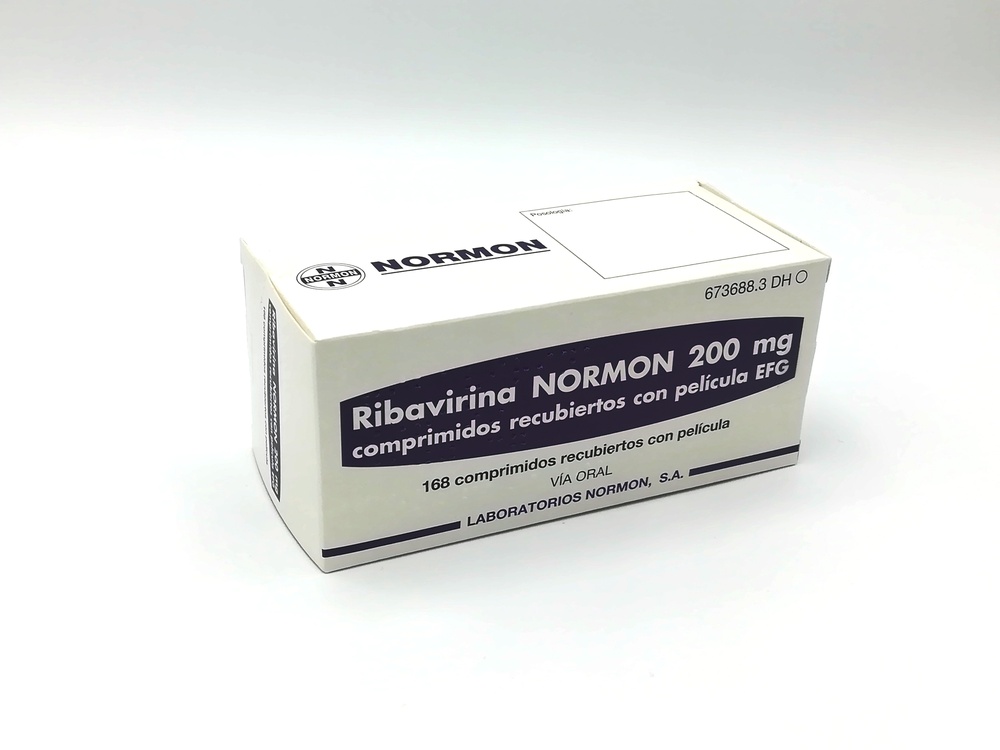
Ribavirina NORMON 200 mg are film-coated tablets of light pink color, elongated and biconvex, presented in packages of 168 tablets.
Marketing Authorization Holder and Manufacturer
LABORATORIOS NORMON, S.A.
Ronda de Valdecarrizo, 6 – 28760 Tres Cantos – Madrid (SPAIN)
Date of the Last Revision of this Prospectus: June 2021
- Country of registration
- Dosage formTABLET, 200 mg
- ATC codeJ05AP01
- Active substance
- Prescription requiredYes
- Manufacturer
- This information is for reference only and does not constitute medical advice. Always consult a doctor before taking any medication. Oladoctor is not responsible for medical decisions based on this content.
- Alternatives to RIBAVIRIN NORMON 200 mg FILM-COATED TABLETSDosage form: ORAL SOLUTION/SUSPENSION, 150 MG/ 37.5 MGActive substance: sofosbuvir and velpatasvirManufacturer: Gilead Sciences Ireland Unlimited CompanyPrescription requiredDosage form: ORAL SOLUTION/SUSPENSION, 200 MG/50 MGActive substance: sofosbuvir and velpatasvirManufacturer: Gilead Sciences Ireland Unlimited CompanyPrescription requiredDosage form: TABLET, 400 mg/100 mgActive substance: sofosbuvir and velpatasvirManufacturer: Gilead Sciences Ireland Unlimited CompanyPrescription required
Online doctors for RIBAVIRIN NORMON 200 mg FILM-COATED TABLETS
Discuss questions about RIBAVIRIN NORMON 200 mg FILM-COATED TABLETS, including use, safety considerations and prescription review, subject to medical assessment and local regulations.









Get RIBAVIRIN NORMON 200 mg FILM-COATED TABLETS Prescription Online
Fill in a 2-min form
Tell us your symptoms, history, and what medicine you're requesting.
Pick a doctor or let us assign
Choose a specialist or we'll match you with the next available doctor.
Doctor reviews your case
Usually within 30 minutes. They may ask follow-up questions via chat.
Collect from any pharmacy
Electronic prescription sent to your email — valid across Spain.
Frequently Asked Questions
RIBAVIRIN NORMON 200 mg FILM-COATED TABLETS requires a prescription in Spain. You can check with a doctor online whether this medicine may be appropriate for your situation.
The active ingredient in RIBAVIRIN NORMON 200 mg FILM-COATED TABLETS is ribavirin. This information helps identify medicines with the same composition but different brand names.
RIBAVIRIN NORMON 200 mg FILM-COATED TABLETS is manufactured by Laboratorios Normon S.A.. Pharmacy brands and packaging may differ depending on the distributor.
Doctors such as Family doctors, Psychiatrists, Dermatologists, Cardiologists, Endocrinologists, Gastroenterologists, Pulmonologists, Nephrologists, Rheumatologists, Hematologists, Infectious disease physicians, Allergists, Geriatricians, Paediatricians, Oncologists may assess whether RIBAVIRIN NORMON 200 mg FILM-COATED TABLETS is appropriate, depending on your situation and local regulations. You can book an online consultation to discuss your symptoms and possible next steps.
Spain has a well-developed healthcare infrastructure across major cities such as Madrid, Barcelona, Valencia, and Seville. Pharmacies are widely available and operate under strict regulations, ensuring access to prescribed medications.
You can buy RIBAVIRIN NORMON 200 mg FILM-COATED TABLETS in Madrid, Barcelona, Seville, or Valencia at any local pharmacy with a valid prescription.
To obtain a prescription, you can use Oladoctor:
Other medicines with the same active substance (ribavirin) include EPCLUSA 150 mg/37.5 mg COATED GRANULES IN SACHET, EPCLUSA 200 mg/50 mg COATED GRANULES IN SACHET, EPCLUSA 400 MG/100 MG FILM-COATED TABLETS. These may have different brand names or formulations but contain the same therapeutic ingredient. Always consult a doctor before switching or starting a new medicine.
