



RHODOGIL 750,000 IU/125 mg Film-coated tablets

Prescription review online
A doctor will review your case and decide whether a prescription is medically appropriate.

Talk to a doctor about this medicine
Discuss your symptoms and possible next steps in a quick online consultation.



How to use RHODOGIL 750,000 IU/125 mg FILM-COATED TABLETS
Contents of the leaflet
- Introduction
- What Rhodogil is and what it is used for
- Before taking Rhodogil
- How to take Rhodogil
- Possible side effects
- Storage of Rhodogil
- Additional Information
Introduction
Package Leaflet: Information for the User
Rhodogil 750,000 IU/125 mg Film-Coated Tablets
Spiramycin and Metronidazole
Read the entire package leaflet carefully before starting to take the medicine
- Keep this package leaflet, as you may need to read it again.
- If you have any further questions, ask your doctor or pharmacist.
- This medicine has been prescribed for you only. Do not pass it on to others. It may harm them, even if their symptoms are the same as yours.
- If you experience any side effects, talk to your doctor or pharmacist. This includes any possible side effects not listed in this package leaflet.
Contents of the Package Leaflet
- What Rhodogil is and what it is used for
- Before taking Rhodogil
- How to take Rhodogil
- Possible side effects
- Storage of Rhodogil
- Further information
1. What Rhodogil is and what it is used for
This medicine is a synergistic combination of two antibacterial agents: metronidazole and spiramycin, effective against a wide range of germs, especially those related to oral cavity infections (e.g., dental infections).
Antibiotics are used to treat bacterial infections and are not effective againstviral infections (such as flu or common cold).
It is essential to follow the instructions regarding dosage, administration interval, and treatment duration as indicated by your doctor.
Do not store or reuse this medicine. If you have any leftover antibiotic after completing treatment, return it to the pharmacy for proper disposal.Do not throw medicines down the drain or into the trash.
It is indicated in:
- Treatment and prevention of acute, chronic, or recurrent stomatological infections, such as dental abscesses and periodontitis.
- Oropharyngeal infections caused by anaerobic germs.
- Otitis and sinusitis.
- Prevention of local infectious complications after odonto-stomatological surgery.

Not sure if this medicine is right for you?
Discuss your symptoms and treatment with a doctor online.
2. Before taking Rhodogil
Do not take Rhodogil
- If you are allergic (hypersensitive) to metronidazole or spiramycin or imidazoles or any other component of Rhodogil.
- If you have liver problems.
In case of doubt, consult your doctor or pharmacist.
Be cautious when taking Rhodogil
- If you experience neurological disorders such as difficulty moving, lack of coordination (ataxia), altered sense of touch or perception of pain, heat, pricking, burning, tingling in any extremity, incoordination, or convulsions, as well as altered sense of balance (vertigo), you should discontinue the medication.
- If you have severe nerve or brain diseases, you should inform your doctor due to the possibility of worsening these conditions.
- If you have or have had any blood disease or disorder, your doctor will indicate that you undergo periodic blood tests to count white blood cells (leukocytes), both during and after treatment, as a reduction in the number of leukocytes in the blood (leukopenia) may occur.
- If you have liver failure, your doctor will prescribe that you undergo analysis and other tests on the liver due to the possibility of worsening your disease. Additionally, since this medicine is eliminated from the body through the liver, the dose should be adjusted according to the degree of functional impairment of the liver.
- If you consume alcoholic beverages, as unpleasant reactions may occur, known as the Antabus effect, which include: nausea, vomiting, sweating, and skin flushing. You should avoid alcoholic beverages and medications containing alcohol during treatment and until at least one day after treatment.
- There have been reports of severe hepatic toxicity/acute liver failure, some of which were fatal, in patients with Cockayne syndrome taking metronidazole-containing medications.
If you have Cockayne syndrome, your doctor should closely monitor your liver function while you are receiving treatment with metronidazole and thereafter.
- There have been reports of severe skin reactions, such as Stevens-Johnson syndrome (SJS), toxic epidermal necrolysis (TEN), or acute generalized exanthematous pustulosis (AGEP) with metronidazole.
If you experience symptoms or signs of these severe skin reactions (SJS, TEN, or AGEP), treatment should be discontinued immediately.
Inform your doctor immediately and stop taking metronidazole if you experience:
- Stomach pain, anorexia, nausea, vomiting, fever, general malaise, fatigue, jaundice, dark urine, clay-colored stools, or itching.
- Mental health problems such as irrational thoughts, hallucinations, confusion, or depression, including thoughts of self-harm or suicide. These symptoms can occur even in people who have never had similar problems before. If you or others around you notice any of these symptoms, stop taking this medicine and consult your doctor immediately.
- Metronidazole, one of the active ingredients of this medicine, may cause a reddish-brown coloration of the urine due to pigments from the transformation of the medicine in the body.
Consult your doctor if you have experienced or are experiencing any of the above situations.
If your treatment is prolonged, it is not recommended to use Rhodogil for longer periods than indicated by your doctor.
Use of other medicines
Inform your doctor or pharmacist if you are using or have recently used other medicines, including those obtained without a prescription.
Hydroxychloroquine or chloroquine (used to treat diseases such as rheumatoid arthritis or to treat or prevent malaria): Taking these medicines at the same time as Rhodogil may increase the possibility of you having side effects that affect your heart and can be life-threatening.
The interactions of Rhodogil when taken with other medicines may be due to spiramycin and metronidazole, which are the active ingredients of this medicine.
Due to spiramycin:
You should be cautious when taking it with levodopa and carbidopa, as it may reduce the effect of levodopa.
Due to metronidazole:
- If you are taking disulfiram, do not take metronidazole at the same time or in the two weeks following the end of treatment with disulfiram, as it may cause delirium and confusion.
- You should avoid taking beverages and medicines that contain alcohol, as unpleasant reactions may occur, known as the Antabus effect, which include: heat, flushing, vomiting, rapid heartbeat.
- You should be cautious when taking metronidazole with:
- Oral anticoagulants, as it may increase the risk of bleeding, lithium, cyclosporine, phenytoin, as it may increase the effects of these medicines.
- Phenobarbital, antacids (algedrate), and prednisone, as they may reduce the effect of metronidazole.
- Cimetidine, as it may potentiate the effect and/or toxicity of metronidazole.
- Busulfan, as metronidazole may increase the toxicity and plasma levels of busulfan.
- Metronidazole may increase the toxicity of 5-fluorouracil, and when performing laboratory tests, metronidazole may give a false positive in a test called the Nelson test.
- Inform your doctor if you are taking any medicine that may cause changes in the ECG (certain anti-arrhythmics, certain antibiotics, psychotropic medicines).
Taking Rhodogil with food and drinks
It is recommended not to take Rhodogil with food, as its absorption may be reduced.
It is recommended to avoid beverages and medicines that contain alcohol.
Pregnancy and breastfeeding
If you are pregnant or think you may be pregnant, do not take Rhodogil without consulting your doctor first.
Consult your doctor or pharmacist before using any medicine.
If you are breastfeeding, do not take Rhodogil, as metronidazole and spiramycin, the active ingredients of this medicine, pass into breast milk.
Driving and using machines
Do not drive or operate machinery if you experience confusion, fatigue, altered sense of balance (vertigo), hallucinations, convulsions, or eye disorders after taking Rhodogil.
Rhodogil contains sorbitol and sodium
This medicine contains less than 23 mg of sodium (1 mmol) per tablet; it is essentially "sodium-free".
This medicine contains 8 mg of sorbitol in each tablet.
3. How to take Rhodogil
Follow the administration instructions of this medicine exactly as indicated by your doctor. In case of doubt, consult your doctor or pharmacist.
Remember to take your medicine.
Swallow the tablets without chewing with a sufficient amount of liquid (a glass of water).
Your doctor will indicate the duration of your treatment with this medicine. Do not stop treatment before, as it may worsen your condition or lead to the development of bacterial resistance.
If you think the effect of Rhodogil is too strong or too weak, inform your doctor or pharmacist.
Your doctor will prescribe the lowest sufficient dose to produce the desired effect.
The recommended dose is:
Usual dose for adults over 15 years
4 to 6 tablets per day, divided into 2 or 3 doses, (corresponding to a dose of 3-4.5 million IU of spiramycin and 500-750 mg of metronidazole).
Usual dose for children under 15 years
- 10 to 15 years: 3 tablets per day (corresponding to a dose of 2.25 million IU of spiramycin and 375 mg of metronidazole).
- The pharmaceutical form of this medicine is not suitable for administration to children between 5 and 10 years old. Its use is at the discretion of the doctor. The recommended dose for this age group is 2 tablets per day (corresponding to a dose of 1.5 million IU of spiramycin and 250 mg of metronidazole).
In case of kidney function impairment, your doctor will not need to adjust the dose, as the amount of medicine eliminated in the urine is very small.
The normal treatment duration is usually 6 to 10 consecutive days.
If you take more Rhodogil than you should
Consult your doctor or pharmacist immediately, or go to the nearest hospital emergency department. Bring this package leaflet and the medicine packaging with you.
The usual symptoms of overdose are vomiting, ataxia (incoordination), mild disorientation, dry mouth, tendency to lipotimia (feeling of loss of consciousness), flushing, skin rash, headache, mild depression, altered sense of taste, and nausea. Gastric lavage and symptomatic treatment are recommended.
In case of overdose or accidental ingestion, consult the Toxicology Information Service. Telephone 91 562 04 20.
If you forget to take Rhodogil
Do not take a double dose to make up for forgotten doses.
If you interrupt treatment with Rhodogil
If you have any further questions about the use of this medicine, ask your doctor or pharmacist.

Started taking the medicine and have questions?
Discuss your symptoms and treatment with a doctor online.
4. Possible side effects
Like all medicines, Rhodogil can cause side effects, although not everybody gets them.
Very common side effects (may affect more than 1 in 10 people)
- Paresthesia (tingling in hands or feet, altered sense of touch or perception of pain and heat and pricking)
Common side effects (may affect up to 1 in 10 people)
- Nausea
- Vomiting
- Diarrhea
- Altered taste
- Rash
Rare side effects (may affect up to 1 in 1000 people)
- Gait disturbance
- Ataxia (uncoordinated muscle movement)
- Nosebleeds
- Sweating
- Chest tightness
- Feeling of cold in the mouth or throat
Very rare side effects (may affect up to 1 in 10,000 people)
- Pseudomembranous colitis (severe inflammation of the intestine that can rarely occur after antibiotic treatment)
- Anaphylactic shock (severe allergic reaction that can be life-threatening)
- Transient vision disturbances such as double vision
- Myopia (difficulty seeing distant objects)
- Blurred vision
- Flushing
- Increased liver enzymes (AST, ALT, alkaline phosphatase)
- With the use of metronidazole, a very rare but serious side effect has been reported, which is a brain disease (encephalopathy). The symptoms vary, but you may experience fever, stiff neck, headache, or see or hear things that are not there. You may also have problems using your arms and legs or speaking, or feel confused. Talk to your doctor immediately if you notice any of these side effects.
Side effects of unknown frequency (frequency cannot be determined from available data)
- Stomach pain
- Metallic taste
- Anorexia (loss of appetite)
- Discoloration of the tongue
- Inflammation of the tongue with a feeling of dry mouth
- Stomatitis (inflammation of the mouth mucosa)
- Reversible pancreatitis (reversible inflammation of the pancreas)
- Indigestion
- Peripheral sensory neuropathy
- Seizures
- Subacute cerebellar syndrome (sudden onset of uncoordinated muscle movement, speech disturbance, involuntary and uncontrolled eye movement, gait disturbance, and tremor) which disappears with the discontinuation of treatment
- Optic neuritis (inflammation of the optic nerve)
- Headache
- Psychotic disorders (including confusion and hallucinations)
- Depression
- Difficulty sleeping
- Optic neuropathy (damage to the optic nerve that can cause sudden vision loss in the affected eye)
- Decreased visual acuity
- Color vision disturbance
- Agranulocytosis (decrease in a type of white blood cell, granulocytes)
- Neutropenia (decrease in a type of blood cell called neutrophils)
- Thrombocytopenia (decrease in the number of blood platelets)
- Cholestatic hepatitis (inflammation of the liver with difficulty in bile flow)
- Mixed liver damage
- Hepatocellular damage (sometimes with jaundice)
- Liver failure
- Angioedema (inflammation of feet, hands, throat, lips, and airways)
- Stevens-Johnson syndrome (generalized rash with blisters and skin peeling, particularly around the mouth, nose, eyes, and genitals)
- Toxic epidermal necrolysis (generalized rash with blisters and skin peeling, particularly around the mouth, nose, eyes, and genitals, causing widespread skin peeling (more than 30% of the body surface))
- Acute generalized exanthematous pustulosis (generalized red, scaly rash with bumps and blisters, accompanied by fever, mainly located in skin folds, trunk, and upper limbs)
- Itching
- Urticaria
- Henoch-Schönlein purpura (a type of blood vessel inflammation)
- Fever
- Fatigue
- Vasculitis (inflammation of blood vessels)
- Vertigo
- Aseptic meningitis (a type of inflammation of the meninges, the membranes that surround the brain and spinal cord)
- Change in the electrical activity of the heart seen in the ECG (prolongation of the QT interval) has been seen when metronidazole is administered with medicines that have the potential to prolong the QT interval.
If you experience any side effects, talk to your doctor or pharmacist. This includes any possible side effects not listed in this package leaflet.
Reporting side effects
If you experience any type of side effect, consult your doctor or pharmacist, even if it is a possible side effect not listed in this package leaflet. You can also report them directly through the Spanish Pharmacovigilance System for Human Use Medicines: www.notificaRAM.es. By reporting side effects, you can contribute to providing more information on the safety of this medicine.
5. Storage of Rhodogil
Keep Rhodogil out of the reach and sight of children.
Do not use Rhodogil after the expiration date stated on the packaging. The expiration date is the last day of the month indicated.
Do not store above 25°C.
Medicines should not be disposed of via wastewater or household waste. Return the packaging and any unused medicine to the pharmacy's SIGRE point. If in doubt, ask your pharmacist how to dispose of the packaging and any unused medicine. This will help protect the environment.
6. Additional Information
Composition of Rhodogil tablets
The active ingredients are spiramycin and metronidazole. Each tablet contains 750,000 IU of the active ingredient spiramycin and 125 mg of the active ingredient metronidazole.
The other components are: cornstarch, povidone, sodium croscarmellose, anhydrous colloidal silica, sorbitol, magnesium stearate, microcrystalline cellulose, hypromellose, macrogol 6000, titanium dioxide (E-171).
Appearance of the product and packaging content
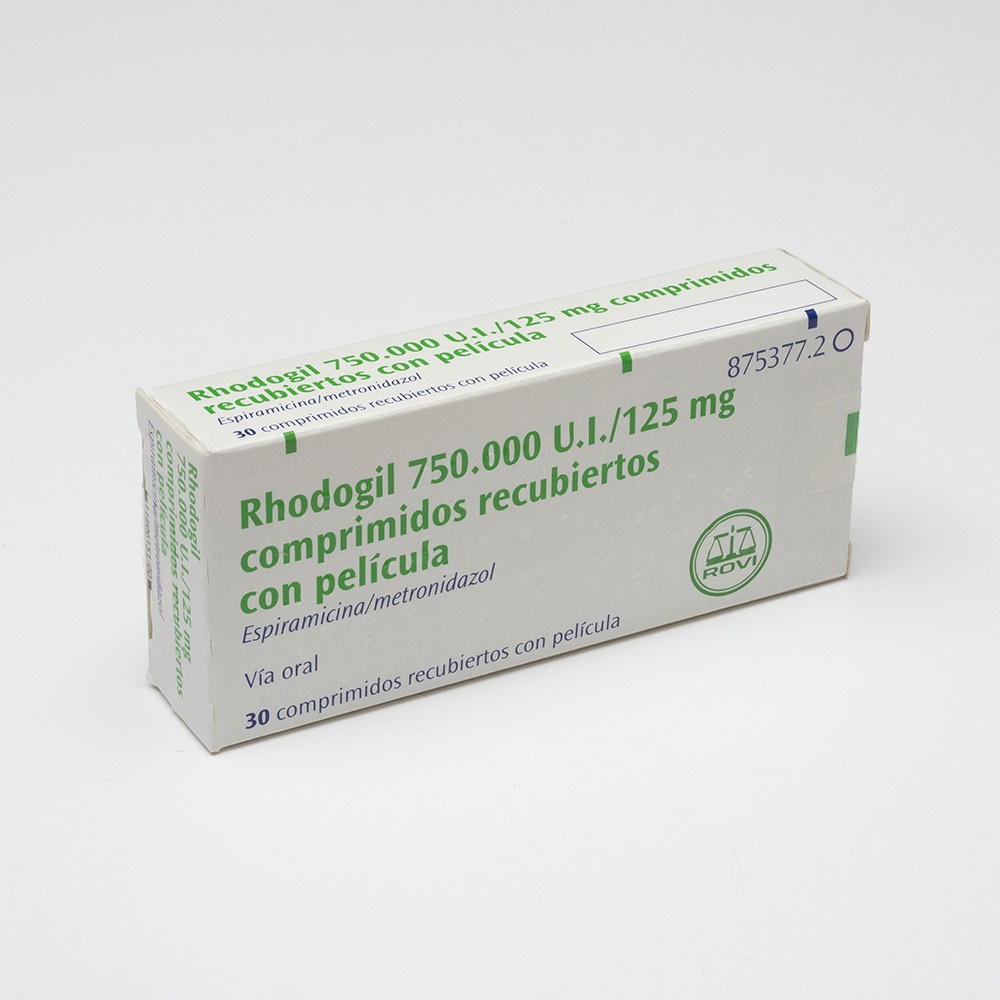
Rhodogil tablets are film-coated, round, and white, for oral administration. They are available in packs of 30 tablets.
Marketing authorization holder
Laboratorios Farmacéuticos Rovi, S.A.
C/Julián Camarillo, 35
28037 Madrid
Spain
Manufacturer
ROVI Pharma Industrial Services, S.A.
Vía Complutense, 140
28805 Alcalá de Henares (Madrid)
Spain
Date of the last revision of this leaflet: July 2022
Detailed and updated information on this medication is available on the website of the Spanish Agency for Medicines and Health Products (AEMPS) http://www.aemps.gob.es/.
- Country of registration
- Dosage formTABLET, 750000 IU of spiramycin; 125 mg of metronidazole
- ATC codeJ01RA04
- Active substance
- Prescription requiredYes
- Manufacturer
- CompositionCROSCARMELOSA SODICA (6,0 mg mg), SORBITOL (8,0 mg mg)
- This information is for reference only and does not constitute medical advice. Always consult a doctor before taking any medication. Oladoctor is not responsible for medical decisions based on this content.
- Alternatives to RHODOGIL 750,000 IU/125 mg FILM-COATED TABLETSDosage form: TABLET, 250 mg/1.5 Million IUActive substance: spiramycin and metronidazoleManufacturer: Farmalider S.A.Prescription requiredDosage form: INJECTABLE INFUSION, 400 mg/250 mlActive substance: moxifloxacinManufacturer: Bayer Hispania S.L.Prescription requiredDosage form: INJECTABLE PERFUSION, 1000 mgActive substance: amikacinManufacturer: B Braun Medical S.A.Prescription required
Online doctors for RHODOGIL 750,000 IU/125 mg FILM-COATED TABLETS
Discuss questions about RHODOGIL 750,000 IU/125 mg FILM-COATED TABLETS, including use, safety considerations and prescription review, subject to medical assessment and local regulations.









Get RHODOGIL 750,000 IU/125 mg FILM-COATED TABLETS Prescription Online
Fill in a 2-min form
Tell us your symptoms, history, and what medicine you're requesting.
Pick a doctor or let us assign
Choose a specialist or we'll match you with the next available doctor.
Doctor reviews your case
Usually within 30 minutes. They may ask follow-up questions via chat.
Collect from any pharmacy
Electronic prescription sent to your email — valid across Spain.
Frequently Asked Questions
RHODOGIL 750,000 IU/125 mg FILM-COATED TABLETS requires a prescription in Spain. You can check with a doctor online whether this medicine may be appropriate for your situation.
The active ingredient in RHODOGIL 750,000 IU/125 mg FILM-COATED TABLETS is spiramycin and metronidazole. This information helps identify medicines with the same composition but different brand names.
RHODOGIL 750,000 IU/125 mg FILM-COATED TABLETS is manufactured by Laboratorios Farmaceuticos Rovi S.A.. Pharmacy brands and packaging may differ depending on the distributor.
Doctors such as Family doctors, Psychiatrists, Dermatologists, Cardiologists, Endocrinologists, Gastroenterologists, Pulmonologists, Nephrologists, Rheumatologists, Hematologists, Infectious disease physicians, Allergists, Geriatricians, Paediatricians, Oncologists may assess whether RHODOGIL 750,000 IU/125 mg FILM-COATED TABLETS is appropriate, depending on your situation and local regulations. You can book an online consultation to discuss your symptoms and possible next steps.
Spain has a well-developed healthcare infrastructure across major cities such as Madrid, Barcelona, Valencia, and Seville. Pharmacies are widely available and operate under strict regulations, ensuring access to prescribed medications.
You can buy RHODOGIL 750,000 IU/125 mg FILM-COATED TABLETS in Madrid, Barcelona, Seville, or Valencia at any local pharmacy with a valid prescription.
To obtain a prescription, you can use Oladoctor:
Other medicines with the same active substance (spiramycin and metronidazole) include METRONIDAZOLE/SPIRAMYCIN FARMALIDER 250 mg/1.5 MU FILM-COATED TABLETS, ACTIRA 400 MG/ 250 ML SOLUTION FOR INFUSION, AMICACIN B BRAUN 10 mg/ml SOLUTION FOR INTRAVENOUS INFUSION. These may have different brand names or formulations but contain the same therapeutic ingredient. Always consult a doctor before switching or starting a new medicine.
