


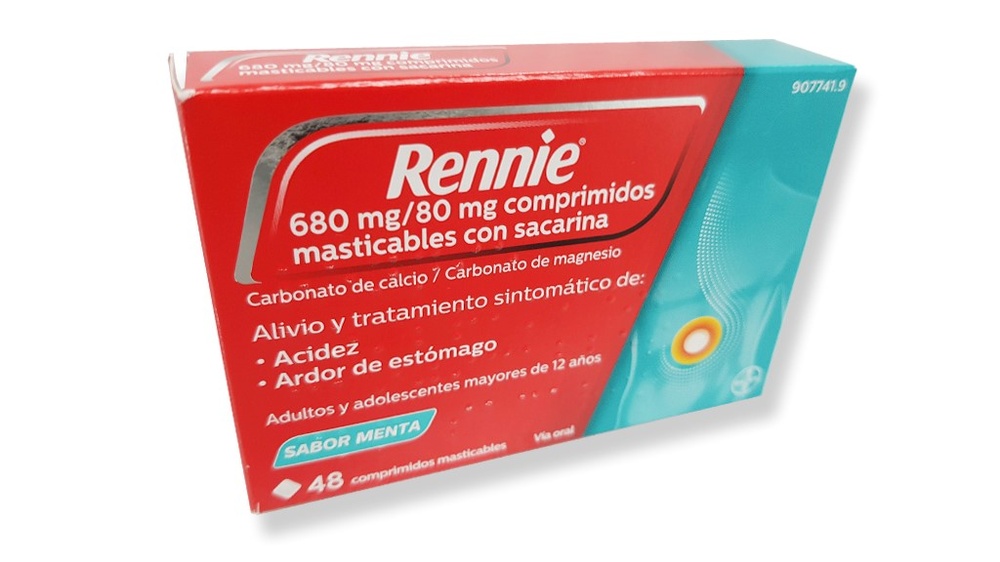
Rennie 680 mg/80 mg comprimidos masticables with saccharin

Prescription review online
A doctor will review your case and decide whether a prescription is medically appropriate.

Talk to a doctor about this medicine
Discuss your symptoms and possible next steps in a quick online consultation.



How to use RENNIE 680 MG/80 MG CHEWABLE TABLETS WITH SACCHARIN
Contents of the leaflet
- Introduction
- What Rennie is and what it is used for
- What you need to know before taking Rennie
- How to take Rennie
- Possible side effects
- Storage of Rennie
- Package contents and additional information
Introduction
PATIENT INFORMATION LEAFLET
Rennie 680 mg/80 mg chewable tablets with saccharin
Calcium carbonate/Magnesium carbonate
Read this leaflet carefully before starting to take this medicine because it contains important information for you.
Follow exactly the administration instructions of the medicine contained in this leaflet or as indicated by your doctor, pharmacist, or nurse.
- Keep this leaflet, as you may need to read it again.
- If you need advice or more information, consult your pharmacist.
- If you experience side effects, consult your doctor, pharmacist, or nurse, even if they are side effects not listed in this leaflet. See section 4.
- You should consult a doctor if it worsens or does not improve after 7 days.
Contents of the leaflet:
- What Rennie is and what it is used for.
- What you need to know before taking Rennie
- How to take Rennie
- Possible side effects.
- Storage of Rennie.
- Package contents and additional information.
1. What Rennie is and what it is used for
Rennie belongs to the group of medicines called aluminum, calcium, and magnesium combinations and complexes.
It contains calcium carbonate and magnesium carbonate as active ingredients, which act by neutralizing excess stomach acid
Rennie is indicated for the relief and symptomatic treatment of heartburn and stomach acid in adults and adolescents over 12 years old.
You should consult a doctor if it worsens or does not improve after 7 days.

Not sure if this medicine is right for you?
Discuss your symptoms and treatment with a doctor online.
2. What you need to know before taking Rennie
Do not take Rennie:
- If you are allergic to any of the active ingredients or to any of the other components of this medicine (listed in section 6).
- If you have severe kidney failure, hypercalcemia (high blood calcium levels), and hypophosphatemia (low phosphate levels in the blood).
- If you have a history of kidney stones made of calcium.
- If you have hypercalciuria (high levels of calcium in the urine)
Warnings and Precautions
Consult your doctor, pharmacist, or nurse before starting to take Rennie
- Avoid prolonged use.
- Do not exceed the recommended dose (see section 3)
- Consult your doctor or pharmacist before taking Rennie if you have kidney problems, as the administration of this medicine in subjects with altered renal function can cause hypercalcemia (elevated blood calcium levels) and metabolic alkalosis (milk-alkali syndrome).
- If the symptoms worsen or persist for more than 7 days, you should consult a doctor.
- The medicine should not be taken with large amounts of milk or dairy products.
Children and adolescents
Do not administer to children under 12 years old without consulting a doctor.
Taking Rennie with other medicines
Tell your doctor or pharmacist if you are taking, have recently taken, or might take any other medicine.
Before taking Rennie, inform your doctor or pharmacist if you are taking any of the following medicines, as they may affect the efficacy of these medicines:
- calcitonin,
- sodium phosphate and other phosphates,
- oral contraceptives,
- thiazide diuretics (medicines used to increase urine excretion rate),
- fluorides (medicines for the prevention of tooth decay),
- amphetamines or quinidine,
- salicylates (medicines with anti-inflammatory, analgesic, and antipyretic properties),
- vitamin D,
- heart medicines such as glycosides (digoxin, bisphosphonates, or dolutegravir),
- levothyroxine (a thyroid hormone),
- eltrombopag (a medicine used to increase platelet count),
- other medicines prescribed by a doctor (e.g., etidronate, iron-containing products, anticholinergics, antimuscarinics, phenothiazines, benzodiazepines, ketoconazole, diflunisal, H2 antihistamines, sucralfate, oral anticoagulants derived from coumarin or indandione, antibiotics such as tetracyclines or quinolones), as they may interfere with its absorption.
It is recommended to space the administration of antacids and other medicines by 1 or 2 hours.
Interference with laboratory tests
If you are going to undergo any laboratory tests (including blood tests, urine tests, skin tests using allergens, etc.), inform your doctor that you are taking this medicine, as it may alter the results.
Taking Rennie with food and drinks
Like all antacids that contain calcium, it should not be taken with large amounts of milk or dairy products, as it may cause increased calcium or magnesium levels in the blood and milk-alkali syndrome.
Pregnancy, breastfeeding, and fertility
If you are pregnant or breastfeeding, or think you may be pregnant or plan to become pregnant, consult your doctor or pharmacist before using this medicine.
Rennie chewable tablets with saccharin may be used during pregnancy and breastfeeding if taken according to these recommendations and not taken for more than 2 weeks.
Pregnant or breastfeeding women should not take more than the recommended amount of medicine (see section 3, How to take Rennie) and should not take large amounts of dairy products and milk at the same time (1 liter of milk contains 1.2 grams of elemental calcium), as this medicine provides a significant amount of calcium in addition to their daily intake.
There is no evidence to suggest that Rennie has adverse effects on human fertility.
Driving and using machines
No effects on the ability to drive and use machines have been reported.
Rennie chewable tablets with saccharin contain isomaltose
This medicine contains 500 mg of isomaltose in each tablet.
If your doctor has told you that you have an intolerance to certain sugars, consult your doctor before taking this medicine.
3. How to take Rennie
Follow exactly the administration instructions of the medicine contained in this leaflet or as indicated by your doctor, pharmacist, or nurse. In case of doubt, ask your doctor, pharmacist, or nurse.
Posology
The recommended dose is:
Adults and adolescents over 12 years old: 1 or 2 tablets, preferably 1 hour after meals and before bedtime. Additionally, if necessary, an extra dose can be taken. Do not take more than 6 tablets in 24 hours. Do not take for more than 2 weeks.
Method of administration
Oral route
Remove the tablets from the packaging. Rennie tablets should be chewed or allowed to dissolve slowly in the mouth. They should not be swallowed whole.
Use in children and adolescents
Do not administer to children under 12 years old.
If symptoms persist after 7 days of treatment, consult your doctor to rule out more serious diseases.
If you take more Rennie than you should:
Symptoms of overdose include nausea, vomiting, constipation, fatigue, difficulty and pain when urinating, and kidney stones. In these cases, stop treatment, drink plenty of water, and consult your doctor or pharmacist.
In case of overdose or accidental ingestion, consult your doctor or pharmacist or go to a medical center or call the Toxicology Information Service, phone: 91 562.04.20, indicating the medicine and the amount ingested.
It is recommended to take the packaging and leaflet of the medicine to the healthcare professional.
If you forget to take Rennie
If you forget to take a dose, wait for the next one. Do not take a double dose to make up for forgotten doses.
If you have any doubts about the use of this medicine, ask your doctor, pharmacist, or nurse.

Started taking the medicine and have questions?
Discuss your symptoms and treatment with a doctor online.
4. Possible side effects
Like all medicines, Rennie can cause side effects, although not everybody gets them.
When used normally, at the recommended doses, it is not expected to cause side effects.
The adverse reactions mentioned below are based on spontaneous notifications and their frequency has not been established with precision:
Immune system disorders
Very rarely, allergic reactions such as skin rashes, itching, difficulty breathing, and swelling of the face, mouth, or throat, and anaphylaxis have been reported. If you experience these reactions, stop taking this medicine and consult your doctor immediately.
Metabolism and nutrition disorders:
Prolonged use of high doses may cause hypermagnesemia (elevated magnesium levels in the blood) or hypercalcemia (elevated calcium levels in the blood) and milk-alkali syndrome, especially in patients with kidney function disorders.
Gastrointestinal disorders:
Prolonged use of high doses may lead to nausea, vomiting, stomach discomfort, constipation, and diarrhea, especially in patients with altered renal function.
In some cases, constipation has occurred. Flatulence (gas), belching, and stomach bloating may also occur.
Musculoskeletal and connective tissue disorders:
Muscle fatigue, especially in patients with altered renal function.
The specific symptoms of milk-alkali syndrome may include taste disorders, headache, kidney problems, fatigue, and lumps under the skin.
If you observe these or any other adverse reactions not described above, consult your doctor or pharmacist.
Reporting of side effects:
If you experience any type of side effect, consult your doctor, pharmacist, or nurse, even if it is a possible side effect not listed in this leaflet. You can also report them directly through the Spanish Medicines and Healthcare Products Agency (AEMPS) website: http://www.notificaram.es. By reporting side effects, you can help provide more information on the safety of this medicine.
5. Storage of Rennie
Keep this medicine out of the sight and reach of children
Do not use Rennie after the expiration date stated on the packaging, after the abbreviation EXP. The expiration date is the last day of the month indicated.
No special storage conditions are required.
Medicines should not be disposed of via wastewater or household waste. Deposit the packaging and medicines you no longer need at the pharmacy's SIGRE point. If in doubt, ask your pharmacist how to dispose of the packaging and medicines you no longer need. This will help protect the environment.
6. Package contents and additional information
Composition of Rennie chewable tablets with saccharin:
- The active ingredients are: calcium carbonate 680 mg and magnesium carbonate 80 mg.
- The other ingredients (excipients) are: isomaltose (E-953), talc, magnesium stearate, peppermint flavor, saccharin.
Appearance of the product and package contents
Rennie is white-cream colored, square-shaped tablets with a peppermint odor.
Rennie is available in packages containing 36 or 48 chewable tablets each. It is presented in aluminum/PVC blisters.
Not all package sizes may be marketed.
Marketing authorization holder and manufacturer
Marketing authorization holder
BAYER HISPANIA, S.L.
Av. Baix Llobregat, 3-5
08970 Sant Joan Despí (Barcelona)
Spain
Manufacturer
Bayer Bitterfeld GmbH
OT Greppin
Salegaster Chaussee 1
06803 Bitterfeld-Wolfen
Germany
Date of the last revision of this leaflet:December 2024
Detailed and updated information on this medicine is available on the website of the Spanish Agency for Medicines and Healthcare Products (AEMPS) http://www.aemps.gob.es/
- Country of registration
- Dosage formCHEWABLE TABLET, 680 mg calcium carbonate; 80 mg magnesium carbonate
- ATC codeA02AD01
- Active substance
- Prescription requiredNo
- Manufacturer
- This information is for reference only and does not constitute medical advice. Always consult a doctor before taking any medication. Oladoctor is not responsible for medical decisions based on this content.
- Alternatives to RENNIE 680 MG/80 MG CHEWABLE TABLETS WITH SACCHARINDosage form: ORAL SOLUTION/SUSPENSION, 310 mg; 190 mg; 315 mg/5 mlActive substance: ordinary salt combinationsManufacturer: Arafarma Group S.A.Prescription not requiredDosage form: CHEWABLE TABLET, 680 mg calcium carbonate; 80 mg magnesium carbonateActive substance: ordinary salt combinationsManufacturer: Bayer Hispania S.L.Prescription not requiredDosage form: ORAL SOLUTION/SUSPENSION, 1.5 gActive substance: almagateManufacturer: Laboratorio Stada S.L.Prescription not required
Online doctors for RENNIE 680 MG/80 MG CHEWABLE TABLETS WITH SACCHARIN
Discuss questions about RENNIE 680 MG/80 MG CHEWABLE TABLETS WITH SACCHARIN, including use, safety considerations and prescription review, subject to medical assessment and local regulations.









Frequently Asked Questions
RENNIE 680 MG/80 MG CHEWABLE TABLETS WITH SACCHARIN does not require a prescription in Spain. You can check with a doctor online whether this medicine may be appropriate for your situation.
The active ingredient in RENNIE 680 MG/80 MG CHEWABLE TABLETS WITH SACCHARIN is ordinary salt combinations. This information helps identify medicines with the same composition but different brand names.
RENNIE 680 MG/80 MG CHEWABLE TABLETS WITH SACCHARIN is manufactured by Bayer Hispania S.L.. Pharmacy brands and packaging may differ depending on the distributor.
Doctors such as Family doctors, Psychiatrists, Dermatologists, Cardiologists, Endocrinologists, Gastroenterologists, Pulmonologists, Nephrologists, Rheumatologists, Hematologists, Infectious disease physicians, Allergists, Geriatricians, Paediatricians, Oncologists may assess whether RENNIE 680 MG/80 MG CHEWABLE TABLETS WITH SACCHARIN is appropriate, depending on your situation and local regulations. You can book an online consultation to discuss your symptoms and possible next steps.
The prescription is issued by a doctor after assessing your health. In Spain, RENNIE 680 MG/80 MG CHEWABLE TABLETS WITH SACCHARIN is then dispensed in pharmacies with that prescription. An online consultation does not guarantee that a prescription will be issued: the decision always rests with the doctor.
To request a review, you can use Oladoctor:
Other medicines with the same active substance (ordinary salt combinations) include ACYLINE 620 mg/380 mg/630 mg ORAL SUSPENSION, RENNIE 680 MG/80 MG CHEWABLE TABLETS WITH SUCROSE, ALMAGATO STADAPHARM 1.5 G ORAL SUSPENSION. These may have different brand names or formulations but contain the same therapeutic ingredient. Always consult a doctor before switching or starting a new medicine.
