


Quinapril Normon 40 mg comprimidos recubiertos con película

Prescription review online
A doctor will review your case and decide whether a prescription is medically appropriate.

Talk to a doctor about this medicine
Discuss your symptoms and possible next steps in a quick online consultation.



How to use QUINAPRIL NORMON 40 mg FILM-COATED TABLETS
Contents of the leaflet
- Introduction
- What is Quinapril Normon and what is it used for
- What you need to know before you take Quinapril Normon
- How to take Quinapril Normon
- Possible Adverse Effects
- Storage of Quinapril Normon
- Package Contents and Additional Information
Introduction
Package Leaflet: Information for the User
Quinapril Normon 40 mg Film-Coated Tablets EFG
Read all of this leaflet carefully before you start taking this medicine because it contains important information for you.Keep this leaflet. You may need to read it again.
- Keep this leaflet, you may need to read it again.
- If you have any further questions, ask your doctor or pharmacist.
- This medicine has been prescribed for you only. Do not pass it on to others. It may harm them, even if their signs of illness are the same as yours.
- If you get any side effects, talk to your doctor or pharmacist. This includes any possible side effects not listed in this leaflet. See section 4.
Contents of the pack and other information
- What is Quinapril Normon and what is it used for
- What you need to know before you take Quinapril Normon
- How to take Quinapril Normon
- Possible side effects
- Storing Quinapril Normon
- Contents of the pack and other information
1. What is Quinapril Normon and what is it used for
Quinapril belongs to a group of medicines called angiotensin-converting enzyme inhibitors (ACE inhibitors). It works by widening the blood vessels, making it easier for the heart to pump blood to all parts of the body and helping to reduce high blood pressure.
Your doctor has prescribed quinapril for the treatment of:
- high blood pressure.
- heart failure.

Not sure if this medicine is right for you?
Discuss your symptoms and treatment with a doctor online.
2. What you need to know before you take Quinapril Normon
Treatment with Quinapril Normon requires regular monitoring by your doctor.
Do not take Quinapril Normon
- If you are allergic to quinapril or any of the other ingredients of this medicine (listed in section 6).
- If you have ever had a serious allergic reaction to ACE inhibitors (a type of medicine used to treat high blood pressure and heart failure), such as swelling of the face, lips, tongue, and/or throat with difficulty breathing, swallowing, and speaking (angioedema of the head and neck) or swelling in the intestines (intestinal angioedema).
- If you have a condition called angioneurotic edema (a swelling of the face, tongue, or throat that causes difficulty breathing).
- If you have a narrowing of the blood vessels leaving the heart.
- If you have diabetes or kidney problems and are being treated with a medicine called aliskiren.
- If you are taking a medicine called sacubitril/valsartan, used to treat heart failure.
- If you have kidney problems.
- If you are pregnant for more than 3 months (it is also recommended to avoid taking Quinapril Normon at the beginning of pregnancy – see section on Pregnancy).
Warnings and precautions
Talk to your doctor or pharmacist before starting Quinapril Normon:
- If, during treatment, even after the first dose, any of the following symptoms appear: swelling of the face, eyes, lips, tongue, or difficulty breathing. Stop taking this medicine and consult your doctor immediately.
- These are signs of inflammatory processes in the deep skin (angioedema), which can be potentially life-threatening and are more common in black patients. Certain cancer or diabetes medications may increase the risk of this condition.
- If you are diabetic, you should carefully monitor your blood glucose levels (especially during the first month of treatment).
- If you are going to have surgery, inform your doctor that you are taking Quinapril Normon.
- If you are on a low-salt diet. Do not use salt substitutes that contain potassium without consulting your doctor.
- If you are pregnant or think you may be pregnant or are planning to become pregnant. Quinapril Normon is not recommended at the beginning of pregnancy, and it should not be taken if you are pregnant for more than 3 months, as it can cause serious harm to your baby if used after the third month of pregnancy.
- If you are taking or have recently taken any of the following medicines used to treat high blood pressure (hypertension):
- An angiotensin II receptor antagonist (ARA) (also known as "sartans" – e.g., valsartan, telmisartan, irbesartan), especially if you have kidney problems related to diabetes.
- Aliskiren.
- If you are taking other medicines to lower blood pressure, as it may lower it too much.
- If you are taking medicines that increase potassium levels in the blood.
- If you have kidney disease, are undergoing dialysis, or have had a kidney transplant.
- If you have liver disease.
- If you have symptoms of infection (e.g., sore throat or fever) or unusual bleeding.
- If you are going to undergo desensitization (allergy vaccination) against insect venom (bees, wasps, etc.).
- If you are going to have your blood cholesterol removed by a machine (LDL apheresis).
- If you are taking Quinapril Normon with pain and inflammation relievers (non-steroidal anti-inflammatory drugs). Your doctor may perform periodic tests to check if your kidneys are working properly. Additionally, Quinapril Normon may have less effect on your blood pressure. If you feel unwell or have dizziness, consult your doctor before taking the next dose. Processes such as vomiting, diarrhea, dehydration, and excessive sweating can lower blood pressure too much.
- If you have kidney failure or are over 65 years old and are taking a medicine that contains sulfamethoxazole/trimethoprim.
- If you are taking medications or have diseases that can reduce sodium levels in the blood.
- Patient receiving concomitantly an mTOR inhibitor (e.g., temsirolimus) or a DPP-4 inhibitor (e.g., vildagliptin) or a neutral endopeptidase inhibitor (e.g., racecadotril) may have an increased risk of angioedema.
Talk to your doctor if you experience dizziness and vertigo. If dizziness occurs, lie down until the sensation passes. After being in bed, always get up slowly to avoid the sensation of dizziness. If you faint or feel dizzy, inform your doctor.
As with other ACE inhibitors, dry cough may occur when taking Quinapril Normon, which disappears when treatment is stopped. In this case, consult your doctor.
Talk to your doctor if any of the above circumstances have ever occurred to you.
Your doctor may monitor your kidney function, blood pressure, and blood electrolyte levels (e.g., potassium) at regular intervals.
See also the information under the heading "Do not take Quinapril Normon".
Talk to your doctor or pharmacist before taking any medicine.
Patients over 65 years old
If you are elderly, you may be more sensitive to the effects mentioned above. If any of these effects occur, inform your doctor immediately.
Using Quinapril Normon with other medicines
Tell your doctor or pharmacist if you are taking, have recently taken, or might take any other medicines, including those obtained without a prescription.
Your doctor may need to change your dose and/or take other precautions:
If you are taking an angiotensin II receptor antagonist (ARA) or aliskiren (see also the information under the headings "Do not take Quinapril Normon" and "Warnings and precautions").
If you are hospitalized or visit another doctor, dentist, or pharmacist, inform them that you are taking Quinapril Normon or any other medicine. Inform your doctor that you are receiving treatment with Quinapril Normon if you are going to undergo any surgical procedure.
Quinapril Normon may interact with the following medicines. It is especially important that you inform your doctor if you are taking:
- Lithium (a medicine used to treat depression and bipolar disorders).
- Tetracyclines (a type of antibiotic).
- Diuretics (medicines that increase urine production).
- Potassium supplements or medicines that increase potassium levels in the blood, or salt substitutes that contain potassium.
- Medicines that contain sulfamethoxazole/trimethoprim (an antibiotic).
- Medicines for diabetes (insulin or oral hypoglycemics).
- Medicines for pain and inflammation relief (non-steroidal anti-inflammatory drugs or NSAIDs).
- Certain medicines for cancer or diabetes.
- Medicines that contain gold.
- Medicines used after transplants (immunosuppressants) and medicines for cancer treatment (cytostatics).
- Alcohol, barbiturates, and narcotics.
- Medicines to lower blood pressure (antihypertensives).
- Antacids.
- Allopurinol (for gout treatment).
- Procainamide (to correct irregular heartbeats).
- Systemic corticosteroids.
- mTOR inhibitors (e.g., temsirolimus) or DPP-4 inhibitors (e.g., vildagliptin) or neutral endopeptidase inhibitors (e.g., racecadotril) may increase the risk of angioedema.
If you have any doubts about taking other medicines with Quinapril Normon, consult your doctor.
Using Quinapril Normon with food and drink
Quinapril Normon can be taken with or without food.
Pregnancy, breastfeeding, and fertility
If you are pregnant or breastfeeding, think you may be pregnant, or are planning to have a baby, ask your doctor for advice before taking this medicine.
Pregnancy:
Inform your doctor if you think you are or might be pregnant. Normally, your doctor will advise you to stop taking Quinapril Normon before you become pregnant or as soon as you know you are pregnant and will advise you to take another medicine instead of Quinapril Normon. Quinapril Normon is not recommended at the beginning of pregnancy and should not be taken after the third month of pregnancy, as it can cause serious harm to your baby if used after the third month of pregnancy.
Breastfeeding
Ask your doctor or pharmacist for advice before taking any medicine.
Tell your doctor if you are breastfeeding or about to start breastfeeding. It is not recommended to take this medicine during breastfeeding in newborns (first weeks after birth) and especially in premature babies. In the case of older babies, your doctor will advise you on the benefits and risks of administering this medicine during breastfeeding, compared to other treatments.
Driving and using machines
Quinapril Normon may cause a sudden drop in blood pressure, leading to dizziness and, in some cases, fainting. This can occur especially during the first days of treatment. Therefore, at the beginning of treatment, do not perform tasks that require special attention (e.g., driving a car or operating hazardous machinery) until you know how you tolerate the treatment.
3. How to take Quinapril Normon
Follow exactly the administration instructions of this medicine given by your doctor. If you are unsure, consult your doctor again.
Remember to take your medicine.
Your doctor will indicate the duration of your treatment with Quinapril Normon. Your doctor may increase or decrease the dose if necessary until the dose that you need is found. Do not stop treatment before, as it may increase your blood pressure or worsen your heart function.
This treatment has been indicated by your doctor specifically for you and your disease. The dose will be established by the doctor according to the needs of each patient. Depending on the individual response, the doctor may modify the quinapril dosage. Follow your doctor's instructions faithfully regarding the dose and method of use.
Quinapril is administered orally. Your doctor will indicate how many tablets you should take each day.
Use in children:the safety and efficacy of quinapril in children have not been established. It should not be administered to children without consulting a doctor.
Instructions for the correct use of the medicine
The Quinapril Normon 40 mg tablet is administered orally and should be swallowed without chewing. Take the tablets with a sufficient amount of liquid (a glass of water). It can be taken with or without food.
If you think the effect of this medicine is too strong or too weak, do not change the dose yourself and inform your doctor or pharmacist.
If you take more Quinapril Normon than you should
In case of overdose or accidental ingestion, consult your doctor or the Toxicology Information Service, Telephone 91 562 04 20. Bring this leaflet with you.
The most likely symptom that would be expected after an overdose of quinapril would be a drop in blood pressure. Symptomatic treatment will be performed, compensating for the effects of this medicine.
In severe cases, the necessary measures will be taken; in addition to maintaining blood volume, it may be necessary to administer medicines that restore blood pressure adequately.
If you forget to take Quinapril Normon
Do not take a double dose to make up for forgotten doses.
If you have any other doubts about the use of this medicine, ask your doctor or pharmacist.
If you stop taking Quinapril Normon
Your doctor will indicate the duration of your treatment with Quinapril Normon. Do not stop taking Quinapril Normon without consulting your doctor. Normally, medicines for treating high blood pressure or heart failure should be taken for life. If you stop taking Quinapril Normon, your condition may worsen.
If you have any other doubts about the use of this medicine, ask your doctor or pharmacist.

Started taking the medicine and have questions?
Discuss your symptoms and treatment with a doctor online.
4. Possible Adverse Effects
Like all medicines, this medicine can cause adverse effects, although not all people suffer from them.
The adverse reactions of quinapril vary in intensity from one individual to another, and should be taken into account especially at the start of treatment, when modifying the dose or when changing medication.
Stop taking Quinapril Normon and contact your doctor immediately if:
- Difficulty breathing with or without swelling of the face, lips, tongue and/or throat appears.
- Swelling of the face, lips, tongue and/or throat that can cause difficulty swallowing appears.
The following are the possible adverse effects during treatment with Quinapril Normon, according to their frequency.
Common adverse effects(may affect between 1 and 10 people out of 100)are: Headache, dizziness, inflammation of the nasal mucosa (rhinitis), cough, fatigue, weakness (asthenia), nausea and/or vomiting, muscle pain (myalgia), diarrhea, chest pain, abdominal pain, digestive discomfort (dyspepsia), breathing difficulties (dyspnea), back pain, pharynx inflammation (pharyngitis), difficulty falling asleep (insomnia), higher than normal levels of certain substances in blood tests (potassium, creatinine, and ureic nitrogen), decreased sodium concentrations in blood, low blood pressure (hypotension), and tingling (paresthesia).
Uncommon adverse effects (may affect between 1 and 10 people out of 1,000)are: Palpitations, dilation of blood vessels (vasodilation), oppressive chest pain (angina pectoris), increased heart rate (tachycardia), myocardial infarction, flatulence, dryness of the mouth or throat, depression, nervousness, confusion, somnolence, temporary interruption of blood supply to an area of the brain (transient ischemic attacks), dizziness, ringing in the ears, sinus inflammation (sinusitis), upper respiratory tract infection, bronchial inflammation (bronchitis), allergic reaction with swelling of the face, tongue, or throat that can cause breathing difficulties (angioedema), urinary tract infections, altered kidney function, protein in the urine, impotence, decreased visual acuity (amblyopia), fever, and excessive fluid accumulation in the body (edema).
Rare adverse effects (may affect up to 1 person out of 1,000)are: Balance disorder, fainting, respiratory disorder (eosinophilic pneumonia), taste alteration, constipation, tongue inflammation, hives, and various skin lesions that can be severe (erythema multiforme, pemphigus).
Very rare adverse effects (may affect up to 1 person out of 10,000)are: Blurred vision, intestinal obstruction (ileus), inflammation in the intestinal tract (intestinal angioedema), and skin eruption like psoriasis.
Adverse effects with unknown frequency(cannot be estimated from the available data) are: Decrease in the number of white blood cells that can favor infections (agranulocytosis), decrease in the number of red blood cells (anemia), decrease in the number of a type of white blood cells (neutropenia), decrease in the number of platelets (thrombocytopenia), severe allergic reaction (anaphylactoid reaction), dark urine, nausea, vomiting, muscle cramps, confusion, and convulsions. These may be symptoms of a condition called SIADH (inadequate secretion of antidiuretic hormone), stroke, decrease in blood pressure when standing up that can cause dizziness (postural hypotension), bronchial constriction that prevents breathing (bronchospasm), in individual cases, obstruction of the upper airways by angioedema (which can be fatal), pancreas inflammation (pancreatitis), liver inflammation (hepatitis), jaundice (cholestatic jaundice), severe skin disease with blistering and skin loss (necrotizing epidermolysis), various skin lesions that can be severe (exfoliative dermatitis, Stevens-Johnson syndrome), hair loss (alopecia), sensitivity to sunlight (photosensitivity), inflammation of serous tissues, skin changes associated with fever, muscle and joint pain (myalgia, arthralgia, arthritis), blood vessel inflammation (vasculitis), certain changes in blood test values (eosinophilia, leukocytosis, and/or elevated levels of antinuclear antibodies and erythrocyte sedimentation rate), psoriasis or worsening of existing psoriasis (skin disease characterized by red plaques covered with silver scales), reduction of hematocrit, reduction of hemoglobin, and elevation of liver enzymes and bilirubin. In some patients who have a congenital enzyme deficiency (glucose-6-phosphate dehydrogenase deficiency), cases of anemia due to red blood cell destruction (hemolytic anemia) have been reported.
Reporting of Adverse Effects
If you experience any type of adverse effect, consult your doctor or pharmacist, even if it is a possible adverse effect that is not listed in this leaflet. You can also report them directly through the Spanish Medicines and Healthcare Products Agency's pharmacovigilance system: https://www.notificaram.es. By reporting adverse effects, you can contribute to providing more information on the safety of this medicine.
5. Storage of Quinapril Normon
Keep this medicine out of the sight and reach of children.
Do not use this medicine after the expiration date stated on the packaging after CAD. The expiration date is the last day of the month indicated.
Store below 30°C.
Medicines should not be disposed of via wastewater or household waste. Deposit the packaging and medicines you no longer need at the SIGRE point in your pharmacy. In case of doubt, ask your pharmacist how to dispose of the packaging and medicines you no longer need. This way, you will help protect the environment.
6. Package Contents and Additional Information
Composition of Quinapril Normon 40 mg film-coated tablets EFG
- The active ingredient is quinapril. Each film-coated tablet contains 40 mg of quinapril.
- The other ingredients are: magnesium carbonate, hydroxypropylcellulose, crospovidone, magnesium stearate, Eudragit E 12.5%, titanium dioxide (E-171), talc, macrogol 6000, and yellow iron oxide (E-172).
Appearance of the Product and Package Contents
Brown, round, biconvex tablets.
The tablets are packaged in blisters of 28.
Marketing Authorization Holder and Manufacturer
Laboratorios Normon, S.A.
Ronda de Valdecarrizo, 6
28760 – Tres Cantos
Madrid (Spain)
Date of the Last Revision of this Leaflet: February 2023
Detailed information about this medicine is available on the website of the Spanish Agency for Medicines and Healthcare Products (AEMPS) http://www.aemps.gob.es/.
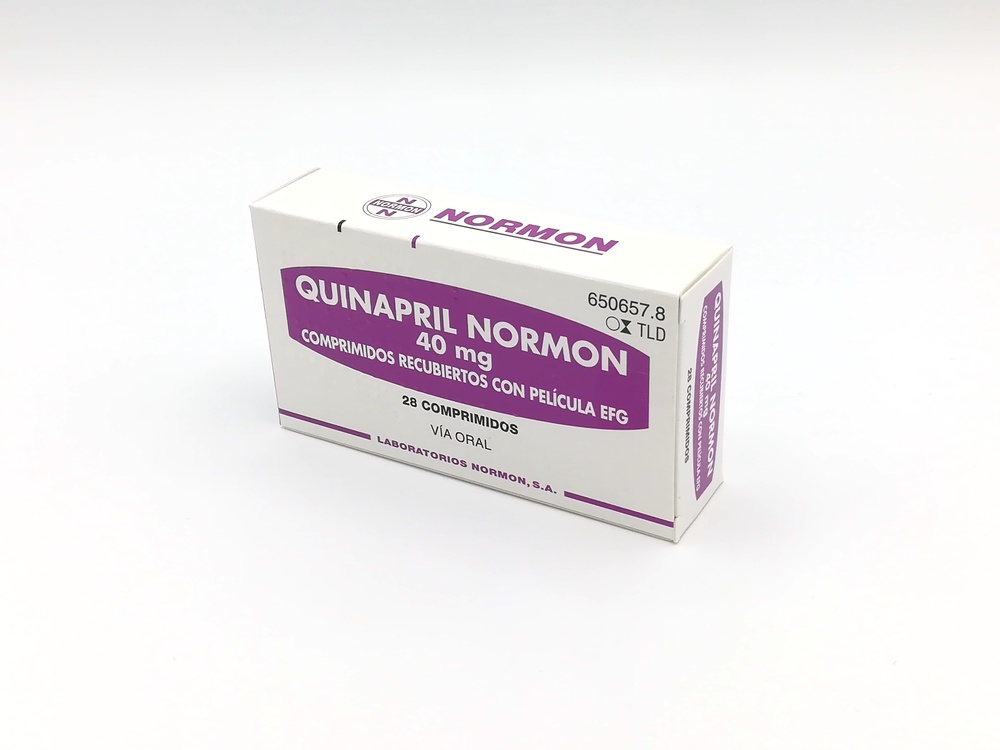
- Country of registration
- Dosage formTABLET, 40 mg
- ATC codeC09AA06
- Average pharmacy price9.3 EUR
- Active substance
- Prescription requiredYes
- Manufacturer
- This information is for reference only and does not constitute medical advice. Always consult a doctor before taking any medication. Oladoctor is not responsible for medical decisions based on this content.
- Alternatives to QUINAPRIL NORMON 40 mg FILM-COATED TABLETSDosage form: TABLET, 20 mgActive substance: quinaprilManufacturer: Lacer S.A.Prescription requiredDosage form: TABLET, 40 mgActive substance: quinaprilManufacturer: Lacer S.A.Prescription requiredDosage form: TABLET, 5 mgActive substance: quinaprilManufacturer: Lacer S.A.Prescription required
Online doctors for QUINAPRIL NORMON 40 mg FILM-COATED TABLETS
Discuss questions about QUINAPRIL NORMON 40 mg FILM-COATED TABLETS, including use, safety considerations and prescription review, subject to medical assessment and local regulations.
Frequently Asked Questions
QUINAPRIL NORMON 40 mg FILM-COATED TABLETS requires a prescription in Spain. You can check with a doctor online whether this medicine may be appropriate for your situation.
The active ingredient in QUINAPRIL NORMON 40 mg FILM-COATED TABLETS is quinapril. This information helps identify medicines with the same composition but different brand names.
The average pharmacy price for QUINAPRIL NORMON 40 mg FILM-COATED TABLETS is around 9.3 EUR. Prices may vary depending on the manufacturer and dosage form.
QUINAPRIL NORMON 40 mg FILM-COATED TABLETS is manufactured by Laboratorios Normon S.A.. Pharmacy brands and packaging may differ depending on the distributor.
Doctors such as Family doctors, Psychiatrists, Dermatologists, Cardiologists, Endocrinologists, Gastroenterologists, Pulmonologists, Nephrologists, Rheumatologists, Hematologists, Infectious disease physicians, Allergists, Geriatricians, Paediatricians, Oncologists may assess whether QUINAPRIL NORMON 40 mg FILM-COATED TABLETS is appropriate, depending on your situation and local regulations. You can book an online consultation to discuss your symptoms and possible next steps.
The prescription is issued by a doctor after assessing your health. In Spain, QUINAPRIL NORMON 40 mg FILM-COATED TABLETS is then dispensed in pharmacies with that prescription. An online consultation does not guarantee that a prescription will be issued: the decision always rests with the doctor.
To request a review, you can use Oladoctor:
Other medicines with the same active substance (quinapril) include LIDALTRIN 20 mg FILM-COATED TABLETS, LIDALTRIN 40 mg FILM-COATED TABLETS, LIDALTRIN 5 mg FILM-COATED TABLETS. These may have different brand names or formulations but contain the same therapeutic ingredient. Always consult a doctor before switching or starting a new medicine.
