



SARIDON 250 mg/150 mg /50 Mg Tablets

Prescription review online
A doctor will review your case and decide whether a prescription is medically appropriate.

Talk to a doctor about this medicine
Discuss your symptoms and possible next steps in a quick online consultation.



How to use Saridon
Contents of the leaflet
- Leaflet attached to the packaging: patient information
- Warning! Keep the leaflet! Information on the immediate packaging in a foreign language.
- Saridon
- 250 mg + 150 mg + 50 mg, tablets
- What is Saridon and what is it used for
- Important information before using Saridon
- How to use Saridon
- Possible side effects
- How to store Saridon
- Contents of the packaging and other information
Leaflet attached to the packaging: patient information
Warning! Keep the leaflet! Information on the immediate packaging in a foreign language.

Not sure if this medicine is right for you?
Discuss your symptoms and treatment with a doctor online.
Saridon
250 mg + 150 mg + 50 mg, tablets
Paracetamol + Propyphenazone + Caffeine
You should carefully read the contents of the leaflet before using the medicine, as it contains important information for the patient.
This medicine should always be used exactly as described in the patient leaflet or as directed by a doctor or pharmacist.
- You should keep this leaflet, so you can read it again if you need to.
- If you need advice or additional information, you should consult a pharmacist.
- If the patient experiences any side effects, including any possible side effects not listed in the leaflet, they should tell their doctor or pharmacist. See section 4.
- If after 3 days in the case of fever and 5 days in the case of pain, no improvement occurs or the patient feels worse, they should contact a doctor.
Table of contents of the leaflet:
- 1. What is Saridon and what is it used for
- 2. Important information before using Saridon
- 3. How to use Saridon
- 4. Possible side effects
- 5. How to store Saridon
- 6. Contents of the packaging and other information

Started taking the medicine and have questions?
Discuss your symptoms and treatment with a doctor online.
1. What is Saridon and what is it used for
Saridon is a combination medicine with a combined effect of its components. Saridon contains paracetamol and propyphenazone, which have analgesic and antipyretic effects, and a small dose of caffeine, which enhances the analgesic effect of paracetamol.
Indications for use:
- headache, toothache, menstrual pain, post-operative pain, rheumatic pain;
- pain and fever associated with colds and flu.
2. Important information before using Saridon
When not to use Saridon
- if the patient has been diagnosed with an allergy (hypersensitivity) to propyphenazone, paracetamol, caffeine, or any of the other ingredients,
- if the patient has been diagnosed with an allergy to pyrazolones or their derivatives (hypersensitivity to phenazone, aminophenazone, metamizole),
- if the patient has been diagnosed with an allergy to phenylbutazone or acetylsalicylic acid,
- if the patient has a congenital deficiency of glucose-6-phosphate dehydrogenase,
- if the patient has alcoholic disease,
- if the patient has severe liver failure (Child-Pugh > 9),
- if the patient has severe kidney failure,
- if the patient has acute hepatic porphyria,
- in children under 12 years of age,
- if the patient has blood system disorders,
- if the patient has Gilbert's syndrome,
- during the third trimester of pregnancy.
Warnings and precautions
- long-term use in people with Gilbert's syndrome (mild jaundice caused by enzyme deficiency - glucuronyltransferase), hematopoietic disorders (blood cell formation process). In these individuals, it may be necessary to reduce the dose or duration of treatment;
- liver failure (Child-Pugh <9), infections affecting liver function (e.g., viral hepatitis) or other liver diseases. For these patients, during high-dose or long-term treatment, the doctor will recommend regular liver function tests. Long-term use of paracetamol-containing medications can lead to severe liver failure (e.g., liver cirrhosis). During therapeutic doses of paracetamol, an increase in alanine aminotransferase (ALT) levels in serum may occur;
- in patients with kidney diseases, dose adjustment by a doctor may be necessary. In patients with severe kidney failure (creatinine clearance <10 ml min), the doctor should assess benefit-to-risk ratio of using a paracetamol-containing medication. long-term use paracetamol with other painkillers can lead to permanent kidney damage and an increased risk failure;< li>
- redness, rash, blisters, or flaking skin. You should stop using the medicine and contact a doctor immediately;
- when the patient is taking other medications, abusing alcohol, has sepsis, or diabetes;
- when the patient has a hereditary deficiency of glucose-6-phosphate dehydrogenase, as there is a risk of hemolytic anemia (accelerated breakdown of red blood cells);
- if the patient is taking other painkillers containing paracetamol in addition to Saridon, as this may lead to paracetamol overdose. You should check if other recently taken medications contain paracetamol;
- if the medicine is taken by patients with asthma, chronic rhinitis, or chronic urticaria, especially if they are hypersensitive to other anti-inflammatory medications, as there are isolated reports of allergic reactions and anaphylactic shock after using propyphenazone and paracetamol;
- when the medicine is used long-term. Long-term use of painkillers for headache treatment can lead to chronic headache.
While using Saridon, you should immediately inform your doctor if you have severe diseases, including severe kidney or sepsis disorders (when bacteria and their toxins are present in the blood, leading to organ damage) or malnutrition, chronic alcoholism, or if you are also taking flucloxacillin (an antibiotic). There have been reports of a severe disease called metabolic acidosis (blood and fluid disorder) in patients who use paracetamol regularly for a longer period or take paracetamol with flucloxacillin. Symptoms of metabolic acidosis may include: severe breathing difficulties, including rapid deep breathing, drowsiness, feeling of nausea (nausea) and vomiting.
Do not drink alcohol while using Saridon.
Saridon and other medicines
You should tell your doctor about all the medicines you have taken recently, including those that are available without a prescription.
The doctor should decide whether you can use Saridon if you are also taking the following medicines: rifampicin, certain sleeping aids, certain antiepileptic medications (e.g., phenobarbital, phenytoin, carbamazepine), chloramphenicol (an antibiotic used in bacterial infections), oral anticoagulant medications from the coumarin group, warfarin, non-steroidal anti-inflammatory medications, zidovudine (an antiviral medication), sedatives (barbiturates and antihistamines), benzodiazepines (anxiolytic medications), sympathomimetic medications - medications that affect the nervous system and, among other things, reduce nasal congestion (e.g., pseudoephedrine), thyroxine (a medication used to treat thyroid diseases), theophylline (a medication used to treat asthma and allergic conditions), cimetidine (a medication used to treat stomach and duodenal ulcers), disulfiram (a medication used to treat alcoholism), oral contraceptives. These medications should be used with Saridon with caution, as they may interact with the substances contained in it.
When using medications that slow down stomach emptying, such as propanteline, the absorption of paracetamol may be slowed down, which may delay the analgesic effect. Accelerated stomach emptying, e.g., after taking metoclopramide, leads to faster absorption of paracetamol.
You should inform your doctor or pharmacist if you are taking flucloxacillin (an antibiotic), due to the serious risk of a disorder affecting blood and body fluids (called metabolic acidosis), which requires urgent treatment (see section 2).
Pregnancy, breastfeeding, and fertility
If you are pregnant or breastfeeding, think you may be pregnant, or plan to have a child, you should consult a doctor or pharmacist before using this medicine.
Pregnancy
Saridon should not be used during pregnancy, especially in the first and second trimesters and during the last six weeks. The medicine may cause kidney and heart disorders in the unborn child. Using the medicine may increase the risk of bleeding in the mother and her child and may cause longer or delayed labor.
From the 20th week of pregnancy, the medicine may cause kidney problems in the fetus, which can lead to a decrease in the level of amniotic fluid surrounding the fetus (oligohydramnios) or cause narrowing of the arterial duct in the fetus's heart. In such a situation, the doctor may recommend additional monitoring of the pregnancy. The medicine can be used only if the potential benefits to the mother outweigh the risk to the fetus.
Breastfeeding
The medicine should not be used during breastfeeding. The ingredients of the medicine pass into the breast milk of breastfeeding women.
Fertility
Paracetamol may affect fertility. This effect disappears after stopping the use of paracetamol.
Driving and using machines
The medicine does not affect the ability to drive vehicles and use machines.
3. How to use Saridon
This medicine should always be used exactly as described in the patient leaflet or as directed by a doctor or pharmacist. If you have any doubts, you should consult a doctor or pharmacist.
Recommended dose
The usual dose of Saridon for adults is 1-2 tablets, for adolescents aged 12-16: 1 tablet. If necessary, the dose can be repeated up to three times a day. If the pain persists for more than 5 days, the fever lasts for more than 3 days, the symptoms worsen, or additional symptoms occur, you should stop using the medicine and consult a doctor. Do not use the medicine in doses higher than recommended.
How to take the medicine
The tablets should be taken with a large amount of water or other liquid.
Using a higher than recommended dose of Saridon
Accidental or intentional overdose of the medicine may cause symptoms such as nausea, vomiting, excessive sweating, drowsiness, and general weakness within a few or several hours. These symptoms may disappear the next day, even though liver damage is starting to develop, which will then manifest as abdominal distension, return of nausea, and jaundice. In the case of acute and/or chronic overdose, hypokalemia (low potassium levels in the blood) and metabolic acidosis, including lactic acidosis (low blood pH), may occur. In any case of taking more than 20 Saridon tablets (5 g of paracetamol) at once, you should induce vomiting (if it has been less than an hour since ingestion) and contact a doctor immediately.
4. Possible side effects
Like all medicines, this medicine can cause side effects, although not everybody gets them.
Frequency of occurrence: "frequency not known" (cannot be determined from available data)
A serious condition that can make the blood more acidic (metabolic acidosis), in patients with severe disease taking paracetamol (see section 2).
Immediatelystop using the medicine and consult a doctor if you experience:
- very rare reports of allergic reactions, such as: skin rash, urticaria; itching, flushing, angioedema (swelling of the lips, tongue, throat, or face), difficulty breathing, or asthma; there have been isolated reports of anaphylactic reactions or anaphylactic shock;
- severe skin reactions (very rare): acute generalized exanthematous pustulosis; Stevens-Johnson syndrome characterized by blisters and erosions on the skin, mouth, eyes, and genitals, fever, and joint pain; toxic epidermal necrolysis (potentially fatal) characterized by large blisters under the skin, widespread erosions on the skin, shedding of large skin patches, and fever;
You should stop using the medicine and consult a doctor if you experience:
- liver failure, hepatitis, as well as dose-dependent liver failure, liver necrosis (including fatal cases) characterized by nausea, vomiting, abdominal distension, yellowing of the skin and eyes, and liver tenderness;
- blood disorders (isolated cases), such as: decreased granulocyte count - a type of white blood cell (agranulocytosis) leading to increased susceptibility to infections, decreased count of all blood cells (pancytopenia), decreased platelet count (thrombocytopenia) leading to decreased blood clotting, bruising, and petechiae, decreased white blood cell count (leukopenia) associated with paracetamol and propyphenazone use;
- kidney damage, especially in the case of overdose.
While using Saridon, the following side effects may also occur:
gastrointestinal disorders (heartburn, nausea, vomiting, stomach upset, diarrhea, abdominal pain) ,
dizziness, drowsiness.
Chronic uncontrolled use can lead to liver fibrosis, liver cirrhosis (including fatal cases).
Caffeine used in high doses can have a negative effect on the heart, causing: palpitations, sudden flushing, high blood pressure, tachycardia.
Reporting side effects
If you experience any side effects, including any side effects not listed in the leaflet, you should tell your doctor or pharmacist. Side effects can be reported directly to the Department of Monitoring of Adverse Reactions to Medicinal Products, Office for Registration of Medicinal Products, Medical Devices, and Biocidal Products, Al. Jerozolimskie 181C, 02-222 Warsaw, tel.: +48 22 49 21 301, fax: +48 22 49 21 309, website: https://smz.ezdrowie.gov.pl.
By reporting side effects, you can help gather more information on the safety of the medicine.
5. How to store Saridon
The medicine should be stored out of sight and reach of children.
Do not store above 30°C.
Store in the original packaging to protect from moisture.
Do not use this medicine after the expiry date stated on the packaging. The expiry date refers to the last day of the specified month.
Medicines should not be disposed of via wastewater or household waste. You should ask your pharmacist how to dispose of medicines that are no longer used. This will help protect the environment.
6. Contents of the packaging and other information
What Saridon contains
- The active substances of the medicine are: paracetamol, propyphenazone, and caffeine. One tablet contains 250 mg of paracetamol, 150 mg of propyphenazone, and 50 mg of caffeine.
- The other ingredients are: hypromellose, microcrystalline cellulose, formaldehyde casein (esma-spreng), corn starch, talc, magnesium stearate, anhydrous colloidal silica.
What Saridon looks like and what the packaging contains
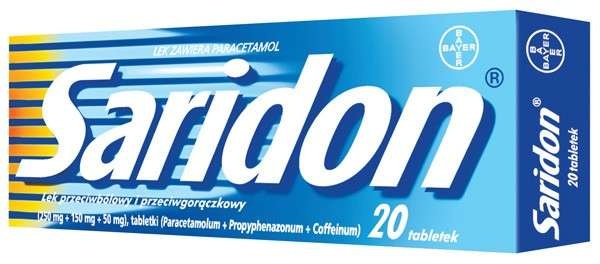
White, round, biconvex tablets with beveled edges, with the inscription "Saridon" on one side and a dividing line on the other side.
The dividing line is intended to facilitate breaking the tablet, not to divide it into equal doses.
The packaging contains 10 or 20 tablets.
For more detailed information, you should contact the marketing authorization holder or the parallel importer.
Marketing authorization holder in Lithuania, the country of export:
UAB Bayer
Sporto 18
LT- 09238, Vilnius
Lithuania
Manufacturer:
Delpharm Gaillard
33, rue de l’Industrie
F-74240 Gaillard
France
Parallel importer:
InPharm Sp. z o.o.
ul. Strumykowa 28/11
03-138 Warsaw
Repackaged by:
InPharm Sp. z o.o. Services sp. k.
ul. Chełmżyńska 249
04-458 Warsaw
Lithuanian marketing authorization number, in the country of export:LT/1/94/0863/001
Parallel import authorization number:334/15
Date of leaflet approval: 11.06.2025
[Information about the trademark]
- Country of registration
- Dosage formTablets, 250 mg + 150 mg + 50 mg
- ATC codeN02BE51
- Active substance
- Prescription requiredNo
- Marketing authorisation holder (MAH)UAB Bayer
- This information is for reference only and does not constitute medical advice. Always consult a doctor before taking any medication. Oladoctor is not responsible for medical decisions based on this content.
- Alternatives to SaridonDosage form: Tablets, 325 mg + 30 mg + 10 mgActive substance: paracetamol, combinations excl. psycholepticsManufacturer: Polfarmex S.A.Prescription not requiredDosage form: Granulate, 500 mg + 200 mg + 4 mgActive substance: paracetamol, combinations excl. psycholepticsManufacturer: Natur Produkt Pharma Sp. z o.o.Prescription not requiredDosage form: Tablets, 500 mg + 200 mg + 4 mgActive substance: paracetamol, combinations excl. psycholepticsManufacturer: Natur Produkt Pharma Sp. z o.o.Prescription not required
Online doctors for Saridon
Discuss questions about Saridon, including use, safety considerations and prescription review, subject to medical assessment and local regulations.









Get Saridon Prescription Online
Fill in a 2-min form
Tell us your symptoms, history, and what medicine you're requesting.
Pick a doctor or let us assign
Choose a specialist or we'll match you with the next available doctor.
Doctor reviews your case
Usually within 30 minutes. They may ask follow-up questions via chat.
Collect from any pharmacy
Electronic prescription sent to your email — valid across Spain.
Frequently Asked Questions
Saridon does not require a prescription in Poland. You can check with a doctor online whether this medicine may be appropriate for your situation.
The active ingredient in Saridon is paracetamol, combinations excl. psycholeptics. This information helps identify medicines with the same composition but different brand names.
Saridon is manufactured by UAB Bayer. Pharmacy brands and packaging may differ depending on the distributor.
Doctors such as Family doctors, Psychiatrists, Dermatologists, Cardiologists, Endocrinologists, Gastroenterologists, Pulmonologists, Nephrologists, Rheumatologists, Hematologists, Infectious disease physicians, Allergists, Geriatricians, Paediatricians, Oncologists may assess whether Saridon is appropriate, depending on your situation and local regulations. You can book an online consultation to discuss your symptoms and possible next steps.
Spain has a well-developed healthcare infrastructure across major cities such as Madrid, Barcelona, Valencia, and Seville. Pharmacies are widely available and operate under strict regulations, ensuring access to prescribed medications.
You can buy Saridon in Madrid, Barcelona, Seville, or Valencia at any local pharmacy with a valid prescription.
To obtain a prescription, you can use Oladoctor:
Other medicines with the same active substance (paracetamol, combinations excl. psycholeptics) include Agripin, Aliflusin, Aliflusin. These may have different brand names or formulations but contain the same therapeutic ingredient. Always consult a doctor before switching or starting a new medicine.
