


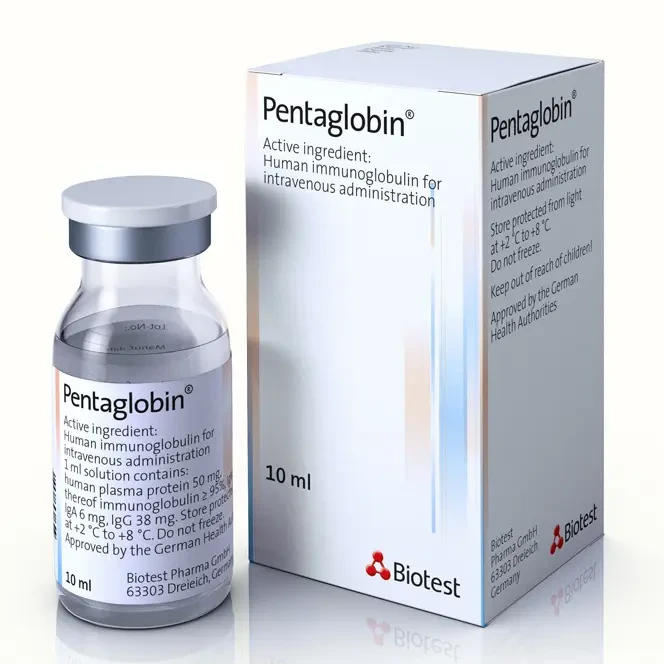
Pentaglobin
Ask a doctor about a prescription for Pentaglobin




How to use Pentaglobin
LEAFLET INCLUDED IN THE PACKAGING: INFORMATION FOR THE USER
Pentaglobin, 50 mg/ml, solution for infusion
Human immunoglobulin for intravenous administration
Please read carefully the contents of this leaflet before using the medicine, as it contains important information for the patient.
Information important for the patient.
- Please keep this leaflet, you may need to read it again.
- If you have any further questions, ask your doctor, pharmacist, or nurse.
- If you experience any side effects, including those not listed in this leaflet, please inform your doctor, pharmacist, or nurse. See section 4.
Table of contents of the leaflet:
- 1. What is Pentaglobin and what is it used for
- 2. Important information before using Pentaglobin
- 3. How to use Pentaglobin
- 4. Possible side effects
- 5. How to store Pentaglobin
- 6. Contents of the pack and other information
1. What is Pentaglobin and what is it used for
Pentaglobin is a medicine made from human blood, containing antibodies (antibodies are part of the body's immune system). This medicine is available as a solution for infusion, administered by drip into a vein.
Pentaglobin is used
- to treat bacterial infections while using antibiotics
- for replacement therapy in patients who do not have enough of their own antibodies (immunoglobulins) and have severe acquired immune deficiencies
2. Important information before using Pentaglobin
When not to use Pentaglobin
- if the patient is allergicto human immunoglobulin or any other component of this medicine (listed in section 6)
- if the patient has immunoglobulin A deficiency, especially if there are antibodies against immunoglobulin A in the blood, as this may lead to anaphylaxis
Warnings and precautions
Before starting treatment with Pentaglobin, discuss with your doctor, pharmacist, or nurse,
- if the patient is receiving human immunoglobulin for the first time or after a long break, or if the patient's medicine containing immunoglobulins is being changed. In such cases, the doctor will closely monitor the patient
- if the patient has an active infectionor a concomitant chronic inflammatory condition
- if the patient has an allergyto immunoglobulins (see "When not to use Pentaglobin")
- if the patient
- is overweightor is elderly,
- has high blood pressure (hypertension),
- has diabetesor vascular disease,
- has a greater tendency to blood clotting in vessels,
- has been bedridden for a long time,
- has low blood volume (hypovolemia)or if the patient's blood is concentrated,
- has kidney diseaseor uses medicines that may harm kidney function
In such cases, more side effects may occur. If necessary, the doctor may stop treatment with Pentaglobin or take other precautions (e.g., reduce the infusion rate).
The patient may be allergic (hypersensitive) to immunoglobulins and not know about it. Hypersensitivity reactions can occur even if the patient has previously received human immunoglobulins and tolerated them well. However, true hypersensitivity reactions are rare. Some side effects (e.g., headache, sudden facial flushing, chills, muscle pain, wheezing, tachycardia, back pain, nausea, and hypotension) may be related to the infusion rate.
If the patient experiences such reactions during the administration of Pentaglobin, they should immediatelytell their doctor. The doctor will decide whether to reduce the infusion rate or discontinue the infusion and take necessary medical measures to treat them.
Information on safety regarding infections
Pentaglobin is made from human plasma (the liquid part of the blood). When medicines are made from human blood or plasma, certain precautions are taken to prevent the transmission of infections to patients. All blood donors are tested for the presence of viruses and infectious diseases. Additionally, measures are taken to inactivate or remove viruses.
Despite these precautions, when administering medicines obtained from human blood or plasma, it is not possible to completely exclude the possibility of transmitting infectious agents.
The measures taken are considered effective against enveloped viruses, such as:
- human immunodeficiency virus (HIV)
- hepatitis B virus (HBV)
- hepatitis C virus (HCV)
The effectiveness of these measures may be limited for non-enveloped viruses, such as:
- hepatitis A virus (HAV)
- parvovirus B19
No association has been found between immunoglobulins and hepatitis A or parvovirus B19 infection, probably because the antibodies against these infections contained in this medicine have a protective effect.
It is strongly recommended that each time a patient receives a dose of Pentaglobin, the doctor records the name and batch number of the medicine. The batch number provides information on the starting materials used in the medicine. If necessary, this allows the patient to be linked to the starting material used.
Children and adolescents
In newborns and infants, different symptoms of infusion-related reactions, hypersensitivity reactions, or allergic reactions may occur compared to other age groups, see section "Possible side effects".
Pentaglobin and other medicines
Tell your doctor or pharmacist about all medicines you are taking, have recently taken, or might take, including those you have bought without a prescription.
Pentaglobin may reduce the effectiveness of some vaccines, e.g., vaccines against
- measles
- rubella
- mumps
- chickenpox (varicella)It may be necessary to wait up to 3 months before receiving some vaccines and up to 1 year before receiving the measles vaccine.
It is recommended to avoid using loop diuretics (commonly known as diuretics) with Pentaglobin.
Pregnancy and breastfeeding
If you are pregnant or breastfeeding, think you may be pregnant, or are planning to have a baby, ask your doctor or pharmacist for advice before taking this medicine.
Your doctor will decide whether you can be treated with Pentaglobin during pregnancy and breastfeeding.
Driving and using machines
Pentaglobin has a minor influence on the ability to drive and use machines. If you experience side effects during treatment, you should wait for them to resolve before driving or operating machines.
Pentaglobin contains glucose and sodium
1 ml of the solution for infusion contains 25 mg of glucose (which corresponds to approximately 0.0021 bread units).
The daily dose of the solution for infusion of approximately 350 ml for adults (70 kg body weight) contains 8.75 g of glucose, which corresponds to approximately 0.735 bread units. This should be taken into account in patients using a diabetic diet.
Pentaglobin contains 0.078 mmol/ml (1.79 mg/ml) of sodium (the main component of common salt).
The daily dose for adults of approximately 350 ml (70 kg body weight) contains 27.3 mmol (627.6 mg) of sodium. This corresponds to approximately 31% of the maximum daily intake of 2 g of sodium recommended by the WHO for adults.
3. How to use Pentaglobin
Pentaglobin is administered by a doctor. The dosage depends on the patient's immune system status and the severity of the disease.
Recommended dose:
Newborns and infants
5 ml (0.25 g) per kg of body weight per day for 3 consecutive days. Further repetition of doses depends on the clinical course.
Children and adults
For the treatment of severe bacterial infections: 5 ml (0.25 g) per kg of body weight per day for 3 consecutive days. Further repetition of doses depends on the clinical course.
For replacement of missing antibodies (immunoglobulins) in patients with weakened immune systems due to medications or radiation, and in severe acquired immunodeficiency: 3-5 ml (0.15-0.25 g) per kg of body weight.
If necessary, it is recommended to repeat the doses at weekly intervals.
Pentaglobin will be administered at the following infusion rates into a vein (intravenous infusion):
Newborns and infants:
1.7 ml per kg of body weight per hour using an infusion pump,
Children and adults:
0.4 ml per kg of body weight per hour,
alternatively: for the first 100 ml 0.4 ml per kg of body weight per hour, then continuously 0.2 ml per kg of body weight per hour until 15.0 ml per kg of body weight is reached within 72 hours.
Examples:
| Body weight | Total dose day 1 | Infusion rate | Infusion duration | |
| Newborn | 3 kg | 15 ml | 5 ml/h | 3 h |
| Child | 20 kg | 100 ml | 8 ml/h | 12.5 h |
| Adult | 70 kg | 350 ml | 28 ml/h alternatively: 28 ml/h 14 ml/h | 12.5 h 3.5 h then continuously for 68 h |
Liver function disorders
There is no evidence to suggest that dose adjustment is necessary.
Kidney function disorders
Dose adjustment is required only if clinically justified, see "Warnings and precautions".
Elderly patients
No dose adjustment is required unless there are clinical indications.
Method of administration
Pentaglobin is intended for intravenous infusion (infusion into a vein).
The medicine should be brought to room temperature or body temperature before administration.
Using a higher dose of Pentaglobin than recommended
Taking too much Pentaglobin can lead to fluid overload and increased blood viscosity, especially in patients at risk, including children, elderly patients, or patients with heart or kidney disorders. If you think you have taken too much Pentaglobin, you should discuss this with your doctor as soon as possible.
If you have any further questions about the use of this medicine, ask your doctor, pharmacist, or nurse.
4. Possible side effects
Like all medicines, Pentaglobin can cause side effects, although not everybody gets them.
The following side effects have been reported in clinical trials with Pentaglobin:
Frequent (may affect up to 1 in 10 people):
- low blood pressure
- nausea, vomiting
- excessive sweating
Uncommon (may affect up to 1 in 100 people):
- allergic reactions
- skin reactions/allergic dermatitis
- back pain
The following side effects have been reported after Pentaglobin was marketed:
Frequency not known (frequency cannot be estimated from the available data)
- meningitis (aseptic meningitis)
- anemia (hemolytic anemia)/red blood cell destruction (hemolysis)
- anaphylactic shock, pseudo-anaphylactic reactions, hypersensitivity reactions
- headache, dizziness
- rapid heartbeat (tachycardia)
- flushing
- shortness of breath
- itching
- acute kidney failure and/or blood test results indicating kidney function disorders (increased serum creatinine levels)
- chills, fever
Children and adolescents:
Although newborns and infants generally experience comparable side effects (e.g., infusion-related reactions, anaphylactic reactions, hypersensitivity) compared to other age groups, their subjective and objective symptoms are different. Additionally, they may experience changes in heart rate (fast or slow heartbeat), rapid breathing, decreased oxygen saturation, skin discoloration, including pallor and/or cyanosis, and decreased muscle tone.
Human immunoglobulin preparations may generally cause the following side effects:
- chills, headache, dizziness, fever, vomiting, allergic reactions, nausea, joint pain, low blood pressure, and moderate back pain
- decrease in red blood cell count due to the breakdown of these cells in blood vessels ((reversible) hemolytic reactions) and (rarely) hemolytic anemia requiring transfusion
- (rarely) sudden drop in blood pressure and, in rare cases, anaphylactic shock
- (rarely) transient skin reactions (including erythema multiforme - frequency not known)
- (very rarely) thromboembolic reactions, such as myocardial infarction, stroke, blood clots in the lungs (pulmonary embolism), and deep vein thrombosis
- cases of transient acute inflammation of the membranes covering the brain and spinal cord (reversible aseptic meningitis)
- cases of blood test results indicating kidney function disorders and/or acute kidney failure
Reporting side effects
If you experience any side effects, including those not listed in this leaflet, please inform your doctor, pharmacist, or nurse. Side effects can be reported directly to the Department of Drug Safety of the Office for Registration of Medicinal Products, Medical Devices, and Biocidal Products:
Al. Jerozolimskie 181C
02-222 Warsaw
Phone: +48 22 49 21 301
Fax: +48 22 49 21 309
Website: https://smz.ezdrowie.gov.pl
Side effects can also be reported to the marketing authorization holder.
By reporting side effects, you can help provide more information on the safety of this medicine.
5. How to store Pentaglobin
Keep this medicine out of the sight and reach of children.
Do not use this medicine after the expiry date stated on the label and carton after "Expiry date".
Store in a refrigerator (2°C–8°C). Do not freeze. Store in the original package to protect from light.
Check the medicine before use. The solution must be clear or slightly opalescent. Do not use Pentaglobin if the solution is cloudy or contains sediment.
After opening the package, the solution for infusion should be used immediately. Due to the risk of bacterial contamination, any unused solution should be discarded.
Medicines should not be disposed of via wastewater or household waste. Ask your pharmacist how to dispose of medicines no longer required. This will help protect the environment.
6. Contents of the pack and other information
What Pentaglobin contains
- The active substance is: human immunoglobulin
- 1 ml of the solution contains 50 mg of human plasma protein, including immunoglobulin ≥ 95%: IgM 6 mg, IgA 6 mg, IgG 38 mg.
- The other ingredients are: glucose monohydrate, sodium chloride, water for injections.
What Pentaglobin looks like and contents of the pack
Pentaglobin is a slightly brownish-yellow and clear or slightly opalescent solution in colorless glass vials.
Pentaglobin is available in the following pack sizes:
Pack containing 1 vial of 10 ml (0.5 g), 50 ml (2.5 g), or 100 ml (5.0 g).
Marketing authorization holder and manufacturer
Biotest Pharma GmbH
Landsteinerstraße 5
63303 Dreieich
Phone: (06103) 801-0
Fax: (06103) 801-150
Email: [email protected]
Date of last revision of the leaflet: 08.06.2023
Information intended for healthcare professionals only:
Warnings and precautions
Potential complications can often be avoided by ensuring that:
- patients are not allergic to normal human immunoglobulin through initial slow (0.4 ml/kg body weight/h) administration of the medicinal product.
- patients are closely monitored during the entire infusion period for the occurrence of any symptoms. In particular, patients receiving human immunoglobulin for the first time, patients who have previously received another IVIg product, or patients with a long break since the previous infusion should be monitored in a hospital or controlled healthcare facility during the first infusion and for one hour after the first infusion to monitor for possible side effects and to ensure the possibility of immediate emergency treatment in case of problems. All other patients should be observed for at least 20 minutes after administration.
In all patients, IVIg administration requires
- adequate hydration before starting IVIg infusion,
- monitoring of diuresis,
- monitoring of serum creatinine levels,
- avoiding concomitant use of loop diuretics.
In the event of a side effect, the infusion rate should be reduced or the infusion discontinued. The required treatment depends on the type and severity of the side effect.
Infusion-related reaction
Some side effects (e.g., headache, sudden facial flushing, chills, muscle pain, wheezing, tachycardia, back pain, nausea, and hypotension) may be related to the infusion rate. The recommended infusion rate specified in the "How to use Pentaglobin" section should be strictly followed. During the infusion, patients should be closely monitored and observed for any symptoms.
Side effects may occur more frequently
- in patients receiving human immunoglobulin for the first time or in rare cases in patients who have had their previously administered immunoglobulin product changed or in patients with a long break since the previous infusion
- in patients with active infection or concomitant chronic inflammatory condition
Hypersensitivity
Hypersensitivity reactions are rare.
Anaphylaxis may occur in patients:
- with undetectable IgA, who have antibodies against IgA
- who have previously tolerated human immunoglobulin well.
In the event of shock, standard medical treatment for shock should be administered.
Thromboembolic complications
There is clinical evidence of a link between the administration of intravenous immunoglobulins (IVIg) and thromboembolic events, such as myocardial infarction, stroke, pulmonary embolism, and deep vein thrombosis. It is assumed that the administration of high doses of immunoglobulin to patients at risk leads to a relative increase in blood viscosity. Caution should be exercised when recommending and infusing immunoglobulins to obese patients, patients with existing risk factors for thromboembolic events (such as advanced age, hypertension, diabetes, and recognized vascular disease or thromboembolic events in the medical history, patients with acquired or congenital predispositions to thrombosis, patients after prolonged bed rest, patients with severe hypovolemia, patients with kidney disease).
In patients with a risk of thromboembolic side effects, IVIg products should be administered at the lowest possible infusion rate and in the smallest possible dose.
Acute kidney failure
Cases of acute kidney failure have been reported in patients receiving IVIg treatment. In most cases, risk factors were identified, such as pre-existing kidney failure, diabetes, hypovolemia, overweight, concomitant use of nephrotoxic medicinal products, or patient age over 65 years.
Before IVIg infusion and then at appropriate intervals, kidney function should be assessed, especially in patients with a potential increased risk of acute kidney failure. In patients with a risk of acute kidney failure, IVIg products should be administered at the lowest possible infusion rate and in the smallest possible dose.
In the event of kidney function disorders, consideration should be given to discontinuing IVIg administration.
Cases of kidney function disorders and acute kidney failure have been observed after the administration of several registered IVIg products containing different excipients, such as sucrose, glucose, and maltose, and products containing sucrose as a stabilizer accounted for the majority of such cases. In patients at risk, consideration can be given to using IVIg products that do not contain such excipients. Pentaglobin does not contain sucrose and maltose but contains glucose (see "Pentaglobin contains glucose").
Aseptic meningitis syndrome (AMS)
AMS has been reported in association with IVIg treatment. The syndrome usually occurs within a few hours to 2 days after IVIg treatment. In cerebrospinal fluid (CSF) examinations, pleocytosis is often found, with a count of up to several thousand cells/mm, mainly of the granulocytic series, and increased protein levels of up to several hundred mg/dL. AMS may occur more frequently in association with high-dose IVIg treatment (2 g/kg).
Patients exhibiting such objective and subjective symptoms should undergo a thorough neurological examination, including CSF examinations, to rule out other causes of meningitis.
Discontinuation of IVIg treatment has led to the resolution of AMS within a few days without sequelae.
Hemolytic anemia
Intravenous immunoglobulins (IVIg) may contain antibodies against blood group antigens, which can act as hemolysins and cause in vivocoating of red blood cells (RBC) with immunoglobulins, resulting in a positive direct antiglobulin test (Coombs test) and rarely hemolysis. Hemolytic anemia may develop after IVIg treatment due to increased sequestration of RBC. Patients treated with IVIg should be monitored for clinical signs and symptoms of hemolysis.
Neutropenia/leukopenia
After IVIg treatment, transient decreases in neutrophil count and/or episodes of neutropenia have been reported, sometimes severe. This usually occurs within hours or days after IVIg administration and resolves spontaneously within 7-14 days.
Acute transfusion-related lung injury (TRALI)
TRALI has been reported in patients receiving IVIg. TRALI is characterized by severe hypoxia, dyspnea, tachypnea, cyanosis, fever, and hypotension. TRALI symptoms usually occur during or within 6 hours of transfusion, often within 1-2 hours. For this reason, patients receiving IVIg should be monitored for pulmonary side effects, and the infusion should be discontinued immediately if they occur. TRALI is a potentially life-threatening condition requiring immediate treatment in an intensive care unit.
Effect on serological test results
After immunoglobulin administration, there may be a transient increase in the level of various passively transferred antibodies in the patient's blood, which may cause false-positive serological test results.
Passive transfer of antibodies against red blood cell antigens, e.g., A, B, D, may interfere with the results of some serological tests for the presence of antibodies against red blood cells, such as the direct antiglobulin test (DAT, direct Coombs test).
Special precautions for the preparation of the medicinal product for administration
Pentaglobin may only be mixed with a saline solution.
- Country of registration
- Active substance
- Prescription requiredYes
- Manufacturer
- ImporterBiotest Pharma GmbH
- This information is for reference only and does not constitute medical advice. Always consult a licensed doctor before taking any medication. Oladoctor is not responsible for medical decisions based on this content.
- Alternatives to PentaglobinActive substance: immunoglobulins, normal human, for intravascular adm.Manufacturer: Baxalta Belgium Manufacturing S.A.Prescription requiredDosage form: Solution, 100 mg/mlActive substance: immunoglobulins, normal human, for intravascular adm.Manufacturer: Instituto Grifols S.A.Prescription requiredDosage form: Solution, 50 mg/mlActive substance: immunoglobulins, normal human, for intravascular adm.Manufacturer: Kedrion S.p.A.Prescription not required
Alternatives to Pentaglobin in other countries
The best alternatives with the same active ingredient and therapeutic effect.
Alternative to Pentaglobin in Spain
Alternative to Pentaglobin in Ukraine
Online doctors for Pentaglobin
Discuss dosage, side effects, interactions, contraindications, and prescription renewal for Pentaglobin – subject to medical assessment and local rules.






Get updates and exclusive offers
Be the first to know about new services, marketplace updates, and subscriber-only promos.

