



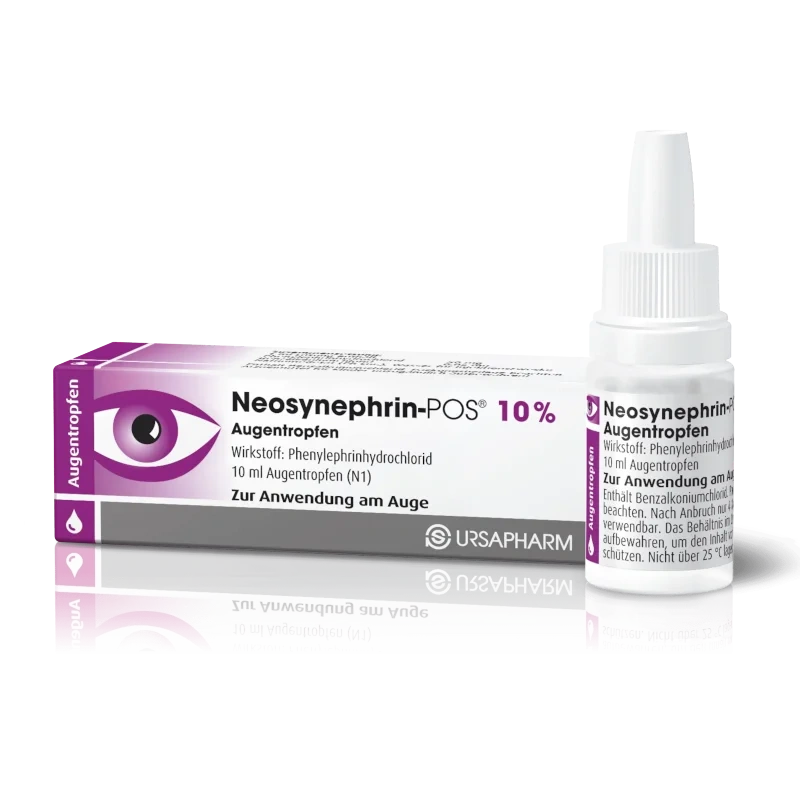
NEOSYNEPHRIN-POS 100 mg /Ml Drops

Prescription review online
A doctor will review your case and decide whether a prescription is medically appropriate.

Talk to a doctor about this medicine
Discuss your symptoms and possible next steps in a quick online consultation.



How to use Neosinephrin-pos 10%
Contents of the leaflet
- Package Leaflet: Information for the Patient
- Neosynephrin-POS 10%
- 100 mg/ml, eye drops, solution
- What is Neosynephrin-POS 10% and what is it used for
- Important information before using Neosynephrin-POS 10%
- How to use Neosynephrin-POS 10%
- Possible side effects
- How to store Neosynephrin-POS 10%
- Package contents and other information
Package Leaflet: Information for the Patient
Neosynephrin-POS 10%

Not sure if this medicine is right for you?
Discuss your symptoms and treatment with a doctor online.
100 mg/ml, eye drops, solution
Phenylephrine hydrochloride
Read the package leaflet carefully before using the medicine, as it contains important information for the patient.
- Keep this package leaflet, you may need to read it again.
- In case of any doubts, consult a doctor or pharmacist.
- This medicine has been prescribed specifically for you. Do not pass it on to others. The medicine may harm another person, even if their symptoms are the same.
- If the patient experiences any side effects, including any side effects not listed in this package leaflet, they should inform their doctor or pharmacist. See section 4.
Package Leaflet Contents:
- 1. What is Neosynephrin-POS 10% and what is it used for
- 2. Important information before using Neosynephrin-POS 10%
- 3. How to use Neosynephrin-POS 10%
- 4. Possible side effects
- 5. How to store Neosynephrin-POS 10%
- 6. Package contents and other information
1. What is Neosynephrin-POS 10% and what is it used for
Neosynephrin-POS 10% is a medicine from the group of alpha-sympathomimetics, acting on the eye through the influence of the autonomic nervous system.
The indication for use is to achieve short-term dilation of the pupil for the purpose of examining the fundus of the eye (especially the peripheral part), as well as after eye surgeries.
It is used to prevent the formation of adhesions between the iris and the lens, and their rupture in the case of uveitis. The indication for use also includes administration for the diagnosis of conjunctivitis and concurrent iritis and uveitis.

Started taking the medicine and have questions?
Discuss your symptoms and treatment with a doctor online.
2. Important information before using Neosynephrin-POS 10%
When not to use Neosynephrin-POS 10%
The medicine is contraindicated in the following cases:
- hypersensitivity to phenylephrine or any of the other ingredients of this medicine (listed in section 6),
- dry conjunctivitis,
- pregnancy and breastfeeding,
- children under 12 years of age.
Warnings and precautions
Before starting to use Neosynephrin-POS 10%, the patient should discuss it with their doctor:
- in the case of glaucoma, as dilation of the pupil may be harmful, especially in the case of narrow-angle glaucoma,
- in the case of hypertension and heart rhythm disorders,
- in the case of severe heart and vascular diseases.
Edition 07/2024
1
- 1.3.1 SPC, labelling and package leaflet
There is a risk that the drops may penetrate the circulatory system. Therefore, they should be used with great caution in patients with heart rhythm disorders and other heart diseases, hypertension, aneurysm, advanced arteriosclerosis, hyperthyroidism.
This note also applies to older patients and children between 12 and 18 years of age.
Neosynephrin-POS 10% may narrow the iridocorneal angle and cause an attack of glaucoma characterized by a sudden increase in intraocular pressure, accompanied by eye and headache pain. In the case of existing glaucoma, additional medications that lower intraocular pressure (e.g., pilocarpine) should be used.
In case of a feeling that the effect of the medicine is too strong or too weak, the patient should consult a doctor.
Neosynephrin-POS 10% and other medicines
The patient should tell their doctor about all medicines they are currently taking or have recently taken, as well as any medicines they plan to take.
In the case of treatment for hypertension with guanethidine and reserpine, a significant increase in blood pressure may occur.
Using Neosynephrin-POS 10% with food and drink
This is not applicable.
Children and adolescents
Neosynephrin-POS 10% should not be used in children under 12 years of age, as children seem to be more susceptible to the risk of serious adverse reactions.
The use of Neosynephrin-POS 10% is not recommended in children between 12 and 18 years of age due to the lack of appropriate clinical experience.
Pregnancy and breastfeeding
If the patient is pregnant or breastfeeding, thinks they may be pregnant, or plans to have a child, they should consult a doctor or pharmacist before using this medicine. Neosynephrin-POS 10% should not be used during pregnancy and breastfeeding.
Driving and operating machinery
Neosynephrin-POS 10% affects vision. Impaired vision may persist for several hours after administering the medicine. The patient should not drive vehicles or operate machinery during this time.
Neosynephrin-POS 10% contains benzalkonium chloride
The medicine contains 0.50 mg of benzalkonium chloride in every 10 ml, which corresponds to 0.05 mg/ml.
Benzalkonium chloride may be absorbed by soft contact lenses and change their color. The patient should remove their contact lenses before administering the drops and wait at least 15 minutes before putting them back on. Benzalkonium chloride may also cause eye irritation, especially in patients with dry eye syndrome or corneal disorders (the transparent layer at the front of the eye). If the patient experiences any abnormal sensations in the eye, stinging, or pain after using the medicine, they should consult a doctor.
3. How to use Neosynephrin-POS 10%
This medicine should always be administered according to the doctor's instructions. In case of doubts, the patient should consult a doctor or pharmacist.
Usually, the recommended dose of Neosynephrin-POS 10% is 1 to 2 times a day, 1 drop of Neosynephrin-POS 10% in each eye.
Edition 07/2024
2
- 1.3.1 SPC, labelling and package leaflet
When administering the medicine to elderly patients or children between 12 and 18 years of age, the prescribed dose should be measured very carefully.
The patient should avoid touching the tip of the dropper bottle to the eye.
To administer the medicine, the patient should unscrew the cap, tilt their head back, pull the lower eyelid down, and gently squeeze the bottle to put one drop of the medicine in the conjunctival sac. The patient should then close their eyes slowly and screw the cap back on carefully.
Using the medicine for more than 5 days should only be done under medical supervision.
In case of a feeling that the effect of the medicine is too strong or too weak, the patient should consult a doctor.
Using a higher dose of Neosynephrin-POS 10% than recommended
The patient should immediately rinse their eyes with water.
In case of accidental ingestion of the contents of the package, the following symptoms may occur:
increased blood pressure accompanied by palpitations, headache, nausea, feeling of fear, tremors, initially accelerated heart rate, then slowed heart rate.
The patient should be given activated charcoal and immediately informed their doctor.
In case of slowed heart rate, the doctor may administer a preparation containing atropine (in children 0.01 to 0.02 mg/kg body weight) or, in case of dangerous increased blood pressure, a preparation containing phentolamine.
Missing a dose of Neosynephrin-POS 10%
The patient should not use a double dose to make up for a missed dose.
Stopping the use of Neosynephrin-POS 10%
In case of any further doubts about using this medicine, the patient should consult a doctor or pharmacist.
4. Possible side effects
Like all medicines, Neosynephrin-POS 10% can cause side effects, although not everybody gets them.
Very common:
more than 1 in 10 people
Common:
more than 1 in 100 people but less than 1 in 10 people
Uncommon:
more than 1 in 1,000 people but less than 1 in 100 people
Rare:
more than 1 in 10,000 people but less than 1 in 1,000 people
Very rare:
less than 1 in 10,000 people
Unknown:
frequency cannot be estimated from the available data
Conjunctival hyperemia, burning eye pain.
Rarely, there may be persistent blurred vision for several hours after administering the medicine, accompanied by a blurred image (in individual cases, the amplitude of accommodation may be up to 3 diopters).
Rarely, there may be increased blood pressure. In individual cases, severe increased blood pressure has been reported, accompanied by palpitations, tachycardia, and severe headaches. These symptoms occurred mainly in patients with conjunctival hyperemia and corneal damage.
Prolonged use may cause eye redness and swelling, and in older patients, the opposite effect may occur, resulting in pupil constriction. In individual cases, prolonged use may cause corneal calcification with closure of the lacrimal puncta and lacrimation.
Benzalkonium chloride may cause eye irritation.
Additional side effects in children:
Pulmonary edema - frequency unknown (cannot be estimated from the available data)
Reporting side effects
If the patient experiences any side effects, including any side effects not listed in this package leaflet, they should inform their doctor or pharmacist, or nurse. Side effects can be reported directly to the Department of Monitoring of Adverse Reactions to Medicinal Products of the Office for Registration of Medicinal Products, Medical Devices, and Biocidal Products:
Jerozolimskie Avenue 181C, 02-222 Warsaw, phone: 22 49-21-301, fax: 22 49-21-309, website: https://smz.ezdrowie.gov.pl .
Side effects can also be reported to the marketing authorization holder.
Reporting side effects will help gather more information on the safety of the medicine.
5. How to store Neosynephrin-POS 10%
The medicine should be stored out of sight and reach of children.
Do not use this medicine after the expiry date stated on the label. The expiry date refers to the last day of the specified month.
After opening the immediate packaging, the medicine is suitable for use for 4 weeks.
Store in a temperature below 25°C.
Store in the original packaging to protect from light.
Medicines should not be disposed of via wastewater or household waste. The patient should ask their pharmacist how to dispose of medicines that are no longer needed. This will help protect the environment.
6. Package contents and other information
What Neosynephrin-POS 10% contains
The active substance of the medicine is phenylephrine.
The other ingredients of the medicine are benzalkonium chloride as a preservative, disodium edetate, water for injections.
What Neosynephrin-POS 10% looks like and what the package contains
A plastic bottle containing 10 ml of eye drops.
Marketing authorization holder and manufacturer
Marketing authorization holder
URSAPHARM Poland Sp. z o.o.,
Gdyńskie Coast 27
01-531 Warsaw
Phone: 22 732 07 90
Fax: 22 732 07 99
e-mail: [email protected]
Edition 07/2024
4
- 1.3.1 SPC, labelling and package leaflet
Manufacturer:
URSAPHARM Arzneimittel GmbH
Industriestraße 35
66129 Saarbrücken, Germany
Date of revision of the package leaflet:
Edition 07/2024
5
- Country of registration
- Dosage formDrops, 100 mg/ml
- ATC codeS01FB01
- Active substance
- Prescription requiredYes
- Manufacturer
- ImporterUrsapharm Arzneimittel GmbH
- This information is for reference only and does not constitute medical advice. Always consult a doctor before taking any medication. Oladoctor is not responsible for medical decisions based on this content.
- Alternatives to Neosinephrin-pos 10%Dosage form: Drops, 10 mg/mlActive substance: atropineManufacturer: Warszawskie Zakłady Farmaceutyczne POLFA S.A.Prescription requiredDosage form: Drops, 10 mg/mlActive substance: cyclopentolateDosage form: Drops, 100 mcg/mlActive substance: atropineManufacturer: Jadran-Galenski laboratorij d.d.Prescription required
Online doctors for Neosinephrin-pos 10%
Discuss questions about Neosinephrin-pos 10%, including use, safety considerations and prescription review, subject to medical assessment and local regulations.









Get Neosinephrin-pos 10% Prescription Online
Fill in a 2-min form
Tell us your symptoms, history, and what medicine you're requesting.
Pick a doctor or let us assign
Choose a specialist or we'll match you with the next available doctor.
Doctor reviews your case
Usually within 30 minutes. They may ask follow-up questions via chat.
Collect from any pharmacy
Electronic prescription sent to your email — valid across Spain.
Frequently Asked Questions
Neosinephrin-pos 10% requires a prescription in Poland. You can check with a doctor online whether this medicine may be appropriate for your situation.
The active ingredient in Neosinephrin-pos 10% is phenylephrine. This information helps identify medicines with the same composition but different brand names.
Neosinephrin-pos 10% is manufactured by Ursapharm Arzneimittel GmbH. Pharmacy brands and packaging may differ depending on the distributor.
Doctors such as Family doctors, Psychiatrists, Dermatologists, Cardiologists, Endocrinologists, Gastroenterologists, Pulmonologists, Nephrologists, Rheumatologists, Hematologists, Infectious disease physicians, Allergists, Geriatricians, Paediatricians, Oncologists may assess whether Neosinephrin-pos 10% is appropriate, depending on your situation and local regulations. You can book an online consultation to discuss your symptoms and possible next steps.
Spain has a well-developed healthcare infrastructure across major cities such as Madrid, Barcelona, Valencia, and Seville. Pharmacies are widely available and operate under strict regulations, ensuring access to prescribed medications.
You can buy Neosinephrin-pos 10% in Madrid, Barcelona, Seville, or Valencia at any local pharmacy with a valid prescription.
To obtain a prescription, you can use Oladoctor:
Other medicines with the same active substance (phenylephrine) include Atropinum sulfuricum Vzf 1%, Cikloftial, Miofree. These may have different brand names or formulations but contain the same therapeutic ingredient. Always consult a doctor before switching or starting a new medicine.
