



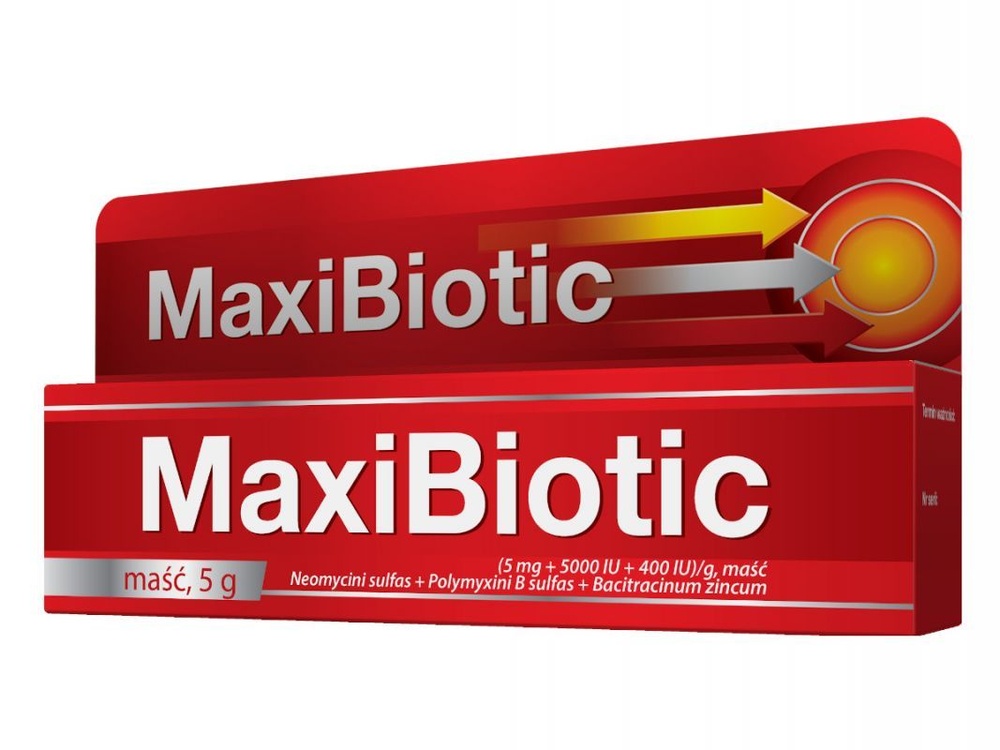
MAXIBIOTIC (5 mg + 5000 IU 400 IU)/g Ointment

Prescription review online
A doctor will review your case and decide whether a prescription is medically appropriate.

Talk to a doctor about this medicine
Discuss your symptoms and possible next steps in a quick online consultation.



How to use Maxibiotic
Contents of the leaflet
- Leaflet accompanying the packaging: patient information
- MAXIBIOTIC, (5 mg + 5000 IU + 400 IU)/g, ointment
- What is M and what is it used for
- Important information before using M
- How to use M
- Possible side effects
- How to store M
- Package contents and other information
Leaflet accompanying the packaging: patient information
MAXIBIOTIC, (5 mg + 5000 IU + 400 IU)/g, ointment
(Neomycin sulfate + Polymyxin B sulfate + Zinc bacitracin)
Please read the contents of the leaflet carefully before using the medicine, as it contains
important information for the patient.
This medicine should always be used exactly as described in the patient leaflet or according to
the doctor's or pharmacist's instructions.
- The leaflet should be kept in case it needs to be read again.
- If advice or additional information is needed, the pharmacist should be consulted.
- If the patient experiences any side effects, including any possible side effects not listed in the leaflet, they should inform their doctor or pharmacist. See section 4.
- If there is no improvement after 7 days or the patient feels worse, they should contact their doctor.
Table of contents of the leaflet
- 1. What is M and what is it used for
- 2. Important information before using M
- 3. How to use M
- 4. Possible side effects
- 5. How to store M
- 6. Package contents and other information

Not sure if this medicine is right for you?
Discuss your symptoms and treatment with a doctor online.
1. What is M and what is it used for
M is a medicine in the form of an ointment, used locally on the skin. The active substances of the medicine are
three antibiotics with a complementary range of antibacterial activity against bacteria
causing most skin infections.
Indications for use:
- minor wounds (abrasions, scratches, bites);
- burns;
- skin ulcers.
2. Important information before using M
When not to use M:
- if the patient is allergic to neomycin sulfate, polymyxin B sulfate, zinc bacitracin, or any of the other ingredients of this medicine (listed in section 6);
- if the patient has hearing disorders (in such cases, the use of the medicine may cause harmful effects on hearing);
- on deep or puncture wounds, severe burns, or large areas of damaged skin, as well as on oozing lesions, due to the risk of absorption of the active substances into the blood and the occurrence of systemic side effects (harmful effects on hearing, kidneys);
- in the eyes.
Warnings and precautions
Before starting to use M, the patient should discuss it with their doctor or pharmacist.
Prolonged use of M may cause excessive growth of insensitive microorganisms, including fungi, similar to the use of other medicines containing antibiotics.
Patients allergic to aminoglycoside or polymyxin antibiotics may be allergic to this medicine. In the event of severe allergic reactions, treatment should be discontinued and the doctor consulted.
If side effects occur, especially irritation at the site of application or the patient notices no improvement, the use of M should be discontinued and the doctor consulted.
Using the medicine on large areas of damaged skin may cause hearing loss, kidney damage, and toxic effects on the nervous system.
Children and adolescents
M should not be used in children under 12 years of age.
M and other medicines
The patient should inform their doctor or pharmacist about all medicines they are currently taking or have recently taken, as well as any medicines they plan to take.
After applying the M ointment to a large area or damaged skin, interactions with other medicines used at the same time may occur.
Concomitant use of M with orally administered neomycin may increase the risk of allergic reactions.
M should not be used with medicines that may damage the kidneys and hearing, such as potent diuretics (e.g., furosemide, ethacrynic acid). These medicines, when used with aminoglycosides, increase their concentration in the blood, which increases the risk of hearing disorders, up to deafness, which may occur even after the medicine is discontinued.
During concomitant use of oral or topical aminoglycoside antibiotics or other medicines with potential harmful effects on the kidneys or nervous system, the risk of side effects may increase.
During concomitant use with other medicines with harmful effects on the kidneys and hearing, M may enhance the effects of these medicines.
Use in patients with kidney function disorders or hearing impairment
Patients with kidney function disorders or hearing impairment should use this medicine with caution, as they are more likely to experience harmful effects on the kidneys and hearing.
Use in elderly patients
There are no special requirements for the use of M in elderly patients.
However, it should be remembered that the highest doses used should be reduced in patients with kidney function disorders.
Pregnancy and breastfeeding
If the patient is pregnant or breastfeeding, thinks they may be pregnant, or plans to have a child, they should consult their doctor before using this medicine.
Due to the lack of appropriate studies, the medicine should not be used during pregnancy and breastfeeding.
Driving and operating machinery
No effects of using M on driving and operating machinery have been reported.

Started taking the medicine and have questions?
Discuss your symptoms and treatment with a doctor online.
3. How to use M
This medicine should always be used exactly as described in the patient leaflet or according to
the doctor's or pharmacist's instructions. In case of doubts, the doctor or pharmacist should be consulted.
After removing the tube from the box and unscrewing the cap, the inverted cap should be used to pierce the aluminum seal on the tube and squeeze out the required amount of ointment.
The wound area should be cleaned and a small amount of the medicine applied to the affected skin area.
The area can be covered with a gauze dressing or left uncovered.
Apply 2 to 5 times a day.
Do not use for more than 7 days.
After completing the treatment, M should not be used again before 3 months have passed.
Using a higher dose of M than recommended
In the event of using the medicine on mucous membranes and/or on a large skin area (especially damaged skin), systemic side effects may occur. This applies primarily to patients with kidney function disorders. Symptoms of kidney damage, hearing loss, and toxic effects on the nervous system may occur. In such cases, the use of M should be discontinued and the doctor consulted.
Missing a dose of M
A double dose should not be used to make up for a missed dose.
In case of any further doubts about using this medicine, the doctor or pharmacist should be consulted.
4. Possible side effects
Like all medicines, M can cause side effects, although not everybody gets them.
The frequency of side effects cannot be determined based on available data.
Infections and infestations:
infection with insensitive strains of bacteria or fungi .
Immune system disorders:
local symptoms of hypersensitivity (itching, rash, redness, swelling, and other symptoms of irritation).
Ear and labyrinth disorders:
hearing loss.
Kidney and urinary disorders:
kidney damage.
Reporting side effects
If any side effects occur, including any side effects not listed in the leaflet, the doctor, pharmacist, or nurse should be informed. Side effects can be reported directly to the Department of Monitoring of Adverse Reactions to Medicinal Products of the Office for Registration of Medicinal Products, Medical Devices, and Biocidal Products
Al. Jerozolimskie 181C, 02-222 Warsaw
Phone: + 48 22 49 21 301
Fax: + 48 22 49 21 309
e-mail: [email protected]
Reporting side effects will help gather more information on the safety of the medicine.
5. How to store M
Store at a temperature below 30°C.
The medicine should be stored in a place out of sight and reach of children.
Do not use this medicine after the expiry date stated on the box or tube. The expiry date refers to the last day of the given month.
Medicines should not be disposed of via wastewater or household waste. The pharmacist should be asked how to dispose of medicines that are no longer used. This will help protect the environment.
6. Package contents and other information
What M contains
- The active substances of the medicine are: neomycin sulfate, polymyxin B sulfate, zinc bacitracin.
- 1 g of ointment contains 5 mg of neomycin sulfate, 5000 IU of polymyxin B sulfate, and 400 IU of zinc bacitracin.
- Excipient: white petrolatum.
What M looks like and what the package contains
M is an ointment.
The package consists of an aluminum tube and a sachet in a cardboard box.
Package sizes:
1 tube of 3 g
1 tube of 5 g
1 tube of 15 g
10 sachets of 1 g.
Not all package sizes may be marketed.
Responsible entity
Bausch Health Ireland Limited
3013 Lake Drive
Citywest Business Campus
Dublin 24, D24PPT3
Ireland
Manufacturer
EMO-FARM Sp. z o.o.
ul. Łódzka 52
95-054 Ksawerów
e-mail: [email protected]
phone: + 48/42/212 80 85
Date of the last update of the leaflet:
- Country of registration
- Dosage formOintment, (5 mg + 5000 IU 400 IU)/g
- Prescription requiredNo
- Manufacturer
- ImporterEMO-FARM Sp. z o.o.
- This information is for reference only and does not constitute medical advice. Always consult a doctor before taking any medication. Oladoctor is not responsible for medical decisions based on this content.
- Alternatives to MaxibioticDosage form: Ointment, (250 IU + 5000 IU)/gActive substance: bacitracinPrescription not required
Online doctors for Maxibiotic
Discuss questions about Maxibiotic, including use, safety considerations and prescription review, subject to medical assessment and local regulations.









Get Maxibiotic Prescription Online
Fill in a 2-min form
Tell us your symptoms, history, and what medicine you're requesting.
Pick a doctor or let us assign
Choose a specialist or we'll match you with the next available doctor.
Doctor reviews your case
Usually within 30 minutes. They may ask follow-up questions via chat.
Collect from any pharmacy
Electronic prescription sent to your email — valid across Spain.
Frequently Asked Questions
Maxibiotic does not require a prescription in Poland. You can check with a doctor online whether this medicine may be appropriate for your situation.
Maxibiotic is manufactured by EMO-FARM Sp. z o.o.. Pharmacy brands and packaging may differ depending on the distributor.
Doctors such as Family doctors, Psychiatrists, Dermatologists, Cardiologists, Endocrinologists, Gastroenterologists, Pulmonologists, Nephrologists, Rheumatologists, Hematologists, Infectious disease physicians, Allergists, Geriatricians, Paediatricians, Oncologists may assess whether Maxibiotic is appropriate, depending on your situation and local regulations. You can book an online consultation to discuss your symptoms and possible next steps.
Spain has a well-developed healthcare infrastructure across major cities such as Madrid, Barcelona, Valencia, and Seville. Pharmacies are widely available and operate under strict regulations, ensuring access to prescribed medications.
You can buy Maxibiotic in Madrid, Barcelona, Seville, or Valencia at any local pharmacy with a valid prescription.
To obtain a prescription, you can use Oladoctor:
Other medicines with the same active substance () include Altabactin, Bactroban, Bactroban. These may have different brand names or formulations but contain the same therapeutic ingredient. Always consult a doctor before switching or starting a new medicine.
