



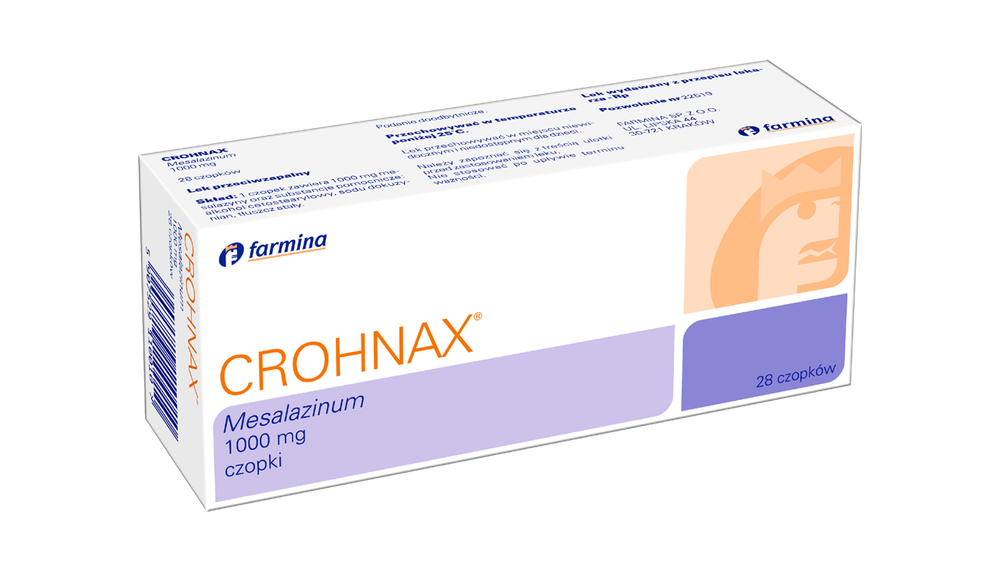
CROHNAX 1000 mg Suppositories

Prescription review online
A doctor will review your case and decide whether a prescription is medically appropriate.

Talk to a doctor about this medicine
Discuss your symptoms and possible next steps in a quick online consultation.



How to use Crohnax
Contents of the leaflet
- PATIENT INFORMATION LEAFLET: USER INFORMATION
- Leaflet enclosed with the packaging: patient information
- What is Crohnax and what is it used for
- Important information before using Crohnax
- How to use Crohnax
- Possible side effects
- How to store Crohnax
- Package contents and other information
PATIENT INFORMATION LEAFLET: USER INFORMATION
Leaflet enclosed with the packaging: patient information
CROHNAX
Mesalazine
500 mg
suppositories
CROHNAX
Mesalazine
1000 mg
suppositories
Read the leaflet carefully before using the medicine, as it contains important information for the patient.
Keep this leaflet, you may need to read it again.
In case of any doubts, consult a doctor or pharmacist.
This medicine has been prescribed to a specific person. Do not pass it on to others. The medicine may harm another person, even if their symptoms are the same.
If the patient experiences any side effects, including any not listed in this leaflet, they should tell their doctor or pharmacist. See section 4.
Table of contents of the leaflet
- 1. What is Crohnax and what is it used for
- 2. Important information before using Crohnax
- 3. How to use Crohnax
- 4. Possible side effects
- 5. How to store Crohnax
- 6. Package contents and other information

Not sure if this medicine is right for you?
Discuss your symptoms and treatment with a doctor online.
1. What is Crohnax and what is it used for
Crohnax is a medicine with anti-inflammatory effects on the diseased rectal wall.
Crohnax is used to treat ulcerative colitis with changes localized in the rectum.
2. Important information before using Crohnax
When not to use Crohnax
Crohnax should not be used if the patient has:
hypersensitivity (allergy) to any of the medicine's ingredients;
hypersensitivity (allergy) to salicylic acid and its derivatives (e.g., aspirin);
severe kidney or liver function disorders;
gastric and duodenal ulcer disease;
blood coagulation disorders.
The medicine should not be used in children under 12 years of age.
Warnings and precautions
Caution should be exercised when using Crohnax in patients with kidney and/or liver disease, lung disease, especially asthma or chronic non-specific lung disease (CNSLD), hypersensitivity to sulfasalazine.
14 days after starting treatment, and then 2-3 times at 4-week intervals, control blood tests (blood count, liver function tests - alanine or aspartate aminotransferase activity, creatinine levels) and urine tests (strip test and urine sediment) should be performed. If the results are normal, subsequent tests should be performed every 3 months, but if additional symptoms occur, the tests should be performed immediately.
The medicine should not be used for 6 weeks after vaccination against chickenpox.
Children and adolescents
Use as directed by a doctor.
Crohnax and other medicines
The doctor or pharmacist should be informed about all medicines currently being taken or recently taken, as well as any medicines the patient plans to take. In particular, the doctor should be informed about the use of:
- medicines used to reduce blood clotting, thin the blood (coumarin derivatives, acenocoumarol);
- medicines with strong antiallergic, anti-inflammatory effects (glucocorticosteroids);
- pain relievers, anti-inflammatory medicines (non-steroidal anti-inflammatory drugs, e.g., indomethacin);
- medicines used in diabetes (sulfonylurea derivatives);
- a medicine used, among other things, in the treatment of cancer, psoriasis, and rheumatoid diseases (methotrexate);
- medicines used in the treatment of gout (probenecid or sulfinpyrazone);
- medicines with diuretic effects, lowering blood pressure (furosemide, spironolactone);
- a medicine used in the treatment of tuberculosis (rifampicin);
- medicines used after organ transplants, inhibiting the immune system (azathioprine, 6-mercaptopurine).
Pregnancy and breastfeeding
Before using any medicine, consult a doctor or pharmacist.
The use of mesalazine during pregnancy and breastfeeding is always decided by a doctor, as mesalazine may pass into breast milk in small amounts.
If the breastfed child experiences diarrhea, breastfeeding should be discontinued.
Driving and using machines
Crohnax does not affect the ability to drive and use machines.

Started taking the medicine and have questions?
Discuss your symptoms and treatment with a doctor online.
3. How to use Crohnax
Crohnax is intended for rectal administration. It is recommended to empty the bowels before use. With a dosing regimen of twice a day, suppositories should be used in the morning and evening. With a dosing regimen of once a day, the suppository should be used in the evening, before bedtime.
Adults and the elderly:
In the exacerbation phase of the disease, a daily dose of 1000-2000 mg is usually used in 1 to 3 doses.
In the remission phase, to prevent the recurrence of the disease, a daily dose of 250-500 mg is usually used in 1 or 2 doses.
Children and adolescents:
There is limited experience and documentation regarding the efficacy and safety of use in children.
The usual dose of the medicine in this group is 500 mg in the evening or 1000 mg in two doses.
It is recommended that the suppository remain in the rectum for as long as possible; if it is expelled within 10 minutes of application, a new suppository should be used.
For the treatment to be effective, it is essential to use Crohnax regularly and consistently, as directed by the doctor.
Using a higher dose of Crohnax than recommended
In case of taking a higher dose of the medicine than recommended, consult a doctor or pharmacist.
Missing a dose of Crohnax
Take the missed dose as soon as possible. Then, apply the next dose at the usual time. However, if it means taking two doses in a short period, do not take the missed dose.
Do not take a double dose to make up for the missed dose.
Stopping the use of Crohnax
Always inform the attending doctor about stopping the treatment with Crohnax or ending it prematurely (e.g., due to side effects).
4. Possible side effects
Like all medicines, Crohnax can cause side effects, although not everybody gets them. During treatment with the medicine, the following may occur:
Frequently (1/100 to <1>
- gastrointestinal disorders, such as abdominal pain, nausea, vomiting, diarrhea;
- nervous system disorders, such as headaches and dizziness;
- skin and subcutaneous tissue disorders, such as hives, erythematous rash. Rarely (
1/10 000 to <1>
- heart disorders, such as myocarditis and pericarditis;
- gastrointestinal disorders, such as increased amylase activity and pancreatitis. Very rarely (<1>
- blood and lymphatic system disorders, such as leukopenia (decreased white blood cell count), granulocytopenia (decreased granulocyte count), neutropenia (decreased neutrophil count), agranulocytosis (decreased granulocyte count), aplastic anemia (bone marrow failure leading to anemia), thrombocytopenia (decreased platelet count), eosinophilia (increased eosinophil count), pancytopenia (decreased count of all blood cells);
neurological disorders, such as peripheral neuropathy (inflammation of peripheral nerves);
- respiratory, thoracic, and mediastinal disorders, such as allergic reactions (dyspnea, cough, allergic pneumonia, eosinophilic pneumonia, pulmonary infiltrates, pneumonia);
- hepatic and biliary disorders, such as increased liver enzyme activity and bilirubin levels, hepatotoxicity (hepatitis, liver cirrhosis, liver failure);
- skin and subcutaneous tissue disorders, such as reversible alopecia, erythema multiforme, Stevens-Johnson syndrome (formation of blisters on mucous membranes, which quickly disappear. The dominant skin changes are, however, drying necrosis, which transforms into layered and hemorrhagic scabs. The most common location of the disease is the oral cavity and genital organs, sometimes the mucous membranes of the eyes and nose);
- musculoskeletal and connective tissue disorders, such as muscle and joint pain, lupus-like symptoms (vasculitis and joint pain, muscle and joint pain);
- renal and urinary disorders, such as acute and chronic interstitial nephritis, renal failure, and nephrotic syndrome.
In case of any side effects, stop using the medicine. Side effects can be reported to a healthcare professional, the marketing authorization holder, or the President of the Office for Registration of Medicinal Products, Medical Devices, and Biocidal Products, Al. Jerozolimskie 181C, 02-222 Warsaw, tel.: +48 22 49 21 301, fax: +48 22 49 21 309, e-mail: [email protected].
5. How to store Crohnax
Store at a temperature below 25°C.
The medicine should be stored in a place inaccessible and invisible to children.
Do not use after the expiration date stated on the packaging.
6. Package contents and other information
What Crohnax contains
The active substance of the medicine is mesalazine.
The excipients are cetostearyl alcohol, sodium docuzate, and solid fat.
What Crohnax looks like and what the package contains
The packaging consists of PVC/PE film blisters and a leaflet in a cardboard box.
Crohnax, 500 mg: 30 suppositories.
Crohnax, 1000 mg: 14, 15, 28, or 30 suppositories.
Marketing authorization holder and manufacturer
Farmina sp. z o.o.
ul. Lipska 44
- 30-721 Kraków [Logo]
Date of the last update of the leaflet:
- Country of registration
- Dosage formSuppositories, 1000 mg
- ATC codeA07EC02
- Active substance
- Prescription requiredYes
- Manufacturer
- ImporterFarmina Sp. z o.o.
- This information is for reference only and does not constitute medical advice. Always consult a doctor before taking any medication. Oladoctor is not responsible for medical decisions based on this content.
- Alternatives to CrohnaxDosage form: Tablets, 250 mgActive substance: mesalazinePrescription requiredDosage form: Suppositories, 250 mgActive substance: mesalazineManufacturer: Temmler Italia S.R.L.Prescription requiredDosage form: Tablets, 500 mgActive substance: mesalazinePrescription required
Online doctors for Crohnax
Discuss questions about Crohnax, including use, safety considerations and prescription review, subject to medical assessment and local regulations.









Get Crohnax Prescription Online
Fill in a 2-min form
Tell us your symptoms, history, and what medicine you're requesting.
Pick a doctor or let us assign
Choose a specialist or we'll match you with the next available doctor.
Doctor reviews your case
Usually within 30 minutes. They may ask follow-up questions via chat.
Collect from any pharmacy
Electronic prescription sent to your email — valid across Spain.
Frequently Asked Questions
Crohnax requires a prescription in Poland. You can check with a doctor online whether this medicine may be appropriate for your situation.
The active ingredient in Crohnax is mesalazine. This information helps identify medicines with the same composition but different brand names.
Crohnax is manufactured by Farmina Sp. z o.o.. Pharmacy brands and packaging may differ depending on the distributor.
Doctors such as Family doctors, Psychiatrists, Dermatologists, Cardiologists, Endocrinologists, Gastroenterologists, Pulmonologists, Nephrologists, Rheumatologists, Hematologists, Infectious disease physicians, Allergists, Geriatricians, Paediatricians, Oncologists may assess whether Crohnax is appropriate, depending on your situation and local regulations. You can book an online consultation to discuss your symptoms and possible next steps.
Spain has a well-developed healthcare infrastructure across major cities such as Madrid, Barcelona, Valencia, and Seville. Pharmacies are widely available and operate under strict regulations, ensuring access to prescribed medications.
You can buy Crohnax in Madrid, Barcelona, Seville, or Valencia at any local pharmacy with a valid prescription.
To obtain a prescription, you can use Oladoctor:
Other medicines with the same active substance (mesalazine) include Asamax 250, Asamax 250, Asamax 500. These may have different brand names or formulations but contain the same therapeutic ingredient. Always consult a doctor before switching or starting a new medicine.
