



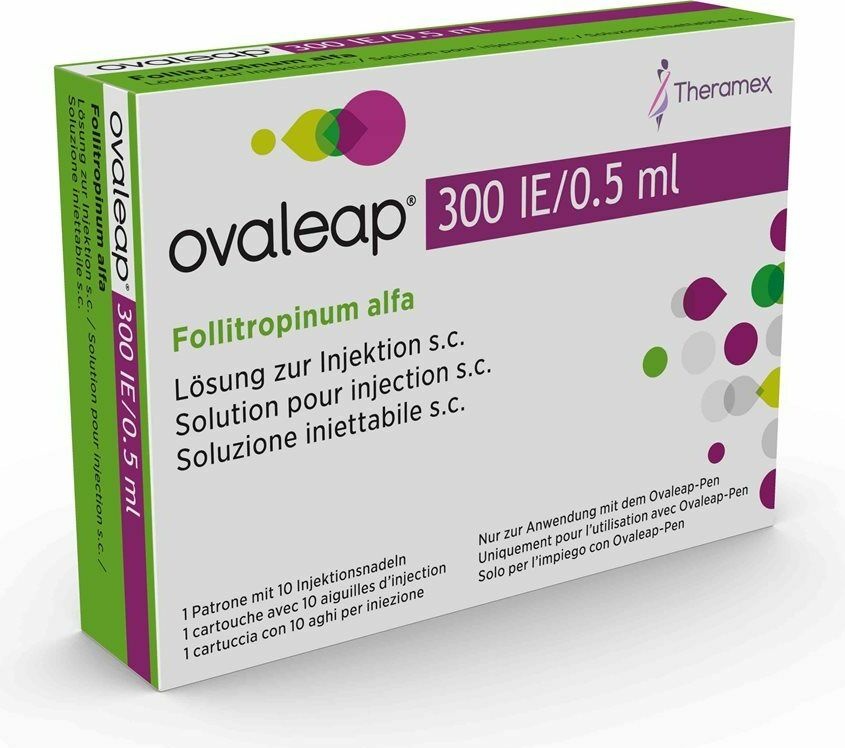
OVALEAP 300 IU/0.5 ml Injectable Solution

Prescription review online
A doctor will review your case and decide whether a prescription is medically appropriate.

Talk to a doctor about this medicine
Discuss your symptoms and possible next steps in a quick online consultation.



How to use Ovaleap 300 IU/0.5 ml Injectable Solution
Contents of the leaflet
- Introduction
- What Ovaleap is and what it is used for
- What you need to know before you use Ovaleap
- How to use Ovaleap
- Possible Adverse Effects
- Storage of Ovaleap
- Package Contents and Additional Information
Introduction
Package Leaflet: Information for the User
Ovaleap 300UI/0.5mlinjectable solution
Ovaleap 450UI/0.75mlinjectable solution
Ovaleap 900UI/1.5mlinjectable solution
Follitropin alfa
Read all of this leaflet carefully before you start using this medicine, because it contains important information for you.
- Keep this leaflet, you may need to read it again.
- If you have any further questions, ask your doctor, pharmacist, or nurse.
- This medicine has been prescribed for you only. Do not pass it on to others. It may harm them, even if their signs of illness are the same as yours.
- If you get any side effects, talk to your doctor, pharmacist, or nurse. This includes any possible side effects not listed in this leaflet.
Contents of the pack
- What Ovaleap is and what it is used for
- What you need to know before you use Ovaleap
- How to use Ovaleap
- Possible side effects
- Storage of Ovaleap
- Contents of the pack and other information
1. What Ovaleap is and what it is used for
What Ovaleap is
This medicine contains the active substance follitropin alfa, which is almost identical to a natural hormone produced by the body called "follicle-stimulating hormone" (FSH). FSH is a gonadotropin, a type of hormone that plays an important role in human fertility and reproduction. In women, FSH is necessary for the growth and development of ovarian follicles that contain eggs. In men, FSH is necessary for sperm production.
What Ovaleap is used for
In adult women, Ovaleap is used:
- to help ovulation (release of a mature egg from the follicle) in women who cannot ovulate and have not responded to treatment with a substance called "clomiphene citrate".
- to help the development of follicles in women undergoing assisted reproduction techniques (techniques that can help you become pregnant), such as "in vitro fertilization", "intratubal gamete transfer", or "intratubal embryo transfer".
- in combination with another substance called "lutropin alfa" (a version of another gonadotropin, "luteinizing hormone" or LH), to help ovulation in women whose body produces too little FSH and LH.
In adult men, Ovaleap is used:
- in combination with a substance called "human chorionic gonadotropin" (hCG), to help produce sperm in men who are infertile due to low levels of certain hormones.

Not sure if this medicine is right for you?
Discuss your symptoms and treatment with a doctor online.
2. What you need to know before you use Ovaleap
Do not use Ovaleap:
- if you are allergic to follitropin alfa, follicle-stimulating hormone (FSH), or any of the other ingredients of this medicine (listed in section 6).
- if you have a tumor in the hypothalamus or pituitary gland (parts of the brain).
- if you are a womanwith:
- large ovaries or fluid-filled sacs in the ovaries (ovarian cysts) of unknown origin.
- unexplained vaginal bleeding.
- ovarian, uterine, or breast cancer.
- any condition that normally makes pregnancy impossible, such as premature ovarian failure (early menopause), uterine fibroids, or a malformation of the reproductive organs.
- if you are a manwith:
- testicular failure that cannot be treated.
Do not use this medicine if any of the above conditions apply to you. If you are not sure, ask your doctor or pharmacist before using this medicine.
Warnings and precautions
A doctor with experience in the treatment of fertility disorders should assess your fertility and that of your partner before starting treatment.
Consult your doctor, pharmacist, or nurse before starting treatment with Ovaleap.
Porphyria
Tell your doctor before starting treatment if you or a family member has porphyria. This is a condition that can be passed from parents to children, which involves an inability to break down porphyrins (organic compounds).
Tell your doctor immediately if:
- your skin becomes fragile and blisters easily, especially in areas frequently exposed to the sun, and/or
- you have stomach, arm, or leg pain.
If you experience these symptoms, your doctor may recommend that you stop treatment.
Ovarian Hyperstimulation Syndrome (OHSS)
If you are a woman, this medicine increases the risk of OHSS. This occurs when your follicles develop too much and become large cysts.
Tell your doctor immediately if:
- you have lower abdominal (stomach) pain,
- you gain weight rapidly,
- you have nausea or vomiting,
- you have difficulty breathing.
If you experience these symptoms, your doctor may recommend that you stop using this medicine (see also section 4, under the heading "Serious side effects in women").
If you do not ovulate and follow the recommended dose and administration schedule, this syndrome is less likely to occur. Treatment with Ovaleap rarely causes severe OHSS, unless the medicine used for final follicular maturation (containing human chorionic gonadotropin, hCG) is administered. If you develop OHSS, your doctor may not prescribe hCG in this treatment cycle. You may be advised to abstain from intercourse or use barrier contraceptives for at least 4 days.
Multiple Pregnancy
If you use this medicine, you have a higher risk of becoming pregnant with more than one baby (i.e., "multiple pregnancy", usually twins) than if you become pregnant naturally. Multiple pregnancy can cause medical complications for you and your babies. You can reduce the risk of multiple pregnancy by using the correct dose of this medicine at the right times. If you undergo assisted reproduction techniques, the risk of multiple pregnancy is related to your age and the quality and number of eggs fertilized or embryos placed inside you.
Miscarriage
If you undergo assisted reproduction techniques or ovarian stimulation to produce eggs, the likelihood of having a miscarriage is higher than in the average woman.
Ectopic Pregnancy
If you undergo assisted reproduction techniques and have damaged fallopian tubes, the likelihood of having a pregnancy outside the uterus (ectopic pregnancy) is higher than in the average woman.
Congenital Anomalies
A baby conceived with assisted reproduction techniques may have a slightly higher risk of congenital anomalies than if conceived naturally. This may be associated with multiple pregnancies or characteristics of the parents, such as maternal age or sperm characteristics.
Blood Clotting Problems (Thromboembolic Events)
If you or a family member has ever had blood clots in the leg or lung, heart attack, or stroke, tell your doctor. You may have a higher risk of these problems or they may worsen with treatment with Ovaleap.
Men with High FSH Levels in the Blood
If you are a man, very high levels of natural FSH in the blood may be a sign of testicular damage. This medicine is usually not effective in these cases. If your doctor decides to try treatment with Ovaleap, your doctor may monitor you by asking you to have a semen analysis, 4 to 6 months after starting treatment.
Children and Adolescents
This medicine must not be used in children and adolescents under 18 years of age.
Other Medicines and Ovaleap
Tell your doctor or pharmacist if you are using, have recently used, or might use any other medicines.
- If you use Ovaleap with other medicines that help ovulation, such as human chorionic gonadotropin (hCG) or clomiphene citrate, your follicles' response may be increased.
- If you use Ovaleap at the same time as a gonadotropin-releasing hormone (GnRH) agonist or antagonist (these medicines decrease sex hormone levels and stop ovulation), you may need a higher dose of Ovaleap to produce follicles.
Pregnancy and Breast-feeding
Do not use this medicine if you are pregnant or breast-feeding.
Driving and Using Machines
This medicine does not affect your ability to drive or use machines.
Ovaleap contains sodium, benzalkonium chloride, and benzyl alcohol
This medicine contains less than 1 mmol of sodium (23 mg) per dose; this is essentially "sodium-free".
This medicine also contains 0.02 mg per ml of benzalkonium chloride and 10.0 mg per ml of benzyl alcohol. Consult your doctor or pharmacist if you have liver or kidney disease and if you are pregnant or breast-feeding. This is because large amounts of benzyl alcohol can accumulate in the body and cause side effects (metabolic acidosis).
3. How to use Ovaleap
Follow the instructions for administration of this medicine exactly as prescribed by your doctor or pharmacist. If you are unsure, consult your doctor or pharmacist again.
This medicine is administered by injection into the tissue just under the skin (subcutaneous injection). Your doctor or nurse will show you how to inject the medicine. If you are self-administering this medicine, read and follow the "Instructions for Use" of the pen carefully. Do not attempt to self-administer this medicine if you have not received training from your doctor or nurse. The first injection of this medicine should always be administered in the presence of a doctor or nurse.
What is the recommended dose
Your doctor will decide how much medicine to administer and how often. The doses described below are expressed in International Units (IU).
Women
If you are not ovulating and have irregular periods or no periods
- This medicine is usually administered every day.
- If you have irregular periods, start using this medicine on the first 7 days of your menstrual cycle. If you do not have periods, you can start using the medicine on any day that is convenient for you.
- The initial dose of this medicine is usually individualized and may be adjusted stepwise.
- The daily dose of this medicine should not exceed 225 IU.
- When the desired response is obtained, you will be administered hCG or "recombinant hCG" (r-hCG, a hCG made in a laboratory using a special DNA technique). The single injection will be 250 micrograms of r-hCG or 5,000 to 10,000 IU of hCG, 24 to 48 hours after the last injection of Ovaleap. The best time for intercourse is the same day as the hCG injection and the day after. Alternatively, intrauterine insemination can be performed by inserting sperm into the uterine cavity.
If your doctor does not observe the desired response, the continuation of that treatment cycle with Ovaleap should be evaluated and managed according to standard clinical practice.
If an excessive response is obtained, your treatment will be stopped and you will not be administered hCG (see also section 2, under the heading "Ovarian Hyperstimulation Syndrome (OHSS)"). For the next cycle, your doctor will administer a lower dose of Ovaleap than in the previous cycle.
If you need to develop multiple eggs for retrieval before any assisted reproduction technique
- The initial dose of this medicine is usually individualized and may be adjusted stepwise up to a maximum of 450 IU per day.
- Treatment continues until the eggs have developed to the desired point. Your doctor will check this through blood tests and/or ultrasound scans.
- When the eggs are ready, you will be administered hCG or r-hCG. The single injection will be 250 micrograms of r-hCG or 5,000 to 10,000 IU of hCG, 24 to 48 hours after the last injection of Ovaleap. This makes your eggs ready for retrieval.
If you have been diagnosed with very low levels of FSH and LH
- The usual initial dose of Ovaleap is 75 to 150 IU, together with 75 IU of lutropin alfa.
- You will use these two medicines every day for a maximum of 5 weeks.
- The dose of Ovaleap can be increased every 7 or 14 days by 37.5 to 75 IU, until the desired response is obtained.
- When the desired response is obtained, you will be administered hCG or r-hCG. The single injection will be 250 micrograms of r-hCG or 5,000 to 10,000 IU of hCG, 24 to 48 hours after the last injections of Ovaleap and lutropin alfa. The best time for intercourse is the same day as the hCG injection and the day after. Alternatively, intrauterine insemination or another medically assisted reproduction procedure can be performed, at the discretion of your doctor.
If your doctor does not observe a response after 5 weeks of treatment, that treatment cycle should be stopped. For the next cycle, your doctor will administer a higher initial dose of this medicine than before.
If an excessive response is obtained, your treatment with Ovaleap will be stopped and you will not be administered hCG (see also section 2, under the heading "Ovarian Hyperstimulation Syndrome (OHSS)"). For the next cycle, your doctor will administer a lower dose of Ovaleap than in the previous cycle.
Men
- The usual dose of this medicine is 150 IU, together with hCG.
- You will use these two medicines three times a week, for at least 4 months.
- If you have not responded to treatment after 4 months, your doctor may suggest that you continue using these two medicines for at least 18 months.
How are the injections administered?
This medicine is administered by injection into the tissue just under the skin (subcutaneous injection) using the Ovaleap Pen. The Ovaleap Pen is a device (a "pen") used for administering injections under the skin.
Your doctor may suggest that you learn to inject this medicine yourself. Your doctor or nurse will give you instructions on how to do this, and you can also find them in the separate "Instructions for Use" of the pen. Do not attempt to self-administer this medicine if you have not received this training from your doctor or nurse. The first injection of this medicine should always be administered in the presence of a doctor or nurse.
Ovaleap solution for injection in cartridges is designed for use with the Ovaleap Pen. You must carefully follow the separate "Instructions for Use" of the Ovaleap Pen. The "Instructions for Use" of the pen will be provided with the Ovaleap Pen. However, proper treatment of your condition requires constant and close collaboration with your doctor.
Discard used needles immediately after injection.
If you use more Ovaleap than you should
The effects of using too much Ovaleap are not known. However, it can be expected that OHSS may occur, which is described in section 4 under the heading "Serious side effects in women". However, this syndrome will only occur if hCG is also administered (see also section 2, under the heading "Ovarian Hyperstimulation Syndrome (OHSS)").
If you forget to use Ovaleap
Do not use a double dose to make up for forgotten doses. Consult your doctor as soon as you realize you have forgotten to take a dose.
If you have any further questions on the use of this medicine, ask your doctor, pharmacist, or nurse.

Started taking the medicine and have questions?
Discuss your symptoms and treatment with a doctor online.
4. Possible Adverse Effects
Like all medicines, this medicine can cause adverse effects, although not all people suffer from them.
Important Adverse Effects
Severe adverse effects in men and women
- Very rare cases (may affect up to 1 in 10,000 people) of allergic reactions such as skin rash, raised and itchy skin areas, and severe allergic reactions with weakness, low blood pressure, difficulty breathing, and swelling of the face have been reported. If you think you are suffering from this type of reaction, you must stop injecting Ovaleap and seek immediate medical attention.
Severe adverse effects in women
- Stomach pain, accompanied by nausea or vomiting, can be symptoms of ovarian hyperstimulation syndrome (OHSS). This may indicate that the ovaries have overreacted to treatment and large ovarian cysts have developed (see also section 2, "Ovarian Hyperstimulation Syndrome (OHSS)"). This adverse effect is frequent (may affect up to 1 in 10 people).
- Ovarian hyperstimulation syndrome can worsen with clearly enlarged ovaries, decreased urine production, weight gain, difficulty breathing, and/or possible fluid accumulation in the abdomen or chest. This adverse effect is infrequent (may affect up to 1 in 100 people).
- In rare cases (may affect up to 1 in 1,000 people), complications of ovarian hyperstimulation syndrome such as ovarian torsion or blood clotting can also occur.
- In very rare cases (may affect up to 1 in 10,000 people), serious complications of blood clotting (thromboembolic episodes) may sometimes occur, sometimes independent of ovarian hyperstimulation syndrome. This could cause chest pain, shortness of breath, stroke, or myocardial infarction (see also section 2, "Blood Clotting Problems (Thromboembolic Episodes)").
If you observe any of the above-mentioned adverse effects, you should consult your doctor immediately, who may ask you to stop treatment with Ovaleap.
Other Adverse Effects in Women
Very frequent (may affect more than 1 in 10 people)
- Local reactions at the injection site, such as pain, redness, hematoma, swelling, and/or irritation
- Headache
- Fluid-filled bags inside the ovaries (ovarian cysts)
Frequent (may affect up to 1 in 10 people)
- Stomach pain
- Abdominal flatulence
- Abdominal cramps
- Nausea
- Vomiting
- Diarrhea
Very rare (may affect up to 1 in 10,000 people)
- Asthma may worsen.
Other Adverse Effects in Men
Very frequent (may affect more than 1 in 10 people)
- Local reactions at the injection site, such as pain, redness, hematoma, swelling, and/or irritation
Frequent (may affect up to 1 in 10 people)
- Swelling of the veins above and behind the testicles (varicocele)
- Breast development
- Acne
- Weight gain
Very rare (may affect up to 1 in 10,000 people)
- Asthma may worsen.
Reporting Adverse Effects
If you experience any type of adverse effect, consult your doctor, pharmacist, or nurse, even if it is a possible adverse effect that is not listed in this prospectus. You can also report them directly through the national reporting system included in Appendix V. By reporting adverse effects, you can contribute to providing more information on the safety of this medicine.
5. Storage of Ovaleap
Keep this medicine out of sight and reach of children.
Do not use this medicine after the expiration date stated on the label and on the outer packaging after CAD. The expiration date is the last day of the month indicated.
Store in a refrigerator (between 2°C and 8°C).
Do not freeze.
Keep the cartridge in the outer packaging to protect it from light.
Before opening and within its validity period, you can remove this medicine from the refrigerator without refrigerating it again for a maximum of 3 months. Do not store at a temperature above 25°C. You must discard this medicine if it has not been used within 3 months.
Once opened, the cartridge in use within the pen can be stored for a maximum of 28 days. Do not store at a temperature above 25°C. Note the date of first use in the patient diary, which will be provided with the Ovaleap Pen.
Replace the pen cap on the Ovaleap Pen after each injection to protect the cartridge from light.
Do not use this medicine if you notice it is cloudy or contains particles.
Medicines should not be disposed of via wastewater. Ask your pharmacist how to dispose of the packaging and medicines you no longer need. This will help protect the environment.
6. Package Contents and Additional Information
Composition of Ovaleap
- The active ingredient is folitropin alfa. Ovaleap 300 UI/0.5 ml: Each cartridge contains 300 UI (equivalent to 22 micrograms) of folitropin alfa in 0.5 ml of solution. Ovaleap 450 UI/0.75 ml: Each cartridge contains 450 UI (equivalent to 33 micrograms) of folitropin alfa in 0.75 ml of solution. Ovaleap 900 UI/1.5 ml: Each cartridge contains 900 UI (equivalent to 66 micrograms) of folitropin alfa in 1.5 ml of solution.
Each milliliter of the solution contains 600 UI (equivalent to 44 micrograms) of folitropin alfa.
- The other ingredients are sodium dihydrogen phosphate dihydrate, sodium hydroxide (2 M) (for pH adjustment), mannitol, methionine, polysorbate 20, benzyl alcohol, benzalkonium chloride, and water for injectable preparations.
All the above-mentioned presentations contain the other ingredients.
Appearance and Package Contents
Ovaleap is an injectable solution (injection). Ovaleap is a clear and colorless solution.
Ovaleap 300 UI/0.5 ml is presented in boxes containing 1 cartridge and 10 injection needles. Ovaleap 450 UI/0.75 ml is presented in boxes containing 1 cartridge and 10 injection needles. Ovaleap 900 UI/1.5 ml is presented in boxes containing 1 cartridge and 20 injection needles.
Only some pack sizes may be marketed.
Marketing Authorization Holder
Theramex Ireland Limited
3rd Floor, Kilmore House,
Park Lane, Spencer Dock,
Dublin 1
D01 YE64
Ireland
Manufacturer
Merckle GmbH
Graf-Arco-Straße 3
89079 Ulm,
Germany
Rechon Life Science AB
Soldattorpsvägen 5
216 13 Limhamn
Sweden
Date of Last Revision of this Prospectus: {month YYYY}.
Detailed information on this medicine is available on the European Medicines Agency website: http://www.ema.europa.eu.
- Country of registration
- Dosage formINJECTABLE PERFUSION, 600 IU/ml
- ATC codeG03GA05
- Active substance
- Prescription requiredYes
- Manufacturer
- CompositionDIHIDROGENOFOSFATO DE SODIO DIHIDRATO (7.8 mg mg), MANITOL (E-421) (5.0 mg mg), POLISORBATO 20 (0.2 mg mg), ALCOHOL BENCILICO (10.0 mg mg), BENZALCONIO, CLORURO DE (0.02 mg mg), HIDROXIDO DE SODIO (E 524) (1.57 mg mg)
- This information is for reference only and does not constitute medical advice. Always consult a doctor before taking any medication. Oladoctor is not responsible for medical decisions based on this content.
- Alternatives to Ovaleap 300 IU/0.5 ml Injectable SolutionDosage form: INJECTABLE, 150 IU/ 0.25 ml (11 micrograms/ 0.25 ml)Active substance: follitropin alfaManufacturer: Gedeon Richter Plc.Prescription requiredDosage form: INJECTABLE, 150 IU/ 0.25 ml (11 micrograms/ 0.25 ml)Active substance: follitropin alfaManufacturer: Gedeon Richter Plc.Prescription requiredDosage form: INJECTABLE, 150 IU/0.25 ml (11 micrograms/0.25 ml)Active substance: follitropin alfaManufacturer: Gedeon Richter Plc.Prescription required
Online doctors for Ovaleap 300 IU/0.5 ml Injectable Solution
Discuss questions about Ovaleap 300 IU/0.5 ml Injectable Solution, including use, safety considerations and prescription review, subject to medical assessment and local regulations.
Get Ovaleap 300 IU/0.5 ml Injectable Solution Prescription Online
Fill in a 2-min form
Tell us your symptoms, history, and what medicine you're requesting.
Pick a doctor or let us assign
Choose a specialist or we'll match you with the next available doctor.
Doctor reviews your case
Usually within 30 minutes. They may ask follow-up questions via chat.
Collect from any pharmacy
Electronic prescription sent to your email — valid across Spain.
Frequently Asked Questions
Ovaleap 300 IU/0.5 ml Injectable Solution requires a prescription in Spain. You can check with a doctor online whether this medicine may be appropriate for your situation.
The active ingredient in Ovaleap 300 IU/0.5 ml Injectable Solution is follitropin alfa. This information helps identify medicines with the same composition but different brand names.
Ovaleap 300 IU/0.5 ml Injectable Solution is manufactured by Theramex Ireland Limited. Pharmacy brands and packaging may differ depending on the distributor.
Doctors such as Family doctors, Psychiatrists, Dermatologists, Cardiologists, Endocrinologists, Gastroenterologists, Pulmonologists, Nephrologists, Rheumatologists, Hematologists, Infectious disease physicians, Allergists, Geriatricians, Paediatricians, Oncologists may assess whether Ovaleap 300 IU/0.5 ml Injectable Solution is appropriate, depending on your situation and local regulations. You can book an online consultation to discuss your symptoms and possible next steps.
Spain has a well-developed healthcare infrastructure across major cities such as Madrid, Barcelona, Valencia, and Seville. Pharmacies are widely available and operate under strict regulations, ensuring access to prescribed medications.
You can buy Ovaleap 300 IU/0.5 ml Injectable Solution in Madrid, Barcelona, Seville, or Valencia at any local pharmacy with a valid prescription.
To obtain a prescription, you can use Oladoctor:
Other medicines with the same active substance (follitropin alfa) include BEMFOLA 150 IU/0.25 ml injectable solution in a pre-filled pen, BEMFOLA 150 IU/0.25 ml injectable solution in a pre-filled pen, BEMFOLA 150 IU/0.25ml injectable solution in a pre-filled pen. These may have different brand names or formulations but contain the same therapeutic ingredient. Always consult a doctor before switching or starting a new medicine.
