


Orserdu 86 mg comprimidos recubiertos con película

Prescription review online
A doctor will review your case and decide whether a prescription is medically appropriate.

Talk to a doctor about this medicine
Discuss your symptoms and possible next steps in a quick online consultation.



How to use ORSERDU 86 mg FILM-COATED TABLETS
Contents of the leaflet
- Introduction
- What is ORSERDU and what is it used for
- What you need to know before you take ORSERDU
- How to take ORSERDU
- Possible side effects
- Storage of ORSERDU
- Contents of the pack and other information
Introduction
Package Leaflet: Information for the Patient
ORSERDU 86mg film-coated tablets
ORSERDU 345mg film-coated tablets
elacestrant
This medicinal product is subject to additional monitoring, which will allow for quick identification of new safety information. You can help by reporting any side effects you may get. The last section of the leaflet includes information on how to report side effects.
Read all of this leaflet carefully before you start taking this medicine, because it contains important information for you.
- Keep this leaflet, you may need to read it again.
- If you have any further questions, ask your doctor or pharmacist.
- This medicine has been prescribed for you only. Do not pass it on to others. It may harm them, even if their signs of illness are the same as yours.
- If you get any side effects, talk to your doctor, pharmacist or nurse. This includes any possible side effects not listed in this leaflet. See section 4.
Contents of the pack
- What is ORSERDU and what is it used for
- What you need to know before you take ORSERDU
- How to take ORSERDU
- Possible side effects
- Storage of ORSERDU
- Contents of the pack and other information
1. What is ORSERDU and what is it used for
What is ORSERDU
ORSERDU contains the active substance elacestrant, which belongs to a group of medicines called selective estrogen receptor degraders.
What is ORSERDU used for
This medicine is used to treat adult men and postmenopausal women with a specific type of advanced or metastatic breast cancer. It can be used to treat breast cancer that is estrogen receptor (ER) positive, which means that the cancer cells have estrogen receptors on their surface, and human epidermal growth factor receptor 2 (HER2) negative, which means that the cancer cells do not have or have only a small amount of this receptor on their surface. ORSERDU is used as monotherapy (on its own) in patients whose cancer has not responded or has progressed after at least one line of hormonal treatment that includes a CDK 4/6 inhibitor and who have certain changes (mutations) in a gene called ESR1.
Your doctor will take a blood sample, which will be tested to detect these mutations in ESR1. A positive result is required to start treatment with ORSERDU.
How ORSERDU works
Estrogen receptors are a group of proteins found inside cells. They are activated when the estrogen hormone binds to them. By binding to these receptors, estrogen can, in some cases, stimulate the growth and proliferation of cancer cells. ORSERDU contains the active substance elacestrant, which binds to the estrogen receptors of cancer cells and stops their activity. By blocking and destroying estrogen receptors, ORSERDU can reduce the growth and spread of breast cancer and help destroy cancer cells.
If you have any questions about how ORSERDU works or why you have been prescribed this medicine, ask your doctor, pharmacist or nurse.

Not sure if this medicine is right for you?
Discuss your symptoms and treatment with a doctor online.
2. What you need to know before you take ORSERDU
Do not take ORSERDU
- if you are allergic to elacestrant or any of the other ingredients of this medicine (listed in section 6).
Warnings and precautions
Talk to your doctor or pharmacist before starting ORSERDU.
- if you have any liver disease (some examples of liver disease are cirrhosis [scarring of the liver], liver impairment or cholestatic jaundice [yellowing of the skin and eyes due to a decrease in bile flow from the liver]). Your doctor will monitor you regularly and closely for adverse reactions.
As you have advanced breast cancer, you may have a higher risk of developing blood clots in the veins (a type of blood vessel). It is not known if ORSERDU also increases this risk.
Children and adolescents
ORSERDU should not be given to children and adolescents under 18 years of age.
Other medicines and ORSERDU
Tell your doctor or pharmacist if you are taking, have recently taken or might take any other medicines. This is because ORSERDU may affect the way other medicines work. Also, other medicines may affect the way ORSERDU works.
Tell your doctor if you are taking any of the following medicines:
- antibiotics to treat bacterial infections (such as ciprofloxacin, clarithromycin, erythromycin, rifampicin, telithromycin);
- medicines for low sodium levels in the blood (such as conivaptan);
- medicines for depression (such as nefazodone or fluvoxamine);
- medicines for anxiety and alcohol withdrawal (such as tofisopam);
- medicines for the treatment of other types of cancer (such as crizotinib, dabrafenib, imatinib, lorlatinib or sotorasib);
- medicines for high blood pressure or chest pain (such as bosentan, diltiazem or verapamil);
- medicines for fungal infections (such as fluconazole, isavuconazole, itraconazole, ketoconazole, posaconazole or voriconazole);
- medicines for HIV infection (such as efavirenz, etravirine, indinavir, lopinavir, ritonavir, nelfinavir, saquinavir or telaprevir);
- medicines for irregular heartbeats (such as digoxin, dronedarone or quinidine);
- medicines used in organ transplants to prevent rejection (such as cyclosporin);
- medicines to prevent cardiovascular disease and to treat high cholesterol (such as rosuvastatin);
- medicines used to prevent seizures (such as carbamazepine, cenobamate, phenobarbital, phenytoin or primidone);
- medicines for nausea and vomiting (such as aprepitant);
- herbal medicines for depression that contain St. John's Wort.
ORSERDU with food and drink
Do not take grapefruit juice or eat grapefruit during treatment with ORSERDU, as it may change the amount of ORSERDU in your body and increase the side effects of ORSERDU (see section 3 "How to take ORSERDU").
Pregnancy, breastfeeding and fertility
This medicine should only be used in men and postmenopausal women.
Pregnancy
ORSERDU may harm the fetus. Do not take ORSERDU if you are pregnant, think you may be pregnant or plan to become pregnant. If you think you may be pregnant or plan to become pregnant, talk to your doctor or pharmacist before using this medicine.
If you are a woman who could become pregnant, you must use effective contraceptive methods during treatment with ORSERDU and for up to one week after stopping treatment with ORSERDU. Ask your doctor about suitable contraceptive methods. If you are a woman who could become pregnant, your doctor will rule out a possible pregnancy before starting treatment with ORSERDU. This may include a pregnancy test.
Breastfeeding
Do not breastfeed during treatment with ORSERDU and for up to one week after the last dose of ORSERDU. During treatment, your doctor will discuss the possible risks of taking ORSERDU during pregnancy or breastfeeding.
Fertility
ORSERDU may affect fertility in women and men.
Driving and using machines
ORSERDU has no or negligible influence on the ability to drive and use machines. However, since fatigue, weakness and difficulty sleeping have been reported in some patients taking elacestrant, patients who experience these adverse reactions should be cautious when driving or using machines.
3. How to take ORSERDU
Always take this medicine exactly as your doctor or pharmacist has told you. If you are not sure, check with your doctor or pharmacist.
ORSERDU should be taken with food, just avoid grapefruit and grapefruit juice during treatment with ORSERDU (see section 2 "ORSERDU with food and drink"). Taking ORSERDU with food may reduce nausea and vomiting.
Take your dose of this medicine at about the same time each day. This will help you to remember to take your medicine.
The tablets of ORSERDU should be swallowed whole. Do not chew, crush or break them before swallowing. Do not take tablets that are broken, cracked or damaged.
The recommended dose of ORSERDU is 345 mg (one 345 mg film-coated tablet) once a day. Your doctor will tell you exactly how many tablets to take. In certain situations (e.g. in case of liver problems, side effects or if you are also taking other medicines), your doctor may tell you to take a lower dose of ORSERDU, e.g. 258 mg (3 x 86 mg tablets) once a day, 172 mg (2 x 86 mg tablets) once a day, or 86 mg (1 x 86 mg tablet) once a day.
If you take more ORSERDU than you should
Tell your doctor or pharmacist if you think you have taken more ORSERDU than you should. They will decide what to do.
If you forget to take ORSERDU
If you forget to take a dose of ORSERDU, take it as soon as you remember. You can take the missed dose up to 6 hours after the time you should have taken it. If more than 6 hours have passed or if you vomit after taking the dose, skip the dose for that day and take the next dose at the usual time the next day. Do not take a double dose to make up for a forgotten dose.
If you stop taking ORSERDU
Do not stop taking this medicine without talking to your doctor or pharmacist first. If you stop taking ORSERDU, your disease may get worse.
If you have any further questions on the use of this medicine, ask your doctor or pharmacist.

Started taking the medicine and have questions?
Discuss your symptoms and treatment with a doctor online.
4. Possible side effects
Like all medicines, this medicine can cause side effects, although not everybody gets them.
Tell your doctor or nurse if you notice any of the following side effects:
Very common(may affect more than 1 in 10 people)
- Decreased appetite
- Nausea
- Increased levels of triglycerides and cholesterol in the blood
- Vomiting
- Fatigue
- Indigestion (dyspepsia)
- Diarrhea
- Decreased levels of calcium in the blood
- Back pain
- Increased levels of creatinine in the blood
- Joint pain (arthralgia)
- Decreased levels of sodium in the blood
- Constipation
- Headache
- Hot flushes
- Abdominal pain
- Low levels of red blood cells, as determined in blood tests (anemia)
- Decreased levels of potassium in the blood
- Elevated liver function, as determined in blood tests (elevated alanine aminotransferase, elevated aspartate aminotransferase)
Common(may affect up to 1 in 10 people)
- Pain in hands and feet (pain in a limb)
- Weakness (asthenia)
- Infection of the parts of the body that collect and expel urine (urinary tract infection)
- Cough
- Shortness of breath (dyspnea)
- Difficulty sleeping (insomnia)
- Elevated liver function, as determined in blood tests (elevated alkaline phosphatase)
- Rash
- Low levels of lymphocytes (a type of white blood cell), as determined in blood tests (decreased lymphocyte count)
- Bone pain
- Dizziness
- Chest pain related to the muscles and bones of the chest (musculoskeletal chest pain)
- Inflammation of the mouth and lips (stomatitis)
- Fainting (syncope)
Uncommon(may affect up to 1 in 100 people)
- Increased risk of blood clots (thromboembolism)
- Liver failure (acute liver failure)
Reporting of side effects
If you experience any side effects, talk to your doctor, pharmacist or nurse. This includes any possible side effects not listed in this leaflet. You can also report side effects directly via the national reporting system listed in Appendix V. By reporting side effects, you can help provide more information on the safety of this medicine.
5. Storage of ORSERDU
Keep this medicine out of the sight and reach of children.
Do not use this medicine after the expiry date which is stated on the carton and blister pack after EXP. The expiry date is the last day of the month shown.
This medicine does not require any special storage conditions.
Do not use this medicine if you notice that the packaging is damaged or if there are signs of tampering with the closure.
Medicines should not be disposed of via wastewater or household waste. Ask your pharmacist how to dispose of medicines no longer required. These measures will help protect the environment.
6. Contents of the pack and other information
Composition of ORSERDU
- The active substance is elacestrant.
- Each 86 mg film-coated tablet of ORSERDU contains 86.3 mg of elacestrant.
- Each 345 mg film-coated tablet of ORSERDU contains 345 mg of elacestrant.
- The other ingredients are:
Core of the tablets
Microcrystalline cellulose [E460]
Silicified microcrystalline cellulose
Crospovidone [E1202]
Magnesium stearate [E470b]
Colloidal silicon dioxide [E551]
Coating of the tablets
Opadry II 85F105080 Blue with polyvinyl alcohol [E1203], titanium dioxide [E171], macrogol [E1521], talc [E553b] and brilliant blue FCF aluminum lake [E133]
Appearance and packaging
ORSERDU is supplied as film-coated tablets in aluminum blisters.
ORSERDU 86 mg film-coated tablets
Film-coated tablet, round and biconvex, blue to light blue in color, with the imprint "ME" on one side and smooth on the other side. Approximate diameter: 8.8 mm.
ORSERDU 345 mg film-coated tablets
Film-coated tablet, oval and biconvex, blue to light blue in color, with the imprint "MH" on one side and smooth on the other side. Approximate size: 19.2 mm (length), 10.8 mm (width).
Each pack contains 28 film-coated tablets (4 blisters with 7 tablets each).
Marketing authorisation holder
Stemline Therapeutics B.V.
Basisweg 10
1043 AP Amsterdam
Netherlands
Manufacturer
Stemline Therapeutics B.V.
Basisweg 10
1043 AP Amsterdam
Netherlands
or
Berlin Chemie AG
Glienicker Weg 125
12489 Berlin
Germany
You can request more information about this medicine from the local representative of the marketing authorisation holder:
België/Belgique/Belgien; ????????; Ceská republika; Danmark; Eesti; Ελλ?δα; Hrvatska; Ireland; Ísland; Κ?προς; Latvija; Lietuva; Luxembourg/Luxemburg; Magyarország; Malta; Nederland; Norge; Polska; Portugal; România; Slovenija; Slovenská republika; Suomi/Finland; Sverige Stemline Therapeutics B.V. Tel: +44 (0)800 047 8675 | Italia Menarini Stemline Italia Srl Tel: +39 800776814 |
DeutschlandMenarini Stemline Deutschland GmbH Tel: +49 (0)800 0008974 | ÖsterreichStemline Therapeutics B.V. Tel: +43 (0)800 297 649 |
España Menarini Stemline España, S.L.U. Tel: +34919490327 | |
France Stemline Therapeutics B.V. Tél: +33 (0)800 991014 |
Date of last revision of this leaflet:
Detailed information on this medicine is available on the European Medicines Agency website: http://www.ema.europa.eu/.
- Country of registration
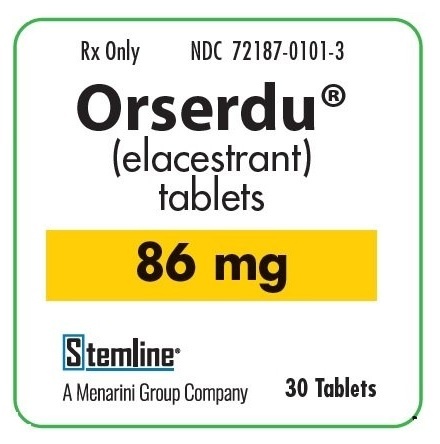
- Dosage formTABLET, 86 mg
- ATC codeL02BA04
- Active substance
- Prescription requiredYes
- Manufacturer
- This information is for reference only and does not constitute medical advice. Always consult a doctor before taking any medication. Oladoctor is not responsible for medical decisions based on this content.
- Alternatives to ORSERDU 86 mg FILM-COATED TABLETSDosage form: TABLET, 345 mgActive substance: elacestrantManufacturer: Stemline Therapeutics B.V.Prescription requiredDosage form: INJECTABLE, 250 mg/5 mlActive substance: fulvestrantManufacturer: Bexal Farmaceutica S.A.Prescription requiredDosage form: INJECTABLE, 250 mgActive substance: fulvestrantManufacturer: Ever Valinject GmbhPrescription required
Online doctors for ORSERDU 86 mg FILM-COATED TABLETS
Discuss questions about ORSERDU 86 mg FILM-COATED TABLETS, including use, safety considerations and prescription review, subject to medical assessment and local regulations.


Frequently Asked Questions
ORSERDU 86 mg FILM-COATED TABLETS requires a prescription in Spain. You can check with a doctor online whether this medicine may be appropriate for your situation.
The active ingredient in ORSERDU 86 mg FILM-COATED TABLETS is elacestrant. This information helps identify medicines with the same composition but different brand names.
ORSERDU 86 mg FILM-COATED TABLETS is manufactured by Stemline Therapeutics B.V.. Pharmacy brands and packaging may differ depending on the distributor.
Doctors such as Family doctors, Psychiatrists, Dermatologists, Cardiologists, Endocrinologists, Gastroenterologists, Pulmonologists, Nephrologists, Rheumatologists, Hematologists, Infectious disease physicians, Allergists, Geriatricians, Paediatricians, Oncologists may assess whether ORSERDU 86 mg FILM-COATED TABLETS is appropriate, depending on your situation and local regulations. You can book an online consultation to discuss your symptoms and possible next steps.
The prescription is issued by a doctor after assessing your health. In Spain, ORSERDU 86 mg FILM-COATED TABLETS is then dispensed in pharmacies with that prescription. An online consultation does not guarantee that a prescription will be issued: the decision always rests with the doctor.
To request a review, you can use Oladoctor:
Other medicines with the same active substance (elacestrant) include ORSERDU 345 mg FILM-COATED TABLETS, AFULTRANT 250 mg Injectable Solution in Pre-filled Syringe, AMBIFUL 250 mg SOLUTION FOR INJECTION IN PRE-FILLED SYRINGE. These may have different brand names or formulations but contain the same therapeutic ingredient. Always consult a doctor before switching or starting a new medicine.
