



NORADRENALINA 1 mg /Ml Injectable Perfusion

Prescription review online
A doctor will review your case and decide whether a prescription is medically appropriate.

Talk to a doctor about this medicine
Discuss your symptoms and possible next steps in a quick online consultation.



How to use NORADRENALINE AGUETTANT 1 mg/ml CONCENTRATE FOR INFUSION SOLUTION
Contents of the leaflet
- Introduction
- What is Noradrenaline Aguettant Concentrate and what is it used for
- What you need to know before you are given Noradrenaline Aguettant Concentrate
- How Noradrenaline Aguettant Concentrate is given
- Possible side effects
- Storing Noradrenaline Aguettant Concentrate
- Contents of the pack and other information
Introduction
Package Leaflet: Information for the User
Noradrenaline Aguettant 1 mg/ml
Concentrate for Solution for Infusion
Norepinephrine
Read all of this leaflet carefully before you start using this medicine because it contains important information for you.
- Keep this leaflet, you may need to read it again.
- If you have any further questions, ask your doctor, pharmacist, or nurse.
- This medicine has been prescribed for you only. Do not pass it on to others. It may harm them, even if their signs of illness are the same as yours.
- If you get any side effects, talk to your doctor, pharmacist, or nurse. This includes any possible side effects not listed in this leaflet. See section 4.
Contents of the pack
- What is Noradrenaline Aguettant and what is it used for
- What you need to know before you are given Noradrenaline Aguettant
- How Noradrenaline Aguettant is given
- Possible side effects
- Storing Noradrenaline Aguettant
- Contents of the pack and other information
1. What is Noradrenaline Aguettant Concentrate and what is it used for
Noradrenaline Aguettant contains the active substance noradrenaline and causes the blood vessels to constrict (vasoconstriction).
Noradrenaline is indicated in adults for the emergency restoration of blood pressure in cases of acute hypotension (low blood pressure).

Not sure if this medicine is right for you?
Discuss your symptoms and treatment with a doctor online.
2. What you need to know before you are given Noradrenaline Aguettant Concentrate
Noradrenaline Aguettant should not be given to you
- if you are allergic to noradrenaline or any of the other ingredients of this medicine (listed in section 6);
- if you are hypotensive (have low blood pressure) due to hypovolemia (low blood volume);
- if you are taking certain anesthetics such as halothane or cyclopropane (this may increase the risk of irregular heartbeats).
Warnings and precautions
Tell your doctor, pharmacist, or nurse before you are given Noradrenaline Aguettant:
- if you have significant left ventricular dysfunction (heart disease);
- if you have coronary vascular thrombosis (blood clot in the heart), mesenteric (blood clot in the intestine), or peripheral (blood clot in the arm or leg);
- if you have hypotension (low blood pressure) after a heart attack;
- if you have variant angina (Prinzmetal's angina);
- if you have cardiac rhythm disorders during treatment – you may need a reduced dose;
- if you have hyperthyroidism (thyroid problems);
- if you have diabetes mellitus;
- if you are elderly.
Additional monitoring tests you may need to undergo during treatment:
Your blood pressure and heart rate will be monitored frequently during treatment to avoid hypertension (high blood pressure).
Children and adolescents
The safety and efficacy of noradrenaline in children under 18 years have not been established. Therefore, it is not recommended for use in children.
Other medicines and Noradrenaline Aguettant
Tell your doctor or pharmacist if you are taking, have recently taken, or might take any other medicines.
The following medicines may affect the effect of Noradrenaline Aguettant
- Halothane, cyclopropane, chloroform, enflurane, or other halogenated anestheticsare contraindicated (see section 2 of this leaflet, subsection “Noradrenaline Aguettant should not be given to you”): these medicines are anesthetics, cause numbness, and are used before some operations. If you are taking these medicines in addition to noradrenaline, this may increase the risk of irregular heartbeats.
- Amitriptyline, imipramine, trimipramine, moclobemide, iproniazid, phenelzine, fluoxetine, sertraline, desipramine: these medicines are used to treat depression. Taking any of these medicines with noradrenaline may increase its concentration in the blood and therefore its vasoconstrictor effect.
- Digitalis glycosidesmay occasionally cause irregular heartbeats.
- Levodopamay enhance the effects of noradrenaline.
- Antihistamines, as some may block the uptake of catecholamines by peripheral tissues and increase the toxicity of injected noradrenaline.
- Chlorpheniramine hydrochloride, tripelennamine hydrochloride: significantly increase the toxicity of noradrenaline.
- Non-selective MAO inhibitors(or within 14 days after stopping such therapy): increase the pressor action of the sympathomimetic, which is usually moderate. They should only be used under strict medical supervision.
- Selective MAO-A inhibitors: by extrapolation from non-selective MAO inhibitors, risk of increased pressor action. Should only be used under close medical supervision.
- Linezolid, an antibiotic (medicine used to treat infections caused by bacteria and other microorganisms), may increase the concentration of noradrenaline in the blood and therefore its vasoconstrictor effect when taken together.
- Alpha and beta-blockers: if you are taking these medicines in addition to noradrenaline, this may increase the risk of severe hypertension (high blood pressure).
- Thyroid hormones, cardiac glycosides (heart), antiarrhythmic agents: if you are taking these medicines in addition to noradrenaline, this may cause an increase in cardiac effects (heart).
- Alkaloids of ergot or oxytocinmay enhance the vasoconstrictor and vasopressor effects (increase blood pressure).
- Desmopressin or vasopressin: their antidiuretic effect is decreased.
- Lithium: decreases the effect of noradrenaline.
- Guanethidine, guanadrel, reserpine, methyldopa, or tricyclic antidepressants, amphetamine, doxapram, mazindol, alkaloids of rauwolfia: may enhance the effects of noradrenaline.
- Propofol: concomitant administration may cause propofol infusion syndrome (PRIS).
Pregnancy and breastfeeding
If you are pregnant or breastfeeding, think you may be pregnant, or are planning to have a baby, ask your doctor for advice before taking this medicine. Noradrenaline may harm the fetus. Your doctor will decide whether you should be given noradrenaline.
It is not known whether this medicine is excreted in breast milk. As many medicines are excreted in breast milk, caution should be exercised when noradrenaline is administered to a breastfeeding woman.
Driving and using machines
As this medicine will be given to you in a hospital, your doctor will inform you when you can drive or use machines.
Noradrenaline Aguettant contains sodium
This medicine contains 3.3 mg of sodium (main component of cooking/table salt) per ml. This is equivalent to 0.16% of the maximum recommended daily intake of sodium for an adult.
3. How Noradrenaline Aguettant Concentrate is given
Noradrenaline Aguettant will be given to you by a doctor or nurse in a hospital.
Dose
Noradrenaline Aguettant is first diluted and then infused into a vein. It must not be mixed with other medicines. The dose of noradrenaline depends on the patient's condition. Your doctor will know what dose is best for you. The initial dose is 0.4 to 0.8 mg per hour of noradrenaline (equivalent to 0.8 to 1.6 mg per hour of noradrenaline tartrate). The dose may then be adjusted using a pump according to the response to treatment, with the aim of establishing normal blood pressure. Your doctor will monitor your blood pressure and blood volume.
If you are given too much Noradrenaline Aguettant
It is unlikely that you will be given too much of this medicine, as it will be given to you in a hospital. However, tell your doctor or nurse if you have any concerns.
In case of overdose or accidental ingestion, contact the Toxicological Information Service. Telephone (91) 562 04 20.
The symptoms that may occur if you are given too much noradrenaline are severe high blood pressure, slow heart rate, severe headache, sensitivity to light, chest pain, cerebral hemorrhage, paleness, fever, excessive sweating, and vomiting, fluid in the lungs causing difficulty breathing.
If you have any further questions on the use of this product, ask your doctor, pharmacist, or nurse.

Started taking the medicine and have questions?
Discuss your symptoms and treatment with a doctor online.
4. Possible side effects
Like all medicines, this medicine can cause side effects, although not everybody gets them.
The frequency of side effects is unknown (frequency cannot be estimated from the available data).
Tell your doctor or nurse immediatelyif you experience:
- difficulty or irregularity in breathing,
- fast, slow, or irregular heartbeat, palpitations
- chest or throat pain
Tell your doctor or nurse as soon as possible if you experience:
- anxiety, insomnia, confusion, headaches, psychotic state, weakness, tremor, decreased alertness, anorexia, nausea, vomiting
- high blood pressure
- paleness (loss of skin color), sweating, sensitivity to light, gangrene (painful and cold limbs that may turn purple or very dark/black, with tissue necrosis)
- skin necrosis if the infusion is not administered directly into the vein
- acute glaucoma (eye problem)
- skin scarification, bluish discoloration of the skin, hot flashes or skin redness, skin rash, urticaria, or itching
- urinary retention
Reporting of side effects
If you get any side effects, talk to your doctor, pharmacist, or nurse. This includes any possible side effects not listed in this leaflet. You can also report side effects directly via the Spanish Medicines Agency's website: www.notificaRAM.es.
By reporting side effects, you can help provide more information on the safety of this medicine.
5. Storing Noradrenaline Aguettant Concentrate
Keep this medicine out of the sight and reach of children.
Do not use this medicine after the expiry date which is stated on the carton and on the label of the ampoule after EXP. The expiry date is the last day of the month shown.
Do not store above 25°C. Store the ampoule in the outer packaging to protect it from light.
Medicines should not be disposed of via wastewater or household waste. Ask your pharmacist how to dispose of medicines no longer required. These measures will help protect the environment.
6. Contents of the pack and other information
What Noradrenaline Aguettant contains
The active substance is noradrenaline (norepinephrine).
Each ml of concentrate for solution for infusion contains 2 mg of noradrenaline tartrate (norepinephrine), equivalent to 1 mg of noradrenaline (norepinephrine).
Each 4 ml ampoule contains 8 mg of noradrenaline tartrate (norepinephrine), equivalent to 4 mg of noradrenaline (norepinephrine).
Each 8 ml ampoule contains 16 mg of noradrenaline tartrate (norepinephrine), equivalent to 8 mg of noradrenaline (norepinephrine).
The other ingredients are sodium chloride, sodium hydroxide, or hydrochloric acid and water for injections.
Appearance and packaging
Clear, colorless, or slightly yellowish solution, pH 3.0 to 4.0, in a 4 ml or 8 ml glass ampoule.
Packs of 10, 50, or 100 ampoules.
Not all pack sizes may be marketed.
Marketing Authorisation Holder
Laboratoire Aguettant
1 rue Alexander Fleming
69007 Lyon
France
Manufacturer
Laboratoire Aguettant
1 rue Alexander Fleming
69007 Lyon
France
or
Delpharm Tours
Rue Paul Langevin
37 170 Chambray-Les-Tours
France
or
Haupt Pharma Livron
1 rue Comte de Sinard,
26250 Livron Sur Drome
France
Local Representative:
Aguettant Ibérica S.L.
Baldiri Reixac, 4-8, Torre I, 4º
08028 Barcelona
Spain
This medicine is authorized in the Member States of the European Economic Area (EEA) and in the United Kingdom (Northern Ireland) under the following names:
BE, LU: Noradrenaline (Norepinephrine) Aguettant
NL: Noradrenaline Aguettant
ES: Noradrenalina Aguettant
BG: Noradrenalin Aguettant
DK, FI, IS, NO, SE: Noradrenalin Laboratoire Aguettant
AT, DE: Norepinephrin Aguettant
UK (NI), IE: Noradrenaline (Norepinephrine)
PT: Noradrenalina tartarato Aguettant
IT: Noradrenalina tartrato Laboratoire Aguettant
Date of last revision of this leaflet 02/2025
Detailed information on this medicine is available on the website of the Spanish Agency for Medicines and Health Products (AEMPS) (http://www.aemps.gob.es/)
The following information is intended for healthcare professionals only:
Method of administration
Intravenous use only after dilution. For single use.
Infusion should be performed at a controlled rate using a syringe pump, infusion pump, or drip counter.
Instructions for dilution
This product should be visually inspected before administration. Only a clear, colorless, or slightly yellowish solution, free of particles or precipitates, should be used. Do not use ampoules with a pink or darker color than light yellow or those containing a precipitate.
Add 2 ml of Noradrenaline Aguettant to 48 ml of 5% dextrose (or sodium chloride 9 mg/ml (0.9%), or isotonic saline solution with dextrose) for administration via syringe pump.
Or add 20 ml of Noradrenaline Aguettant to 480 ml of 5% dextrose (or sodium chloride 9 mg/ml (0.9%), or isotonic saline solution with dextrose) for administration via drip counter.
When diluted, the final concentration of the infusion solution is generally 40 mg/liter of noradrenaline (equivalent to 80 mg/liter of noradrenaline tartrate).
If other dilutions are used, carefully check the calculation before starting treatment.
In the absence of specific data, this medicine should not be mixed with other medicines.
After dilution: The chemical and physical stability of the diluted product (in 5% dextrose, sodium chloride 9 mg/ml (0.9%), or dextrose in isotonic saline solution) has been demonstrated for 48 hours at 30°C.
However, from a microbiological point of view, the diluted product should be used immediately. If the product is not used immediately, the duration and conditions of use are the responsibility of the user.
Posology
Initial infusion rate:
The initial infusion rate should be between 10 ml/hour and 20 ml/hour (0.16 ml/minute to 0.33 ml/minute). This is equivalent to 0.4 mg/hour to 0.8 mg/hour of noradrenaline (equivalent to 0.8 mg/hour to 1.6 mg/hour of noradrenaline tartrate).
Dose adjustment:
Once the noradrenaline infusion is established, the dose should be adjusted according to the observed pressor effect. There is great individual variability in the dose required to achieve and maintain normotension. The goal should be to establish a normal low systolic blood pressure (100-120 mmHg) or to achieve an adequate mean arterial pressure (greater than 65 to 80 mmHg, depending on the patient's condition).
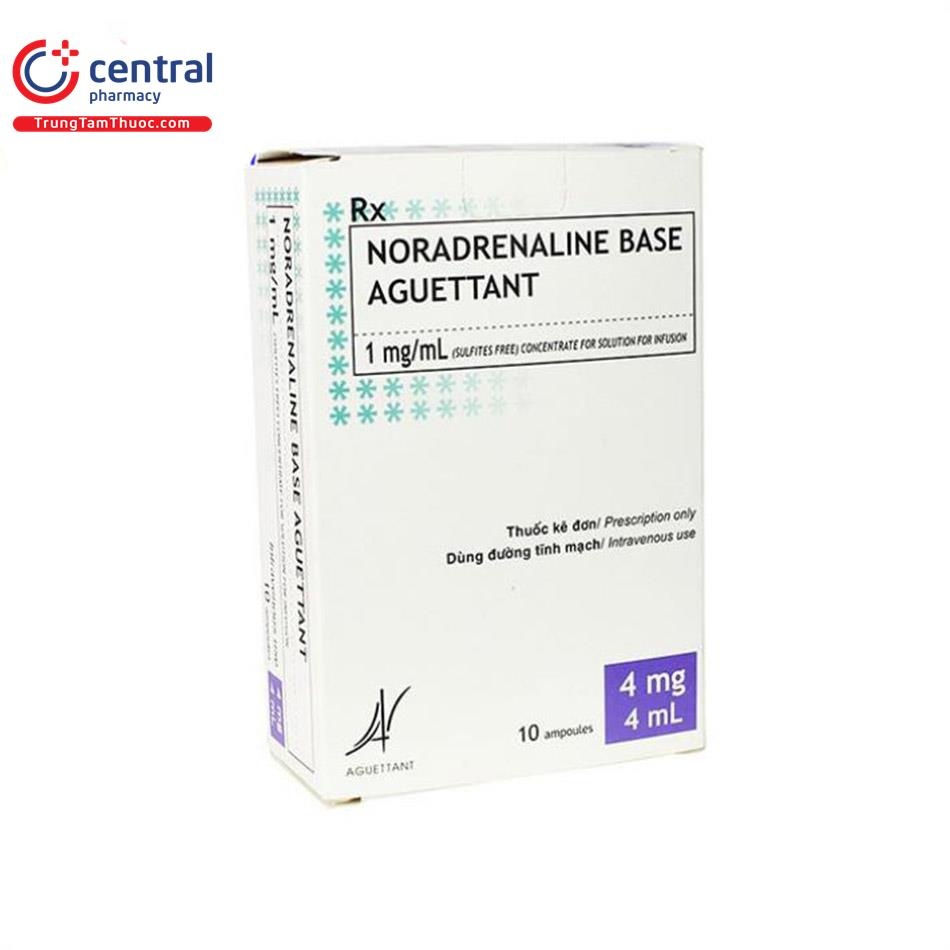
- Country of registration
- Dosage formINJECTABLE PERFUSION, 1 mg/ml
- ATC codeC01CA03
- Active substance
- Prescription requiredYes
- Manufacturer
- CompositionCLORURO DE SODIO (8,4 mg/ml mg), HIDROXIDO DE SODIO (E 524) (3-4 pH mg)
- This information is for reference only and does not constitute medical advice. Always consult a doctor before taking any medication. Oladoctor is not responsible for medical decisions based on this content.
- Alternatives to NORADRENALINE AGUETTANT 1 mg/ml CONCENTRATE FOR INFUSION SOLUTIONDosage form: INJECTABLE PERFUSION, 0.04 mg/mlActive substance: norepinephrineManufacturer: Altan Pharmaceuticals SaPrescription requiredDosage form: INJECTABLE PERFUSION, 0.5 mg/mLActive substance: norepinephrineManufacturer: B Braun Medical S.A.Prescription requiredDosage form: INJECTABLE PERFUSION, 1 mg/mlActive substance: norepinephrineManufacturer: Fresenius Kabi España, S.A.U.Prescription required
Online doctors for NORADRENALINE AGUETTANT 1 mg/ml CONCENTRATE FOR INFUSION SOLUTION
Discuss questions about NORADRENALINE AGUETTANT 1 mg/ml CONCENTRATE FOR INFUSION SOLUTION, including use, safety considerations and prescription review, subject to medical assessment and local regulations.
Get NORADRENALINE AGUETTANT 1 mg/ml CONCENTRATE FOR INFUSION SOLUTION Prescription Online
Fill in a 2-min form
Tell us your symptoms, history, and what medicine you're requesting.
Pick a doctor or let us assign
Choose a specialist or we'll match you with the next available doctor.
Doctor reviews your case
Usually within 30 minutes. They may ask follow-up questions via chat.
Collect from any pharmacy
Electronic prescription sent to your email — valid across Spain.
Frequently Asked Questions
NORADRENALINE AGUETTANT 1 mg/ml CONCENTRATE FOR INFUSION SOLUTION requires a prescription in Spain. You can check with a doctor online whether this medicine may be appropriate for your situation.
The active ingredient in NORADRENALINE AGUETTANT 1 mg/ml CONCENTRATE FOR INFUSION SOLUTION is norepinephrine. This information helps identify medicines with the same composition but different brand names.
NORADRENALINE AGUETTANT 1 mg/ml CONCENTRATE FOR INFUSION SOLUTION is manufactured by Laboratoire Aguettant. Pharmacy brands and packaging may differ depending on the distributor.
Doctors such as Family doctors, Psychiatrists, Dermatologists, Cardiologists, Endocrinologists, Gastroenterologists, Pulmonologists, Nephrologists, Rheumatologists, Hematologists, Infectious disease physicians, Allergists, Geriatricians, Paediatricians, Oncologists may assess whether NORADRENALINE AGUETTANT 1 mg/ml CONCENTRATE FOR INFUSION SOLUTION is appropriate, depending on your situation and local regulations. You can book an online consultation to discuss your symptoms and possible next steps.
Spain has a well-developed healthcare infrastructure across major cities such as Madrid, Barcelona, Valencia, and Seville. Pharmacies are widely available and operate under strict regulations, ensuring access to prescribed medications.
You can buy NORADRENALINE AGUETTANT 1 mg/ml CONCENTRATE FOR INFUSION SOLUTION in Madrid, Barcelona, Seville, or Valencia at any local pharmacy with a valid prescription.
To obtain a prescription, you can use Oladoctor:
Other medicines with the same active substance (norepinephrine) include NORADRENALINE ALTAN 0.04 mg/mL SOLUTION FOR INFUSION, NOREPINEPHRINE B. BRAUN 0.5 mg/mL CONCENTRATE FOR INFUSION SOLUTION, NORADRENALINE KABI 1 mg/ml CONCENTRATE FOR INFUSION SOLUTION. These may have different brand names or formulations but contain the same therapeutic ingredient. Always consult a doctor before switching or starting a new medicine.
