



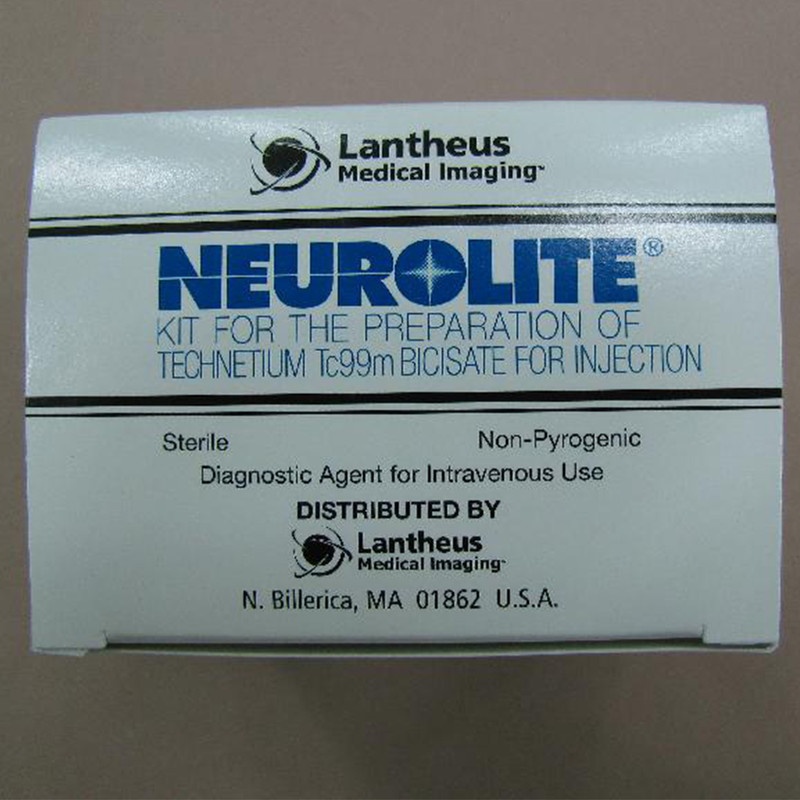
NEUROLITE 740-1700 MBq Injectable

Prescription review online
A doctor will review your case and decide whether a prescription is medically appropriate.

Talk to a doctor about this medicine
Discuss your symptoms and possible next steps in a quick online consultation.



How to use NEUROLITE 900 MICROGRAMS RADIOPHARMACEUTICAL PREPARATION KIT
Contents of the leaflet
- Introduction
- What Neurolite is and what it is used for
- What you need to know before you are given Neurolite
- How Neurolite is used
- Possible side effects
- Storage of Neurolite
- Contents of the pack and further information
Introduction
PATIENT INFORMATION LEAFLET
NEUROLITE 900 micrograms radiopharmaceutical preparation kit
Read all of this leaflet carefully before you are given this medicine because it contains important information for you.
- Keep this leaflet, you may need to read it again.
- If you have any further questions, ask your nuclear medicine doctor who is supervising the procedure.
- If you experience any side effects, consult your nuclear medicine doctor, even if they are not listed in this leaflet. See section 4.
Contents of the pack:
- What Neurolite is and what it is used for
- What you need to know before you are given Neurolite
- How Neurolite is used
- Possible side effects
- Storage of Neurolite
- Contents of the pack and further information
1. What Neurolite is and what it is used for
This medicine is a radiopharmaceutical for diagnostic use only.
Neurolite is used to see how much blood is circulating through the brain. This is an important piece of information for some diseases that affect the brain.
Neurolite is injected into the blood and then circulates throughout the body. It can be detected by special cameras, which can obtain an image (or scan). This scan will show exactly the distribution of radioactivity in the area of the body being investigated.
Administration of Neurolite involves receiving a small amount of radioactivity. Your doctor and nuclear medicine doctor have considered that the clinical benefit you will get from the procedure with the radiopharmaceutical outweighs the risk of radiation.

Not sure if this medicine is right for you?
Discuss your symptoms and treatment with a doctor online.
2. What you need to know before you are given Neurolite
Neurolite must not be used:
- if you are allergic (hypersensitive) to technetium-99m bicisate or any of the other components of this medicine (listed in section 6).
Warnings and precautions
Be particularly careful with Neurolite:
- If you are pregnant or think you may be pregnant
- If you are breast-feeding
Neurolite is not recommended for children under 18 years or patients with impaired renal function.
Before administration of Neurolite you must:
- Drink a large amount of water before the examination to urinate as frequently as possible during the first few hours after the study.
Your doctor will inform you if you need to take any special precautions after using this product.
Other medicines and Neurolite
Tell your nuclear medicine doctor if you are taking, or have recently taken, or might take any other medicines.
Using Neurolite with food and drinks
Your doctor will ask you to drink plenty of liquid.
Pregnancy and breast-feeding
If you are pregnant or breast-feeding, think you may be pregnant or are planning to have a baby, ask your nuclear medicine doctor for advice before you are given this medicine.
You must tell your nuclear medicine doctor before administration of Neurolite if there is any possibility that you may be pregnant, if you have a delayed period or if you are breast-feeding. In case of doubt, it is important that you consult your nuclear medicine doctor who is supervising the procedure.
If you are pregnant
Your nuclear medicine doctor will only give you this medicine during pregnancy if the expected benefit outweighs the risk.
If you are breast-feeding
Tell your doctor if you are breast-feeding, as they may consider delaying the investigation until you have finished breast-feeding or they may ask you to stop breast-feeding your child for 12 hours until there is no more radioactivity in your body. Breast milk expressed must be discarded. Ask your nuclear medicine doctor when you can restart breast-feeding.
Driving and using machines
It is considered unlikely that Neurolite will affect your ability to drive or use machines.
Neurolite contains sodium
This product contains less than 1 mmol of sodium (23 mg) per dose; this is essentially "sodium-free".
3. How Neurolite is used
There are strict rules about the use, handling, and disposal of radiopharmaceuticals. Neurolite should only be used in special controlled areas. This product will only be handled and administered by trained and qualified personnel who are authorized to use it safely. These people will pay special attention to the safe use of this product and will keep you informed of their actions.
Neurolite must be reconstituted with a solution of sodium pertechnetate (99mTc) before administration.
The nuclear medicine doctor supervising the procedure will decide the amount of Neurolite to be used in your case. This will be the minimum amount necessary to obtain the desired information. The recommended amount for administration to an adult is 740 MBq (Megabecquerels, the unit used to express radioactivity).
Administration of Neurolite and performance of the procedure
Neurolite is administered by injection into a vein by qualified personnel.
A single injection is sufficient to perform the procedure that your doctor needs. The scintigraphy must be performed before 6 hours have passed since administration of the product.
Duration of the procedure
Your nuclear medicine doctor will inform you about the usual duration of the procedure.
After administration of Neurolite, you must:
- Avoid contact with children and pregnant women during the first 12 hours after injection
- Urinate frequently to eliminate the product from your body
Your nuclear medicine doctor will inform you if you need to take any special precautions after you are given this medicine. Consult your nuclear medicine doctor if you have any doubts.
If you have been given more Neurolite than you need:
Overdose is unlikely because you will receive a precisely controlled single dose of Neurolite by the nuclear medicine doctor supervising the procedure. However, in case of overdose, you will receive appropriate treatment.
In case of overdose, your doctor will ask you to drink plenty of liquid and to urinate and defecate frequently to accelerate the elimination of radioactivity from your body.
If you have any further questions about the use of Neurolite, ask your nuclear medicine doctor who is supervising the procedure.

Started taking the medicine and have questions?
Discuss your symptoms and treatment with a doctor online.
4. Possible side effects
Like all medicines, this medicine can cause side effects, although not everybody gets them.
This radiopharmaceutical will deliver small amounts of ionizing radiation that are associated with minor risks of cancer and genetic abnormalities.
The following are the possible side effects by frequency:
Frequency | Possible side effects |
common: affects 1 to 10 users in 100 | Headache |
uncommon: affects 1 to 10 users in 1,000 | Agitation, convulsions, a disorder characterized by a strange olfactory sensation (aromatic odor, mild and transient), somnolence, hallucinations, anxiety, dizziness, heart pain (angina), heart failure, dizziness/syncope, hypertension, breathing difficulties that may cause the appearance of a bluish tone on lips and fingernails, rash, lower back pain, generalized discomfort, constipation, nausea, indigestion, and diarrhea. |
rare: affects 1 to 10 users in 10,000 | Allergic reactions (in the form of itching, erythema, skin rash, facial swelling, lip swelling, ocular hyperemia, hypotension, nausea) |
Reporting of side effects
If you experience side effects, consult your nuclear medicine doctor, even if they are not listed in this leaflet.
You can also report side effects directly through the Spanish Pharmacovigilance System for Human Use Medicines: www.notificaRAM.es
By reporting side effects, you can help provide more information on the safety of this medicine.
5. Storage of Neurolite
You will not need to store this medicine. This medicine is stored under the responsibility of a specialist in suitable facilities. The storage of radiopharmaceuticals will be carried out in accordance with national regulations on radioactive materials.
The following information is intended for specialists only.
Neurolite should not be used after the expiry date stated on the vial and carton after EXP. The expiry date is the last day of the month indicated.
The packaged product should be stored below 25°C. Do not refrigerate or freeze.
The reconstituted and prepared solution for injection can be stored for 8 hours below 25°C.
Do not refrigerate or freeze.
Neurolite should not be used if particles and/or color alteration are observed.
6. Contents of the pack and further information
Composition of Neurolite
Vial A: Powder for solution for injection
The active ingredient is:
900 micrograms of technetium-99m bicisate dihydrochloride.
The other ingredients are:
Tin(II) chloride dihydrate, disodium edetate, mannitol, hydrochloric acid.
Vial B: Solvent for solution for injection
The active ingredient is:
Does not contain active ingredients.
The other ingredients are:
Disodium phosphate heptahydrate, sodium dihydrogen phosphate monohydrate, and water for injections.
Appearance of Neurolite and pack contents
Neurolite consists of two vials, one powder (vial A) and one solvent (vial B).
Before use, the powder is mixed with the solvent and with a solution of the radioactive substance, sodium pertechnetate (99mTc), to obtain the technetium-99m bicisate injectable solution.
The mixed solution is clear and does not contain visible particles.
Marketing authorization holder and manufacturer
Marketing authorization holder
Lantheus EU Limited
Rocktwist House
Block 1, Western Business Park
Shannon
Co. Clare
V14 FW97
Ireland
Manufacturer
Millmount Healthcare Limited
Block 7
City North Business Campus
Stamullen, Co. Meath K32Y D60
Ireland
This leaflet was approved in 11/2018
<------------------------------------------------------------------------------------------------------------------
<This information is intended for healthcare professionals only:>>
Posology and method of administration
The recommended dose for an average patient (70 kg) by intravenous administration after reconstitution with sodium pertechnetate (99mTc) injectable, Ph.Eur., is 740 MBq.
Scintigraphy should be performed before 6 hours have passed since administration of the product.
If necessary, a maximum recommended activity of up to 1700 MBq can be injected, ensuring that the patient is able to urinate at least every two hours.
The dose for the patient should be measured using a suitable radioactivity calibration system immediately before administration. It is recommended to check the radiochemical purity beforehand (see below).
Precautions to be taken by relatives, caregivers, hospital staff when administering a dose from non-sealed sources.
Administration of radiopharmaceuticals creates risks for other people due to external radiation or contamination from spills of urine, vomit, etc. Therefore, radiological protection measures should be taken in accordance with national regulations.
Preparation of the Neurolite reaction kit
Preparation of technetium-99m bicisate from the Neurolite reaction kit is carried out using the following aseptic procedure:
- Before adding the sodium pertechnetate (99mTc) injectable to vial B (the buffer vial), note the estimated activity, date, and time of preparation in the space provided on the vial label. Then cut a radiation symbol and attach it to the neck of the vial.
- During the preparation procedure, impermeable gloves should be used. Remove the plastic disc from both vials and clean the top of the stopper of each vial with alcohol to disinfect the surface.
- Place vial B in a suitable radiation shield, properly labeled with the date, time of preparation, volume, and activity.
- Using a sterile and shielded syringe, aseptically add 3.70 GBq (100 mCi) of sodium pertechnetate (99mTc) injectable, sterile, apyrogenic, and free of oxidants in approximately 2.0 ml, to vial B. Without removing the needle, eliminate an equal volume of air to maintain the pressure inside the vial.
- Using a sterile and shielded syringe, rapidly inject 3.0 ml of Sodium Chloride Injection, BP (0.9% NaCl, without bacteriostatics) into vial A (the lyophilized vial) to dissolve the contents. Without removing the needle, eliminate an equal volume of air to maintain the pressure inside the vial. Shake the contents of the vial for a few seconds.
- Using another sterile and shielded syringe, immediately (within 30 seconds) transfer 1.0 ml of the solution from vial A to vial B. Immediately discard vial A.
- Shake the contents of vial B for a few seconds and let the mixture stand for thirty (30) minutes at room temperature.
- Before administration to the patient, examine the contents of the vial to determine if there are particles and color alteration. If particles or color change are observed, DO NOT USE.
- Measure the reaction vial using a suitable radioactivity measurement system (dose calibrator or activity meter). Note the technetium-99m concentration, total volume, date and time of activity measurement, expiry date, and batch number on the label of the vial shield and attach the label to the shield.
- Keep the reaction vial containing technetium-99m bicisate below 25°C until the time of use; at that time, the product must be aseptically withdrawn. Do not freeze or refrigerate. The vial does not contain preservatives.
- Waste must be disposed of in accordance with national regulations for radioactive materials.
The product must be used before 8 hours have passed since the time of preparation.
Determination of radiochemical purity
Quality control of the radiopharmaceutical should follow the procedure indicated below:
Materials for the thin-layer chromatography (TLC) procedure
- Silica gel IB-F Baker-Flex, 2.5 x 7.5 cm, Baker No. 2/4463/03, or equivalent.
- Solvent system: Ethyl acetate, HPLC quality
- Dose calibrator or gamma counter to measure radioactivity
- Small chromatography development chamber
- Shielded syringe and vials, as necessary
TLC procedure
Establish the radiochemical purity of the final solution by thin-layer chromatography (TLC) using silica gel IB-F Baker-Flex plates or equivalent and an ethyl acetate solvent system.
Procedure- Using fresh ethyl acetate, pour sufficient solvent into the development chamber to a depth of 3 to 4 mm. Seal the tank with Parafilm and let it stand for 15 to 40 minutes until the solvent is equilibrated. It is essential to pre-equilibrate and preserve the integrity of the headspace in the chromatography chamber; otherwise, unreproducible TLC results are obtained.
Note: Ethyl acetate is a skin and mucous membrane irritant, so it should be handled in a fume hood whenever possible.
With a pencil, draw a faint line that crosses the TLC plate at a height of 2 cm, 4.5 cm, and 7 cm from the base of the plate. Place approximately 5 μl of the final solution in the center of the 2 cm mark. This can be achieved using a syringe fitted with a 25G or 27G needle and allowing a drop to form while holding the syringe in a vertical position. The spot diameter should not be greater than 10 mm. Let the spot dry for 5 to 10 minutes, but no longer.
Place the plate in the pre-equilibrated TLC chamber and let it develop until the 7.0 cm line (approximately 15 minutes). Remove the plate and dry it in a ventilated area.
Quantification
Cut the TLC plate at the 4.5 cm mark with scissors. Count the activity of each piece using a dose calibrator or gamma counter. The upper part contains technetium-99m bicisate, and the lower part contains all radioimpurities.
Calculate the radiochemical purity using the following equation:
AS
% of 99mTc bicisate = x 100
AS + Ai
Where: As = activity of the upper piece
and Ai = activity of the lower piece
Criteria
Technetium-99m bicisate has an Rf of 0.9 (± 0.1); the colloid, TcO4-, and EDTA 99mTc remain at the origin. If the radiochemical purity is less than 90%, do not use the reaction kit and reject the preparation.
Disposal of unused medicinal products and all materials that have come into contact with them should be carried out in accordance with local regulations.
- Country of registration
- Dosage formINJECTABLE, 740-1700 MBq Technetium
- ATC codeV09AA02
- Availability in pharmaciesSupply issue reported
- Active substance
- Prescription requiredYes
- Manufacturer
- CompositionHIDROGENOFOSFATO DE SODIO HEPTAHIDRATO (4,1 mg mg), DIHIDROGENOFOSFATO DE SODIO MONOHIDRATO (0,46 mg mg), EDETATO DE DISODIO (0,36 mg mg), MANITOL (E-421) (24 mg mg)
- This information is for reference only and does not constitute medical advice. Always consult a doctor before taking any medication. Oladoctor is not responsible for medical decisions based on this content.
- Alternatives to NEUROLITE 900 MICROGRAMS RADIOPHARMACEUTICAL PREPARATION KITDosage form: RADIOPHARMACEUTICAL, 0.5 mg exametazineActive substance: technetium (99mTc) exametazimeManufacturer: Ge Healthcare Bio-Sciences, S.A.U.Prescription requiredDosage form: RADIOPHARMACEUTICAL, 350-500 MBq (0.5 mg exametazime)Active substance: technetium (99mTc) exametazimeManufacturer: Ge Healthcare Bio-Sciences, S.A.U.Prescription requiredDosage form: RADIOPHARMACEUTICAL, 500 microgramsActive substance: technetium (99mTc) exametazimeManufacturer: Radiopharmacy Laboratorium Kft.Prescription required
Online doctors for NEUROLITE 900 MICROGRAMS RADIOPHARMACEUTICAL PREPARATION KIT
Discuss questions about NEUROLITE 900 MICROGRAMS RADIOPHARMACEUTICAL PREPARATION KIT, including use, safety considerations and prescription review, subject to medical assessment and local regulations.

Get NEUROLITE 900 MICROGRAMS RADIOPHARMACEUTICAL PREPARATION KIT Prescription Online
Fill in a 2-min form
Tell us your symptoms, history, and what medicine you're requesting.
Pick a doctor or let us assign
Choose a specialist or we'll match you with the next available doctor.
Doctor reviews your case
Usually within 30 minutes. They may ask follow-up questions via chat.
Collect from any pharmacy
Electronic prescription sent to your email — valid across Spain.
Frequently Asked Questions
NEUROLITE 900 MICROGRAMS RADIOPHARMACEUTICAL PREPARATION KIT requires a prescription in Spain. You can check with a doctor online whether this medicine may be appropriate for your situation.
The active ingredient in NEUROLITE 900 MICROGRAMS RADIOPHARMACEUTICAL PREPARATION KIT is technetium (99mTc) bicisate. This information helps identify medicines with the same composition but different brand names.
NEUROLITE 900 MICROGRAMS RADIOPHARMACEUTICAL PREPARATION KIT is manufactured by Lantheus Eu Limited. Pharmacy brands and packaging may differ depending on the distributor.
Doctors such as Family doctors, Psychiatrists, Dermatologists, Cardiologists, Endocrinologists, Gastroenterologists, Pulmonologists, Nephrologists, Rheumatologists, Hematologists, Infectious disease physicians, Allergists, Geriatricians, Paediatricians, Oncologists may assess whether NEUROLITE 900 MICROGRAMS RADIOPHARMACEUTICAL PREPARATION KIT is appropriate, depending on your situation and local regulations. You can book an online consultation to discuss your symptoms and possible next steps.
Spain has a well-developed healthcare infrastructure across major cities such as Madrid, Barcelona, Valencia, and Seville. Pharmacies are widely available and operate under strict regulations, ensuring access to prescribed medications.
You can buy NEUROLITE 900 MICROGRAMS RADIOPHARMACEUTICAL PREPARATION KIT in Madrid, Barcelona, Seville, or Valencia at any local pharmacy with a valid prescription.
To obtain a prescription, you can use Oladoctor:
Other medicines with the same active substance (technetium (99mTc) bicisate) include CERETEC 500 MICROGRAMS KIT FOR RADIOPHARMACEUTICAL PREPARATION, CERETEC STABILIZED 500 MICROGRAMS KIT FOR RADIOPHARMACEUTICAL PREPARATION, EXAMETAZIMA RADIOPHARMACY 500 MICROGRAMS RADIOPHARMACEUTICAL PREPARATION KIT. These may have different brand names or formulations but contain the same therapeutic ingredient. Always consult a doctor before switching or starting a new medicine.
