



MIGLUSTAT 100 mg Hard Capsules

Prescription review online
A doctor will review your case and decide whether a prescription is medically appropriate.

Talk to a doctor about this medicine
Discuss your symptoms and possible next steps in a quick online consultation.



How to use MIGLUSTAT DIPHARMA 100 mg HARD CAPSULES
Contents of the leaflet
- Introduction
- What is Miglustat Dipharma and what is it used for
- What you need to know before you take Miglustat Dipharma
- How to take Miglustat Dipharma
- Possible side effects
- Storing Miglustat Dipharma
- Contents of the pack and other information
Introduction
Package Leaflet: Information for the User
Miglustat Dipharma 100 mg Hard Capsules EFG
miglustat
Read all of this leaflet carefully before you start taking this medicine because it contains important information for you.
- Keep this leaflet, you may need to read it again.
- If you have any further questions, ask your doctor or pharmacist.
- This medicine has been prescribed for you only. Do not pass it on to others. It may harm them, even if their signs of illness are the same as yours.
- If you get any side effects, talk to your doctor or pharmacist. This includes any possible side effects not listed in this leaflet. See section 4.
Contents of the pack
- What is Miglustat Dipharma and what is it used for.
- What you need to know before you take Miglustat Dipharma.
- How to take Miglustat Dipharma.
- Possible side effects.
- Storing Miglustat Dipharma.
- Contents of the pack and other information.
1. What is Miglustat Dipharma and what is it used for
Miglustat Dipharma contains the active substance miglustat, which belongs to a group of medicines that have an effect on metabolism. It is used to treat two disorders:
- Miglustat Dipharma is used to treat mild to moderate type 1 Gaucher disease in adults.
In type 1 Gaucher disease, your body cannot break down a substance called glucosylceramide. As a result, it builds up in some cells of your immune system. This can lead to an enlarged liver and spleen, changes in the blood, and bone disease.
The usual treatment for type 1 Gaucher disease is enzyme replacement therapy (ERT). Miglustat Dipharma will only be used in cases where enzyme replacement therapy is not suitable for the patient.
- Miglustat Dipharma is also used to treat the progressive neurological symptoms of Niemann-Pick disease type C in adults and children.
If you have Niemann-Pick disease type C, lipids such as glycosphingolipids can build up in the cells of your brain. This can lead to impaired neurological functions such as slow eye movements, balance, swallowing, memory, or seizures.
Miglustat Dipharma works by inhibiting the enzyme called glucosylceramide synthase, which is responsible for the first step in the synthesis of most glycosphingolipids.

Not sure if this medicine is right for you?
Discuss your symptoms and treatment with a doctor online.
2. What you need to know before you take Miglustat Dipharma
Do not take Miglustat Dipharma:
- if you are allergic to miglustat or any of the other ingredients of this medicine (listed in section 6).
Warnings and precautions
Consult your doctor or pharmacist before starting treatment with Miglustat Dipharma
- if you have kidney disease
- if you have liver disease
Your doctor will perform the following tests before and during treatment with Miglustat Dipharma:
- physical examination of the nerves in your arms and legs
- measurement of vitamin B12 levels
- monitoring of growth in children or adolescents with Niemann-Pick disease type C
- monitoring of platelet count in blood
These tests are necessary because some patients have reported symptoms such as tingling or numbness in hands and feet, or weight loss during treatment with Miglustat Dipharma. The tests will help your doctor determine if these effects are due to your disease or pre-existing conditions or are side effects of Miglustat Dipharma (see section 4 for more details).
If you have diarrhea, your doctor may ask you to modify your diet to reduce lactose and carbohydrate intake, such as sucrose (cane sugar), or not to take Miglustat Dipharma with food, or to temporarily reduce the dose. In some cases, your doctor may prescribe medications to treat diarrhea, such as loperamide. Consult your doctor if the diarrhea does not respond to these measures or if you experience any other abdominal discomfort. In this case, your doctor may decide to perform additional tests.
Male patients are advised to use reliable contraceptive methods during treatment with Miglustat Dipharma and for up to three months after stopping treatment.
Children and adolescents
Do not give this medicine to children and adolescents (under 18 years of age) with type 1 Gaucher disease because it is not known if it works in this disease.
Other medicines and Miglustat Dipharma
Tell your doctor or pharmacist if you are taking or have recently taken or might take any other medicines.
Tell your doctor if you are taking medicines that contain imiglucerase, which are sometimes used at the same time as Miglustat Dipharma. They may decrease the amount of Miglustat Dipharma in your body.
Pregnancy, breastfeeding, and fertility
Do not take Miglustat Dipharma if you are pregnant or plan to become pregnant. For more information, consult your doctor or pharmacist. You must use an effective contraceptive method while taking Miglustat Dipharma. You should not breastfeed while taking Miglustat Dipharma.
Male patients must use a reliable contraceptive method during treatment with Miglustat Dipharma and for three months after stopping treatment.
If you are pregnant or breastfeeding, think you may be pregnant, or plan to become pregnant, consult your doctor or pharmacist before using this medicine.
Driving and using machines
Miglustat Dipharma may cause dizziness. Do not drive or operate tools or machines if you feel dizzy.
3. How to take Miglustat Dipharma
Follow the instructions for administration of this medicine exactly as prescribed by your doctor. If you are unsure, consult your doctor or pharmacist again.
- For type 1 Gaucher disease: In adults, the usual dose is one capsule (100 mg) three times a day (morning, afternoon, evening), which is a maximum daily dose of three capsules (300 mg).
- For Niemann-Pick disease type C: In adults and adolescents (over 12 years), the usual dose is 2 capsules (200 mg) three times a day (morning, afternoon, and evening). This is a maximum daily dose of six capsules (600 mg).
For children under 12 years, your doctor will adjust the dose for Niemann-Pick disease type C.
If you have kidney problems, your doctor may prescribe a lower initial dose. It is possible that your doctor will reduce the dose of Miglustat Dipharma to one capsule (100 mg) one or two times a day if you experience diarrhea during treatment with Miglustat Dipharma (see section 4). Your doctor will tell you how long to take the treatment.
Miglustat Dipharma can be taken with or without food. The capsule should be swallowed whole with a glass of water.
If you take more Miglustat Dipharma than you should
If you take more capsules than prescribed, consult your doctor immediately. In clinical trials, miglustat has been used at doses of up to 3000 mg: this caused a reduction in white blood cell counts and other side effects similar to those described in section 4.
If you forget to take Miglustat Dipharma
Take the next capsule when it is due. Do not take a double dose to make up for forgotten doses.
If you stop taking Miglustat Dipharma
Do not stop treatment with Miglustat Dipharma without consulting your doctor.
If you have any further questions on the use of this medicine, ask your doctor or pharmacist.

Started taking the medicine and have questions?
Discuss your symptoms and treatment with a doctor online.
4. Possible side effects
Like all medicines, this medicine can cause side effects, although not everybody gets them.
More serious side effects
Some patients have reported tingling or numbness in hands and feet (this is a common side effect). These could be signs of peripheral neuropathy, due to side effects of Miglustat Dipharma or could be due to pre-existing conditions. Your doctor will perform tests before and during treatment with Miglustat Dipharma to assess your case (see section 2).
If you experience any of these effects, tell your doctor as soon as possible.
If you experience a slight tremor, usually tremor in the hands, informyour doctor as soon as possible. Often the tremor resolves without the need to stop treatment. In some cases, your doctor may need to reduce the dose and even stop treatment with Miglustat Dipharma to control the tremor.
Very common– may affect more than 1 in 10 people
The most common side effects include diarrhea, flatulence (gas), abdominal pain (stomach pain), weight loss, and decreased appetite.
If you lose some weightwhen starting treatment with Miglustat Dipharma, do not worry, people usually stop losing weight with continued treatment.
Common– may affect up to 1 in 10 people
Common side effects include headache, dizziness, paresthesia (tingling or numbness), coordination disorders, hypoesthesia (reduced sensation to touch), dyspepsia (heartburn), nausea (feeling sick), constipation, and vomiting, abdominal swelling or discomfort (stomach) and thrombocytopenia (reduced platelet count). Neurological symptoms and thrombocytopenia may be due to the underlying disease.
Other possible side effects are muscle spasms or weakness, fatigue, chills, and general malaise, difficulty sleeping, memory loss, and decreased libido.
Most patients experience one or more of these side effects, usually when starting treatment or at different times during treatment. Most are mild and resolve quickly. If any of these side effects cause you problems, consult your doctor. He or she may reduce the dose of Miglustat Dipharma or prescribe other medicines to control the side effects.
Reporting of side effects
If you experience side effects, talk to your doctor or pharmacist. This includes any possible side effects not listed in this leaflet. You can also report side effects directly via the national reporting system listed in Appendix V. By reporting side effects, you can help provide more information on the safety of this medicine.
5. Storing Miglustat Dipharma
Keep this medicine out of the sight and reach of children.
Do not use this medicine after the expiry date which is stated on the blister and carton after “EXP/CAD”. The expiry date is the last day of the month stated.
This medicine does not require any special storage conditions.
Medicines should not be disposed of via wastewater or household waste. Ask your pharmacist how to dispose of medicines no longer required. These measures will help protect the environment.
6. Contents of the pack and other information
- The active substance is miglustat. Each hard capsule contains 100 mg of miglustat.
- The other ingredients are magnesium stearate, gelatin, titanium dioxide (E171), printing ink (which consists of iron oxide black (E172), propylene glycol (E1520), potassium hydroxide, shellac).
Appearance and packaging
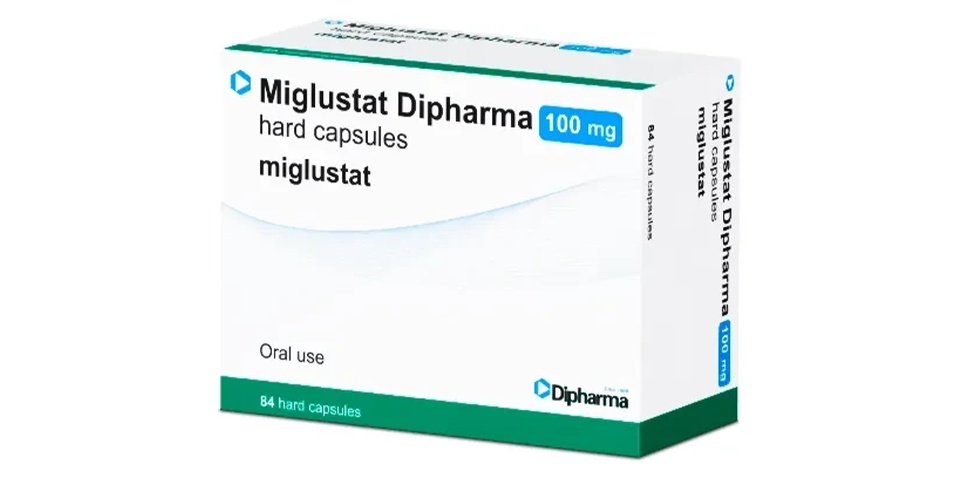
Miglustat Dipharma is a white, opaque capsule of 100 mg, printed in black ink with “DPH02” on the top and “100” on the body. The capsules are presented in PCTFE/PVC and aluminum blister packs, in pack sizes of 84 capsules in non-perforated blisters and 84x1 capsules in perforated unit-dose blisters.
Not all pack sizes may be marketed.
Marketing authorisation holder
Dipharma Arzneimittel GmbH
Offheimer Weg 33
65549 Limburg a. d. Lahn
Germany
Manufacturer
Doppel Farmaceutici S.r.l
Via Volturno 48
20089 Quinto di Stampi - Rozzano (MI)
Italy
Date of last revision of this leaflet:{MM/AAAA}.
Other sources of information
Detailed information on this medicine is available on the European Medicines Agency website: http://www.ema.europa.eu.
- Country of registration
- Dosage formCAPSULE, 100 mg
- ATC codeA16AX06
- Active substance
- Prescription requiredYes
- Manufacturer
- CompositionPROPILENGLICOL (q.s. mg mg), POTASIO, HIDROXIDO DE (E-525) (q.s. mg mg)
- This information is for reference only and does not constitute medical advice. Always consult a doctor before taking any medication. Oladoctor is not responsible for medical decisions based on this content.
- Alternatives to MIGLUSTAT DIPHARMA 100 mg HARD CAPSULESDosage form: CAPSULE, 100 mgActive substance: miglustatManufacturer: Accord Healthcare S.L.U.Prescription requiredDosage form: CAPSULE, 100 mgActive substance: miglustatManufacturer: Gen.Orph S.A.S.Prescription requiredDosage form: CAPSULE, 65 mgActive substance: miglustatManufacturer: Amicus Therapeutics Europe LimitedPrescription required
Online doctors for MIGLUSTAT DIPHARMA 100 mg HARD CAPSULES
Discuss questions about MIGLUSTAT DIPHARMA 100 mg HARD CAPSULES, including use, safety considerations and prescription review, subject to medical assessment and local regulations.









Get MIGLUSTAT DIPHARMA 100 mg HARD CAPSULES Prescription Online
Fill in a 2-min form
Tell us your symptoms, history, and what medicine you're requesting.
Pick a doctor or let us assign
Choose a specialist or we'll match you with the next available doctor.
Doctor reviews your case
Usually within 30 minutes. They may ask follow-up questions via chat.
Collect from any pharmacy
Electronic prescription sent to your email — valid across Spain.
Frequently Asked Questions
MIGLUSTAT DIPHARMA 100 mg HARD CAPSULES requires a prescription in Spain. You can check with a doctor online whether this medicine may be appropriate for your situation.
The active ingredient in MIGLUSTAT DIPHARMA 100 mg HARD CAPSULES is miglustat. This information helps identify medicines with the same composition but different brand names.
MIGLUSTAT DIPHARMA 100 mg HARD CAPSULES is manufactured by Dipharma Arzneimittel Gmbh. Pharmacy brands and packaging may differ depending on the distributor.
Doctors such as Family doctors, Psychiatrists, Dermatologists, Cardiologists, Endocrinologists, Gastroenterologists, Pulmonologists, Nephrologists, Rheumatologists, Hematologists, Infectious disease physicians, Allergists, Geriatricians, Paediatricians, Oncologists may assess whether MIGLUSTAT DIPHARMA 100 mg HARD CAPSULES is appropriate, depending on your situation and local regulations. You can book an online consultation to discuss your symptoms and possible next steps.
Spain has a well-developed healthcare infrastructure across major cities such as Madrid, Barcelona, Valencia, and Seville. Pharmacies are widely available and operate under strict regulations, ensuring access to prescribed medications.
You can buy MIGLUSTAT DIPHARMA 100 mg HARD CAPSULES in Madrid, Barcelona, Seville, or Valencia at any local pharmacy with a valid prescription.
To obtain a prescription, you can use Oladoctor:
Other medicines with the same active substance (miglustat) include MIGLUSTAT ACCORD 100 mg HARD CAPSULES, MIGLUSTAT GEN.ORPH 100 mg HARD CAPSULES, OPFOLDA 65 mg HARD CAPSULES. These may have different brand names or formulations but contain the same therapeutic ingredient. Always consult a doctor before switching or starting a new medicine.
