



MANIDIPINO 10 mg Tablets

Prescription review online
A doctor will review your case and decide whether a prescription is medically appropriate.

Talk to a doctor about this medicine
Discuss your symptoms and possible next steps in a quick online consultation.



How to use MANIDIPINO STADA 10 mg TABLETS
Contents of the leaflet
- Introduction
- What is Manidipino Stada and what is it used for
- What you need to know before you take Manidipino Stada
- How to take Manidipino Stada
- Possible side effects
- Storage of Manidipino Stada
- Contents of the pack and other information
Introduction
Package Leaflet: Information for the User
Manidipino Stada 10 mg tablets EFG
Manidipino Stada 20 mg tablets EFG
Manidipino dihydrochloride
Read all of this leaflet carefully before you start taking this medicine because it contains important information for you.
- Keep this leaflet, you may need to read it again.
- If you have any further questions, ask your doctor, pharmacist, or nurse.
- This medicine has been prescribed for you only. Do not pass it on to others. It may harm them, even if their signs of illness are the same as yours.
- If you get any side effects, talk to your doctor, pharmacist, or nurse. This includes any possible side effects not listed in this leaflet. See section 4.
Contents of the pack and other information
- What is Manidipino Stada and what is it used for
- What you need to know before you take Manidipino Stada
- How to take Manidipino Stada
- Possible side effects
- Storage of Manidipino Stada
- Contents of the pack and other information
1. What is Manidipino Stada and what is it used for
Manidipino Stada tablets contain an active substance that belongs to calcium channel blockers, which block the flow of calcium in the smooth muscle cells of blood vessels, causing vasodilation and the corresponding reduction of blood pressure.
Manidipino is indicated for the treatment of mild to moderate essential hypertension in adults.

Not sure if this medicine is right for you?
Discuss your symptoms and treatment with a doctor online.
2. What you need to know before you take Manidipino Stada
Do not take Manidipino Stada
- If you are allergic (hypersensitive) to manidipino or any of the other ingredients of this medicine (listed in section 6).
- If you have heart problems, for example, if you have had a heart attack in the last 4 weeks or if you suffer from unstable angina (chest pain due to inadequate oxygen supply to the heart) or if you suffer from heart failure and are not receiving specific treatment;
- If you have severe kidney disease.
- If you have moderate to severe liver disease.
Manidipino must not be administered to children and adolescents under 18 years of age.
Warnings and precautions
Consult your doctor or pharmacist before starting to take Manidipino Stada
Be especially careful with Manidipino Stada
- if you suffer from certain heart problems (e.g., left ventricular dysfunction, left ventricular outflow tract obstruction, right-sided heart failure in patients with untreated sick sinus syndrome);
- if you suffer from heart rhythm disorders;
- if you are elderly or have mild liver problems (see section 3).
You should also tell your doctor:
- if you are pregnant, think you may be pregnant, or are planning to become pregnant, or if you are breast-feeding (see section "Pregnancy and Breast-feeding").
- if you are undergoing peritoneal dialysis
Other medicines and Manidipino Stada
Tell your doctor or pharmacist if you are taking or have recently taken or might take any other medicines.
It is especially important that you tell your doctor if you are taking any of the following medicines:
- diuretics (used to remove water from the body by increasing urine production) and other medicines that lower blood pressure, such as beta-blockers or other antihypertensive drugs. These medicines can increase the blood pressure-lowering effect of manidipino;
- medicines that may affect the metabolism of the active substance manidipino, such as protease inhibitors, cimetidine (used to treat stomach ulcers), or certain antibiotics (used to treat bacterial infections, such as clarithromycin, erythromycin, and rifampicin), or some antifungals (used to treat fungal infections, such as ketoconazole and itraconazole), or phenytoin, carbamazepine, phenobarbital, terfenadine, astemizole, or class III antiarrhythmics used in heart rate problems (such as amiodarone and quinidine);
- medicines containing digoxin, used to treat heart rhythm disorders.
If you are taking any of the above medicines, your doctor may prescribe a different medicine or adjust the dose of manidipino or another medicine.
Taking Manidipino Stada with food, drinks, and alcohol
Do not take manidipino with grapefruit juice, as blood pressure may drop too low.
Consuming alcohol can enhance the blood pressure-lowering effect of manidipino.
Fertility, pregnancy, and breast-feeding
If you are pregnant or breast-feeding, think you may be pregnant, or are planning to become pregnant, consult your doctor or pharmacist before using this medicine.
Pregnancy
Consult your doctor if you are pregnant, think you may be pregnant, or are planning to become pregnant.
Since manidipino should not be taken during pregnancy, your doctor will advise you to stop treatment before becoming pregnant or as soon as you know you are pregnant, and will recommend suitable treatment.
Breast-feeding
Consult your doctor if you are breast-feeding or before starting breast-feeding.
Manidipino should be avoided in breast-feeding women. If treatment with manidipino cannot be stopped, your doctor will advise you to stop breast-feeding.
.
Driving and using machines
Occasionally, in some patients during treatment for high blood pressure, this medicine may cause dizziness. In these cases, you should discuss it with your doctor before performing activities such as driving or operating machines.
Manidipino Stada contains lactose
If your doctor has told you that you have an intolerance to some sugars, consult with them before taking this medicine.
3. How to take Manidipino Stada
Follow exactly the administration instructions of this medicine given by your doctor or pharmacist. In case of doubt, consult your doctor or pharmacist again.
Initially, the usual dose of manidipino is 10 mg per day.
After 2-4 weeks, if the reduction in blood pressure is considered insufficient, your doctor may increase this dose to 20 mg once a day.
Children and adolescents should not take manidipino (see section 2).
Dose adjustment:
If you are elderly or have kidney or liver disease, your doctor may prescribe a reduced dose.
If you think the effect of manidipino is too strong or too weak, tell your doctor or pharmacist.
Administration
Manidipino should be taken in the morning or after breakfast. The tablet should be swallowed, without chewing, with a sufficient amount of water.
Try to take your daily dose at the same time each day.
Duration of treatment
It is important that you continue taking manidipino until your doctor tells you otherwise.
Take exactly the prescribed dose and do not modify it without talking to your doctor first.
If you take more Manidipino Stada than you should
If you have accidentally taken more tablets than you should, consult your doctor immediately, as your blood pressure may be abnormally low.
In case of overdose or accidental ingestion, consult your doctor or pharmacist immediately or call the Toxicology Information Service, phone: 91 562 04 20, indicating the medicine and the amount ingested. It is recommended to take the package and the package leaflet of the medicine to the healthcare professional.
If you forget to take Manidipino Stada
If you forget to take a dose, take the next dose as prescribed.
Do not take a double dose to make up for forgotten doses.
If you stop taking Manidipino Stada
It is important that you continue taking manidipino until your doctor tells you otherwise.
If you have any further questions on the use of this medicine, ask your doctor or pharmacist.

Started taking the medicine and have questions?
Discuss your symptoms and treatment with a doctor online.
4. Possible side effects
Like all medicines, this medicine can cause side effects, although not everybody gets them.
Common side effects (may affect up to 1 in 10 people):headache, dizziness, vertigo, swelling due to fluid retention, palpitations, hot flashes.
Uncommon side effects (may affect up to 1 in 100 people):painful tingling or numbness (paresthesia), lack of energy, increased heart rate (tachycardia), low blood pressure (hypotension), difficulty breathing (dyspnea), weakness, nausea, vomiting, constipation, dry mouth, stomach upset, skin rash, skin inflammation with redness and itching (eczema), transient changes in laboratory tests of some enzymes (ALT, AST, LDH, GammaGT, ALP, Urea in blood, and creatinine in blood).
Rare side effects (may affect up to 1 in 1,000 people):drowsiness, numbness, chest pain due to inadequate blood supply to the heart (angina pectoris), high blood pressure, stomach pain (gastralgia), abdominal pain, skin redness, itching, and irritability, decreased appetite (anorexia), abnormal blood test results (increased bilirubin in blood), jaundice.
Very rare side effects (may affect up to 1 in 10,000 people):heart attack, in patients with pre-existing angina, they may experience an increase in frequency, duration, or severity of these attacks, gum inflammation and overgrowth, which require careful dental attention but usually resolve with treatment discontinuation.
Side effects of unknown frequency (frequency cannot be estimated from the available data):abnormal skin redness (erythema multiforme), skin disease with abnormal redness and scales (exfoliative dermatitis). Muscle pain, breast swelling with or without pain in men (gynecomastia), cloudy fluid (during dialysis through a tube in the abdomen).
Reporting of side effects
If you experience any side effects, talk to your doctor or pharmacist, even if it is possible side effects not listed in this leaflet. You can also report side effects directly through the Spanish Pharmacovigilance System for Human Use Medicines: https://www.notificaram.es. By reporting side effects, you can help provide more information on the safety of this medicine.
5. Storage of Manidipino Stada
Keep out of the reach and sight of children.
Do not use this medicine after the expiry date which is stated on the carton, after EXP.
The expiry date is the last day of the month stated.
This medicine does not require any special storage conditions.
Medicines should not be disposed of via wastewater or household waste. Place the package and any unused medicine in the SIGRE collection point at your pharmacy. If you have any doubts, ask your pharmacist how to dispose of medicines no longer needed. This will help protect the environment.
6. Contents of the pack and other information
The active substance is manidipino dihydrochloride.
The other ingredients are lactose monohydrate, corn starch, low-substituted hydroxypropylcellulose, hydroxypropylcellulose, magnesium stearate, riboflavin.
Appearance of the product and contents of the pack
Manidipino is available in two strengths: 10 and 20 mg.
The 10 mg tablets are round, convex, yellow, and scored.
The 20 mg tablets are oval, convex, yellow, and scored.
Manidipino Stada is available in pack sizes of 28, 30, and 90 tablets.
Not all pack sizes may be marketed.
Marketing authorisation holder and manufacturer
Marketing authorisation holder
Laboratorio STADA, S.L.
Frederic Mompou, 5
08960 Sant Just Desvern (Barcelona)
Spain
Manufacturer
Abiogen Pharma SpA
Via Meucci 36, Ospedaletto
56121 Pisa
Italy
or
Doppel Farmaceutici S.r.l.
Via Volturno, 48
20089 Quinto de Stampi, Rozzano (Milan)
Italy
Date of last revision of this leaflet:August 2024
Detailed and updated information on this medicine is available on the website of the Spanish Agency for Medicines and Health Products (AEMPS) http://www.aemps.gob.es/
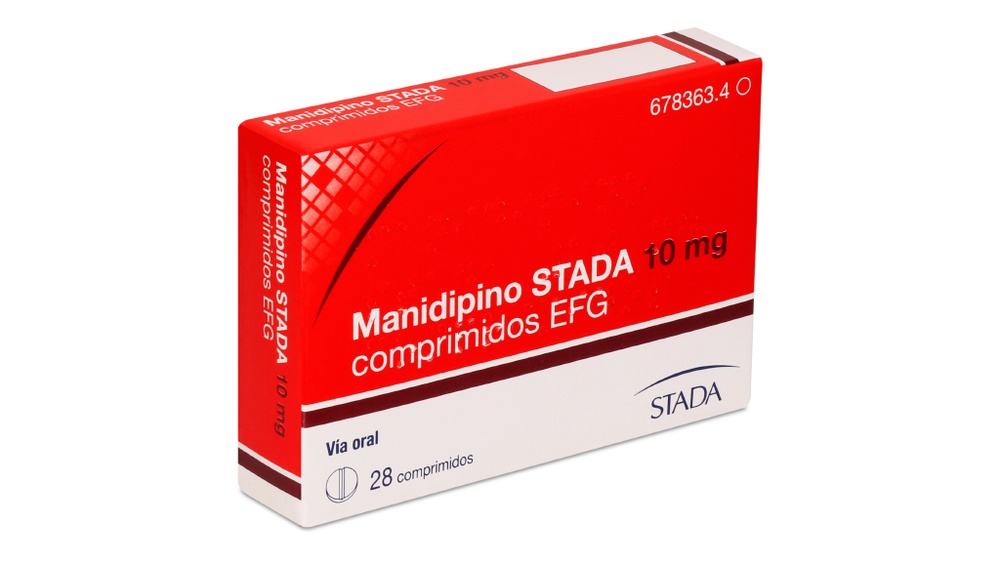
- Country of registration
- Dosage formTABLET, 10 mg
- ATC codeC08CA11
- Average pharmacy price7.09 EUR
- Active substance
- Prescription requiredYes
- Manufacturer
- CompositionLACTOSA MONOHIDRATO (66,40 mg mg)
- This information is for reference only and does not constitute medical advice. Always consult a doctor before taking any medication. Oladoctor is not responsible for medical decisions based on this content.
- Alternatives to MANIDIPINO STADA 10 mg TABLETSDosage form: TABLET, 10 mgActive substance: manidipineManufacturer: Chiesi España S.A.U.Prescription requiredDosage form: TABLET, 20 mgActive substance: manidipineManufacturer: Chiesi España S.A.U.Prescription requiredDosage form: TABLET, 10 mgActive substance: manidipineManufacturer: Aurovitas Spain, S.A.U.Prescription required
Online doctors for MANIDIPINO STADA 10 mg TABLETS
Discuss questions about MANIDIPINO STADA 10 mg TABLETS, including use, safety considerations and prescription review, subject to medical assessment and local regulations.
Get MANIDIPINO STADA 10 mg TABLETS Prescription Online
Fill in a 2-min form
Tell us your symptoms, history, and what medicine you're requesting.
Pick a doctor or let us assign
Choose a specialist or we'll match you with the next available doctor.
Doctor reviews your case
Usually within 30 minutes. They may ask follow-up questions via chat.
Collect from any pharmacy
Electronic prescription sent to your email — valid across Spain.
Frequently Asked Questions
MANIDIPINO STADA 10 mg TABLETS requires a prescription in Spain. You can check with a doctor online whether this medicine may be appropriate for your situation.
The active ingredient in MANIDIPINO STADA 10 mg TABLETS is manidipine. This information helps identify medicines with the same composition but different brand names.
The average pharmacy price for MANIDIPINO STADA 10 mg TABLETS is around 7.09 EUR. Prices may vary depending on the manufacturer and dosage form.
MANIDIPINO STADA 10 mg TABLETS is manufactured by Laboratorio Stada S.L.. Pharmacy brands and packaging may differ depending on the distributor.
Doctors such as Family doctors, Psychiatrists, Dermatologists, Cardiologists, Endocrinologists, Gastroenterologists, Pulmonologists, Nephrologists, Rheumatologists, Hematologists, Infectious disease physicians, Allergists, Geriatricians, Paediatricians, Oncologists may assess whether MANIDIPINO STADA 10 mg TABLETS is appropriate, depending on your situation and local regulations. You can book an online consultation to discuss your symptoms and possible next steps.
Spain has a well-developed healthcare infrastructure across major cities such as Madrid, Barcelona, Valencia, and Seville. Pharmacies are widely available and operate under strict regulations, ensuring access to prescribed medications.
You can buy MANIDIPINO STADA 10 mg TABLETS in Madrid, Barcelona, Seville, or Valencia at any local pharmacy with a valid prescription.
To obtain a prescription, you can use Oladoctor:
Other medicines with the same active substance (manidipine) include ARTEDIL 10 mg TABLETS, ARTEDIL 20 mg TABLETS, MANIDIPINE AUROVITAS 10 mg TABLETS. These may have different brand names or formulations but contain the same therapeutic ingredient. Always consult a doctor before switching or starting a new medicine.
