



LONQUEX 6 mg /0.6 Ml Injectable Solution

Prescription review online
A doctor will review your case and decide whether a prescription is medically appropriate.

Talk to a doctor about this medicine
Discuss your symptoms and possible next steps in a quick online consultation.



How to use LONQUEX 6 mg/0.6 mL Injectable Solution
Contents of the leaflet
- Introduction
- What is Lonquex and what is it used for
- What you need to know before you receive Lonquex
- How Lonquex is administered
- Possible side effects
- Storage of Lonquex
- Contents of the pack and further information
Introduction
Package Leaflet: Information for the Patient
Lonquex 6 mg/0.6 ml Solution for Injection
lipegfilgrastim
Read all of this leaflet carefully before you start receiving this medicine because it contains important information for you.
- Keep this leaflet, you may need to read it again.
- If you have any further questions, ask your doctor, pharmacist or nurse.
- If you experience any side effects, talk to your doctor, pharmacist or nurse, even if they are not listed in this leaflet. See section 4.
Contents of the Package Leaflet
- What is Lonquex and what is it used for
- What you need to know before you receive Lonquex
- How Lonquex is administered
- Possible side effects
- Storage of Lonquex
- Contents of the pack and further information
1. What is Lonquex and what is it used for
What is Lonquex
It belongs to a group of proteins called cytokines and is similar to a natural protein (granulocyte-colony stimulating factor [G-CSF]) produced by your own body.
What Lonquex is used for
Your doctor has prescribed Lonquex to you or your child to reduce the duration of a condition called neutropenia (low white blood cell count) and the occurrence of febrile neutropenia (low white blood cell count with fever). These problems can be caused by the use of cytotoxic chemotherapy (medicines that destroy rapidly growing cells).
How Lonquex works

Not sure if this medicine is right for you?
Discuss your symptoms and treatment with a doctor online.
2. What you need to know before you receive Lonquex
Do not use Lonquex:
- if you or your child is allergic to lipegfilgrastim or to any of the other ingredients of this medicine (listed in section 6).
Warnings and precautions
Talk to your doctor, pharmacist or nurse before starting Lonquex.
- if you or your child notices pain in the upper left side of the abdomen or in the tip of the shoulder. This could be due to a spleen disorder (see section 4 “Possible side effects”).
- if you or your child has a cough, fever, and difficulty breathing. This could be due to a lung disorder (see section 4 “Possible side effects”).
- if you or your child has sickle cell anaemia or other conditions where the red blood cells are abnormal.
- if you or your child has previously experienced allergic reactions to other medicines similar to this one (e.g. filgrastim, lenograstim or pegfilgrastim from the G-CSF group). You may also be at risk of a reaction to Lonquex.
Your doctor will perform regular blood tests to monitor various components of your blood and their concentrations. Your doctor will also periodically check your urine or your child's urine, as other medicines similar to this one (e.g. other granulocyte-colony stimulating factors such as filgrastim, lenograstim or pegfilgrastim) may damage the small filters in the kidneys (glomerulonephritis; see section 4 “Possible side effects”).
Rarely, inflammation of the aorta (the large blood vessel that carries blood from the heart to the rest of the body) has been reported with other medicines like this one (e.g. filgrastim, lenograstim or pegfilgrastim from the G-CSF group). Symptoms may include fever, abdominal pain, general malaise, back pain, and increased inflammatory markers. Tell your doctor if you experience these symptoms.
Children and adolescents
Other medicines and Lonquex
Tell your doctor or pharmacist if you or your child is using, has recently used or might use any other medicines.
Pregnancy and breastfeeding
It is not known whether the active substance of this medicine passes into breast milk. Therefore, you should stop breastfeeding during treatment.
Driving and using machines
The influence of Lonquex on your ability to drive and use machines is negligible or nil.
This medicine contains 30 mg of sorbitol in each vial.
This medicine contains less than 1 mmol of sodium (23 mg) per vial, i.e. it is essentially “sodium-free”.
3. How Lonquex is administered
What is the recommended dose
The recommended dose in adults is 6 mg (one 0.6 ml vial) once per chemotherapy cycle.
The recommended dose in children and adolescents is based on their body weight:
Body weight (kg) | Dose (once per chemotherapy cycle) |
< 10 | 0.6 mg (0.06 ml) |
≥ 10 to < 20 | 1.5 mg (0.15 ml) |
≥ 20 to < 30 | 2.5 mg (0.25 ml) |
≥ 30 to < 45 | 4.0 mg (0.40 ml) |
≥ 45 | 6.0 mg (0.60 ml) |
When will Lonquex be administered
The dose of Lonquex will usually be injected approximately 24 hours after the last dose of chemotherapy, at the end of each chemotherapy cycle.
If you have any further questions on the use of this medicine, ask your doctor, pharmacist or nurse.

Started taking the medicine and have questions?
Discuss your symptoms and treatment with a doctor online.
4. Possible side effects
Like all medicines, this medicine can cause side effects, although not everybody gets them.
More serious side effects
- Rarely (may affect up to 1 in 100 people), allergic reactions such as skin rash, raised and itchy patches on the skin, and severe allergic reactions with weakness, low blood pressure, difficulty breathing, and swelling of the face have been reported. If you think you are experiencing this type of reaction, you must stop the injection of Lonquex and seek medical help immediately.
- Rarely, cases of enlarged spleen and spleen rupture have been reported with other medicines similar to Lonquex. Some cases of spleen rupture were fatal. It is important that you contact your doctor immediately if you notice pain in the upper left side of the abdomen or in the left shoulder, as these symptoms may be related to a problem with the spleen.
- Cough, fever, and difficulty or pain when breathing may be signs of serious lung side effects, such as pneumonia and acute respiratory distress syndrome, which can be fatal. If you experience fever or any of these symptoms, it is important that you contact your doctor immediately.
- Contact your doctor immediately if you experience any of the following symptoms: swelling that may be associated with urinating less often, difficulty breathing, swelling, and feeling of fullness in the abdomen, and a general feeling of tiredness. These symptoms usually develop very quickly.
These may be symptoms of a condition called “capillary leak syndrome”, which causes blood to leak from small blood vessels in your body and requires urgent medical attention.
Other side effects
Very common (may affect more than 1 in 10 people)
- Musculoskeletal pain, such as bone pain, joint pain, muscle pain, limb pain, chest pain, neck pain, or back pain. Tell your doctor if you experience severe musculoskeletal pain.
- Nausea.
Common (may affect up to 1 in 10 people)
- Decreased platelet count, which increases the risk of bleeding or bruising.
- Headache.
- Skin reactions, such as redness or rash.
- Low potassium levels in the blood, which can cause muscle weakness, twitching, or heart rhythm disturbances.
- Chest pain.
- Bloody cough.
Uncommon (may affect up to 1 in 100 people)
- Increased white blood cell count.
- Local reactions at the injection site, such as pain or hardening.
- Some changes in blood tests may occur, but these will be detected in routine blood tests.
- Bleeding in the lung.
Frequency not known (cannot be estimated from the available data)
- Inflammation of the aorta (the large blood vessel that carries blood from the heart to the rest of the body), see section 2.
Side effects that have been seen with similar medicines, but not yet with Lonquex
- Sickle cell crisis in patients with sickle cell anaemia.
- Painful red-purple skin lesions on the limbs, and sometimes on the face and neck, accompanied by fever (Sweet's syndrome).
- Inflammation of the blood vessels in the skin.
- Damage to the small filters in the kidneys (glomerulonephritis; see section 2 under the heading “Warnings and precautions”).
Reporting of side effects
If you experience any side effects, talk to your doctor, pharmacist or nurse, even if they are not listed in this leaflet. You can also report side effects directly via the national reporting system listed in Appendix V. By reporting side effects, you can help provide more information on the safety of this medicine.
5. Storage of Lonquex
Keep this medicine out of the sight and reach of children.
Do not use this medicine after the expiry date which is stated on the outer packaging and on the label of the vial after EXP. The expiry date is the last day of the month shown.
Store in a refrigerator (2 °C – 8 °C).
Do not freeze.
Keep the vial in the outer packaging to protect it from light.
Do not use this medicine if it is cloudy or contains particles.
6. Contents of the pack and further information
Composition of Lonquex
- The active substance is lipegfilgrastim. Each ml of solution contains 10 mg of lipegfilgrastim. Each 0.6 ml vial contains 6 mg of lipegfilgrastim.
- The other ingredients (excipients) are glacial acetic acid, sodium hydroxide, sorbitol (E420), polysorbate 20, and water for injections.
Appearance and packaging of the product
Not all pack sizes may be marketed.
Marketing authorisation holder
Teva B.V.
Swensweg 5
2031 GA Haarlem
Netherlands
Manufacturer
Teva Biotech GmbH
Dornierstraße 10
89079 Ulm
Germany
Merckle GmbH
Graf-Arco-Straße 3
89079 Ulm
Germany
You can get more information about this medicine from your local representative of the marketing authorisation holder:
België/Belgique/Belgien Teva Pharma Belgium N.V./S.A./AG Tel: +32 38207373 | Lietuva UAB Teva Baltics Tel: +370 52660203 |
| Luxembourg/Luxemburg Teva Pharma Belgium N.V./S.A./AG Belgique/Belgien Tel: +32 38207373 |
Česká republika Teva Pharmaceuticals CR, s.r.o. Tel: +420 251007111 | Magyarország Teva Gyógyszergyár Zrt. Tel: +36 12886400 |
Danmark Teva Denmark A/S Tlf: +45 44985511 | Malta Teva Pharmaceuticals Ireland Ireland Tel: +44 2075407117 |
Deutschland TEVA GmbH Tel: +49 73140208 | Nederland Teva Nederland B.V. Tel: +31 8000228400 |
Eesti UAB Teva Baltics Eesti filiaal Tel: +372 6610801 | Norge Teva Norway AS Tlf: +47 66775590 |
Ελλάδα Specifar A.B.E.E. Τηλ: +30 2118805000 | Österreich ratiopharm Arzneimittel Vertriebs-GmbH Tel: +43 1970070 |
España Teva Pharma, S.L.U. Tel: +34 913873280 | Polska Teva Pharmaceuticals Polska Sp. z o.o. Tel: +48 223459300 |
France Teva Santé Tél: +33 155917800 | Portugal Teva Pharma - Produtos Farmacêuticos, Lda. Tel: +351 214767550 |
Hrvatska Pliva Hrvatska d.o.o. Tel: +385 13720000 | România Teva Pharmaceuticals S.R.L. Tel: +40 212306524 |
Ireland Teva Pharmaceuticals Ireland Tel: +44 2075407117 | Slovenija Pliva Ljubljana d.o.o. Tel: +386 15890390 |
Ísland Alvogen ehf. Sími: +354 5222900 | Slovenská republika TEVA Pharmaceuticals Slovakia s.r.o. Tel: +421 257267911 |
Italia Teva Italia S.r.l. Tel: +39 028917981 | Suomi/Finland Teva Finland Oy Puh/Tel: +358 201805900 |
Κύπρος Specifar A.B.E.E. Ελλάδα Τηλ: +30 2118805000 | Sverige Teva Sweden AB Tel: +46 42121100 |
Latvija UAB Teva Baltics filiale Latvija Tel: +371 67323666 | United Kingdom (Northern Ireland) Teva Pharmaceuticals Ireland Ireland Tel: +44 2075407117 |
Date of last revision of this leaflet: {month YYYY}
Detailed information on this medicine is available on the European Medicines Agency web site: http://www.ema.europa.eu.
This information is intended only for healthcare professionals or medical staff:
Storage and inspection
Store in a refrigerator (2 °C – 8 °C). Do not freeze. Keep the vial in the outer packaging to protect it from light.
The solution should be allowed to reach a comfortable temperature (15°C – 25°C) for injection.
Once removed from the refrigerator, Lonquex can be stored below 25 °C for a single period of up to 7 days.
The solution must be inspected visually before use. Only clear and colourless solutions without particles should be used.
Vigorous shaking should be avoided. Excessive shaking may cause the lipegfilgrastim to aggregate, making it biologically inactive.
Method of administration
The recommended dose should be injected subcutaneously (SC) using a suitable syringe with the appropriate graduation for the prescribed dose.
The injection should be administered in the abdomen, upper arm, or thigh.
Procedure for proper disposal
Disposal of unused medicine and all materials that have come into contact with it should be done according to local regulations.
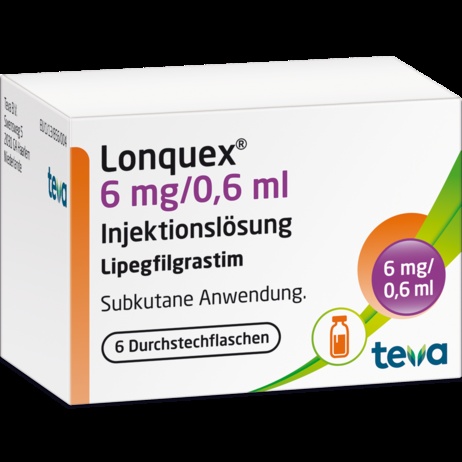
- Country of registration
- Dosage formINJECTABLE, 6 mg/0.6 mL
- ATC codeL03AA14
- Active substance
- Prescription requiredYes
- Manufacturer
- CompositionHIDROXIDO DE SODIO (E 524) (0,14 mg mg), POLISORBATO 20 (0,02 mg mg), SORBITOL (30 mg mg)
- This information is for reference only and does not constitute medical advice. Always consult a doctor before taking any medication. Oladoctor is not responsible for medical decisions based on this content.
- Alternatives to LONQUEX 6 mg/0.6 mL Injectable SolutionDosage form: INJECTABLE, 6 mgActive substance: lipegfilgrastimManufacturer: Teva B.V.Prescription requiredDosage form: INJECTABLE, 12 IU/0.2 mlActive substance: filgrastimManufacturer: Accord Healthcare S.L.U.Prescription requiredDosage form: INJECTABLE, 0.3 mg / prefilled syringeActive substance: filgrastimManufacturer: Accord Healthcare S.L.U.Prescription required
Online doctors for LONQUEX 6 mg/0.6 mL Injectable Solution
Discuss questions about LONQUEX 6 mg/0.6 mL Injectable Solution, including use, safety considerations and prescription review, subject to medical assessment and local regulations.
Get LONQUEX 6 mg/0.6 mL Injectable Solution Prescription Online
Fill in a 2-min form
Tell us your symptoms, history, and what medicine you're requesting.
Pick a doctor or let us assign
Choose a specialist or we'll match you with the next available doctor.
Doctor reviews your case
Usually within 30 minutes. They may ask follow-up questions via chat.
Collect from any pharmacy
Electronic prescription sent to your email — valid across Spain.
Frequently Asked Questions
LONQUEX 6 mg/0.6 mL Injectable Solution requires a prescription in Spain. You can check with a doctor online whether this medicine may be appropriate for your situation.
The active ingredient in LONQUEX 6 mg/0.6 mL Injectable Solution is lipegfilgrastim. This information helps identify medicines with the same composition but different brand names.
LONQUEX 6 mg/0.6 mL Injectable Solution is manufactured by Teva B.V.. Pharmacy brands and packaging may differ depending on the distributor.
Doctors such as Family doctors, Psychiatrists, Dermatologists, Cardiologists, Endocrinologists, Gastroenterologists, Pulmonologists, Nephrologists, Rheumatologists, Hematologists, Infectious disease physicians, Allergists, Geriatricians, Paediatricians, Oncologists may assess whether LONQUEX 6 mg/0.6 mL Injectable Solution is appropriate, depending on your situation and local regulations. You can book an online consultation to discuss your symptoms and possible next steps.
Spain has a well-developed healthcare infrastructure across major cities such as Madrid, Barcelona, Valencia, and Seville. Pharmacies are widely available and operate under strict regulations, ensuring access to prescribed medications.
You can buy LONQUEX 6 mg/0.6 mL Injectable Solution in Madrid, Barcelona, Seville, or Valencia at any local pharmacy with a valid prescription.
To obtain a prescription, you can use Oladoctor:
Other medicines with the same active substance (lipegfilgrastim) include Lonquex 6mg injectable solution, ACCOFIL 12 IU/0.2 mL Injectable Solution and Perfusion Solution in Pre-filled Syringe, Accofil 30 IU/0.5 ml injectable solution and perfusion in pre-filled syringe. These may have different brand names or formulations but contain the same therapeutic ingredient. Always consult a doctor before switching or starting a new medicine.
