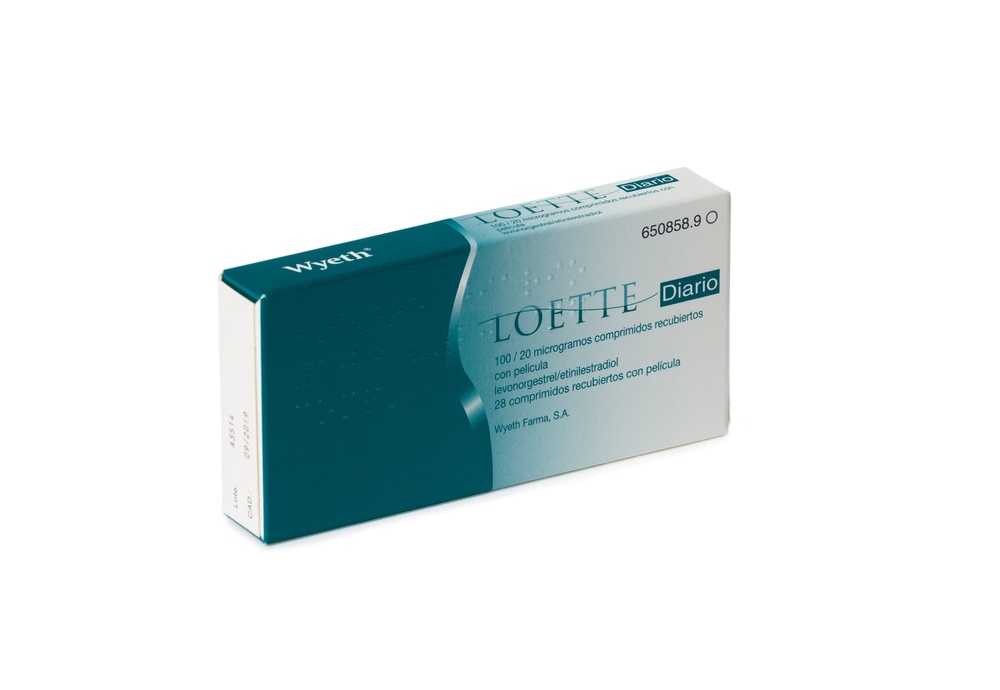
Loette Diario 100/20 Micrograms Film-Coated Tablets

Prescription review online
A doctor will review your case and decide whether a prescription is medically appropriate.

Talk to a doctor about this medicine
Discuss your symptoms and possible next steps in a quick online consultation.



How to use LOETTE DIARIO 100/20 micrograms FILM-COATED TABLETS
Contents of the leaflet
- Introduction
- Package Leaflet: Information for the Patient
- Loette Daily 100/20 micrograms film-coated tablets
- What is Loette Daily and what is it used for
- What you need to know before you start taking Loette Daily
- How to Take Loette Daily
- Possible side effects
- Storage of Loette Daily
- Package contents and additional information
Introduction
Package Leaflet: Information for the Patient

Not sure if this medicine is right for you?
Discuss your symptoms and treatment with a doctor online.
Loette Daily 100/20 micrograms film-coated tablets
levonorgestrel / ethinylestradiol
Read all of this leaflet carefully before you start taking this medicine because it contains important information for you.
|
Contents of the pack
- What is Loette Daily and what is it used for
- What you need to know before you start taking Loette Daily
- How to take Loette Daily
- Possible side effects
- Storing Loette Daily
- Contents of the pack and other information
1. What is Loette Daily and what is it used for
Loette Daily is a combined oral contraceptive pill for the prevention of pregnancy. It contains two different female hormones, levonorgestrel and ethinylestradiol.
Each of the 21 round pink tablets contains 100 micrograms of levonorgestrel and 20 micrograms of ethinylestradiol. The pack also includes 7 white inactive tablets (placebo).

Started taking the medicine and have questions?
Discuss your symptoms and treatment with a doctor online.
2. What you need to know before you start taking Loette Daily
Before you start taking Loette Daily, your doctor will ask you some questions about your medical history and about your personal relationships. Your doctor will also check your blood pressure and may do some other tests. This leaflet describes some situations where you should stop taking Loette Daily or where the reliability of Loette Daily may be decreased, resulting in a risk of pregnancy. In these situations, you should not have sex or should take extra non-hormonal contraceptive precautions (for example, use a condom or another barrier method). Do not use the rhythm or temperature method. These methods may not be reliable as Loette Daily alters the monthly changes in body temperature and cervical mucus. Loette Daily, like other combined oral contraceptives, does not protect against HIV infection (AIDS) or other sexually transmitted diseases. |
Do not take Loette Daily:
- If you are allergic to the active substances (levonorgestrel or ethinylestradiol) or to any of the other ingredients of this medicine (listed in section 6).
- If you have or have had heart or blood vessel problems, in particular:
- heart attack (myocardial infarction), abnormal heart rhythm or heart valve disorders
- blood clots in the legs (deep vein thrombosis), or in the lungs (pulmonary embolism) or rupture of blood vessels in the brain (stroke), mini-stroke or general tendency to form blood clots (venous or arterial thrombosis)
- chest pain caused by angina pectoris.
- If you have uncontrolled high blood pressure.
- If you have certain types of migraine (migraine with focal neurological symptoms).
- If you have breast cancer or cancer of the uterus, or a type of cancer that is sensitive to female hormones, or if you suspect you may have one of these cancers.
- If you have vaginal bleeding of unknown cause.
- If you have high blood sugar levels (diabetes) associated with blood vessel problems.
- If you are pregnant or think you may be pregnant.
- If you have or have had a benign or malignant tumor in the liver, or if you have recently had liver disease. In these cases, your doctor will ask you to stop taking Loette Daily until your liver has returned to normal.
- If you have hepatitis C and are taking medicines that contain ombitasvir/paritaprevir/ritonavir and dasabuvir, glecaprevir/pibrentasvir, or sofosbuvir/velpatasvir/voxilaprevir (see also section "Taking Loette Daily with other medicines").
Warnings and precautions
Consult your doctor, pharmacist, or nurse before you start taking Loette Daily.
In some situations, you may need to take special care when taking Loette Daily or any other combined oral contraceptive. Your doctor will check you regularly. Smoking cigarettes increases the risk of serious heart and blood vessel problems due to the use of oral contraceptives. This risk increases with age and the amount of tobacco, and is quite significant in women over 35 years of age. Women who use oral contraceptives should not smoke. Women over 35 years of age who smoke should consider using other contraceptive methods.
If you have any of the following conditions, tell your doctor before you start taking Loette Daily. If any of the following conditions develop or get worse while you are taking Loette Daily, you should consult your doctor to decide whether Loette Daily is suitable for you.
Tell your doctor if:
- You have high blood pressure.
- You have high levels of cholesterol or lipids (fats) in the blood (dislipidemia) - these levels are detected in a blood test.
- You are obese.
- You are diabetic.
- You have heart valve problems or abnormal heart rhythm (atrial fibrillation).
- You or a close relative (parents, brothers, or sisters) have had a blood clotting disorder (in the legs, lungs, or anywhere else in the body) or have had a heart attack or stroke at a young age.
- You have varicose veins or have had inflammation in the superficial veins of the legs.
- You experience sudden and unexplained changes in vision.
- You have gallstones, gallbladder disorders, or problems caused by blockage of the bile ducts (cholestasis) - this can cause intense itching.
- You develop migraine for the first time or your migraine gets worse.
- You have or develop liver disease, jaundice, or inflammation of the pancreas or kidney disorder.
- You have depression.
- You have hearing loss due to a condition known as otosclerosis.
- You have had a skin problem during pregnancy or when taking another contraceptive pill that caused itching, red spots, or blisters (herpes gestationis).
- You have had temporary brown spots on the skin during pregnancy (chloasma). The pill may make this come back, so you should avoid exposure to the sun or sunbeds while taking Loette Daily.
- You have a disorder that affects your immune system (systemic lupus erythematosus).
- You have a condition known as Sydenham's chorea. The symptoms include irregular, sudden, and involuntary movements.
- You have had a blood disorder associated with kidney disease (hemolytic uremic syndrome).
- You have had a blood disorder called porphyria.
- You have had ulcerative colitis or Crohn's disease (inflammation of the intestine that causes abdominal pain, frequent diarrhea, and fatigue).
- If you have a blood disorder called sickle cell disease, also known as sickle cell anemia.
If you experience symptoms of angioedema such as swelling of the face, tongue, and/or throat, and/or difficulty swallowing or urticaria with possible difficulty breathing, contact a doctor immediately. Products that contain estrogens may cause or worsen the symptoms of hereditary and acquired angioedema.
Psychiatric disorders
Some women who use hormonal contraceptives like Loette Daily have reported depression or a depressed mood. Depression can be serious and sometimes may induce suicidal thoughts. If you experience mood changes and depressive symptoms, contact your doctor for additional medical advice as soon as possible.
Loette Daily and blood clots (thrombosis)
Venous thrombosis (blood clots)
The use of any combined pill, including Loette Daily, increases the risk in women of developing a venous thrombosis (formation of blood clots in the blood vessels) compared to women who do not take any pill (contraceptive).
The risk of venous thrombosis in patients taking combined pills increases:
- with age
- if you are overweight
- if a close relative has had a disease with a tendency to form blood clots in the blood vessels at a young age
- with prolonged immobilization (for example, with one or both legs in a cast or splint), major surgery, any type of surgery on the legs, significant trauma. In these situations, it is best to stop taking Loette Daily (if surgery is planned, you should stop taking it at least four weeks before) and not start again until two weeks after you can get up again.
- immediately after childbirth, women have an increased risk of forming blood clots, so you should consult your doctor when you can start taking the combined pill after childbirth.
Arterial thrombosis (blood clots)
The use of combined pills has been associated with an increased risk of arterial thrombosis (blockage of an artery), for example, in the blood vessels of the heart (heart attack) or brain (stroke).
The risk of arterial thrombosis in patients taking combined pills increases:
- if you smoke. It is strongly recommended to stop smoking when taking Loette Daily, especially if you are over 35 years old
- with age, even if you do not smoke
- if you have high levels of fat in the blood (cholesterol or triglycerides)
- if you are overweight
- if a close relative has had a heart attack or stroke at a young age
- if you have high blood pressure
- if you have migraines
- if you have any heart problems (heart valve disorders, abnormal heart rhythm).
Stop taking Loette Daily and consult your doctor immediately or go to the emergency department of your nearest hospital if you experience any of the following symptoms of a blood clot:
|
Loette Daily and cancer
Breast cancer has been diagnosed slightly more frequently in women who use the combined pill, but it is not known if the cancer is caused by the pill. It is possible that these women are simply examined more thoroughly and frequently, so there is a greater chance that breast cancer will be detected earlier.
There have been studies in which cases of cervical cancer have been reported in women who take combined pills for a relatively long period. Currently, it is not known if this is caused by the pill or is related to sexual behavior (e.g., more frequent changes of partner) and other factors.
In rare cases, benign liver tumors, and even a few cases of malignant liver tumors, have been reported in patients taking the pill. Contact your doctor if you have severe unusual abdominal pain.
Irregular bleeding
During the first few months that you are taking Loette Daily, you may have unexpected bleeding [bleeding or spotting outside of the week when you are taking the white inactive tablets (placebo)]. If this bleeding lasts for more than a few months, or if it starts after some months, your doctor should investigate the cause.
What to do if you do not have bleeding during the last week of tablet-taking (white tablets)
If you have taken all the tablets correctly, have not had vomiting or severe diarrhea, and have not taken any other medicine, it is very unlikely that you are pregnant.
If your period does not arrive for the second time in a row, you may be pregnant. Consult your doctor immediately. Do not start the next pack until you are sure you are not pregnant.
Taking Loette Daily with other medicines
Tell your doctor or pharmacist if you are taking, have recently taken, or might take any other medicines.
There are medicines that can interact with Loette Daily.
Medicines can sometimes interfere with each other. If you are receiving treatment from another doctor, nurse, or qualified healthcare professional, make sure they are aware that you are taking Loette Daily as a contraceptive.
They may tell you to take extra precautions (e.g., use a condom or another barrier method) while taking other medicines with Loette Daily.
Some medicines may make Loette Daily less effective in preventing pregnancy or may cause unexpected bleeding. These include medicines used to treat:
- HIV infections (ritonavir, nevirapine)
- epilepsy (e.g., phenobarbital, phenytoin, primidone, felbamate, carbamazepine, oxcarbazepine, or topiramate)
- infections (e.g., rifabutin, rifampicin, or griseofulvin)
- sleep disorders (modafinil)
- gout (phenylbutazone)
- St. John's Wort (Hypericum perforatum) that is used to treat certain types of depression.
If you have been told to take extra contraceptive precautions while taking any of the above medicines, follow your doctor's instructions carefully. If you need to continue taking the medicine after finishing the pink tablets of your current pack, do not take the white tablets and start a new pack immediately.
In some cases, you may need to continue using an additional barrier contraceptive for several weeks after stopping the medicine.
Loette Daily may interfere with the following medicines:
- Ciclosporin (used to reduce the immune response)
- Lamotrigine (used to treat epilepsy)
Taking an antibiotic called troleandomycin may increase the risk of cholestasis (bile retention in the liver) during treatment with the combined pill.
Taking a medicine called flunarizine used to prevent migraines may increase the risk of galactorrhea. This is a condition in which the breasts produce milk spontaneously without breastfeeding or having had a baby recently.
Do not take LOETTE DAILY if you have hepatitis C and are taking medicines that contain ombitasvir/paritaprevir/ritonavir and dasabuvir, glecaprevir/pibrentasvir, or sofosbuvir/velpatasvir/voxilaprevir, as these medicines may cause increases in liver test results (increase in liver enzyme ALT).
Your doctor will prescribe another type of contraceptive before starting treatment with these medicines.
LOETTE DAILY can be used again approximately 2 weeks after the end of this treatment. See the section "Do not take LOETTE DAILY".
Pregnancy and breastfeeding
Pregnancy
Do not take Loette Daily if you are pregnant. If you think you may have become pregnant while taking Loette Daily, consult your doctor immediately.
Breastfeeding
It is not recommended to take the combined pill while breastfeeding, as the hormones may affect the milk. If you want to breastfeed, your doctor will advise you on alternative contraceptive methods.
Always consult your doctor, nurse, or healthcare professional before using any medicine.
Driving and using machines
The effect of Loette Daily on the ability to drive or use machines has not been studied. Dizziness has been reported as a side effect. If you experience dizziness, do not drive or use machines until it has resolved.
Loette Daily contains lactose
Loette Daily contains lactose. If your doctor has told you that you have an intolerance to some sugars, consult your doctor before taking Loette Daily.
3. How to Take Loette Daily
Follow the administration instructions for this medication exactly as indicated by your doctor or pharmacist. In case of doubt, consult your doctor or pharmacist again.
Each Loette Daily blister pack contains 21 pink tablets and 7 white tablets. Take the first pink tablet from the blister pack where the number "1" appears. You should take one pink tablet every day for 21 days, followed by the white tablets for 7 days. Take the tablets with water if necessary, and at the same time every day until the pack is finished. Once you have finished the last tablet, start a new pack of tablets the next day. You should always start the next pack on the same day of the week.
During the week you are taking the white tablets, you will have a bleed similar to a period. This bleed usually starts after 2 or 3 days and may not have finished before you start the next pack of tablets.
If this is the first time you are starting the pill or you have not used any hormonal contraceptive in the previous month
Take the first tablet on the first day of your period.
If you start after the first day of your period (on days 2-7 of the cycle), you will need to use an additional barrier contraceptive method (e.g., condoms) for the first 7 days.
If you are switching from a combined contraceptive pill
If you are taking pills that contain 21 tablets in the pack
Finish the current pill pack, and start taking Loette Daily the next day, without a break.
If you are taking "daily" pills that contain 28 tablets in the pack
If your current pill pack contains inactive (placebo) tablets, do not take these tablets, and start Loette Daily immediately the next day.
If you are switching from a progestogen-only pill, injection, or implant
- If you are switching from a progestogen-only pill, you can start Loette Daily at any time during your menstrual cycle, the day after you stop taking the progestogen-only pill.
- If you are switching from an implant, start using Loette Daily the day after the implant is removed.
- If you are switching from an injectable contraceptive, start Loette Daily the day after you would have had your next injection.
In all cases, you must use a barrier contraceptive method during the first 7 days of taking the pill.
If you start Loette Daily after an abortion during the first trimester (3 months) of pregnancy
You can start taking Loette Daily immediately, but you should follow your doctor's advice before doing so. No additional barrier contraceptive method is needed.
If you start Loette Daily after having a baby or after an abortion during the second trimester
Like any other contraceptive pill, Loette Daily should not be started before 28 days after giving birth or after an abortion in the second trimester of pregnancy, as this increases the risk of blood clots. If you start later, it is recommended that you use a barrier contraceptive method during the first 7 days of taking the pill. If you have had sex before starting Loette Daily, make sure you are not pregnant or wait until your next period.
In case of doubt, always consult your doctor.
If you forget to take Loette Daily
If you forget to take a pink tablet, there is a risk that you may become pregnant |
If you realize you have forgotten to take a pink tablet within 12 hours of the usual time, take the missed tablet immediately and continue as normal, taking the following tablets at the usual times until the pack is finished. If you realize you have forgotten to take a pink tablet more than 12 hours after the usual time, there is a risk that you may become pregnant. In this case:
If you have forgotten one or more pink tablets in a pack and do not have any bleeding during the week you are taking the white tablets, you may be pregnant and should consult your doctor. If you forget to take a whitetablet, you do not need to take any other action, apart from starting the next pack on the usual day. If you experience vomiting or diarrhea If you vomit or experience severe diarrhea within 4 hours of taking the tablet, it is as if you had forgotten to take the pink tablet. After vomiting or having diarrhea, you should take another pink tablet from the reserve pack as soon as possible. If possible, take it within the next 12 hoursor when you would normally take the pill. If it is not possible or more than 12 hours have passed, you should follow the recommendations given in "If you realize you have forgotten to take a pink tablet more than 12 hours after the usual time". If episodes of vomiting or severe diarrhea recur over several days, you should use a barrier contraceptive method (e.g., condoms) until the start of the next pack. Consult your doctor in case of doubt. If you vomit or experience diarrhea while taking the whitetablets, you do not need to take any action as long as the vomiting and diarrhea have stopped by the time you start the next pack on the usual day. How to delay your period You can delay your period by starting another pack of Loette Daily immediately without taking any of the whitetablets. You may experience some spotting or bleeding while taking the second pack, but you do not need to worry about this. You should have a normal bleed after finishing the pink tablets of the second pack. If you take more Loette Daily than you should If you accidentally take more Loette Daily than you should, you may experience symptoms that include gastrointestinal problems (e.g., nausea, vomiting, abdominal pain), breast tenderness, dizziness, numbness/fatigue, and vaginal bleeding. These symptoms will naturally decrease as your body deals with the excess hormones. If you are concerned, consult your doctor. Consult your doctor or pharmacist, or the Toxicology Information Service. Telephone: 91 562 04 20. 4. Possible side effectsLike all medicines, this medicine can cause side effects, although not everybody gets them. If you think any of the side effects you are experiencing are serious or if you notice any side effects not mentioned in this leaflet, tell your doctor or pharmacist. If you experience any of the following serious side effects, consult your doctor immediately:
Symptoms include sudden wheezing, difficulty breathing, or dizziness, swelling of the eyelids, face, lips, or throat, skin rash, hives.
Symptoms include swelling of the face, tongue, and/or throat, and/or difficulty swallowing or urticaria with possible difficulty breathing (see also section "Warnings and precautions").
Symptoms include loss of vision, pain, and swelling of the eye, especially if sudden.
Symptoms include vomiting, diarrhea (which may be bloody), fever, feeling of weakness, decreased urination.
Symptoms include severe pain in the upper abdomen, which may radiate to the back.
Symptoms include a skin rash with pink-red patches, especially on the palms or soles of the feet, which may blister. You may also have ulcers in the mouth, eyes, or genitals, and may have a fever. Other side effects include: Very common(may affect more than 1 in 10 people)
Common(may affect up to 1 in 10 people)
Uncommon(may affect up to 1 in 100 people)
Rare(may affect up to 1 in 1,000 people)
Frequency not known:cannot be estimated from available data
If you are concerned about new symptoms or other aspects of your health while taking Loette Daily, consult your doctor. Reporting side effects: If you experience any side effects, consult your doctor or pharmacist, even if they are not listed in this leaflet. You can also report them directly through the Spanish Pharmacovigilance System for Human Use Medicines: www.notificaram.es. By reporting side effects, you can help provide more information on the safety of this medicine. 5. Storage of Loette DailyKeep this medicine out of the sight and reach of children. This medicine does not require special storage conditions. Do not use this medicine after the expiry date stated on the blister pack and carton after EXP. The expiry date is the last day of the month indicated. If you stop taking Loette Daily: Medicines should not be disposed of via wastewater or household waste. Return the pack and any unused medicine to a pharmacy for disposal. Ask your pharmacist how to dispose of the pack and any unused medicine. This will help protect the environment. 6. Package contents and additional informationComposition of Loette Daily The active ingredients of the pink tablets are 100 micrograms of levonorgestrel and 20 micrograms of ethinylestradiol. The other ingredients are: lactose monohydrate, microcrystalline cellulose, potassium polacrilin, magnesium stearate, hypromellose (E464), macrogol 1450, titanium dioxide (E171), red iron oxide (E172), and glycolized montan wax. The inactive white tablets contain: lactose monohydrate, microcrystalline cellulose, magnesium stearate, potassium polacrilin, hypromellose 2910 (E464), hydroxypropyl cellulose, titanium dioxide (E171), macrogol, macrogol 1500, and glycolized montan wax. Appearance and package contents Loette Daily is packaged in aluminum/PVC blister packs containing 21 film-coated, round, biconvex pink tablets marked with a "W" on one face and 912 on the other face, and 7 film-coated, biconvex white tablets. The blister packs are inside a cardboard box or a wallet that fits inside the cardboard box. Each blister pack is packaged in an aluminum bag containing a desiccant sachet (silica gel). Once the aluminum bag is opened, the desiccant can be discarded. Each pack may contain: 1 x 28 tablets 3 x 28 tablets 6 x 28 tablets 13 x 28 tablets. Only some pack sizes may be marketed. Marketing authorization holder and manufacturer
You can request more information about this medicine from the local representative of the marketing authorization holder: Pfizer, S.L. Avda. de Europa, 20-B Parque Empresarial La Moraleja 28108 Alcobendas (Madrid) This medicine is authorized in the Member States of the European Economic Area under the following names:
Date of last revision of this leaflet: November 2023 Detailed and updated information on this medicine is available on the website of the Spanish Agency for Medicines and Health Products (AEMPS) http://www.aemps.gob.es/. |