



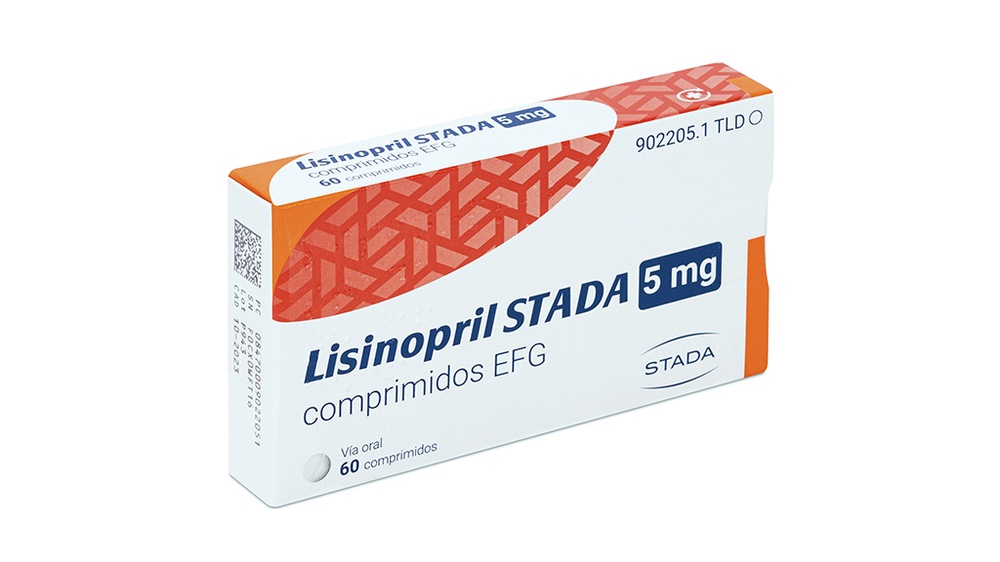
LISINOPRIL 5 mg Tablets

Prescription review online
A doctor will review your case and decide whether a prescription is medically appropriate.

Talk to a doctor about this medicine
Discuss your symptoms and possible next steps in a quick online consultation.



How to use LISINOPRIL STADA 5 mg TABLETS
Contents of the leaflet
- Introduction
- What is Lisinopril Stada and what is it used for
- What you need to know before you take Lisinopril Stada
- How to take Lisinopril Stada
- Possible side effects
- Storage of Lisinopril Stada
- Contents of the pack and further information
Introduction
Package Leaflet: Information for the User
Lisinopril STADA 5 mg tablets EFG
Read all of this leaflet carefully before you start taking this medicine because it contains important information for you.
- Keep this leaflet, you may need to read it again.
- If you have any further questions, ask your doctor or pharmacist.
- This medicine has been prescribed for you only. Do not pass it on to others. It may harm them, even if their signs of illness are the same as yours.
- If you get any side effects, talk to your doctor or pharmacist. This includes any possible side effects not listed in this leaflet. See section 4.
Contents of the pack
- What is Lisinopril Stada and what is it used for
- What you need to know before you take Lisinopril Stada
- How to take Lisinopril Stada
- Possible side effects
- Storage of Lisinopril Stada
- Contents of the pack and further information
1. What is Lisinopril Stada and what is it used for
Lisinopril Stada belongs to a group of medicines called angiotensin-converting enzyme inhibitors (ACE inhibitors).
Lisinopril Stada is indicated for:
- Treatment of high blood pressure (hypertension).
- Treatment of symptomatic heart failure.
- Short-term treatment of acute myocardial infarction.
- Treatment of renal complications of type 2 diabetes in hypertensive patients.

Not sure if this medicine is right for you?
Discuss your symptoms and treatment with a doctor online.
2. What you need to know before you take Lisinopril Stada
Do not take Lisinopril Stada:
- If you are allergic to lisinopril, to other medicines of the same group (ACE inhibitors), or to any of the other ingredients of this medicine (listed in section 6).
- If you have previously taken a medicine of the same group of drugs as lisinopril (ACE inhibitors) and have presented an allergic reaction that caused swelling of hands, feet or ankles, face, lips, tongue and/or throat with difficulty swallowing or breathing, or if you or a member of your family has had a similar reaction (angioedema).
- If you are pregnant. (See section "Pregnancy and lactation")
- If you have diabetes or kidney failure and are being treated with a blood pressure-lowering medicine that contains aliskiren.
- If you have taken or are currently taking sacubitril/valsartan, a medicine used to treat a type of long-term (chronic) heart failure in adults, as the risk of angioedema (rapid swelling under the skin in areas such as the throat) is high.
Warnings and precautions
Consult your doctor or pharmacist before starting to take Lisinopril Stada.
- If you have a narrowing of the aorta (aortic stenosis), of the renal arteries (renal artery stenosis), or of the heart valves (mitral valve stenosis), or an increase in the thickness of the heart muscle (hypertrophic cardiomyopathy).
- If you have had a heart attack.
- If you have kidney problems or are on dialysis.
- If you have liver failure.
- If you have a disease of the blood vessels (collagen vascular disease) and/or are being treated with allopurinol (for gout), procainamide (for heart rhythm disorders), immunosuppressants (medicines that suppress the body's immune response).
- If you have diabetes.
- If you follow a salt-free diet, take potassium supplements, potassium-sparing diuretics, or salt substitutes that contain potassium, or if you have recently had excessive vomiting or diarrhea.
- If you have a cough.
- If you are going to undergo a treatment called low-density lipoprotein (LDL) apheresis, or a desensitization treatment to reduce the effect of an allergy to bee or wasp stings.
- If you have low blood pressure (you may notice it as dizziness or lightheadedness, especially in the initial doses and when standing up. In these cases, lying down may help).
- If you are taking any of the following medicines used to treat high blood pressure (hypertension):
- an angiotensin II receptor antagonist (ARA) (also known as "sartans" - e.g., valsartan, telmisartan, irbesartan), especially if you have kidney problems related to diabetes.
- aliskiren
- If you are taking any of the following medicines, the risk of angioedema (rapid swelling under the skin in areas such as the throat) may increase:
- Racecadotril, a medicine used to treat diarrhea
- Medicines used to prevent organ transplant rejection and for cancer (e.g., temsirolimus, sirolimus, everolimus) and other medicines of the mTOR inhibitor class
- Vildagliptin, a medicine used to treat diabetes
Your doctor may monitor your kidney function, blood pressure, and blood electrolyte levels (e.g., potassium) at regular intervals.
See also the information under the heading "Do not take Lisinopril Stada".
In all these cases, inform your doctor as you may need a dose adjustment or to stop taking Lisinopril Stada.
Stop taking Lisinopril Stada and seek medical attention immediately if you have difficulty breathing or swallowing with or without swelling of the face, lips, tongue and/or throat.
Inform your doctor if you are going to be hospitalized for surgery. Tell your doctor or dentist that you are taking Lisinopril Stada before they administer a local or general anesthetic.
Children
The use of Lisinopril Stada is not recommended in children as the information on safety and efficacy in this age group is limited.
Other medicines and Lisinopril Stada
Tell your doctor or pharmacist if you are taking, have recently taken, or might take any other medicines.
Note that these instructions may also apply to medicines that have been used before or may be used after.
Certain medicines may interact with Lisinopril Stada; in these cases, your doctor may need to change your dose and/or take other precautions.
It is important that you inform your doctor if you are taking or have recently taken any of the following medicines:
- Diuretics (medicines used to increase urine production).
- Medicines for mental disorders such as lithium, antipsychotics, or tricyclic antidepressants.
- Non-steroidal anti-inflammatory medicines (NSAIDs) such as indomethacin and high doses of aspirin (more than 3 grams per day) used to treat arthritis or muscle pain.
- Antihypertensives (medicines that lower high blood pressure).
- If you are taking an angiotensin II receptor antagonist (ARA) or aliskiren (see also the information under the headings "Do not take Lisinopril Stada" and "Warnings and precautions")
- Sympathomimetic medicines (stimulate the central nervous system).
- Medicines for the treatment of diabetes, such as insulin or oral antidiabetics.
- Thrombolytic medicines (prevent blood clot formation).
This applies especially if you are also taking:
- Medicines used more frequently to prevent organ transplant rejection (sirolimus, everolimus, and other medicines of the mTOR inhibitor class). See section "Warnings and precautions".
- Potassium supplements (including salt substitutes), diuretics (especially potassium-sparing diuretics), and other medicines that may increase potassium levels in the blood (e.g., trimethoprim and cotrimoxazole for bacterial infections; cyclosporin, an immunosuppressive medicine used to prevent organ transplant rejection; and heparin, a medicine used to thin the blood to prevent clots).
Pregnancy, breastfeeding, and fertility
If you are pregnant or breastfeeding, think you may be pregnant, or are planning to have a baby, ask your doctor or pharmacist for advice before taking this medicine.
Lisinopril Stada is contraindicated during pregnancy and should not be used during breastfeeding.
Angiotensin-converting enzyme inhibitors (the group to which lisinopril belongs) may cause fetal harm and death when administered during the second and third trimesters of pregnancy. If pregnancy is detected, the administration of this medicine should be stopped as soon as possible.
Driving and using machines
It is unlikely that Lisinopril Stada tablets will affect your ability to drive or use machines; however, if you notice symptoms of dizziness or fatigue, avoid performing tasks that require special attention until you know how you tolerate the medicine.
3. How to take Lisinopril Stada
Follow exactly the instructions of administration of this medicine indicated by your doctor or pharmacist. In case of doubt, consult your doctor or pharmacist again.
Remember to take your medicine.
Your doctor will indicate how many tablets you should take each day and the duration of your treatment with Lisinopril Stada. Do not stop treatment before.
Adults
- High blood pressure
The usual initial recommended dose is 10 mg once a day. The usual long-term dose is 20 mg once a day.
- Symptomatic heart failure
The usual initial recommended dose is 2.5 mg once a day.
The usual long-term dose is 5 mg up to a maximum of 35 mg once a day.
- Acute myocardial infarction
The usual initial recommended dose is 5 mg on the first and second day after the infarction, followed by 10 mg once a day.
- Renal complications of diabetes
The usual dose is 10 mg or 20 mg once a day.
Kidney failure
Your doctor will adjust the dose.
Method of administration:
- Swallow the tablet with water.
- Try to take your tablets at the same time every day. It does not matter whether you take Lisinopril Stada before or after meals.
- Do not stop taking your tablets if you feel well, unless your doctor tells you to.
- Remember, the first dose of Lisinopril Stada may cause a greater decrease in blood pressure than will be present when continuing treatment. This effect may be noticed as dizziness, in which case lying down may help.
If you think the action of Lisinopril Stada is too strong or too weak, consult your doctor or pharmacist.
If you take more Lisinopril Stada than you should
If you take more Lisinopril Stada than you should, consult your doctor or pharmacist immediately. The most frequent symptoms in case of overdose are: hypotension, shock, kidney failure, hyperventilation, tachycardia, palpitations, bradycardia, dizziness, anxiety, and cough.
In case of overdose or accidental ingestion, consult your doctor, pharmacist, or call the Toxicology Information Service. Phone 91 562 04 20, indicating the medicine and the amount administered. It is recommended to take the packaging and the leaflet of the medicine to the healthcare professional.
If you forget to take Lisinopril Stada
Do not take a double dose to make up for forgotten doses and wait for the next administration.

Started taking the medicine and have questions?
Discuss your symptoms and treatment with a doctor online.
4. Possible side effects
Like all medicines, this medicine can cause side effects, although not everybody gets them.
The following side effects have been described according to the following frequency categories: very common (?1/10), common (?1/100 to <1>
Blood and lymphatic system disorders
Rare: decrease in hemoglobin (a blood protein), decrease in hematocrit (proportion of cells in the blood).
Very rare: bone marrow depression, anemia, thrombocytopenia (greater tendency to bruise), changes in some blood cells or components.
Metabolism and nutrition disorders
Very rare: decrease in blood glucose.
Nervous system and psychiatric disorders
Common: dizziness, headache.
Uncommon: mood changes, tingling and/or numbness of certain limbs, vertigo, changes in taste, sleep disorders.
Rare: mental confusion.
Cardiac and vascular disorders
Common: dizziness or lightheadedness when standing up quickly.
Uncommon: myocardial infarction or stroke, palpitations, rapid heartbeats, numbness and spasms in the fingers, followed by heat and pain (Raynaud's phenomenon).
Respiratory, thoracic, and mediastinal disorders
Common: cough.
Uncommon: rhinitis.
Very rare: shortness of breath, sinusitis, lung inflammation.
Gastrointestinal disorders
Common: diarrhea, vomiting.
Uncommon: nausea, abdominal pain, and indigestion.
Rare: dry mouth.
Very rare: liver or pancreas inflammation, jaundice (yellowing of the skin and/or eyes)
Skin and subcutaneous tissue disorders
Uncommon: rash, itching.
Rare: intense skin itching (with hives), hair loss, psoriasis, allergic reaction (angioedema) characterized by swelling of the face, limbs, lips, tongue, and/or larynx.
Very rare: sweating, severe skin disorders (whose symptoms may include redness, blisters, and peeling)
Sometimes fatigue or sore throat may appear, which may be accompanied by fever, joint and muscle pain, swelling of the joints or glands, or sensitivity to sunlight.
Renal and urinary disorders
Common: changes in kidney function.
Rare: increase in urea in the urine, acute kidney failure.
Very rare: pain or inability to urinate.
Reproductive system and breast disorders:
Uncommon: impotence.
Rare: development of breasts in males.
General disorders and administration site conditions
Uncommon: fatigue, tiredness.
Investigations
Uncommon: increase in blood urea, increase in blood creatinine, increase in liver enzymes, increase in blood potassium.
Rare: increase in blood bilirubin, decrease in blood sodium.
Reporting of side effects
If you experience any side effects, talk to your doctor or pharmacist. This includes any possible side effects not listed in this leaflet. You can also report side effects directly via the Spanish Medicines and Healthcare Products Agency (AEMPS) website: https://www.notificaram.es. By reporting side effects, you can help provide more information on the safety of this medicine.
5. Storage of Lisinopril Stada
Keep this medicine out of the sight and reach of children.
No special storage conditions are required.
Do not use this medicine after the expiry date which is stated on the carton after EXP. The expiry date refers to the last day of the month shown.
Medicines should not be disposed of via wastewater or household waste. Return any unused medicine to a pharmacy for disposal. Ask your pharmacist how to dispose of medicines no longer required. This will help protect the environment.
6. Contents of the pack and further information
Composition of Lisinopril Stada
- The active substance is lisinopril.
Each tablet contains 5 mg of lisinopril (as lisinopril dihydrate).
- The other ingredients are calcium hydrogen phosphate dihydrate, mannitol, maize starch, pregelatinized maize starch, and magnesium stearate.
Appearance of the product and pack contents
Lisinopril Stada 5 mg is presented as white, round, biconvex tablets with a score line on one face and a "5" mark on the other.
The score line is only to facilitate breaking the tablet if you have difficulty swallowing it whole.
Each pack contains 60 or 500 (clinical pack) tablets.
Not all pack sizes may be marketed.
Marketing authorization holder and manufacturer
Marketing authorization holder
Laboratorio STADA, S.L.
Frederic Mompou, 5
08960 Sant Just Desvern (Barcelona)
Spain
Manufacturer
Neuraxpharm Pharmaceuticals, S.L.
Avda. Barcelona, 69
08970 Sant Joan Despí (Barcelona)
Spain
Date of last revision of this leaflet:November 2019
Detailed and updated information on this medicine is available on the website of the Spanish Agency for Medicines and Healthcare Products (AEMPS) http://www.aemps.gob.es/
- Country of registration
- Dosage formTABLET, 5 mg lisinopril
- ATC codeC09AA03
- Average pharmacy price3.4 EUR
- Active substance
- Prescription requiredYes
- Manufacturer
- CompositionMANITOL (E-421) (21,481 mg mg)
- This information is for reference only and does not constitute medical advice. Always consult a doctor before taking any medication. Oladoctor is not responsible for medical decisions based on this content.
- Alternatives to LISINOPRIL STADA 5 mg TABLETSDosage form: TABLET, 5 mgActive substance: lisinoprilManufacturer: Neuraxpharm Spain S.L.Prescription requiredDosage form: TABLET, 20 mgActive substance: lisinoprilManufacturer: Neuraxpharm Spain S.L.Prescription requiredDosage form: TABLET, 20 mgActive substance: lisinoprilManufacturer: Aurovitas Spain, S.A.U.Prescription required
Online doctors for LISINOPRIL STADA 5 mg TABLETS
Discuss questions about LISINOPRIL STADA 5 mg TABLETS, including use, safety considerations and prescription review, subject to medical assessment and local regulations.
Get LISINOPRIL STADA 5 mg TABLETS Prescription Online
Fill in a 2-min form
Tell us your symptoms, history, and what medicine you're requesting.
Pick a doctor or let us assign
Choose a specialist or we'll match you with the next available doctor.
Doctor reviews your case
Usually within 30 minutes. They may ask follow-up questions via chat.
Collect from any pharmacy
Electronic prescription sent to your email — valid across Spain.
Frequently Asked Questions
LISINOPRIL STADA 5 mg TABLETS requires a prescription in Spain. You can check with a doctor online whether this medicine may be appropriate for your situation.
The active ingredient in LISINOPRIL STADA 5 mg TABLETS is lisinopril. This information helps identify medicines with the same composition but different brand names.
The average pharmacy price for LISINOPRIL STADA 5 mg TABLETS is around 3.4 EUR. Prices may vary depending on the manufacturer and dosage form.
LISINOPRIL STADA 5 mg TABLETS is manufactured by Laboratorio Stada S.L.. Pharmacy brands and packaging may differ depending on the distributor.
Doctors such as Family doctors, Psychiatrists, Dermatologists, Cardiologists, Endocrinologists, Gastroenterologists, Pulmonologists, Nephrologists, Rheumatologists, Hematologists, Infectious disease physicians, Allergists, Geriatricians, Paediatricians, Oncologists may assess whether LISINOPRIL STADA 5 mg TABLETS is appropriate, depending on your situation and local regulations. You can book an online consultation to discuss your symptoms and possible next steps.
Spain has a well-developed healthcare infrastructure across major cities such as Madrid, Barcelona, Valencia, and Seville. Pharmacies are widely available and operate under strict regulations, ensuring access to prescribed medications.
You can buy LISINOPRIL STADA 5 mg TABLETS in Madrid, Barcelona, Seville, or Valencia at any local pharmacy with a valid prescription.
To obtain a prescription, you can use Oladoctor:
Other medicines with the same active substance (lisinopril) include DONEKA 5 mg TABLETS, DONEKA 20 mg TABLETS, LISINOPRIL AUROVITAS 20 mg TABLETS. These may have different brand names or formulations but contain the same therapeutic ingredient. Always consult a doctor before switching or starting a new medicine.
