


Lioresal 25 mg comprimidos

Prescription request online
A doctor will review your case and decide whether a prescription is medically appropriate.

Talk to a doctor about this medicine
Discuss your symptoms and possible next steps in a quick online consultation.



How to use LIORESAL 25 mg TABLETS
Contents of the leaflet
- Introduction
- What is Lioresal and what is it used for
- What you need to know before you take Lioresal
- How to take Lioresal
- Possible side effects
- Storing Lioresal
- Packaging Content and Additional Information
Introduction
Package Leaflet: Information for the User
Lioresal 25 mg Tablets
Baclofen
Read all of this leaflet carefully before you start taking this medicine because it contains important information for you.
- Keep this leaflet, you may need to read it again.
- If you have any further questions, ask your doctor or pharmacist.
- This medicine has been prescribed for you only. Do not pass it on to others. It may harm them, even if their signs of illness are the same as yours.
- If you get any side effects, talk to your doctor or pharmacist. This includes any possible side effects not listed in this leaflet. See section 4.
Contents of the pack
- What is Lioresal and what is it used for
- What you need to know before you take Lioresal
- How to take Lioresal
- Possible side effects
- Storing Lioresal
- Contents of the pack and other information
1. What is Lioresal and what is it used for
Lioresal belongs to a group of medicines called muscle relaxants.
Adults
It is used to reduce and relieve excessive muscle stiffness (spasms) that occur in muscles with some diseases such as multiple sclerosis, stroke, spinal cord diseases, and certain nervous system disorders.
Use in children and adolescents
It is used in patients from 0 to 18 years for the symptomatic treatment of muscle stiffness (spasms), especially when this is due to cerebral palsy, after stroke, degenerative brain diseases, infectious spinal cord diseases, and other nervous system disorders.

Not sure if this medicine is right for you?
Discuss your symptoms and treatment with a doctor online.
2. What you need to know before you take Lioresal
Do not take Lioresal
- if you are allergic to baclofen or any of the other ingredients of this medicine (listed in section 6).
Warnings and precautions
Consult your doctor or pharmacist before starting to take Lioresal:
- if you have Parkinson's disease or any mental illness accompanied by confusion or depression,
- if you suffer from epilepsy (seizures),
- if you have acute stomach pain (ulcer) or intestine, cerebral circulation disorders, breathing problems, or liver disease,
- if you have kidney disease. Your doctor will decide if Lioresal is the right treatment for you,
- if you have difficulty urinating,
- if you are diabetic,
- if you are pregnant and taking Lioresal during pregnancy, the newborn may suffer from seizures and other symptoms related to the sudden interruption of treatment just after birth (see "if you stop taking Lioresal" and "pregnancy, breastfeeding, and fertility"). Your doctor may need to administer small doses of Lioresal to the newborn and gradually reduce them to control and prevent symptoms,
- do not stop treatment without consulting your doctor,
- if it is necessary to maintain posture, balance, or circulatory function, your doctor will adjust the dose,
- if you are an elderly patient or have cerebrovascular disease, your doctor will closely monitor you and may need to adapt the dose of Lioresal,
- if you have a history of drug abuse or dependence.
Some people treated with baclofen have thought about self-harm or suicide or have attempted suicide. Most of these people also had depression, had consumed excessive alcohol, or were prone to having suicidal thoughts. If at any time you think about self-harm or suicide, talk to your doctor or go to a hospital immediately. Also, ask a family member or close friend to inform you if they observe any worrying change in your behavior and ask them to read this leaflet.
If you are in any of these circumstances, inform your doctor before starting to take Lioresal.
There have been reports of decreased brain function (encephalopathy) in some patients taking Lioresal at the prescribed doses, which resolved after treatment was discontinued. The symptoms include increased sleepiness, drowsiness, confusion, sudden muscle movements, or coma.
If you experience any of these symptoms, inform your doctor immediately. Your doctor will decide if you should discontinue treatment with baclofen.
Other safety measures
Before undergoing any surgical procedure (including dental procedures) or emergency treatment, inform your doctor that you are taking Lioresal.
Children and adolescents
It is not recommended to use Lioresal tablets in children with a weight below 33 kg or in children under 6 years of age.
Experience with the use of Lioresal in children under one year of age is very limited.
Taking Lioresal with other medicines
Inform your doctor or pharmacist if you are taking, have recently taken, or might take any other medicines.
There are some medicines that interfere with the action of Lioresal, which can increase side effects or decrease the effectiveness of Lioresal:
- medicines (such as opioids like morphine) and substances that inhibit the central nervous system (alcohol).
- medicines for treating mood disorders such as tricyclic antidepressants or lithium, as movement disorders may occur.
- medicines that lower blood pressure, including medicines for treating high blood pressure. When taken with Lioresal, blood pressure may decrease.
- medicines for treating Parkinson's disease (carbidopa, levodopa), as nervous system disorders may occur and Parkinsonian symptoms may worsen.
- medicines that reduce kidney function.
- medicines for arthritis or pain.
Taking Lioresal with food, drinks, and alcohol
Take Lioresal during meals with a little liquid. You should not drink alcohol during treatment with Lioresal.
Pregnancy, breastfeeding, and fertility
If you are pregnant or breastfeeding, think you may be pregnant, or are planning to have a baby, ask your doctor or pharmacist for advice before taking this medicine.
Pregnancy
Do not use this medicine during pregnancy unless your doctor advises you to. Your doctor will assess whether you can take this medicine during pregnancy and will inform you about the possible risks. If you need to take Lioresal during pregnancy, your baby may have seizures and other symptoms related to the sudden interruption of treatment just after birth (see "if you stop taking Lioresal" and "warnings and precautions").
Breastfeeding
The active substance of Lioresal passes into breast milk in very small amounts. This medicine should not be used during breastfeeding unless your doctor advises you to. In this case, your doctor will inform you about the possible effects that this medicine may have on your child.
Fertility
No data are available on the effect of baclofen on human fertility.
Driving and using machines
Lioresal may cause drowsiness, dizziness, vision problems, or clumsiness in some people. If this happens, do not drive or use tools or machines.
Information on some of the ingredients of Lioresal
This medicine contains very low levels of gluten (from wheat starch) and is very unlikely to cause problems if you have celiac disease.
One Lioresal 25 mg tablet does not contain more than 8.3 micrograms of gluten.
If you have a wheat allergy (different from celiac disease), do not take this medicine.
3. How to take Lioresal
Follow exactly the instructions of administration of this medicine given by your doctor. In case of doubt, consult your doctor or pharmacist again. Do not exceed the recommended dose.
Lioresal should be taken during meals with a little liquid. The score line is only to facilitate breaking the tablet if you have difficulty swallowing it whole.
Take Lioresal always at the same time every day and it will help you remember when you should take the medicine.
Make sure you take the medicine every day as indicated by your doctor. This will help you get the best results and reduce the risk of adverse reactions.
The recommended dose is:
Adults:
Normally, you will start treatment with 15 mg per day, preferably in divided doses of 2 to 3 times. The dose will be gradually increased until the desired results are achieved; this can be at doses between 30 and 80 mg per day, divided into 2 to 4 times. Your doctor may decide to administer higher doses.
Use in children and adolescents
Treatment in children should be adjusted according to their body weight. The recommended dose for treatment in children usually starts at a very low dose (approximately 0.3 mg/kg per day), in divided doses twice a day. Then the dose should be increased cautiously at weekly intervals until the sufficient dose is reached to meet the individual needs of the child, which is between 0.75 and 2 mg/kg body weight. The total daily dose should not exceed a maximum of 40 mg/day in children under 8 years of age. In children over 8 years of age, the maximum daily dose should not exceed 60 mg/day.
Lioresal tablets are not suitable for use in children with a weight below 33 kg or in children under 6 years of age.
Patients with kidney problems
If you have kidney disease or are receiving hemodialysis, your dose may be lower and your doctor will decide if Lioresal is the right treatment for you.
Patients with liver problems
The dose recommended by your doctor may be lower.
Elderly patients
Your doctor may recommend a lower dose that will be gradually increased.
The dose prescribed by your doctor may be different from the one indicated in this leaflet. If that is the case, follow your doctor's instructions.
Your doctor will inform you how many tablets you should take. Depending on how you respond to treatment, your doctor may recommend increasing or reducing the dose.
Follow exactly the instructions of administration of the medicine contained in this leaflet or as indicated by your doctor or pharmacist. In case of doubt, ask your doctor or pharmacist.
How long to take Lioresal
If after 6-8 weeks of treatment you do not notice any improvement, inform your doctor. Your doctor will decide whether or not to continue treatment with Lioresal.
Continue taking Lioresal until your doctor tells you to stop.
If you have any doubts about how long to take Lioresal, consult your doctor or pharmacist.
If you take more Lioresal than you should
In case of overdose or accidental ingestion, consult your doctor or pharmacist immediately or call the Toxicology Information Service, phone: 91 562 04 20, indicating the medicine and the amount ingested.
The main symptoms of overdose are drowsiness, breathing difficulties, changes in consciousness, and coma.
Other symptoms may appear, such as feeling confused, hallucinations, agitation, seizures, blurred vision, unusual muscle weakness, sudden muscle contractions, few or no reflexes, high or low blood pressure, slow, fast, or irregular heartbeat, low body temperature, nausea, vomiting, diarrhea, excessive salivation, or ringing in the ears.
If you forget to take Lioresal
If you forget to take a dose, take it as soon as possible.
Do not take a double dose to make up for forgotten doses. Simply return to your regular administration schedule. If you forget to take several doses, you should contact your doctor.
If you stop taking Lioresal
Do not stop treatment with Lioresal abruptly without first consulting your doctor. Your doctor will tell you when and how you can stop taking this medicine; stopping treatment abruptly can cause important side effects. If your doctor decides to discontinue your treatment, it will be done gradually by progressively reducing the dose.
If you stop taking Lioresal suddenly, you may experience: nervousness, confusion, hallucinations, abnormal thoughts or behaviors, seizures, uncontrolled tics, sudden muscle movements or cramps, increased muscle tone, rapid heart rate, increased body temperature. Excessive muscle tension (spasms) may even worsen.
If you have any other questions about the use of this medicine, ask your doctor or pharmacist.

Started taking the medicine and have questions?
Discuss your symptoms and treatment with a doctor online.
4. Possible side effects
Like all medicines, this medicine can cause side effects, although not everybody gets them.
They are usually mild and appear at the beginning of treatment and normally disappear after a few days.
In elderly patients, these adverse reactions can be more severe.
Some side effects can be serious
If you experience any of the following side effects, inform your doctor immediately:
- breathing problems,
- severe coordination and speech disorders,
- skin rash, hives, and signs of hypersensitivity to the medicine,
- resting or exertional dyspnea, leg swelling, and fatigue (signs of decreased cardiac output).
If any of these symptoms affect you, inform your doctor immediately.
Some side effects are very common(may affect more than 1 in 10 patients):
- drowsiness,
- sleepiness,
- nausea.
If you experience any of the mentioned side effects severely, inform your doctor.
Some side effects are common(may affect up to 1 in 10 patients):
- fatigue,
- tiredness,
- dizziness,
- headache,
- difficulty sleeping,
- breathing problems,
- confusion,
- euphoria,
- sadness (depression),
- loss of coordination, affecting balance and walking, eye and limb movements, and/or speech (signs of ataxia),
- tremors,
- hallucinations,
- nightmares,
- blurred vision/vision disorders,
- heart disorders,
- low blood pressure (hypotension),
- difficulty urinating, painful urination, or sudden decrease in urine output,
- seizures,
- weakness of arms and legs,
- muscle pain,
- uncontrolled eye movements,
- dry mouth,
- gastrointestinal disorders,
- retching,
- vomiting,
- constipation,
- diarrhea,
- increased sweating,
- increased urine output,
- nocturnal incontinence.
If you experience any of the mentioned side effects severely, inform your doctor.
Some side effects are rare(may affect up to 1 in 1,000 patients):
- tingling or numbness of hands and/or feet,
- difficulty speaking,
- taste disorders,
- abdominal pain,
- sudden decrease in urine output,
- impotence,
- abdominal pain, yellowing of the skin and eyes (signs of liver disorder).
Some side effects are very rare(may affect less than 1 in 10,000 patients):
- low body temperature.
Side effects of unknown frequency(cannot be estimated from the available data):
- increased blood sugar levels,
- slow heart rate,
- itching,
- withdrawal syndrome,
- skin rash and hives,
- the symptoms that occur after abrupt discontinuation of treatment (withdrawal syndrome*) have been described in section 3,
- difficulty breathing during sleep (sleep apnea syndrome),
- swelling of ankles, feet, or lower legs,
- swelling of the face,
- allergic reaction (hypersensitivity),
- hair loss,
- sexual problems,
- decreased brain function (encephalopathy).
*Postnatal seizures have been reported after intrauterine exposure to oral Lioresal as a withdrawal syndrome
If you experience any of the mentioned side effects severely, inform your doctor.
Reporting of side effects:
If you experience any side effects, talk to your doctor or pharmacist, even if they are not listed in this leaflet. You can also report them directly through the Spanish Pharmacovigilance System for Human Use Medicines: https://www.notificaRAM.es. By reporting side effects, you can help provide more information on the safety of this medicine.
5. Storing Lioresal
Keep this medicine out of the sight and reach of children.
Do not use this medicine after the expiry date which is stated on the carton after EXP. The expiry date refers to the last day of the month shown.
No special storage conditions are required.
"Medicines should not be disposed of via wastewater or household waste. Ask your pharmacist how to dispose of medicines no longer required. These measures will help protect the environment."
6. Packaging Content and Additional Information
Composition of Lioresal 25 mg tablets
- The active ingredient is baclofen. Each tablet contains 25 mg of baclofen.
- The other components (excipients) are: anhydrous colloidal silica, microcrystalline cellulose, magnesium stearate, povidone, wheat starch.
Appearance of the product and packaging content
White, round, flat tablets with slightly beveled edges, which have the inscription "CG" on one side and the letters "U" and "R" on either side of the score line on the other. The score line is only for fractionation and to facilitate swallowing, but not for dividing into equal doses.
Each package contains 30 tablets.
Marketing Authorization Holder
Novartis Farmacéutica, S.A.
Gran Via de les Corts Catalanes 764
08013 Barcelona
Spain
Manufacturer
Novartis Pharma GmbH
Roonstrasse 25
90429 Nürnberg
Germany
Novartis Farmacéutica, S.A.
Gran Vía de les Corts Catalanes, 764
08013 Barcelona
Spain
Date of the last revision of this leaflet:September 2024
Other sources of information
Detailed and updated information on this medication is available on the website of the Spanish Agency for Medicines and Health Products (AEMPS) http://www.aemps.gob.es.
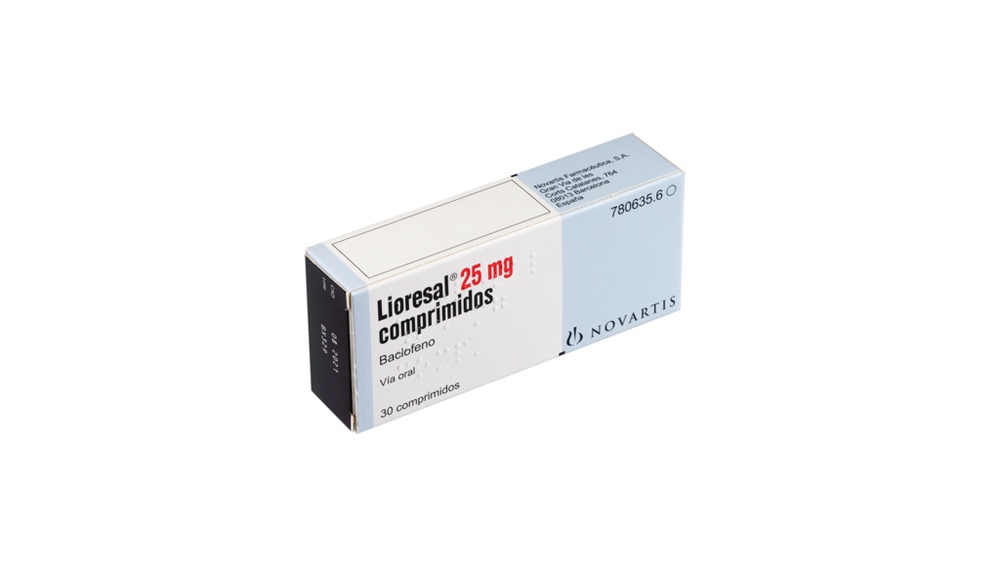
- Country of registration
- Dosage formTABLET, 25 mg
- ATC codeM03BX01
- Average pharmacy price4.78 EUR
- Active substance
- Prescription requiredYes
- Manufacturer
- CompositionALMIDON DE TRIGO (83 mg mg)
- This information is for reference only and does not constitute medical advice. Always consult a doctor before taking any medication. Oladoctor is not responsible for medical decisions based on this content.
- Alternatives to LIORESAL 25 mg TABLETSDosage form: TABLET, 10 mgActive substance: baclofenManufacturer: Laboratorios Combix S.L.U.Prescription requiredDosage form: INJECTABLE, 0.05 mgActive substance: baclofenManufacturer: Novartis Farmaceutica S.A.Prescription requiredDosage form: INJECTABLE PERFUSION, 10 mgActive substance: baclofenManufacturer: Novartis Farmaceutica S.A.Prescription required
Online doctors for LIORESAL 25 mg TABLETS
Discuss questions about LIORESAL 25 mg TABLETS, including use, safety considerations and whether a prescription is appropriate, subject to medical assessment and local regulations.









Frequently Asked Questions
LIORESAL 25 mg TABLETS requires a prescription in Spain. You can check with a doctor online whether this medicine may be appropriate for your situation.
The active ingredient in LIORESAL 25 mg TABLETS is baclofen. This information helps identify medicines with the same composition but different brand names.
The average pharmacy price for LIORESAL 25 mg TABLETS is around 4.78 EUR. Prices may vary depending on the manufacturer and dosage form.
LIORESAL 25 mg TABLETS is manufactured by Novartis Farmaceutica S.A.. Pharmacy brands and packaging may differ depending on the distributor.
Doctors such as Family doctors, Psychiatrists, Dermatologists, Cardiologists, Endocrinologists, Gastroenterologists, Pulmonologists, Nephrologists, Rheumatologists, Hematologists, Infectious disease physicians, Allergists, Geriatricians, Paediatricians, Oncologists may assess whether LIORESAL 25 mg TABLETS is appropriate, depending on your situation and local regulations. You can book an online consultation to discuss your symptoms and possible next steps.
The prescription is issued by a doctor after assessing your health. In Spain, LIORESAL 25 mg TABLETS is then dispensed in pharmacies with that prescription. An online consultation does not guarantee that a prescription will be issued: the decision always rests with the doctor.
To request an assessment, you can use Oladoctor:
Other medicines with the same active substance (baclofen) include BACLOFEN COMBIX 10 mg TABLETS, LIORESAL 0.05 mg/mL Injectable Solution, LIORESAL 0.5 mg/mL SOLUTION FOR INFUSION. These may have different brand names or formulations but contain the same therapeutic ingredient. Always consult a doctor before switching or starting a new medicine.
