



LAZCLUZE 240 mg Film-Coated Tablets

Prescription review online
A doctor will review your case and decide whether a prescription is medically appropriate.

Talk to a doctor about this medicine
Discuss your symptoms and possible next steps in a quick online consultation.



How to use LAZCLUZE 240 mg FILM-COATED TABLETS
Contents of the leaflet
- Introduction
- What is Lazcluze and what is it used for
- What you need to know before you take Lazcluze
- How to take Lazcluze
- Possible side effects
- Storage of Lazcluze
- Package Contents and Additional Information
Introduction
Package Leaflet: Information for the Patient
Lazcluze 80 mg film-coated tablets
Lazcluze 240 mg film-coated tablets
lazertinib
This medicinal product is subject to additional monitoring, which will allow for quick identification of new safety information. You can help by reporting any side effects you may get. The last section of the leaflet includes information on how to report side effects.
Read all of this leaflet carefully before you start taking this medicine, because it contains important information for you.
- Keep this leaflet, you may need to read it again.
- If you have any further questions, ask your doctor, pharmacist, or nurse.
- This medicine has been prescribed for you only. Do not pass it on to others. It may harm them, even if their signs of illness are the same as yours.
- If you get any side effects, talk to your doctor, pharmacist, or nurse. This includes any possible side effects not listed in this leaflet. See section 4.
Contents of the pack
- What is Lazcluze and what is it used for
- What you need to know before you take Lazcluze
- How to take Lazcluze
- Possible side effects
- Storage of Lazcluze
- Contents of the pack and other information
1. What is Lazcluze and what is it used for
Lazcluze is a cancer medicine that contains the active substance "lazertinib". It belongs to a group of medicines called protein kinase inhibitors.
Lazcluze is used with amivantamab, another cancer medicine, to treat adults who have a type of lung cancer called "non-small cell lung cancer". It is used when the cancer is advanced (cure is unlikely) and has undergone certain changes (deletion mutation in exon 19 or substitution mutation in exon 21) in a gene called EGFR.
There is a separate package leaflet for amivantamab. Read it before starting treatment.
The EGFRgene produces a protein, EGFR, which is involved in the growth and survival of cells. Mutations (changes) in the EGFRgene alter the shape of this protein, which can cause cancer cells to grow and spread throughout the body. The active substance in Lazcluze, lazertinib, works by blocking the defective protein and may help slow down or stop the growth of the lung cancer you have. It may also help reduce the size of the tumor. Lazertinib targets the EGFR protein mutations that are known to cause cancer, while having less effect on normal EGFR proteins.

Not sure if this medicine is right for you?
Discuss your symptoms and treatment with a doctor online.
2. What you need to know before you take Lazcluze
Do not take Lazcluze
- if you are allergic to lazertinib or any of the other ingredients of this medicine (listed in section 6).
If you are not sure, talk to your doctor, pharmacist, or nurse before taking Lazcluze.
Warnings and precautions
Talk to your doctor, pharmacist, or nurse before starting Lazcluze if:
- you have had inflammation of the lungs (a condition called "interstitial lung disease" or "pneumonitis").
Tell your doctor immediately if you experience any of the following serious side effects (for more information, see section 4 "Serious side effects"):}
- Skin problems. To reduce the risk of skin problems, stay out of the sun, wear protective clothing, apply sunscreen, use moisturizing creams on the skin and nails, and use an anti-dandruff shampoo while taking this medicine. You will need to keep doing this for 2 months after stopping treatment. Your doctor may recommend starting to take one or more medicines to prevent skin problems, may treat you with a medicine, or refer you to a skin specialist (dermatologist) if you have skin reactions during treatment.
- Sudden difficulty breathing, coughing, or fever that may indicate the presence of lung inflammation. This condition can be life-threatening, so healthcare professionals will monitor you for possible symptoms.
- When used with another medicine called amivantamab, serious side effects can occur that can be life-threatening (due to the formation of blood clots in the veins). Your doctor will give you additional medicines to help prevent blood clots during treatment and will monitor you for possible symptoms.
- Eye problems. If you have vision problems or eye pain, contact your doctor or nurse immediately. If you wear contact lenses and have any new eye symptoms, stop wearing them and inform your doctor immediately.
Children and adolescents
Lazcluze has not been studied in children and adolescents. Do not give this medicine to children or adolescents under 18 years of age.
Other medicines and Lazcluze
Tell your doctor or pharmacist if you are taking, have recently taken, or might take any other medicines. This is because Lazcluze may affect the way other medicines work. Also, other medicines may affect the way Lazcluze works.
The following medicines may reduce the effectiveness of Lazcluze:
- Carbamazepine or phenytoin(antiepileptic used to treat seizures or epilepsy)
- Rifampicin(used to treat tuberculosis)
- St. John's Wort(a herbal medicine used to treat mild anxiety and depression)
- Bosentan(used to treat pulmonary arterial hypertension)
- Efavirenz(used for the treatment and prevention of HIV-1 infection)
- Modafinil(used for sleep disorders)
Lazcluze may affect the effectiveness of other medicines and/or increase the risk of side effects of these medicines:
- Tizanidine(used to relax muscles)
- Ciclosporin or sirolimus or tacrolimus(used to suppress the immune system)
- Everolimus(used to treat advanced breast cancer with positive hormone receptors, pancreatic or gastrointestinal or lung neuroendocrine tumors, and renal cell carcinoma)
- Pimozide(used in patients with Tourette's syndrome)
- Quinidine(used to treat malaria)
- Sunitinib(used to treat gastrointestinal stromal tumors, renal cell carcinoma, and pancreatic neuroendocrine tumors)
This list of medicines is not exhaustive. Tell your healthcare professional about all the medicines you are taking. Your doctor will tell you what the best treatment is for you.
Pregnancy
- If you are pregnant, think you may be pregnant, or are planning to have a baby, ask your doctor for advice before taking this medicine.
- This medicine may be harmful to the fetus. If you become pregnant during treatment, inform your doctor immediately. You and your doctor will decide whether you should continue to take Lazcluze.
- If you are able to become pregnant, you must use an effective method of birth control during treatment and for up to 3 weeks after stopping treatment.
- Male patients with a female partner who can become pregnant must use effective contraceptive methods, such as a condom, and not donate sperm during treatment with Lazcluze and for 3 weeks after stopping treatment.
Breast-feeding
Do not breast-feed during treatment with Lazcluze and for 3 weeks after stopping treatment, as it is not known whether there is a risk to the baby.
Driving and using machines
Lazcluze has a minor influence on the ability to drive and use machines. If you feel tired after taking Lazcluze, do not drive or use machines.
Lazcluze contains sodium
This medicine contains less than 1 mmol of sodium (23 mg) per tablet; this is essentially "sodium-free".
3. How to take Lazcluze
Always take this medicine exactly as your doctor or pharmacist has told you. If you are not sure, talk to your doctor or pharmacist.
How much to take
- The recommended dose is 240 mg once daily with amivantamab.
- If you experience certain side effects, your doctor may reduce the dose to 160 mg or 80 mg once daily.
How to take it
- Lazcluze is taken orally.
- Swallow the tablet whole. Do not crush, break, or chew the tablet.
- You can take this medicine with or without food.
- Do not take an extra dose if you vomit after taking Lazcluze. Wait until the next scheduled dose.
If you take more Lazcluze than you should
If you take more than the prescribed dose, contact your doctor. You may be at increased risk of side effects.
If you forget to take Lazcluze
If you miss a dose, take it as soon as you remember. However, if it is less than 12 hours before the next dose, do not take the missed dose. Take the next scheduled dose at the scheduled time.
If you stop taking Lazcluze
Do not stop taking this medicine unless your doctor tells you to.
If you have any further questions on the use of this medicine, ask your doctor, pharmacist, or nurse.

Started taking the medicine and have questions?
Discuss your symptoms and treatment with a doctor online.
4. Possible side effects
Like all medicines, this medicine can cause side effects, although not everybody gets them.
Serious side effects
The following side effects have been reported in clinical studies with Lazcluze in combination with amivantamab. Tell your doctor immediately if you notice any of the following serious side effects:
Very common(may affect more than 1 in 10 people):
- Skin problems, such as rash (including acne), dry skin, itching, pain, and redness. Tell your doctor if your skin problems get worse.
- Blood clots in the veins, especially in the lungs or legs. Symptoms may include sharp chest pain, difficulty breathing, rapid breathing, leg pain, and swelling in the arms or legs.
Common(may affect up to 1 in 10 people):
- Signs of inflammation and scarring in the lungs, such as sudden difficulty breathing, shortness of breath, coughing, or fever. This could lead to permanent damage. Your doctor may want to stop treatment with Lazcluze if you have this side effect.
- Signs of corneal inflammation (front part of the eye), such as redness of the eyes, eye pain, vision problems, or sensitivity to light.
- Eye problems - such as vision problems or eyelash growth.
Tell your doctor immediately if you notice any of the above serious side effects.
Other side effects
If you experience any side effects, talk to your doctor. These include:
Very common(may affect more than 1 in 10 people):
- nail problems
- signs of amivantamab infusion reaction
- low level of the protein "albumin" in the blood
- liver damage
- swelling caused by fluid accumulation in the body
- mouth sores
- nerve damage that can cause tingling, numbness, pain, or loss of pain sensation
- feeling very tired
- diarrhea
- constipation
- decreased appetite
- low calcium level in the blood
- feeling sick
- muscle spasms
- low potassium level in the blood
- feeling dizzy
- muscle pain
- vomiting
- fever
- abdominal pain
Common(may affect up to 1 in 10 people):
- hemorrhoids
- redness, swelling, peeling, or pain on palpation, mainly on the hands or feet
- low magnesium level in the blood
- itchy rash (urticaria)
Reporting of side effects
If you experience any side effects, talk to your doctor, pharmacist, or nurse, even if they are not listed in this leaflet. You can also report side effects directly through the national reporting system listed in Appendix V. By reporting side effects, you can help provide more information on the safety of this medicine.
5. Storage of Lazcluze
Keep this medicine out of the sight and reach of children.
Do not use this medicine after the expiry date which is stated on the packaging (aluminum blister, inner carton, outer carton, bottle, and packaging) after EXP. The expiry date is the last day of the month stated.
This medicine does not require any special storage conditions.
Medicines should not be disposed of via wastewater or household waste. Ask your pharmacist how to dispose of medicines no longer required. This will help protect the environment.
6. Package Contents and Additional Information
Lazcluze Composition
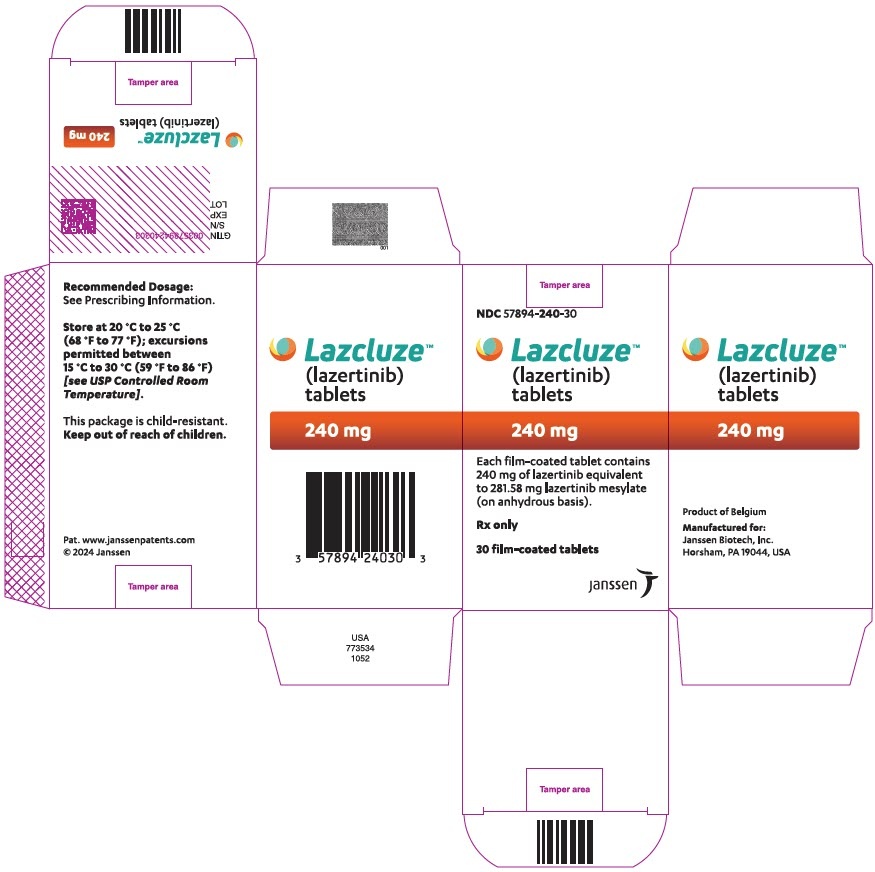
- The active ingredient is lazertinib (as monohydrate mesylate). Each 80 mg film-coated tablet contains 80 mg of lazertinib. Each 240 mg film-coated tablet contains 240 mg of lazertinib.
- The other components are:
Tablet core: hydrophobic colloidal silica, sodium croscarmellose (E468), microcrystalline cellulose (E460 (i)), mannitol (E421), and magnesium stearate (E572). See section 2
"Lazcluze contains sodium".
Tablet coating: macrogol and polyvinyl alcohol graft copolymer (E1209), polyvinyl alcohol (E1203), glycerol monocaprylate type I (E471), titanium dioxide (E171), and talc (E553b). Each 80 mg tablet also contains yellow iron oxide (E172). Each 240 mg tablet also contains red iron oxide (E172) and black iron oxide (E172).
Product Appearance and Package Contents
Lazcluze 80 mg is presented in the form of oval, yellow, film-coated tablets, 14 mm in length, and engraved with "LZ" on one side and "80" on the other. Lazcluze 80 mg is available in packages of 56 film-coated tablets (two cardboard boxes of 28 tablets each) or bottles of 60 or 90 tablets.
Lazcluze 240 mg is presented in the form of oval, reddish-purple, film-coated tablets, 20 mm in length, and engraved with "LZ" on one side and "240" on the other. Lazcluze 240 mg is available in packages of 14 film-coated tablets (one cardboard box of 14 tablets), packages of 28 film-coated tablets (two cardboard boxes of 14 tablets each), or bottles of 30 tablets.
Only some package sizes may be marketed.
Marketing Authorization Holder
Janssen-Cilag International NV
Turnhoutseweg 30
B-2340 Beerse
Belgium
Manufacturer
Janssen Cilag SpA
Via C. Janssen,
Borgo San Michele
Latina 04100
Italy
You can request more information about this medicinal product by contacting the local representative of the marketing authorization holder:
België/Belgique/Belgien Janssen-Cilag NV Tel/Tél: +32 14 64 94 11 | Lietuva UAB "JOHNSON & JOHNSON" Tel: +370 5 278 68 88 |
| Luxembourg/Luxemburg Janssen-Cilag NV Tél/Tel: +32 14 64 94 11 |
Ceská republika Janssen-Cilag s.r.o. Tel: +420 227 012 227 | Magyarország Janssen-Cilag Kft. Tel.: +36 1 884 2858 |
Danmark Janssen-Cilag A/S Tlf.: +45 4594 8282 | Malta AM MANGION LTD Tel: +356 2397 6000 |
Deutschland Janssen-Cilag GmbH Tel: 0800 086 9247 / +49 2137 955 6955 | Nederland Janssen-Cilag B.V. Tel: +31 76 711 1111 |
Eesti UAB "JOHNSON & JOHNSON" Eesti filiaal Tel: +372 617 7410 | Norge Janssen-Cilag AS Tlf: +47 24 12 65 00 |
Ελλάδα Janssen-Cilag Φαρμακευτικ? Μονοπρóσωπη Α.Ε.Β.Ε. Tηλ: +30 210 80 90 000 | Österreich Janssen-Cilag Pharma GmbH Tel: +43 1 610 300 |
España Janssen-Cilag, S.A. Tel: +34 91 722 81 00 | Polska Janssen-Cilag Polska Sp. z o.o. Tel.: +48 22 237 60 00 |
France Janssen-Cilag Tél: 0 800 25 50 75 / +33 1 55 00 40 03 | Portugal Janssen-Cilag Farmacêutica, Lda. Tel: +351 214 368 600 |
Hrvatska Johnson & Johnson S.E. d.o.o. Tel: +385 1 6610 700 | România Johnson & Johnson România SRL Tel: +40 21 207 1800 |
Ireland Janssen Sciences Ireland UC Tel: 1 800 709 122 | Slovenija Johnson & Johnson d.o.o. Tel: +386 1 401 18 00 |
Ísland Janssen-Cilag AB c/o Vistor hf. Sími: +354 535 7000 | Slovenská republika Johnson & Johnson, s.r.o. Tel: +421 232 408 400 |
Italia Janssen-Cilag SpA Tel: 800.688.777 / +39 02 2510 1 | Suomi/Finland Janssen-Cilag Oy Puh/Tel: +358 207 531 300 |
Κύπρος Βαρν?βας Χατζηπαναγ?ς Λτδ Τηλ: +357 22 207 700 | Sverige Janssen-Cilag AB Tfn: +46 8 626 50 00 |
Latvija UAB "JOHNSON & JOHNSON" filiale Latvija Tel: +371 678 93561 |
Date of Last Revision of this Leaflet
Other Sources of Information
Detailed information on this medicinal product is available on the European Medicines Agency website: https://www.ema.europa.eu.
- Country of registration
- Dosage formTABLET, 240 mg
- ATC codeL01EB09
- Active substance
- Prescription requiredYes
- Manufacturer
- CompositionMANITOL (E-421) (150,00 mg mg), CROSCARMELOSA SODICA (28,50 mg mg), GLICEROL, MONOCAPRILOCAPRATO DE (1,37 mg mg)
- This information is for reference only and does not constitute medical advice. Always consult a doctor before taking any medication. Oladoctor is not responsible for medical decisions based on this content.
- Alternatives to LAZCLUZE 240 mg FILM-COATED TABLETSDosage form: TABLET, 80 mgActive substance: lazertinibManufacturer: Janssen-Cilag International N.VPrescription requiredDosage form: TABLET, 100 mgActive substance: erlotinibManufacturer: Sandoz Farmaceutica S.A.Prescription requiredDosage form: TABLET, 150 mgActive substance: erlotinibManufacturer: Sandoz Farmaceutica S.A.Prescription required
Online doctors for LAZCLUZE 240 mg FILM-COATED TABLETS
Discuss questions about LAZCLUZE 240 mg FILM-COATED TABLETS, including use, safety considerations and prescription review, subject to medical assessment and local regulations.
Get LAZCLUZE 240 mg FILM-COATED TABLETS Prescription Online
Fill in a 2-min form
Tell us your symptoms, history, and what medicine you're requesting.
Pick a doctor or let us assign
Choose a specialist or we'll match you with the next available doctor.
Doctor reviews your case
Usually within 30 minutes. They may ask follow-up questions via chat.
Collect from any pharmacy
Electronic prescription sent to your email — valid across Spain.
Frequently Asked Questions
LAZCLUZE 240 mg FILM-COATED TABLETS requires a prescription in Spain. You can check with a doctor online whether this medicine may be appropriate for your situation.
The active ingredient in LAZCLUZE 240 mg FILM-COATED TABLETS is lazertinib. This information helps identify medicines with the same composition but different brand names.
LAZCLUZE 240 mg FILM-COATED TABLETS is manufactured by Janssen-Cilag International N.V. Pharmacy brands and packaging may differ depending on the distributor.
Doctors such as Family doctors, Psychiatrists, Dermatologists, Cardiologists, Endocrinologists, Gastroenterologists, Pulmonologists, Nephrologists, Rheumatologists, Hematologists, Infectious disease physicians, Allergists, Geriatricians, Paediatricians, Oncologists may assess whether LAZCLUZE 240 mg FILM-COATED TABLETS is appropriate, depending on your situation and local regulations. You can book an online consultation to discuss your symptoms and possible next steps.
Spain has a well-developed healthcare infrastructure across major cities such as Madrid, Barcelona, Valencia, and Seville. Pharmacies are widely available and operate under strict regulations, ensuring access to prescribed medications.
You can buy LAZCLUZE 240 mg FILM-COATED TABLETS in Madrid, Barcelona, Seville, or Valencia at any local pharmacy with a valid prescription.
To obtain a prescription, you can use Oladoctor:
Other medicines with the same active substance (lazertinib) include LAZCLUZE 80 mg FILM-COATED TABLETS, ERLOTINIB SANDOZ 100 mg FILM-COATED TABLETS, ERLOTINIB SANDOZ 150 mg FILM-COATED TABLETS. These may have different brand names or formulations but contain the same therapeutic ingredient. Always consult a doctor before switching or starting a new medicine.
