



LANVIS 40 mg Tablets

Prescription review online
A doctor will review your case and decide whether a prescription is medically appropriate.

Talk to a doctor about this medicine
Discuss your symptoms and possible next steps in a quick online consultation.



How to use LANVIS 40 mg TABLETS
Contents of the leaflet
- Introduction
- Lanvis 40mg Tablets
- What is Lanvis and what is it used for
- What you need to know before you take Lanvis
- How to take Lanvis
- Possible side effects
- Storing Lanvis
- Contents of the pack and further information
Introduction
Package Leaflet: Information for the User
Lanvis 40mg Tablets
tioguanine
Read all of this leaflet carefully before you start taking this medicine because it contains important information for you.
- Keep this leaflet, you may need to read it again.
- If you have any further questions, ask your doctor, pharmacist, or nurse.
- This medicine has been prescribed for you only. Do not pass it on to others. It may harm them, even if their signs of illness are the same as yours.
- If you get any side effects, talk to your doctor, pharmacist, or nurse. This includes any possible side effects not listed in this leaflet. See section 4.
Contents of the pack
- What is Lanvis and what is it used for
- What you need to know before you take Lanvis
- How to take Lanvis
- Possible side effects
- Storing Lanvis
- Contents of the pack and further information

Not sure if this medicine is right for you?
Discuss your symptoms and treatment with a doctor online.
1. What is Lanvis and what is it used for
Lanvis tablets contain a medicine called tioguanine. This belongs to a group of medicines called cytotoxics (also called chemotherapy). Lanvis is used for certain blood problems and blood cancers. It works by reducing the number of new blood cells your body produces.
Lanvis is used for acute (fast-growing) leukaemias, especially:
- Acute myeloid leukaemia(also called acute myeloblastic leukaemia or AML): a fast-growing disease that increases the number of white blood cells produced by the bone marrow. This can cause infections and bleeding.
- Acute lymphoblastic leukaemia(also called acute lymphocytic leukaemia or ALL): a fast-growing disease that increases the number of white blood cells produced by the bone marrow. These immature white blood cells cannot grow and work properly and, therefore, cannot fight infections and can cause bleeding.
Ask your doctor if you want more information about these diseases.
2. What you need to know before you take Lanvis
Do not take Lanvis:
- if you are allergic to tioguanine or any of the other ingredients of this medicine (listed in section 6).
Warnings and precautions
Talk to your doctor, pharmacist, or nurse before you start taking Lanvis:
- if you have a liver problem, so that your doctor can monitor your liver function with blood tests,
- if you have been taking this medicine for a long time. This can increase the risk of side effects, such as liver problems,
- if you have a condition where your body produces very little of a substance called TPMT or «thiopurine methyltransferase»,
- if you have a mutation in the NUDT15gene, you may be at a higher risk of having low white blood cell counts in your blood compared to other patients. This can lead to infections. The mutation can also put you at a higher risk of hair loss. Patients of Asian descent may be particularly at risk.
- if you have «Lesch-Nyhan syndrome». This is a rare disease that occurs in families, caused by the lack of a substance called HPRT or «hypoxanthine-guanine phosphoribosyltransferase».
If you are not sure if any of the above applies to you, talk to your doctor, pharmacist, or nurse before taking Lanvis.
Infections in all populations
Tell your doctor immediately if you experience severe chills, fever, sore throat, cough, flu-like symptoms, and headache, accompanied by nausea, rash, and/or confusion, while taking tioguanine with other cancer treatments, as these symptoms may indicate that you have a bacterial, viral, or fungal infection. Your doctor may prescribe antiviral treatment and other supportive treatments.
Blood tests
Your doctor may ask you to have a blood test while taking Lanvis. This is to check your blood cell count. Your doctor may also perform genetic tests (i.e., examine your TPMTand/or NUDT15genes) before or during treatment to determine if your response to this medicine may be affected by your genetics. Your doctor may change the dose of Lanvis after these tests.
Lanvis and the sun
While taking Lanvis, you may become sensitive to sunlight, which can cause skin discoloration or a rash. Take precautions to avoid excessive sun exposure, cover yourself, and use sunscreen.
Other medicines and Lanvis
Tell your doctor, pharmacist, or nurse if you are taking, have recently taken, or might take any other medicines.
In particular, tell your doctor or pharmacist if you are taking any of the following:
- olsalazine or mesalazine: used for a bowel problem called ulcerative colitis.
- sulfasalazine: used for rheumatoid arthritis or ulcerative colitis.
- mercaptopurine - a cytotoxic drug (patients with a tumor resistant to mercaptopurine will not respond to Lanvis).
- medicines that can have a harmful effect on the bone marrow, such as other chemotherapies or radiotherapy. This can lead to bone marrow damage and it may be necessary to reduce the dose of Lanvis.
Vaccination while taking Lanvis
If you are going to be vaccinated, talk to your doctor or nurse before you receive the vaccine. This is because some vaccines (such as polio, measles, mumps, and rubella) can cause you to become infected if they are given while you are taking Lanvis.
Pregnancy, breastfeeding, and fertility
If you are pregnant or breastfeeding, think you may be pregnant, or are planning to have a baby, ask your doctor for advice before taking this medicine. This applies to both men and women. Lanvis may harm your sperm or eggs. Reliable contraceptive precautions must be taken to avoid pregnancy while you or your partner are taking this medicine.
Driving and using machines
No data are available on the effects of Lanvis on the ability to drive and use machines.
Lanvis contains lactose
If your doctor has told you that you have an intolerance to some sugars, consult them before taking this medicine.

Started taking the medicine and have questions?
Discuss your symptoms and treatment with a doctor online.
3. How to take Lanvis
Lanvis should only be given by a specialist doctor with experience in treating blood problems.
Follow exactly the administration instructions of the medicine given by your doctor. It is important to take the medicine at the right time. The label on the pack will tell you how many tablets to take and how often to take them. If you are unsure, ask your doctor, pharmacist, or nurse again.
- Swallow the tablets whole with a glass of water.
- If you need to break the tablet in half, do not inhale any powder from the tablet. Wash your hands afterwards.
- When taking Lanvis, your doctor will perform regular blood tests. This is to check the number and type of cells in your blood and to make sure your liver is working properly. Your doctor may change the dose from time to time, depending on the results of the blood test.
The dose of Lanvis given to you will be worked out by your doctor based on the following:
- your body size (surface area),
- the results of your blood tests,
- the disease being treated.
The usual dose is between 60 and 200 mg/m2 of body surface area per day. If you have a kidney or liver problem, you may be given a lower dose of Lanvis.
If you take more Lanvis than you should
If you take more Lanvis than you should, tell your doctor immediately or go to the hospital immediately. Take the medicine pack with you.
If you forget to take Lanvis
Tell your doctor. Do not take a double dose to make up for forgotten doses.
If you stop taking Lanvis
Do not stop taking Lanvis without talking to your doctor.
If you have any further questions on the use of this medicine, ask your doctor, pharmacist, or nurse.
4. Possible side effects
Like all medicines, this medicine can cause side effects, although not everybody gets them.
If you have any of the following symptoms, talk to your specialist doctor or go to the hospital immediately, as you may need to stop taking Lanvis:
- any sign of fever or infection (sore throat, mouth pain, or urinary problems)
- the treatment with Lanvis can cause a decrease in the number of white blood cells. White blood cells fight infection, and when there are too few white blood cells, infections can occur,
- any unexpectedbruising or bleeding, as this could mean that there are too few blood cells of a particular type,
- if you suddenlyfeel unwell (even with a normal temperature),
- any yellowing of the whites of the eyes or skin (jaundice).
Talk to your doctor if you get any of the following side effects:
Very common (may affect more than 1 in 10 people)
- decrease in the number of white blood cells (leucopenia),
- decrease in the number of platelets in the blood (cells that help the blood to clot),
- jaundice (the skin and whites of the eyes turn yellow) and severe liver damage (symptoms include tiredness and nausea followed by itching, dark urine, and may include rash or fever) - with long-term or high-dose use of Lanvis - this can also appear in blood tests.
Common (may affect up to 1 in 10 people)
- liver damage that can cause jaundice (the skin and whites of the eyes turn yellow) or liver enlargement (swelling under the rib cage); with short-term use of Lanvis, this can also appear in blood tests.
- feeling dizzy or being sick (nausea or vomiting), diarrhea, and mouth ulcers,
- increased levels of uric acid in the blood (hyperuricemia), which can sometimes lead to decreased kidney function.
Rare (may affect up to 1 in 10,000 people)
- a problem with the intestines, called necrotizing colitis, which can cause severe stomach pain, vomiting, diarrhea, and fever,
- severe liver damage when used with other chemotherapy medicines, oral contraceptives, and alcohol.
The following effects have also been reported with a frequency that cannot be estimated: skin rash, sensitivity to light, heart problems, ringing in the ears, and deafness, and unusual eye movements.
Reporting of side effects
If you get any side effects, talk to your doctor, pharmacist, or nurse. This includes any possible side effects not listed in this leaflet. You can also report side effects directly via the Spanish Medicines and Healthcare Products Agency (AEMPS) website: www.notificaRAM.es. By reporting side effects, you can help provide more information on the safety of this medicine.
5. Storing Lanvis
- Keep this medicine out of the sight and reach of children.
- Do not use this medicine after the expiry date which is stated on the label and carton after «EXP». The expiry date refers to the last day of that month. Store the Lanvis tablets below 25°C. Store in the original package to protect from light. Keep the container tightly closed to protect from moisture.
- If your doctor tells you to stop taking the tablets, it is important that you return the remaining tablets to your pharmacist, who will dispose of them in accordance with the guidelines for the disposal of hazardous waste. Only keep the tablets if your doctor tells you to.
6. Contents of the pack and further information
What Lanvis contains
- The active substance is tioguanine. Each Lanvis tablet contains 40 mg of tioguanine.
- The other ingredients are lactose monohydrate, potato starch, gum arabic, stearic acid, and magnesium stearate.
Appearance and packaging
Lanvis tablets are white to off-white, round, biconvex, beveled, and engraved with «T40» on the upper side, without bevel or engraving on the lower side.
Lanvis tablets are supplied in bottles of 25 tablets.
Marketing authorisation holder and manufacturer
Marketing authorisation holder:
Aspen Pharma Trading Limited
3016 Lake Drive, Citywest Business Campus,
Dublin 24,
Ireland
Tel: +34 952 010 137
Manufacturer:
EXCELLA GmbH & Co. KG, Nürnberger Strasse 12,
90537 Feucht,
Germany
Local representative:
Aspen Pharmacare España S.L.
Avenida Diagonal, 512
Planta Interior 1, Oficina 4
08006 Barcelona
Spain
Date of last revision of this leaflet: December 2022
Detailed information on this medicine is available on the website of the Spanish Medicines and Healthcare Products Agency (AEMPS) http://www.aemps.gob.es/
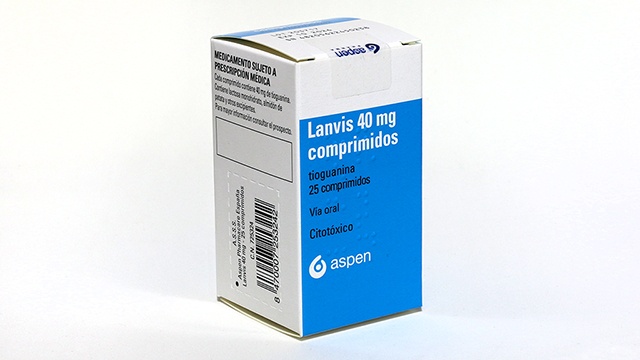
- Country of registration
- Dosage formTABLET, 40 mg
- ATC codeL01BB03
- Average pharmacy price116.89 EUR
- Active substance
- Prescription requiredYes
- Manufacturer
- CompositionLACTOSA MONOHIDRATO (150 mg mg)
- This information is for reference only and does not constitute medical advice. Always consult a doctor before taking any medication. Oladoctor is not responsible for medical decisions based on this content.
- Alternatives to LANVIS 40 mg TABLETSDosage form: INJECTABLE INFUSION, 250 mgActive substance: nelarabineManufacturer: Sandoz Pharmaceuticals D.D.Prescription requiredDosage form: TABLET, 10 mg of fludarabine phosphateActive substance: fludarabineManufacturer: Sanofi B.V.Prescription requiredDosage form: INJECTABLE PERFUSION, 1 mg/mlActive substance: clofarabineManufacturer: Accord Healthcare S.L.U.Prescription required
Get LANVIS 40 mg TABLETS Prescription Online
Fill in a 2-min form
Tell us your symptoms, history, and what medicine you're requesting.
Pick a doctor or let us assign
Choose a specialist or we'll match you with the next available doctor.
Doctor reviews your case
Usually within 30 minutes. They may ask follow-up questions via chat.
Collect from any pharmacy
Electronic prescription sent to your email — valid across Spain.
Frequently Asked Questions
LANVIS 40 mg TABLETS requires a prescription in Spain. You can check with a doctor online whether this medicine may be appropriate for your situation.
The active ingredient in LANVIS 40 mg TABLETS is tioguanine. This information helps identify medicines with the same composition but different brand names.
The average pharmacy price for LANVIS 40 mg TABLETS is around 116.89 EUR. Prices may vary depending on the manufacturer and dosage form.
LANVIS 40 mg TABLETS is manufactured by Aspen Pharma Trading Limited. Pharmacy brands and packaging may differ depending on the distributor.
Doctors such as Family doctors, Psychiatrists, Dermatologists, Cardiologists, Endocrinologists, Gastroenterologists, Pulmonologists, Nephrologists, Rheumatologists, Hematologists, Infectious disease physicians, Allergists, Geriatricians, Paediatricians, Oncologists may assess whether LANVIS 40 mg TABLETS is appropriate, depending on your situation and local regulations. You can book an online consultation to discuss your symptoms and possible next steps.
Spain has a well-developed healthcare infrastructure across major cities such as Madrid, Barcelona, Valencia, and Seville. Pharmacies are widely available and operate under strict regulations, ensuring access to prescribed medications.
You can buy LANVIS 40 mg TABLETS in Madrid, Barcelona, Seville, or Valencia at any local pharmacy with a valid prescription.
To obtain a prescription, you can use Oladoctor:
Other medicines with the same active substance (tioguanine) include ATRIANCE 5 mg/ml SOLUTION FOR INFUSION, BENEFLUR 10 mg FILM-COATED TABLETS, CLOFARABINE ACCORD 1 mg/ml CONCENTRATE FOR INFUSION SOLUTION. These may have different brand names or formulations but contain the same therapeutic ingredient. Always consult a doctor before switching or starting a new medicine.
