



KEMADREN 5 mg Tablets

Prescription review online
A doctor will review your case and decide whether a prescription is medically appropriate.

Talk to a doctor about this medicine
Discuss your symptoms and possible next steps in a quick online consultation.



How to use KEMADREN 5 mg TABLETS
Contents of the leaflet
- Introduction
- What is Kemadren and what is it used for
- What you need to know before you take Kemadren
- How to take Kemadren
- Possible side effects
- Storage of Kemadren
- Contents of the pack and other information
Introduction
Package Leaflet: Information for the Patient
Kemadren 5 mg Tablets
Procyclidine Hydrochloride
Read all of this leaflet carefully before you start taking this medicine because it contains important information for you.
- Keep this leaflet, you may need to read it again.
- If you have any further questions, ask your doctor or pharmacist.
- This medicine has been prescribed for you only. Do not pass it on to others. It may harm them, even if their signs of illness are the same as yours.
- If you get any side effects, talk to your doctor or pharmacist. This includes any possible side effects not listed in this leaflet. See section 4.
Contents of the pack
- What is Kemadren and what is it used for
- What you need to know before you take Kemadren
- How to take Kemadren
- Possible side effects
- Storage of Kemadren
- Contents of the pack and other information
1. What is Kemadren and what is it used for
Kemadren contains the active substance procyclidine hydrochloride. It belongs to a group of medicines called anticholinergics.
This medicine works by blocking a substance in the body called acetylcholine.
Kemadren is used to:
- Treat and relieve the symptoms of Parkinson's disease (such as muscle stiffness, paralysis, tremors, speech problems, writing and walking difficulties, excessive saliva production and drooling, sweating, involuntary eye movements, and depression).
- Prevent side effects called "extrapyramidal effects" caused by some medicines. These can include symptoms similar to those caused by Parkinson's disease, as well as restlessness or unusual head and body movements.

Not sure if this medicine is right for you?
Discuss your symptoms and treatment with a doctor online.
2. What you need to know before you take Kemadren
Do not take Kemadren
- if you are allergic to procyclidine hydrochloride or any of the other ingredients of this medicine (listed in section 6),
- if you have a problem caused by too much pressure in the eye called narrow-angle glaucoma,
- if you have difficulty urinating (urinary retention),
- if you have constipation.
Do not take Kemadren if you have any of the above symptoms. If you are not sure, consult your doctor before taking Kemadren.
Warnings and precautions
Consult your doctor or pharmacist before taking Kemadren if:
- You have an enlarged prostate,
- You have a mental illness and are taking Kemadren to control the side effects of other medicines. Sometimes, people taking this medicine may experience a psychotic episode,
- If you are elderly, you should be carefully monitored for the dose to avoid side effects,
- If you have liver or kidney disease,
- If you are prone to glaucoma (a group of diseases that damage the optic nerve),
- If you are prone to diseases that obstruct the gastrointestinal tract (total or partial obstruction of both the large and small intestine),
- Some patients taking Kemadren to control side effects of other medicines may experience repetitive involuntary body movements. If this happens, your doctor may decide to reduce the dose.
If you are not sure if any of the above applies to you, consult your doctor or pharmacist before taking Kemadren.
Children
This medicine is not suitable for use in children.
Taking Kemadren with other medicines
Tell your doctor or pharmacist if you are taking, have recently taken, or might take any other medicines, including those obtained without a prescription and/or herbal remedies, before taking Kemadren.
In particular, tell your doctor if you are taking any of the following medicines:
- Medicines for mental illnesses, such as monoamine oxidase inhibitors, tricyclic antidepressants, paroxetine, clozapine, or phenothiazines.
- Medicines for treating dementia, including Alzheimer's disease (such as memantine or tacrine).
- Antihistamines for the treatment of hay fever and allergies.
- Disopyramide, quinine, and nitrate tablets (including tablets that dissolve under the tongue) used to treat heart problems.
- Levodopa and amantadine used in Parkinson's disease.
- Cisapride, domperidone, and metoclopramide, used to treat nausea, vomiting, and indigestion.
- Nefopam, used to treat pain.
- Ketoconazole for treating fungal infections.
- If you are taking medicines for psychosis, such as chlorpromazine in combination with Kemadren, you should be aware that this medicine may cause you to develop a fever if you travel to a tropical (hot and humid) climate.
Pregnancy and breastfeeding
If you are pregnant or breastfeeding, think you may be pregnant, or are planning to have a baby, ask your doctor or pharmacist for advice before taking this medicine.
Driving and using machines
Taking Kemadren may cause blurred vision, dizziness, confusion, or disorientation. If this happens, do not drive, do not use tools, and do not operate machinery.
Kemadren contains lactose
If your doctor has told you that you have an intolerance to some sugars, consult them before taking this medicine.
Kemadren contains sodium
This medicine contains less than 1 mmol sodium (23 mg) per tablet, which is essentially "sodium-free".
3. How to take Kemadren
Follow exactly the administration instructions of this medicine given by your doctor. If you are unsure, consult your doctor or pharmacist again.
- Take the tablets with a glass of water.
- You can take Kemadren at any time of the day, with or without food. Some people feel less dizzy if they take it during meals.
- The tablet can be divided into equal doses.
In the treatment of Parkinson's disease
- The recommended initial dose is half a tablet three times a day.
- Your doctor may increase the dose by adding half or one tablet per day until an effect is seen. This is known as the maintenance dose.
- The usual maintenance dose is 15-30 mg (3 to 6 tablets) per day.
- The maximum dose that your doctor will decide to prescribe is 60 mg (12 tablets) per day.
- Although the dose is usually taken three times a day, your doctor may ask you to take a fourth dose before bedtime.
In the treatment of uncontrolled body movements (extrapyramidal symptoms) caused by taking other medicines:
- The recommended initial dose is half a tablet three times a day.
- Your doctor may increase the dose by adding half a tablet per day until an effect is seen. The usual daily maintenance dose is 10-30 mg (2 to 6 tablets).
- Your doctor may decide to stop your treatment with Kemadren after 3-4 months to see if your side effects continue.
- If you need to take Kemadren for a longer period, your doctor may decide to interrupt treatment from time to time.
Elderly people
It is necessary to carefully monitor the dose in elderly people to avoid side effects.
Use in children
In general, the use of Kemadren tablets is not recommended in children.
If you take more Kemadren than you should
If you take more than you should, consult your doctor or go to the hospital immediately. Take the medicine pack with you.
In case of overdose or accidental ingestion, consult your doctor or pharmacist immediately or call the Toxicology Information Service, phone 91 562 04 20, indicating the medicine and the amount ingested.
If you forget to take Kemadren
If you forget to take a dose, take it as soon as possible. Do not take a double dose to make up for forgotten doses. Take the next dose at the usual time. If you have problems remembering to take the tablets, inform your doctor or pharmacist.
If you stop taking Kemadren
Do not stop taking Kemadren without consulting your doctor.
If you have any further questions on the use of this product, ask your doctor or pharmacist.

Started taking the medicine and have questions?
Discuss your symptoms and treatment with a doctor online.
4. Possible side effects
Like all medicines, this medicine can cause side effects, although not everybody gets them. The following side effects may happen with this medicine.
If you are taking a medicine for a mental illness (called a neuroleptic) at the same time as Kemadren:
- You may develop uncontrolled movements of the face and tongue (called tardive dyskinesia). It may be necessary to adjust the dose of either of your medicines.
- Unusual body movements, especially hands, arms, and legs, that you already had with the medicine for your mental illness and that may be worsened by Kemadren.
If any of these occur, tell your doctor immediately.
Common(may affect up to 1 in 10 people):
- Urination problems (urinary retention)
- Blurred vision
- Dry mouth
- Constipation
Uncommon(may affect up to 1 in 100 people):
- Nausea or vomiting
- Gingivitis (gum inflammation)
- Dizziness, nervousness, confusion, disorientation, decreased concentration or memory, hearing voices or seeing unexpected things (hallucinations), anxiety, agitation (irritability)
- Skin rashes
Rare(may affect up to 1 in 1,000 people):
- "Psychotic disorder", which includes symptoms that occur together such as dizziness, confusion, decreased concentration or memory, disorientation, hearing voices or seeing unexpected things (hallucinations), anxiety, agitation (irritability).
If you think you have any of the serious side effects mentioned, even if they are not listed in this leaflet, tell your doctor or pharmacist.
Reporting of side effects
If you get any side effects, talk to your doctor, pharmacist, or nurse. This includes any possible side effects not listed in this leaflet. You can also report side effects directly via the Spanish Pharmacovigilance System for Human Use Medicines: https://www.notificaram.es. By reporting side effects, you can help provide more information on the safety of this medicine.
5. Storage of Kemadren
- Keep this medicine out of the sight and reach of children.
- Do not store above 25°C.
- Do not use this medicine after the expiry date which is stated on the carton after EXP. The expiry date is the last day of the month shown.
- .
- Medicines should not be disposed of via wastewater or household waste. Ask your pharmacist how to dispose of medicines no longer required. These measures will help protect the environment.
6. Contents of the pack and other information
Composition of Kemadren
The active substance is procyclidine hydrochloride. Each tablet contains 5 mg of the active substance.
The other ingredients are: lactose monohydrate, sodium starch glycolate (type A), povidone, and magnesium stearate.
Appearance of the product and pack contents
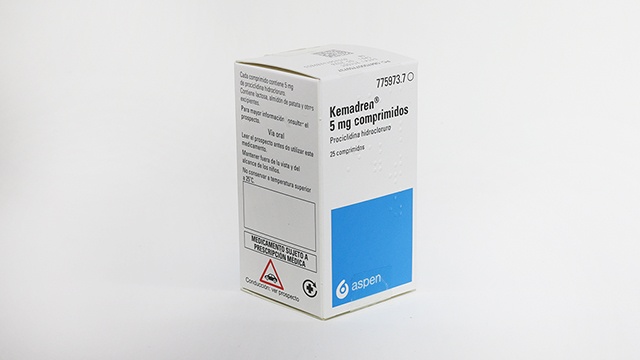
Kemadren 5 mg tablets are white, round, biconvex, with a break line on one face, engraved with KT above the break line and 05 below the break line, and with a score line on the other face. They are available in amber glass bottles with a polyethylene screw cap, containing 25 tablets.
Marketing authorisation holder and manufacturer
Marketing authorisation holder
Aspen Pharma Trading Limited
3016 Lake Drive
Citywest Business Campus
Dublin 24, Ireland
Tel: +34 952010137
Manufacturer
Aspen Bad Oldesloe GmbH
Industriestrasse 32-36
23843 Bad Oldesloe
Germany
Local Representative
Aspen Pharmacare España S.L.
Avenida Diagonal, 512
Planta Interior 1, Oficina 4
08006 Barcelona
Spain
Date of last revision of this leaflet:02/2023
Detailed and updated information on this medicine is available on the website of the Spanish Agency for Medicines and Health Products (AEMPS) http://www.aemps.gob.es
- Country of registration
- Dosage formTABLET, 5 mg prociclidine hydrochloride
- ATC codeN04AA04
- Average pharmacy price1.65 EUR
- Active substance
- Prescription requiredYes
- Manufacturer
- CompositionCARBOXIMETILALMIDON SODICO (16 mg mg), LACTOSA (174 mg mg)
- This information is for reference only and does not constitute medical advice. Always consult a doctor before taking any medication. Oladoctor is not responsible for medical decisions based on this content.
- Alternatives to KEMADREN 5 mg TABLETS
Online doctors for KEMADREN 5 mg TABLETS
Discuss questions about KEMADREN 5 mg TABLETS, including use, safety considerations and prescription review, subject to medical assessment and local regulations.



Get KEMADREN 5 mg TABLETS Prescription Online
Fill in a 2-min form
Tell us your symptoms, history, and what medicine you're requesting.
Pick a doctor or let us assign
Choose a specialist or we'll match you with the next available doctor.
Doctor reviews your case
Usually within 30 minutes. They may ask follow-up questions via chat.
Collect from any pharmacy
Electronic prescription sent to your email — valid across Spain.
Frequently Asked Questions
KEMADREN 5 mg TABLETS requires a prescription in Spain. You can check with a doctor online whether this medicine may be appropriate for your situation.
The active ingredient in KEMADREN 5 mg TABLETS is procyclidine. This information helps identify medicines with the same composition but different brand names.
The average pharmacy price for KEMADREN 5 mg TABLETS is around 1.65 EUR. Prices may vary depending on the manufacturer and dosage form.
KEMADREN 5 mg TABLETS is manufactured by Aspen Pharma Trading Limited. Pharmacy brands and packaging may differ depending on the distributor.
Doctors such as Family doctors, Psychiatrists, Dermatologists, Cardiologists, Endocrinologists, Gastroenterologists, Pulmonologists, Nephrologists, Rheumatologists, Hematologists, Infectious disease physicians, Allergists, Geriatricians, Paediatricians, Oncologists may assess whether KEMADREN 5 mg TABLETS is appropriate, depending on your situation and local regulations. You can book an online consultation to discuss your symptoms and possible next steps.
Spain has a well-developed healthcare infrastructure across major cities such as Madrid, Barcelona, Valencia, and Seville. Pharmacies are widely available and operate under strict regulations, ensuring access to prescribed medications.
You can buy KEMADREN 5 mg TABLETS in Madrid, Barcelona, Seville, or Valencia at any local pharmacy with a valid prescription.
To obtain a prescription, you can use Oladoctor:
Other medicines with the same active substance (procyclidine) include AKINETON 2 mg TABLETS, AKINETON 5mg/ml INJECTABLE SOLUTION, AKINETON RETARD 4 mg PROLONGED-RELEASE TABLETS. These may have different brand names or formulations but contain the same therapeutic ingredient. Always consult a doctor before switching or starting a new medicine.
