



KALINOX 50%/50% MEDICINAL COMPRESSED GAS LOZENGES

Prescription review online
A doctor will review your case and decide whether a prescription is medically appropriate.

Talk to a doctor about this medicine
Discuss your symptoms and possible next steps in a quick online consultation.



How to use KALINOX 50%/50% MEDICINAL COMPRESSED GAS LOZENGES
Contents of the leaflet
- Introduction
- What KALINOX is and what it is used for
- What you need to know before taking KALINOX
- How to use KALINOX
- Possible side effects
- Storage of KALINOX
- Container Content and Additional Information
Introduction
Package Leaflet: Information for the User
KALINOX 50%/50%,compressed medicinal gas in cylinders
Nitrous oxide / Oxygen
Read this package leaflet carefully before starting to use this medicine, as it contains important information for you.
? Keep this package leaflet, as you may need to read it again.
- If you have any doubts, consult your doctor, pharmacist, or nurse.
- This medicine has been prescribed to you only, and you should not give it to others, even if they have the same symptoms as you, as it may harm them.
- If you experience side effects, consult your doctor, pharmacist, or nurse, even if they are side effects not listed in this package leaflet. See section 4
Contents of the package leaflet
- What KALINOX is and what it is used for
- What you need to know before taking KALINOX
- How to take KALINOX
- Possible side effects
- Storage of KALINOX
- Package contents and additional information
1. What KALINOX is and what it is used for
KALINOX is a mixture of two medicinal gases (50% nitrous oxide and 50% oxygen). It belongs to the group of analgesics (pain-relieving medicines).
At this concentration, KALINOX has no anesthetic effects.
KALINOX is indicated for short-duration painful operations.

Not sure if this medicine is right for you?
Discuss your symptoms and treatment with a doctor online.
2. What you need to know before taking KALINOX
Do not use KALINOXin the following cases
- Any change in the state of consciousness that prevents the patient from cooperating.
- Patients who require pure oxygen ventilation
- Head injuries
- Pneumothorax (accumulation of air or gas in the pleural cavity)
- Bullous emphysema (destruction of lung tissue due to air presence)
- Gas embolism (obstruction of a vessel by air or gas bubbles)
- Decompression sickness
- After recent underwater immersion
- After air encephalography
- Abdominal gas distension
- Maxillofacial trauma affecting the mask application area
- During middle ear, inner ear, or nasal sinus surgery
- If air has been injected into the epidural space to determine the placement of the needle for epidural anesthesia
- Patients who have received a recent intraocular gas injection (such as SF6, C3F8, CsF6) as long as an intraocular gas bubble persists or during the 3 months following the last intraocular gas injection. The expansion of an intraocular gas bubble by nitrous oxide can cause severe visual impairment
The use of KALINOX should be discontinued immediately in case of loss of verbal contact.
Warnings and precautions:
- The gas must be administered by personnel with adequate training. You should never transport KALINOX cylinders.
- The rooms where KALINOX is used must be equipped with an air conditioning system or an adequate ventilation system to maintain the levels of nitrous oxide in the ambient air at a minimum.
- Breathe normally during gas inhalation.
- Before administering KALINOX, do not apply greasy substances (creams, ointments, etc.) to the face.
- The success rate of treatment is lower in children under 3 years of age.
- Nitrous oxide causes the inactivation of vitamin B12 (a cofactor of methionine synthase) that interferes with folate metabolism. The evaluation of vitamin B12 levels should be considered in patients with risk factors for vitamin B12 deficiency before using anesthesia with nitrous oxide. Risk factors may include patients with anemia or atrophic gastritis, those with a vegetarian diet, or those who have used medication that may interfere with vitamin B12 and/or folate metabolism. Vitamin B12 supplements should be given in case of repeated or prolonged administration.
- In case of Eustachian tube obstruction, due to increased pressure in the tympanic cavity, ear pain and/or eardrum rupture may be observed.
- Abuse, misuse, and diversion: due to the euphoric effects of nitrous oxide, it may be sought after and subject to abuse for recreational use.
- Intracranial pressure should be closely monitored in patients diagnosed with and/or at risk of intracranial hypertension, as an increase in intracranial pressure has been observed during nitrous oxide administration in some patients with intracranial disorders.
Using KALINOXwith other medicines
Tell your doctor if you are using or have recently used other medicines, including those obtained without a prescription.
- If you have been treated with ophthalmic gases (SF6, C2F6, C3F8) in eye surgery, always tell your doctor so that they can ensure that administration does not expose you to post-operative complications that may cause an increase in pressure inside the eye.
- In combination with medicines that act on the central nervous system (such as morphine derivatives, benzodiazepines, and other psychotropic medicines), the risk of somnolence, desaturation (reduction of oxygen in the blood), vomiting, and hypotension increases. In case of association with this type of medicine, patient surveillance should be reinforced.
- Medicines that interfere with vitamin B12 and/or folate metabolism may potentiate the inactivation of vitamin B12 by nitrous oxide.
Pregnancy and breastfeeding
Consult your doctor or pharmacist before using any medicine.
- The use of KALINOX is not recommended during the first trimester of pregnancy. Nitrous oxide may be used during pregnancy if it is clinically necessary. When nitrous oxide is used near birth, newborns should be monitored for possible side effects.
- An increased number of spontaneous abortions and malformations have been reported in women exposed to chronic occupational inhalation of nitrous oxide during pregnancy, in the absence of an adequate sweeping or ventilation system.
Driving and using machines
After KALINOX administration, it is not recommended to drive or use machines until all side effects have disappeared and normal consciousness has been restored.
3. How to use KALINOX
Follow exactly the administration instructions of this medicine indicated by your doctor. Consult your doctor if you have doubts.
Administration must be performed in adapted premises, by specialist doctors or nurses specifically trained, in charge of continuous patient surveillance.
The duration of gas inhalation depends on the duration of the corresponding operation and should not exceed 60 minutes continuously. In case of daily administration, it should not exceed 15 consecutive days. After inhalation suspension, the return to the initial situation is almost immediate and without residual effect.
The flow rate of the mixture (amount of gas received per second or per minute) is determined by the patient's spontaneous ventilation.
Use in painful operations:
Before performing the operation, the mask should be kept on for 3 minutes. During this time, verbal contact is maintained with the patient. The person monitoring the administration gives their consent to start the operation. Gas inhalation is maintained throughout the operation, indicating to the patient to breathe normally.
During administration, surveillance is essentially clinical. The patient should be relaxed, breathe normally, and respond to simple orders; in case of intense sedation with loss of verbal contact, the mask will be removed until verbal contact is reestablished.
Use in dentistry:
In patients whose disability does not allow them to keep the mask correctly in place, it will be held by another person without exerting much pressure. After 3 minutes, the operation can be performed uninterruptedly, if a nasal mask is used, or during periods of 20 to 30 seconds, if a buconasal mask (covering the nose and mouth) is used, which, in these cases, will be lifted over the nose during the mentioned periods.
At the end of the operation, the mask will be removed, and the patient will remain at rest in the dental chair for 5 minutes.
Use in obstetrics (pregnancy, childbirth, and postpartum):
Gas inhalation should start from the beginning of contractions, before pain appears. The parturient should breathe normally during contractions and try not to hyperventilate (breathe rapidly or deeply, producing a feeling of lack of air) due to the risk of oxygen desaturation between contractions. Gas inhalation will be interrupted when pain decreases. In this indication, it is recommended to continuously monitor the oxygen level.
If you use more KALINOX than you should
If you have used more KALINOX than you should, consult your doctor immediately or call the Toxicology Information Service, phone 91-562 0420, indicating the medicine and the amount.
In case of inadequate storage, at a temperature below 0°C, cyanosis (lack of oxygen) may occur. In this case, both gases (nitrous oxide and oxygen) may come out separately from the container.
If cyanosis appears during administration, treatment suspension is mandatory; if, despite this, cyanosis does not disappear quickly, it will be necessary to ventilate the patient with a manual balloon filled with ambient air.
Overdose may cause increased dizziness, unconsciousness, cyanosis, and death by anoxia.
Under these circumstances, treatment should be stopped immediately, and appropriate measures should be taken.

Started taking the medicine and have questions?
Discuss your symptoms and treatment with a doctor online.
4. Possible side effects
Like all medicines, KALINOX can cause side effects, although not everyone gets them.
Nitrous oxide passes into all gas-containing spaces faster than nitrogen. The use of nitrous oxide can result in the expansion of non-ventilated gas-containing cavities.
Frequent (> 1/100 to < 1/10):
Gastrointestinal disorders: Nausea, vomiting
Uncommon (> 1/1,000 to < 1/100):
Nervous system disorders: paresthesia, excessive sedation
Psychiatric disorders: euphoria, agitation, anxiety, hallucinations, dreams
Unknown (cannot be estimated from available data):
Nervous system disorders: dizziness, myelopathy, neuropathy, increased intracranial pressure, generalized convulsions
Blood and lymphatic system disorders: megaloblastic anemia, pancytopenia (observed in prone circumstances (cobalamin deficiency, substance abuse)), leukopenia/agranulocytosis (observed after very high and prolonged exposures to tetanus treatment in the 1950s)
Eye disorders: Severe visual impairment (caused by the expansion of an intraocular gas bubble)
Ear and labyrinth disorders: Ear pain, middle ear disorders, eardrum rupture (in case of Eustachian tube obstruction)
Respiratory, thoracic, and mediastinal disorders: Respiratory depression (in the newborn, when nitrous oxide is used during childbirth)
Metabolic and nutritional disorders: Vitamin B12 deficiency
Psychiatric disorders: Disorientation
Reporting side effects
If you experience any side effects, consult your doctor or pharmacist, even if they are possible side effects not listed in this package leaflet. You can also report them directly through the Spanish Pharmacovigilance System for Human Use Medicines: www.notificaRAM.es. By reporting side effects, you can contribute to providing more information on the safety of this medicine.
5. Storage of KALINOX
Keep out of sight and reach of children.
Full cylinders should be stored IN A HORIZONTAL POSITION, between 10 and 30°C, at least 48 hours before use, with the valves closed.
Protect the cylinders from shocks, falls, heat sources or ignition, combustible materials, weather conditions, and, in particular, cold temperatures.
Do not use KALINOX after the expiration date shown on the packaging after "CAD". The expiration date is the last day of the month indicated.
All regulations regarding the handling of pressure vessels should be followed.
6. Container Content and Additional Information
Composition of KALINOX
- The active principles are: nitrous oxide and oxygen. In each cylinder, there is a mixture of both components at 50%. (mol/mol).
- It does not contain other components (excipients).
Appearance of the Product and Container Content
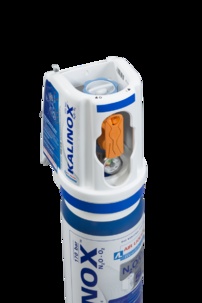
KALINOX is packaged in cylinders, available in the following sizes:
Type of Container | Water Capacity (L) | Quantity of Gaseous Product Released at 1 atm and 15°C (m3) | Weight of Stored Product (Kg) | Type of Valve (see legend at the end) |
B2 | 2 | 0.60 | 0.943 | 2, 3 |
B5 | 5 | 1.47 | 2.358 | 1, 2, 3 |
B11 | 11 | 3.23 | 5.187 | 2, 3 |
B15 | 15 | 4.4 | 7.073 | 2, 3 |
Valve Type Legend:
1Container available with valve without integrated pressure regulator (Standard RPV Valves).
2Container available with valve with integrated pressure regulator (Compact G2 (Compact) Valves).
3Container available with valve with integrated pressure regulator (M706 (One K) Valves).
Only some container sizes may be marketed.
Marketing Authorization Holder and Manufacturer
Marketing Authorization Holder:
AIR LIQUIDE Santé INTERNATIONAL
75, Quai D`Orsay
75007 - Paris (France)
Manufacturer:
AIR LIQUIDE MEDICAL
Tolhuisstraat 46-48
2627 - Schelle (Belgium)
AIR LIQUIDE Santé FRANCE
Les petits carreaux
2, avenue du Lys
94380 Bonneuil sur Marne
France
Date of the Last Revision of this Prospectus:June 2024
Instructions for Use and Handling
KALINOX is reserved for hospital use.
The oxygen concentration (FiO2) should never be less than 21%.
To avoid accidents, the following instructions must be respected:
- The personnel handling the cylinders must be trained in the use of gases.
- Do not use any cylinder suspected of having been exposed to a temperature below 0°C.
- In case of observing frost on the cylinder, do not use it and return it.
- Do not handle a cylinder whose valve is not protected by a tulip.
- Never use a cylinder that has leaks.
- Do not lift the cylinder by its valve.
- Do not attempt to repair a faulty valve.
- Hold the cylinders with a suitable means (chains, mooring hooks, etc.), in order to keep them in VERTICAL POSITIONand avoid falls.
- Never force the placement of a cylinder in a support where it fits with difficulty.
- Ventilate the place of use adequately. In case of prolonged use, accident, or unexpected leak, ensure the possibility of evacuating the gases. The Median Exposure Limit Value of nitrous oxide has been set at 50 ppm with respect to personnel exposure.
- Never place yourself in front of the valve outlet, but on the opposite side of the flow meter, behind the cylinder, and at a certain distance. Do not expose the patient, in any case, to the gas flow.
- Handle the material with clean and grease-free hands.
- Do not use aerosol generators (lacquer, deodorant, etc.), solvents (alcohol, gasoline, etc...) on the material or in its proximity.
- Do not apply greasy substances (vaseline, ointments, etc.) to the patients' faces.
- Do not grease.
- Do not smoke.
- Do not approach a flame.
And in particular:
- Never introduce this gas into a device that may contain combustible substances, especially greases.
- Never clean the devices that contain this gas, the valves, gaskets, closing devices, as well as the circuits, with combustible products, especially greasy materials.
In case of a leak, close the valve that presents the leak. Ventilate the area intensely and evacuate it.
In case of a fire, the toxicity risk increases due to the formation of nitrous vapors.
In the case of cylinders equipped with a valve:
- Open the cylinder valves slightly before connecting the pressure regulator to remove any particles or foreign matter. Keep the point of contact between the cylinder and the pressure regulator clean at all times.
- The cylinders are equipped with a flow meter: They have a specific connection for the nitrous oxide-oxygen mixture for medical use, according to the NF S 90-116 standard.
- Use a pressure regulator with a flow meter capable of reading pressures of at least 1.5 times the maximum working pressure of the cylinder.
To open the cylinder after connection:
- Follow the instructions on the cylinder label.
- Never force the valve when opening it or opening it fully.
- Always open the valve slowly to avoid cooling that can cause deshomogenization of the mixture.
- Never pressurize the pressure regulator repeatedly.
- Do not transfer gas from a low-pressure cylinder to another cylinder.
After use:
- Close the cylinder valve after use and allow the pressure regulator to be read by leaving the flow meter open; then, close the flow meter and loosen the pressure regulator adjustment screw.
- Never completely empty a cylinder and always leave it at a minimum pressure of 10 bar.
Keep the empty cylinders in a VERTICALposition, with the valves closed (to avoid corrosion due to humidity).
- Country of registration
- Dosage formPULMONARY INHALATION, 50% nitrous oxide; 50% oxygen
- ATC codeN01AX63
- Active substance
- Prescription requiredYes
- Manufacturer
- This information is for reference only and does not constitute medical advice. Always consult a doctor before taking any medication. Oladoctor is not responsible for medical decisions based on this content.
- Alternatives to KALINOX 50%/50% MEDICINAL COMPRESSED GAS LOZENGESDosage form: PULMONARY INHALATION, 50% / 50% v/vActive substance: nitrous oxide, combinationsManufacturer: Sociedad Española De Carburos Metalicos S.A.Prescription requiredDosage form: PULMONARY INHALATION, 50%/50% (V/V)Active substance: nitrous oxide, combinationsManufacturer: Sol France Sucursal En EspanaPrescription requiredDosage form: PULMONARY INHALATION, 50%/ 50%Active substance: nitrous oxide, combinationsManufacturer: Linde Sverige AbPrescription required
Online doctors for KALINOX 50%/50% MEDICINAL COMPRESSED GAS LOZENGES
Discuss questions about KALINOX 50%/50% MEDICINAL COMPRESSED GAS LOZENGES, including use, safety considerations and prescription review, subject to medical assessment and local regulations.









Get KALINOX 50%/50% MEDICINAL COMPRESSED GAS LOZENGES Prescription Online
Fill in a 2-min form
Tell us your symptoms, history, and what medicine you're requesting.
Pick a doctor or let us assign
Choose a specialist or we'll match you with the next available doctor.
Doctor reviews your case
Usually within 30 minutes. They may ask follow-up questions via chat.
Collect from any pharmacy
Electronic prescription sent to your email — valid across Spain.
Frequently Asked Questions
KALINOX 50%/50% MEDICINAL COMPRESSED GAS LOZENGES requires a prescription in Spain. You can check with a doctor online whether this medicine may be appropriate for your situation.
The active ingredient in KALINOX 50%/50% MEDICINAL COMPRESSED GAS LOZENGES is nitrous oxide, combinations. This information helps identify medicines with the same composition but different brand names.
KALINOX 50%/50% MEDICINAL COMPRESSED GAS LOZENGES is manufactured by Air Liquide Sante International. Pharmacy brands and packaging may differ depending on the distributor.
Doctors such as Family doctors, Psychiatrists, Dermatologists, Cardiologists, Endocrinologists, Gastroenterologists, Pulmonologists, Nephrologists, Rheumatologists, Hematologists, Infectious disease physicians, Allergists, Geriatricians, Paediatricians, Oncologists may assess whether KALINOX 50%/50% MEDICINAL COMPRESSED GAS LOZENGES is appropriate, depending on your situation and local regulations. You can book an online consultation to discuss your symptoms and possible next steps.
Spain has a well-developed healthcare infrastructure across major cities such as Madrid, Barcelona, Valencia, and Seville. Pharmacies are widely available and operate under strict regulations, ensuring access to prescribed medications.
You can buy KALINOX 50%/50% MEDICINAL COMPRESSED GAS LOZENGES in Madrid, Barcelona, Seville, or Valencia at any local pharmacy with a valid prescription.
To obtain a prescription, you can use Oladoctor:
Other medicines with the same active substance (nitrous oxide, combinations) include ACTYNOX 50%/50% MEDICINAL COMPRESSED GAS, DONOPA 50%/50% MEDICINAL COMPRESSED GAS, ENTONOX 50%/50% MEDICINAL GAS COMPRESSED. These may have different brand names or formulations but contain the same therapeutic ingredient. Always consult a doctor before switching or starting a new medicine.
