


Intestifalk 3 mg cápsulas gastrorresistentes

Prescription review online
A doctor will review your case and decide whether a prescription is medically appropriate.

Talk to a doctor about this medicine
Discuss your symptoms and possible next steps in a quick online consultation.



How to use INTESTIFALK 3 mg GASTRO-RESISTANT CAPSULES
Contents of the leaflet
- Introduction
- What is Intestifalk and what is it used for
- What you need to know before you take Intestifalk
- How to take Intestifalk
- Possible side effects
- Storing Intestifalk
- Contents of the pack and further information
Introduction
PACKAGE LEAFLET: INFORMATION FOR THE USER
Intestifalk 3 mg gastro-resistant capsules
budesonide
Read all of this leaflet carefully before you start taking this medicine because it contains important information for you.
- Keep this leaflet, you may need to read it again.
- If you have any further questions, ask your doctor or pharmacist.
- This medicine has been prescribed for you only. Do not pass it on to others. It may harm them, even if their signs of illness are the same as yours.
- If you get any side effects, talk to your doctor or pharmacist. This includes any possible side effects not listed in this leaflet. See section 4.
Contents of the pack
- What is Intestifalk and what is it used for
- What you need to know before you take Intestifalk
- How to take Intestifalk
- Possible side effects
- Storing Intestifalk
- Contents of the pack and further information
1. What is Intestifalk and what is it used for
Intestifalk contains the active substance budesonide, a type of steroid with local action used to treat chronic inflammatory diseases of the intestine and liver.
Intestifalk is used in the treatment of:
- Crohn's disease: mild to moderate acute attacks of chronic inflammation of the intestine with involvement of the lower part of the small intestine (ileum) and/or the upper part of the large intestine (ascending colon).
- Microscopic colitis: a disease with subtypes of collagenous colitis and lymphocytic colitis, characterized by chronic inflammation of the large intestine, usually accompanied by chronic watery diarrhea.
Autoimmune hepatitis: a disease with chronic inflammation of the liver.

Not sure if this medicine is right for you?
Discuss your symptoms and treatment with a doctor online.
2. What you need to know before you take Intestifalk
Do not take Intestifalk:
- if you are allergic to budesonide or any of the other ingredients of this medicine (listed in section 6)
- if you have severe liver disease(liver cirrhosis)
Warnings and precautions
Consult your doctor before starting to take Intestifalk if you have:
- tuberculosis
- high blood pressure
- diabetes, or if a family member has been diagnosed with diabetes
- bone fragility (osteoporosis)
- stomach or duodenal ulcer (peptic ulcer)
- increased eye pressure (glaucoma) or problems such as cataracts, or if a family member has been diagnosed with glaucoma
- severe liver problems
Intestifalk is not suitable for patients with Crohn's disease that affects the upper gastrointestinal tract.
Sometimes this disease can cause symptoms outside the intestine (e.g., affecting the skin, eyes, and joints) that are unlikely to respond to this medicine.
The typical effects of cortisone preparations may occur, affecting all parts of the body, particularly if you take this medicine at high doses and for prolonged periods (see section 4. Possible side effects).
Additional precautions during treatment with Intestifalk
- Tell your doctor if you have an infection. The symptoms of some infections may be atypical or less marked.
- Stay away from people who have chickenpox or shingles (herpes zoster), if you have not had them before. They can affect you severely. If you come into contact with chickenpox or shingles, see your doctor immediately.
- Tell your doctor if you have not had measles.
- If you need to receive any vaccine during treatment with this medicine, tell your doctor beforehand.
- Tell your doctor that you are using this medicine if you are scheduled for surgery.
- If you have been treated with a more potent cortisone preparation before starting treatment with Intestifalk, your symptoms may recur when you switch medicines. If this happens, tell your doctor.
- Get in touch with your doctor if you experience blurred vision or other visual disturbances.
- If you have autoimmune hepatitis, your doctor will perform regular liver function tests and adjust the dose of this medicine periodically.
Taking Intestifalk with other medicines
Tell your doctor or pharmacist if you are taking, have recently taken, or might take any other medicines. In particular:
- cardiac glycosidessuch as digoxin (medicine used to treat heart disorders)
- diuretics(medicines used to treat excess fluid in your body)
- ketoconazole or itraconazole(to treat fungal infections)
- antibiotics, medicines to treat infections (such as clarithromycin)
- carbamazepineused in the treatment of epilepsy
- rifampicin(to treat tuberculosis)
- estrogens or oral contraceptives
- cimetidine(used to inhibit stomach acid production)
Some medicines may increase the effects of Intestifalk, so your doctor will monitor you closely if you are taking these medicines (including some for HIV: ritonavir, cobicistat).
If you take cholestyramine(to treat high cholesterol and also used to treat diarrhea) or antacids(for indigestion) with Intestifalk, take these medicines at least 2 hours apart.
Intestifalk may affect the results of tests performed by your doctor or in a hospital. Tell your doctor that you are taking Intestifalk before any test.
Taking Intestifalk with food and drinks
Do not drink grapefruit juiceduring treatment with this medicine, as it may alter its effects.
Pregnancy and breastfeeding
If you are pregnant or breastfeeding, think you may be pregnant, or plan to become pregnant, consult your doctor before using this medicine.
You should only take Intestifalk during pregnancy if your doctor advises you to.
Budesonide passes into breast milk in small amounts. If you are breastfeeding, you should only take Intestifalk if your doctor advises you to.
Driving and using machines
It is unlikely that Intestifalk will affect your ability to drive or use machines.
Intestifalk contains sucrose and lactose
If your doctor has told you that you have an intolerance to some sugars, consult them before taking this medicine.
3. How to take Intestifalk
Follow the instructions for administration of this medicine exactly as prescribed by your doctor. If you are unsure, consult your doctor or pharmacist again.
Crohn's disease
Take three capsules once a day in the morning or 1 capsule three times a day (morning, noon, and night), unless your doctor tells you otherwise.
Duration of treatment
Your treatment should last approximately 8 weeks.
Microscopic colitis (collagenous colitis and lymphocytic colitis)
Treatment of acute inflammation
Take three capsules once a day in the morning, unless your doctor tells you otherwise.
Maintenance treatment
Maintenance treatment should only be started if symptoms recur after stopping initial treatment. Depending on the course of the disease, your doctor will decide how many capsules you should take per day. The usual dose is two capsules once a day in the morning (a total of 6 mg of budesonide per day). Alternatively, take two capsules in the morning on the first day and one capsule in the morning on the second day (corresponding to an average of 4.5 mg of budesonide per day). Continue taking the medicine, alternating the daily dose of two capsules and one capsule.
Duration of treatment
Treatment of acute inflammation should last approximately 8 weeks. Your doctor will determine the duration of maintenance treatment. Maintenance treatment is usually given for a maximum of 12 months. If indicated, your doctor may extend the duration of treatment.
Autoimmune hepatitis
Treatment of acute inflammation:
Take one capsule three times a day (morning, noon, and night), unless your doctor tells you otherwise. Depending on laboratory results, your doctor will decide how long you should take three capsules per day.
Maintenance treatment:
Take one capsule twice a day (morning and night), unless your doctor tells you otherwise. Depending on laboratory results, your doctor will decide how long you should take two capsules per day.
Note: In most cases, your doctor will prescribe Intestifalk together with azathioprine, a medicine that works by reducing the body's immune response.
Duration of treatment
Depending on the results of your blood and liver tissue tests, your doctor will decide how long you should continue using the medicine and how many capsules you should take per day.
Use in children (all indications)
Intestifalk should not be used in children under 12 years of age.
There is only limited experience with the use of this medicine in children over 12 years of age.
Method of administration
Intestifalk should be taken orally only.
The capsules should be swallowed whole with a glass of water, approximately half an hour before meals. Do not chew the capsules.
If you take more Intestifalk than you should
If you take too much medicine at once, just take the prescribed dose when it is time for your next dose.
Do not take a lower dose. If you are unsure, contact your doctor to decide what to do. If possible, take the pack and this leaflet with you.
If you forget to take Intestifalk
If you forget to take a dose, continue treatment with the prescribed dose. Do not take a double dose to make up for the forgotten dose.
If you stop taking Intestifalk
Talk to your doctor if you want to stop or conclude your treatment prematurely. It is important that you do not stop taking your medicine suddenly, as this could make you ill. Continue taking your medicine until your doctor tells you to stop, even if you start to feel better.
Your doctor will probably want to reduce your dose gradually over two weeks.
If you have any further questions on the use of this medicine, ask your doctor or pharmacist.

Started taking the medicine and have questions?
Discuss your symptoms and treatment with a doctor online.
4. Possible side effects
Like all medicines, this medicine can cause side effects, although not everybody gets them.
If you get any of the following symptoms after taking this medicine, you should contact your doctor immediately:
- Infection
- Headache
- Changes in behavior such as depression, irritability, euphoria, restlessness, anxiety, or aggression
The following side effects have also been reported:
Common: may affect up to 1 in 10 people
- Cushing's syndrome - for example, moon face, weight gain, reduced glucose tolerance, high blood sugar, high blood pressure, fluid retention in tissues (e.g., swollen legs), increased potassium excretion (hypokalemia), irregular periods in women, unwanted hair growth in women, impotence, abnormal laboratory findings (reduced adrenal function), formation of red striae on the skin (stretch marks), acne
- Indigestion, irritable stomach (dyspepsia), abdominal pain
- Increased risk of infection
- Muscle and joint pain, muscle weakness, muscle cramps
- Bone fragility (osteoporosis)
- Headache
- Mood changes, such as depression, irritation, or euphoria
- Rash due to hypersensitivity reactions, red spots due to bleeding in the skin, delayed wound healing, local skin reactions such as contact dermatitis
Uncommon: may affect up to 1 in 100 people
- Ulcers in the stomach or small intestine
- Restlessness with increased physical activity, anxiety
Rare: may affect up to 1 in 1,000 people
- Blurred vision
- Pancreatitis
- Bone loss due to poor blood circulation (osteonecrosis)
- Aggression
- Bruising
Very rare: may affect up to 1 in 10,000 people
- Delayed growth in children
- Constipation
- Increased intracranial pressure, possibly with increased eye pressure (inflammation of the optic disc) in adolescents
- Increased risk of thrombosis, inflammation of blood vessels (associated with the end of cortisone treatment after long-term treatment)
- Fatigue, feeling of general malaise
These side effects are typical of steroid medicines and most of them are also predictable for treatments with other steroids. They may occur depending on the dose, duration of treatment, whether you have followed or are following treatment with other cortisone preparations, and your personal sensitivity.
If you have received treatment with a more potent cortisone preparation before starting treatment with Intestifalk, your symptoms may recur when you switch medicines.
Reporting of side effects
If you experience any side effects, talk to your doctor or pharmacist. This includes any possible side effects not listed in this leaflet. You can also report side effects directly through the Spanish Pharmacovigilance System for Human Use Medicines: www.notificaRAM.es. By reporting side effects, you can help provide more information on the safety of this medicine.
5. Storing Intestifalk
Keep this medicine out of the sight and reach of children.
This medicine does not require any special storage conditions.
Do not use this medicine after the expiry date which is stated on the carton and blister. The expiry date refers to the last day of the month.
Medicines should not be disposed of via wastewater or household waste. Ask your pharmacist how to dispose of medicines no longer required. These measures will help protect the environment.
6. Contents of the pack and further information
Composition of Intestifalk
The active substanceof Intestifalk is budesonide. Each gastro-resistant capsule contains 3 mg of budesonide.
The other ingredientsare ammonio methacrylate copolymer (type A) (Eudragit RL), ammonio methacrylate copolymer (type B) (Eudragit RS), lactose monohydrate, corn starch, methacrylic acid - methyl methacrylate copolymer (1:1) (Eudragit L 100), methacrylic acid - methyl methacrylate copolymer (1:2) (Eudragit S 100), povidone K25, purified water, sucrose, talc, triethyl citrate, gelatin, erythrosine (E 127), titanium dioxide (E 171), red and black iron oxide (E 172), sodium lauryl sulfate (see also the end of section 2 for more important information on lactose and sucrose).
Appearance of the product and pack contents
Intestifalk are hard gastro-resistant capsules of pink color contained in blister strips.
Intestifalk is available in pack sizes of 10, 50, 90, 100, or 120 capsules.
Not all pack sizes may be marketed.
Marketing authorization holder and manufacturer
DR. FALK PHARMA GmbH
Leinenweberstr. 5
79108 Freiburg
Germany
Tel: +49 (0) 761 / 1514-0
Fax: +49 (0) 761 / 1514-321
Email: [email protected]
You can obtain further information on this medicine by contacting the local representative of the marketing authorization holder:
Spain
Dr. Falk Pharma España
Camino de la Zarzuela, 19
28023 Madrid
Tel: 91 372 95 08
This medicine is authorized in the Member States of the European Economic Area under the following names:
Denmark, Finland, United Kingdom, Ireland, Sweden: Budenofalk
Spain: Intestifalk 3 mg gastro-resistant capsules
France: Mikicort
Italy: Intesticort
Date of last revision of this leaflet: 12/2019
Detailed information on this medicine is available on the website of the Spanish Agency for Medicines and Health Products (AEMPS) http://www.aemps.es/
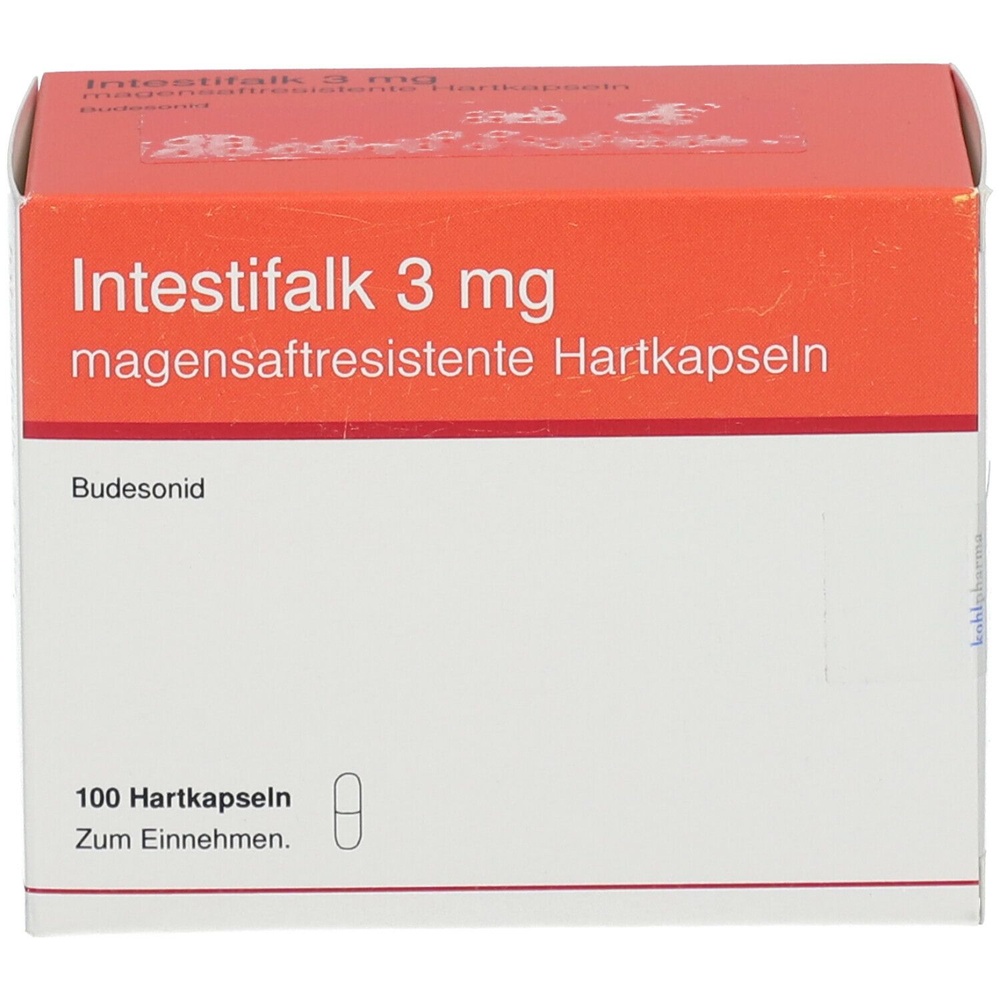
- Country of registration
- Dosage formCAPSULE, 3 mg budesonide
- ATC codeA07EA06
- Average pharmacy price47.39 EUR
- Active substance
- Prescription requiredYes
- Manufacturer
- CompositionSACAROSA (240,00 mg mg), LACTOSA HIDRATADA (12,00 mg mg), COLORANTE ROJO COCHINILLA (E-124) (1,0336 mg mg), SULFATO DODECILO SODICO (0-0,1520 mg mg)
- This information is for reference only and does not constitute medical advice. Always consult a doctor before taking any medication. Oladoctor is not responsible for medical decisions based on this content.
- Alternatives to INTESTIFALK 3 mg GASTRO-RESISTANT CAPSULESDosage form: RECTAL LIQUID, 2 mg budesonideActive substance: budesonideManufacturer: Tillotts Pharma GmbhPrescription requiredDosage form: MODIFIED-RELEASE CAPSULE, 3 mg budesonideActive substance: budesonideManufacturer: Tillotts Pharma GmbhPrescription requiredDosage form: RECTAL SEMISOLID, 2 mgActive substance: budesonideManufacturer: Dr. Falk Pharma GmbhPrescription required
Online doctors for INTESTIFALK 3 mg GASTRO-RESISTANT CAPSULES
Discuss questions about INTESTIFALK 3 mg GASTRO-RESISTANT CAPSULES, including use, safety considerations and prescription review, subject to medical assessment and local regulations.









Frequently Asked Questions
INTESTIFALK 3 mg GASTRO-RESISTANT CAPSULES requires a prescription in Spain. You can check with a doctor online whether this medicine may be appropriate for your situation.
The active ingredient in INTESTIFALK 3 mg GASTRO-RESISTANT CAPSULES is budesonide. This information helps identify medicines with the same composition but different brand names.
The average pharmacy price for INTESTIFALK 3 mg GASTRO-RESISTANT CAPSULES is around 47.39 EUR. Prices may vary depending on the manufacturer and dosage form.
INTESTIFALK 3 mg GASTRO-RESISTANT CAPSULES is manufactured by Dr. Falk Pharma Gmbh. Pharmacy brands and packaging may differ depending on the distributor.
Doctors such as Family doctors, Psychiatrists, Dermatologists, Cardiologists, Endocrinologists, Gastroenterologists, Pulmonologists, Nephrologists, Rheumatologists, Hematologists, Infectious disease physicians, Allergists, Geriatricians, Paediatricians, Oncologists may assess whether INTESTIFALK 3 mg GASTRO-RESISTANT CAPSULES is appropriate, depending on your situation and local regulations. You can book an online consultation to discuss your symptoms and possible next steps.
The prescription is issued by a doctor after assessing your health. In Spain, INTESTIFALK 3 mg GASTRO-RESISTANT CAPSULES is then dispensed in pharmacies with that prescription. An online consultation does not guarantee that a prescription will be issued: the decision always rests with the doctor.
To request a review, you can use Oladoctor:
Other medicines with the same active substance (budesonide) include ENTOCORD 2 mg TABLETS AND SOLUTION FOR RECTAL SUSPENSION, ENTOCORD 3 mg MODIFIED-RELEASE CAPSULES, INTESTIFALK 2 mg/DOSE RECTAL FOAM. These may have different brand names or formulations but contain the same therapeutic ingredient. Always consult a doctor before switching or starting a new medicine.
