



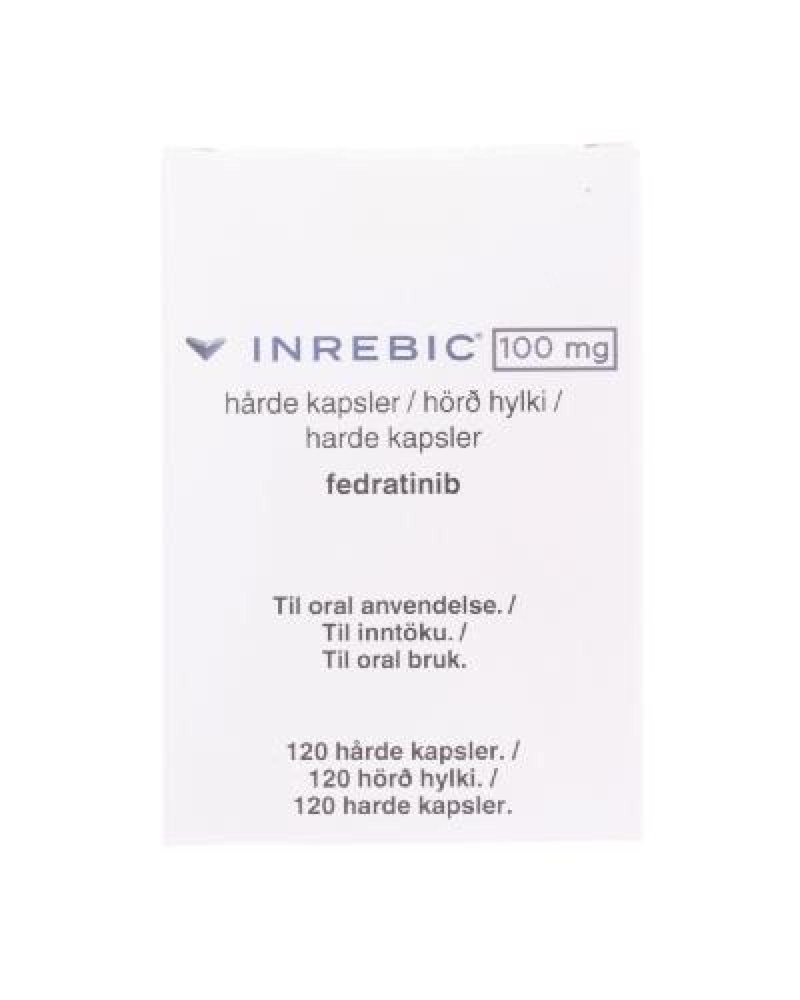
INREBIC 100 mg Hard Capsules

Prescription review online
A doctor will review your case and decide whether a prescription is medically appropriate.

Talk to a doctor about this medicine
Discuss your symptoms and possible next steps in a quick online consultation.



How to use INREBIC 100 mg HARD CAPSULES
Contents of the leaflet
- Introduction
- What is Inrebic and what is it used for
- What you need to know before you take Inrebic
- How to take Inrebic
- Possible side effects
- Storage of Inrebic
- Packaging Contents and Additional Information
Introduction
Package Leaflet: Information for the Patient
Inrebic100mg hard capsules
fedratinib
This medicinal product is subject to additional monitoring, which will allow for the quick identification of new safety information. You can help by reporting any side effects you may get. The last section of section 4 will tell you how to report side effects.
Read all of this leaflet carefully before you start taking this medicine, because it contains important information for you.
- Keep this leaflet, you may need to read it again.
- If you have any further questions, ask your doctor or pharmacist.
- This medicine has been prescribed for you only. Do not pass it on to others. It may harm them, even if their signs of illness are the same as yours.
- If you get any side effects, talk to your doctor or pharmacist. This includes any possible side effects not listed in this leaflet. See section 4.
Contents of the pack
- What is Inrebic and what is it used for
- What you need to know before you take Inrebic
- How to take Inrebic
- Possible side effects
- Storage of Inrebic
- Contents of the pack and other information
1. What is Inrebic and what is it used for
What is Inrebic
Inrebic contains the active substance fedratinib. It is a type of medicine known as a “protein kinase inhibitor”.
What is Inrebic used for
Inrebic is used to treat adult patients with splenomegaly (enlarged spleen) or symptoms related to myelofibrosis, a rare form of blood cancer.
How Inrebic works
An enlarged spleen is one of the features of myelofibrosis. Myelofibrosis is a bone marrow disorder in which the marrow is replaced by scar tissue. The abnormal marrow stops producing enough normal blood cells, and as a result, the spleen becomes much larger. By blocking the action of certain enzymes (called Janus-associated kinases), Inrebic can reduce the size of the spleen in patients with myelofibrosis and relieve symptoms such as fever, night sweats, bone pain, and weight loss in patients with myelofibrosis.

Not sure if this medicine is right for you?
Discuss your symptoms and treatment with a doctor online.
2. What you need to know before you take Inrebic
Do not take Inrebic
- if you are allergic to fedratinib or any of the other ingredients of this medicine (listed in section 6).
- if you are pregnant or think you may be pregnant.
Warnings and precautions
Talk to your doctor or pharmacist before starting to take these capsules and during treatment if you have any of the following signs or symptoms:
A condition that affects the brain called encephalopathy, including Wernicke's encephalopathy
- Confusion, memory loss, or difficulty thinking; loss of balance or problems walking.
- Eye problems such as random eye movement, double vision, blurred vision, and loss of vision.
These may be signs of a brain condition called encephalopathy, including Wernicke's encephalopathy, which can be fatal.
Contact your doctor immediately if you experience any of these signs or symptoms.
Talk to your doctor or pharmacist during treatment
- if you feel very tired, short of breath, pale skin, or a fast heartbeat: these may be signs of a low red blood cell count.
- if you have bleeding or bruising, or bleeding from the gums: these may be signs of a low platelet count.
- if you have frequent infections or recurring infections, which may be a sign of a low white blood cell count.
- if you have nausea, vomiting, or diarrhea.
- if you have or have had kidney problems.
- if you have or have had liver problems.
- if you have or have had pancreas problems.
It has been observed with another type of similar medicine used to treat rheumatoid arthritis: heart problems, blood clots, and cancer. Talk to your doctor or pharmacist before or during treatment if:
- you are over 65 years old. Patients 65 years or older may have a higher risk of heart problems, including heart attack, and some types of cancer.
- you have or have had heart problems.
- you have or have had cancer.
- you are a smoker or have smoked in the past.
- you have had blood clots in the veins of your legs (deep vein thrombosis) or lungs (pulmonary embolism) in the past.
- if you suddenly feel short of breath or have difficulty breathing, chest pain, or pain in the upper back, swelling of the legs or arms, pain or tenderness in the legs, redness or discoloration of the legs or arms, as these may be signs of blood clots in the veins.
- if you notice new growths on the skin or changes in existing ones. Your doctor may recommend that you have regular skin checks while taking Inrebic.
Your doctor will decide if Inrebic is suitable for you.
Blood tests
Before and during treatment, you will have blood tests to check your blood cell counts (red blood cells, white blood cells, and platelets) and liver and pancreas function.
Before treatment, you will have a blood test to check your vitamin B1 levels. Your doctor will also tell you to take a daily dose of 100 mg of vitamin B1 supplement during treatment. Your doctor may also ask for additional blood tests to check your vitamin B1 levels during treatment.
Based on the results of the blood tests, your doctor may adjust the dose or stop treatment.
Children and adolescents
Inrebic should not be used in children or adolescents under 18 years of age because this medicine has not been studied in this age group.
Other medicines and Inrebic
Tell your doctor or pharmacist if you are taking, have recently taken, or might take any other medicines, because Inrebic may affect the way some medicines work. Also, some medicines may affect the way Inrebic works.
The following medicines may increase the risk of side effects with Inrebic:
- Ketoconazole, fluconazole (used to treat fungal infections);
- Fluvoxamine (used to treat depression);
- Ritonavir (used to treat HIV/AIDS).
The following medicines may reduce the effectiveness of Inrebic:
- Rifampicin (used to treat tuberculosis (TB) and other infections);
- Phenytoin (used to treat epilepsy and control seizures or convulsions);
- Efavirenz (used to treat HIV/AIDS).
Inrebic may affect other medicines:
- Midazolam (used to help you sleep or relieve anxiety);
- Omeprazole (used to treat stomach problems);
- Metoprolol (used to treat angina or high blood pressure);
- Metformin (used to lower blood sugar levels);
- Also simvastatin, S-mephenytoin, and dextromethorphan.
Your doctor will decide if it is necessary to change the dose.
Also, tell your doctor if you have had surgery recently or are going to have surgery or a procedure, because Inrebic may interact with some anesthetics.
Pregnancy and breastfeeding
If you are pregnant or breastfeeding, think you may be pregnant, or are planning to have a baby, ask your doctor or pharmacist for advice before taking this medicine.
Do not take Inrebic during pregnancy. If you can become pregnant, you must use an effective contraceptive method while taking these capsules and avoid becoming pregnant for at least one month after the last dose.
Do not breastfeed while taking Inrebic and for at least one month after the last dose, as it is not known if this medicine passes into breast milk.
Driving and using machines
If you feel dizzy, do not drive or use machines until these effects have stopped.
Inrebic contains sodium
This medicine contains less than 23 mg of sodium (1 mmol) per dose; this is essentially “sodium-free”.
3. How to take Inrebic
Take this medicine exactly as your doctor or pharmacist has told you. If you are not sure, ask your doctor or pharmacist again.
The recommended dose is 400 mg (four 100 mg capsules) taken orally once a day.
You will have blood tests before and while taking this medicine to monitor your progress. Your doctor will also tell you to take a daily dose of 100 mg of vitamin B1 supplement during treatment (see section 2, “Blood tests”).
If you experience certain side effects while taking Inrebic (see section 4), your doctor may reduce the dose or pause or stop treatment.
How to take these capsules
- Swallow the capsules whole, preferably with water.
- Do not break, open, or chew the capsules.
- The capsules can be taken with or without food, but it is recommended to take them with food to avoid nausea and vomiting.
You should continue to take Inrebic for as long as your doctor tells you. This is a long-term treatment.
If you take more Inrebic than you should
If you accidentally take too many Inrebic capsules or a higher dose than you should, contact your doctor or pharmacist immediately.
If you forget to take Inrebic
If you miss a dose or vomit after taking a capsule, skip the missed dose and take the next scheduled dose at the usual time the next day. Do not take a double dose to make up for the missed or vomited capsules.
If you stop taking Inrebic
Do not stop taking Inrebic unless your doctor tells you to.
If you have any further questions on the use of this medicine, ask your doctor, pharmacist, or nurse.

Started taking the medicine and have questions?
Discuss your symptoms and treatment with a doctor online.
4. Possible side effects
Like all medicines, this medicine can cause side effects, although not everybody gets them.
Tell your doctor immediately if you notice any of the following symptoms, which may be signs of a serious brain disease called encephalopathy (including Wernicke's encephalopathy):
- Confusion, memory loss, or difficulty thinking,
- Loss of balance or problems walking,
- Eye problems such as double vision, blurred vision, loss of vision, or random eye movement.
Tell your doctor if you experience any other side effects. These may include:
Very common side effects(may affect more than 1 in 10 people)
- Low red blood cell count, which can cause tiredness, shortness of breath, pale skin, or a fast heartbeat (anemia).
- Low platelet count, which can cause bleeding or bruising (thrombocytopenia).
- Low white blood cell count (neutropenia), sometimes with fever. A low white blood cell count can reduce your ability to fight infections.
- Feeling sick (nausea)and being sick (vomiting).
- Diarrhea.
- Constipation.
- Bleeding.
- Urinary tract infection.
- Headache.
- Muscle spasms.
- Feeling tired (fatigue)or weak (asthenia).
- Changes in blood test results (increased alanine aminotransferase, increased aspartate aminotransferase, increased blood creatinine, increased amylase, and increased lipase). These may be signs of liver, kidney, or pancreas problems.
Common side effects(may affect up to 1 in 10 people)
- Dizziness.
- High blood pressure (hypertension).
- Indigestion (dyspepsia).
- Bone pain.
- Pain in the limbs, hands, or feet (limb pain).
- Weight gain.
- Painful urination.
Reporting of side effects
If you experience side effects, talk to your doctor or pharmacist, even if they are not listed in this leaflet. You can also report side effects directly via the national reporting system listed in Appendix V. By reporting side effects, you can help provide more information on the safety of this medicine.
5. Storage of Inrebic
Keep this medicine out of the sight and reach of children.
Do not use this medicine after the expiry date which is stated on the carton and bottle after “EXP”. The expiry date refers to the last day of the month shown.
Keep the bottle tightly closed to protect it from moisture.
This medicine does not require any special storage conditions.
Medicines should not be disposed of via wastewater or household waste. Ask your pharmacist how to dispose of medicines no longer required. These measures will help protect the environment.
6. Packaging Contents and Additional Information
Inrebic Contents
- The active ingredient is fedratinib. Each hard capsule contains fedratinib dihydrochloride monohydrate equivalent to 100 mg of fedratinib.
- The other ingredients are:
- The capsule contents contain silicified microcrystalline cellulose (contains microcrystalline cellulose (E460) and colloidal anhydrous silica (E551)) and sodium stearyl fumarate (see section 2, "Inrebic contains sodium").
- The capsule shell contains gelatin (E441), titanium dioxide (E171), and red iron oxide (E172).
- The white printing ink is composed of shellac (E904), titanium dioxide (E171), and propylene glycol (E1520).
Appearance of Inrebic and Packaging Contents
- Inrebic are reddish-brown capsules of 21.4-22.0 mm, with "FEDR" printed on the cap and "100 mg" on the body in white ink.
- The capsules are packaged in a high-density polyethylene (HDPE) bottle with a child-resistant screw cap and a tamper-evident seal. Each bottle contains 120 capsules and is packaged in a cardboard box.
Marketing Authorization Holder
Bristol-Myers Squibb Pharma EEIG
Plaza 254
Blanchardstown Corporate Park 2
Dublin 15, D15 T867
Ireland
Manufacturer
Celgene Distribution B.V.
Orteliuslaan 1000
3528 BD Utrecht
Netherlands
You can request more information about this medication by contacting the local representative of the marketing authorization holder:
Belgium/België/Belgien N.V. Bristol-Myers Squibb Belgium S.A. Tel: + 32 2 352 76 11 | Lithuania Swixx Biopharma UAB Tel: + 370 52 369140 |
Swixx Biopharma EOOD Tel: + 359 2 4942 480 | Luxembourg/Luxemburg N.V. Bristol-Myers Squibb Belgium S.A. Tel: + 32 2 352 76 11 |
Czech Republic Bristol-Myers Squibb spol. s r.o. Tel: + 420 221 016 111 | Hungary Bristol-Myers Squibb Kft. Tel: + 36 1 301 9797 |
Denmark Bristol-Myers Squibb Denmark Tel: + 45 45 93 05 06 | Malta A.M. Mangion Ltd Tel: + 356 23976333 |
Germany Bristol-Myers Squibb GmbH & Co. KGaA Tel: 0800 0752002 (+ 49 89 121 42 350) | Netherlands Bristol-Myers Squibb B.V. Tel: + 31 (0)30 300 2222 |
Estonia Swixx Biopharma OÜ Tel: + 372 640 1030 | Norway Bristol-Myers Squibb Norway AS Tel: + 47 67 55 53 50 |
Greece Bristol-Myers Squibb A.E. Tel: + 30 210 6074300 | Austria Bristol-Myers Squibb GesmbH Tel: + 43 1 60 14 30 |
Spain Bristol-Myers Squibb, S.A. Tel: + 34 91 456 53 00 | Poland Bristol-Myers Squibb Polska Sp. z o.o. Tel: + 48 22 2606400 |
France Bristol-Myers Squibb SAS Tel: + 33 (0)1 58 83 84 96 | Portugal Bristol-Myers Squibb Farmacêutica Portuguesa, S.A. Tel: + 351 21 440 70 00 |
Croatia Swixx Biopharma d.o.o. Tel: + 385 1 2078 500 | Romania Bristol-Myers Squibb Marketing Services S.R.L. Tel: + 40 (0)21 272 16 19 |
Ireland Bristol-Myers Squibb Pharmaceuticals uc Tel: 1 800 749 749 (+ 353 (0)1 483 3625) | Slovenia Swixx Biopharma d.o.o. Tel: + 386 1 2355 100 |
Iceland Vistor hf. Tel: + 354 535 7000 | Slovakia Swixx Biopharma s.r.o. Tel: + 421 2 20833 600 |
Italy Bristol-Myers Squibb S.r.l. Tel: + 39 06 50 39 61 | Finland Oy Bristol-Myers Squibb (Finland) Ab Tel: + 358 9 251 21 230 |
Cyprus Bristol-Myers Squibb A.E. Tel: 800 92666 (+ 30 210 6074300) | Sweden Bristol-Myers Squibb Aktiebolag Tel: + 46 8 704 71 00 |
Latvia Swixx Biopharma SIA Tel: + 371 66164750 |
Date of Last Revision of this Leaflet:
Other Sources of Information
Detailed information on this medicinal product is available on the European Medicines Agency website: https://www.ema.europa.eu. There are also links to other websites on rare diseases and orphan medicines.
You can access detailed information about this medicinal product by scanning the QR code included in the outer packaging with your smartphone. You can also access this information at the following internet address: www.inrebic-eu-pil.com.
- Country of registration
- Dosage formCAPSULE, 100 mg
- ATC codeL01EJ02
- Active substance
- Prescription requiredYes
- Manufacturer
- CompositionFUMARATO DE ESTEARILO Y SODIO (3 mg mg), PROPILENGLICOL (q.s. mg mg)
- This information is for reference only and does not constitute medical advice. Always consult a doctor before taking any medication. Oladoctor is not responsible for medical decisions based on this content.
- Alternatives to INREBIC 100 mg HARD CAPSULESDosage form: TABLET, 10 mgActive substance: ruxolitinibManufacturer: Novartis Europharm LimitedPrescription requiredDosage form: TABLET, 15 mgActive substance: ruxolitinibManufacturer: Novartis Europharm LimitedPrescription requiredDosage form: TABLET, 20 mgActive substance: ruxolitinibManufacturer: Novartis Europharm LimitedPrescription required
Online doctors for INREBIC 100 mg HARD CAPSULES
Discuss questions about INREBIC 100 mg HARD CAPSULES, including use, safety considerations and prescription review, subject to medical assessment and local regulations.
Get INREBIC 100 mg HARD CAPSULES Prescription Online
Fill in a 2-min form
Tell us your symptoms, history, and what medicine you're requesting.
Pick a doctor or let us assign
Choose a specialist or we'll match you with the next available doctor.
Doctor reviews your case
Usually within 30 minutes. They may ask follow-up questions via chat.
Collect from any pharmacy
Electronic prescription sent to your email — valid across Spain.
Frequently Asked Questions
INREBIC 100 mg HARD CAPSULES requires a prescription in Spain. You can check with a doctor online whether this medicine may be appropriate for your situation.
The active ingredient in INREBIC 100 mg HARD CAPSULES is fedratinib. This information helps identify medicines with the same composition but different brand names.
INREBIC 100 mg HARD CAPSULES is manufactured by Bristol-Myers Squibb Pharma Eeig. Pharmacy brands and packaging may differ depending on the distributor.
Doctors such as Family doctors, Psychiatrists, Dermatologists, Cardiologists, Endocrinologists, Gastroenterologists, Pulmonologists, Nephrologists, Rheumatologists, Hematologists, Infectious disease physicians, Allergists, Geriatricians, Paediatricians, Oncologists may assess whether INREBIC 100 mg HARD CAPSULES is appropriate, depending on your situation and local regulations. You can book an online consultation to discuss your symptoms and possible next steps.
Spain has a well-developed healthcare infrastructure across major cities such as Madrid, Barcelona, Valencia, and Seville. Pharmacies are widely available and operate under strict regulations, ensuring access to prescribed medications.
You can buy INREBIC 100 mg HARD CAPSULES in Madrid, Barcelona, Seville, or Valencia at any local pharmacy with a valid prescription.
To obtain a prescription, you can use Oladoctor:
Other medicines with the same active substance (fedratinib) include JAKAVI 10 mg TABLETS, JAKAVI 15 mg TABLETS, JAKAVI 20 mg TABLETS. These may have different brand names or formulations but contain the same therapeutic ingredient. Always consult a doctor before switching or starting a new medicine.
