



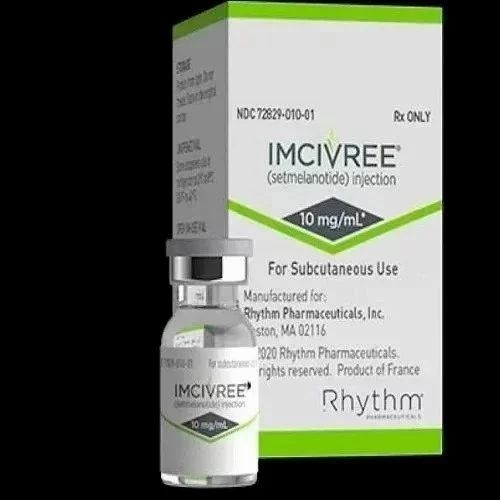
IMCIVREE 10 mg /Ml Injectable Solution

Prescription review online
A doctor will review your case and decide whether a prescription is medically appropriate.

Talk to a doctor about this medicine
Discuss your symptoms and possible next steps in a quick online consultation.



How to use IMCIVREE 10 mg/ml INJECTABLE SOLUTION
Contents of the leaflet
- Introduction
- What is IMCIVREE and what is it used for
- What you need to know before you use IMCIVREE
- How to use IMCIVREE
- Possible side effects
- Storage of IMCIVREE
- Container Contents and Additional Information
Introduction
Package Leaflet: Information for the Patient
IMCIVREE 10 mg/ml solution for injection
setmelanotide
This medicinal product is subject to additional monitoring, which will allow for the quick identification of new safety information. You can help by reporting any side effects you may have. The last section of the leaflet contains information on how to report side effects.
Read all of this leaflet carefully before you start using this medicine, because it contains important information for you.
- Keep this leaflet, you may need to read it again.
- If you have any further questions, ask your doctor, pharmacist, or nurse.
- This medicine has been prescribed for you only. Do not pass it on to others. It may harm them, even if their symptoms are the same as yours.
- If you get any side effects, talk to your doctor, pharmacist, or nurse. This includes any possible side effects not listed in this leaflet. See section 4.
Contents of the pack
- What is IMCIVREE and what is it used for
- What you need to know before you use IMCIVREE
- How to use IMCIVREE
- Possible side effects
- Storing IMCIVREE
- Contents of the pack and other information
1. What is IMCIVREE and what is it used for
IMCIVREE contains the active substance setmelanotide. It is used in adults and children from
2 years of age to treat obesity caused by certain genetic diseases that affect the way the brain controls the feeling of hunger.
The genetic diseases for which this medicine is used as a treatment are:
- Bardet-Biedl syndrome (BBS)
- obesity due to proopiomelanocortin (POMC) deficiency
- obesity due to proprotein convertase subtilisin/kexin type 1 (PCSK1) deficiency
- obesity due to leptin receptor (LEPR) deficiency
People with these diseases lack certain natural substances that are involved in appetite control, or these substances do not work properly. This increases hunger levels and leads to obesity. This medicine helps to restore appetite control and reduce the symptoms of the disease.

Not sure if this medicine is right for you?
Discuss your symptoms and treatment with a doctor online.
2. What you need to know before you use IMCIVREE
Do not use IMCIVREE
- if you are allergic to setmelanotide or any of the other ingredients of this medicine (listed in section 6).
Warnings and precautions
Talk to your doctor, pharmacist, or nurse before you start using IMCIVREE.
Before you start treatment with this medicine, and while you are having treatment, your doctor should examine your skin to detect any marks or dark areas. While you are using this medicine, you may get more marks or dark spots on your skin. A review before you start treatment will help to identify any new marks that may appear once you have used this medicine.
It is very common (may affect more than 1 in 10 people) for male patients to experience spontaneous erections of the penis when using this medicine. If an erection lasts for more than 4 hours, see a doctor urgently. Prolonged erections (priapism) can reduce your ability to have erections in the future if not treated.
Children
Do not give this medicine to children under 2 years of age, as there is no information on the use of this medicine in children under this age.
Other medicines and IMCIVREE
Tell your doctor or pharmacist if you are taking, have recently taken, or might take any other medicines.
Pregnancy and breastfeeding
If you are pregnant or breastfeeding, think you may be pregnant, or are planning to have a baby, ask your doctor or pharmacist for advice before using this medicine.
This medicine should not be used in women who are pregnant or trying to become pregnant, as it has not been studied in pregnant women. Weight loss during pregnancy may harm the baby.
Talk to your doctor before you start taking this medicine if you are breastfeeding. Your doctor will explain the benefits and risks of taking IMCIVREE during this time.
Driving and using machines
This medicine is not likely to affect your ability to drive or use machines.
IMCIVREE contains benzyl alcohol
This medicine contains 10 mg of benzyl alcohol in each 1 ml, which is equivalent to 1 mg per mg of your dose.
Benzyl alcohol has been associated with serious side effects in young children (less than 3 years). There is a greater risk that benzyl alcohol will build up in your body (a condition called "metabolic acidosis") and cause "gasping syndrome". Children aged 2 years should be monitored by their doctor for signs of build-up (which can be seen as rapid heart rate, rapid breathing, or confusion).
Benzyl alcohol may cause allergic reactions.
Talk to your doctor or pharmacist if you are pregnant or breastfeeding. This is because large amounts of benzyl alcohol can build up in your body and cause side effects (metabolic acidosis).
Talk to your doctor or pharmacist if you have liver or kidney disease. This is because benzyl alcohol can build up in your body and cause side effects (metabolic acidosis).
IMCIVREE contains sodium
This medicine contains less than 1 mmol of sodium (23 mg) per dose, which is essentially
"sodium-free".
3. How to use IMCIVREE
Follow the administration instructions of this medication exactly as indicated by your doctor or pharmacist. In case of doubt, consult your doctor or pharmacist again.
IMCIVREE is administered as a subcutaneous injection once a day at the beginning of the day. This medication is intended for long-term use.
Your doctor will advise you on the appropriate dose to be injected.
Proopiomelanocortin deficiency obesity, proprotein convertase subtilisin/kexin type 1 deficiency obesity, and leptin receptor deficiency obesity.
In adults and children aged 12 years and older, the recommended doses are as follows:
Treatment week | Daily dose in mg | Volume to be injected |
Weeks 1 – 2 | 1 mg once a day | 0.1 ml once a day |
Week 3 onwards | 2 mg once a day | 0.2 ml once a day |
If the dose is not sufficient and the adverse effects are acceptable | 2.5 mg once a day | 0.25 ml once a day |
If the dose is not sufficient and the adverse effects are acceptable | 3 mg once a day | 0.3 ml once a day |
In children aged 6 to less than 12 years, the recommended doses are as follows:
Treatment week | Daily dose in mg | Volume to be injected |
Weeks 1 – 2 | 0.5 mg once a day | 0.05 ml once a day |
Weeks 3 – 4 | 1 mg once a day | 0.1 ml once a day |
Week 5 onwards | 2 mg once a day | 0.2 ml once a day |
If the dose is not sufficient and the adverse effects are acceptable | 2.5 mg once a day | 0.25 ml once a day |
In children aged 2 to less than 6 years, the recommended doses are as follows:
Patient weight/treatment week | Daily dose | Volume to be injected |
Less than 20 kg | ||
Week 1 onwards | 0.5 mg once a day | 0.05 ml once a day |
20 to less than 30 kg | ||
Weeks 1-2 | 0.5 mg once a day | 0.05 ml once a day |
Week 3 onwards (if the dose is not sufficient and the adverse effects are acceptable) | 1 mg once a day | 0.1 ml once a day |
30 to less than 40 kg | ||
Weeks 1-2 | 0.5 mg once a day | 0.05 ml once a day |
Weeks 3-4 (if the dose is not sufficient and the adverse effects are acceptable) | 1 mg once a day | 0.1 ml once a day |
Week 5 onwards (if the dose is not sufficient and the adverse effects are acceptable) | 1.5 mg once a day | 0.15 ml once a day |
40 kg or more | ||
Weeks 1-2 | 0.5 mg once a day | 0.05 ml once a day |
Weeks 3-4 (if the dose is not sufficient and the adverse effects are acceptable) | 1 mg once a day | 0.1 ml once a day |
Weeks 5-6 (if the dose is not sufficient and the adverse effects are acceptable) | 1.5 mg once a day | 0.15 ml once a day |
Weeks 7-8 (if the dose is not sufficient and the adverse effects are acceptable) | 2 mg once a day | 0.2 ml once a day |
Week 9 onwards (if the dose is not sufficient and the adverse effects are acceptable) | 2.5 mg once a day | 0.25 ml once a day |
After the initial dose, if the adverse effects of a subsequent dose are not acceptable, the dose will be reduced to the previous dose level. If the adverse effects of the reduced dose are acceptable, the dose will be increased.
In patients with mild or moderate renal disease, no change in the dosing regimen is needed.
For adults and children aged 12 to 17 yearswith severe renal impairment, the recommended doses are as follows:
Treatment week | Daily dose in mg | Volume to be injected |
Weeks 1 – 2 | 0.5 mg once a day | 0.05 ml once a day |
Week 3 onwards (if the adverse effects are acceptable) | 1 mg once a day | 0.1 ml once a day |
If the dose is not sufficient and the adverse effects are acceptable | 2 mg once a day | 0.2 ml once a day |
If the dose is not sufficient and the adverse effects are acceptable | 2.5 mg once a day | 0.25 ml once a day |
If the dose is not sufficient and the adverse effects are acceptable | 3 mg once a day | 0.3 ml once a day |
If the adverse effects of the initial dose of 0.5 mg are not acceptable, it will be reduced to 0.25 mg (0.025 ml). If the adverse effects of the dose of 0.25 mg once a day are acceptable, the dose will be increased.
After the initial dose, if the adverse effects of a subsequent dose are not acceptable, the dose will be reduced to the previous dose level. If the adverse effects of the reduced dose are acceptable, the dose will be increased.
If the adverse effects of the dose of 3 mg are not acceptable, it will be reduced to 2.5 mg and this dose will be continued.
In children aged 6 to less than 12 yearswith severe renal impairment, the recommended doses are as follows:
Treatment week | Daily dose in mg | Volume to be injected |
Weeks 1 – 2 | 0.25 mg once a day | 0.025 ml once a day |
Weeks 3 – 4 (if the adverse effects are acceptable) | 0.5 mg once a day | 0.05 ml once a day |
Week 5 onwards (if the adverse effects are acceptable) | 1 mg once a day | 0.1 ml once a day |
If the dose is not sufficient and the adverse effects are acceptable | 2 mg once a day | 0.2 ml once a day |
If the adverse effects of the initial dose of 0.25 mg are not acceptable, treatment will be discontinued.
After the initial dose, if the adverse effects of a subsequent dose are not acceptable, the dose will be reduced to the previous dose level. If the adverse effects of the reduced dose are acceptable, the dose will be increased.
If the adverse effects of the dose of 2 mg are not acceptable, it will be reduced to 1 mg and this dose will be continued.
In children aged 2 to less than 6 yearswith severe renal impairment, the recommended doses are as follows:
Patient weight/treatment week | Daily dose | Volume to be injected |
Less than 20 kg | ||
Week 1 onwards | 0.25 mg once a day | 0.025 ml once a day |
20 to less than 30 kg | ||
Weeks 1-2 | 0.25 mg once a day | 0.025 ml once a day |
Week 3 onwards (if the dose is not sufficient and the adverse effects are acceptable) | 0.5 mg once a day | 0.05 ml once a day |
30 to less than 40 kg | ||
Weeks 1-2 | 0.25 mg once a day | 0.025 ml once a day |
Weeks 3-4 (if the dose is not sufficient and the adverse effects are acceptable) | 0.5 mg once a day | 0.05 ml once a day |
Week 5 onwards (if the dose is not sufficient and the adverse effects are acceptable) | 1 mg once a day | 0.1 ml once a day |
40 kg or more | ||
Weeks 1-2 | 0.25 mg once a day | 0.025 ml once a day |
Weeks 3-4 (if the dose is not sufficient and the adverse effects are acceptable) | 0.5 mg once a day | 0.05 ml once a day |
Weeks 5-6 (if the dose is not sufficient and the adverse effects are acceptable) | 1 mg once a day | 0.1 ml once a day |
Week 7 onwards (if the dose is not sufficient and the adverse effects are acceptable) | 1.5 mg once a day | 0.15 ml once a day |
If the adverse effects of the initial dose of 0.25 mg are not acceptable, treatment should be discontinued.
After the initial dose, if the adverse effects of a subsequent dose are not acceptable, the dose will be reduced to the previous dose level. If the adverse effects of the reduced dose are acceptable, the dose will be increased.
Bardet-Biedl syndrome
In adults and children aged 16 years and older, the recommended doses are as follows:
Treatment week | Daily dose in mg | Volume to be injected |
Weeks 1 – 2 | 2 mg once a day | 0.2 ml once a day |
Week 3 onwards (if the adverse effects are acceptable) | 3 mg once a day | 0.3 ml once a day |
If the adverse effects of the initial dose of 2 mg are not acceptable, it will be reduced to 1 mg (0.1 ml). If the adverse effects of the dose of 1 mg once a day are acceptable, the dose will be increased.
After the initial dose, if the adverse effects of a subsequent dose are not acceptable, the dose will be reduced to the previous dose level. If the adverse effects of the reduced dose are acceptable, the dose will be increased.
If the adverse effects of the dose of 3 mg are not acceptable, it will be reduced to 2 mg and this dose will be continued.
In children aged 6 to less than 16 years, the recommended doses are as follows:
Treatment week | Daily dose in mg | Volume to be injected |
Week 1 | 1 mg once a day | 0.1 ml once a day |
Week 2 (if the adverse effects are acceptable) | 2 mg once a day | 0.2 ml once a day |
Week 3 onwards (if the adverse effects are acceptable) | 3 mg once a day | 0.3 ml once a day |
If the adverse effects of the initial dose of 1 mg are not acceptable, it will be reduced to 0.5 mg (0.05 ml). If the adverse effects of the dose of 0.5 mg are acceptable, the dose will be increased.
After the initial dose, if the adverse effects of a subsequent dose are not acceptable, the dose will be reduced to the previous dose level.
If the adverse effects of the reduced dose are acceptable, the dose will be increased.
If the adverse effects of the dose of 3 mg are not acceptable, it will be reduced to 2 mg and this dose will be continued.
In children aged 2 to less than 6 years, the recommended doses are as follows:
Patient weight/treatment week | Daily dose | Volume to be injected |
Less than 20 kg | ||
Week 1 onwards | 0.5 mg once a day | 0.05 ml once a day |
20 to less than 30 kg | ||
Weeks 1-2 | 0.5 mg once a day | 0.05 ml once a day |
Week 3 onwards (if the dose is not sufficient and the adverse effects are acceptable) | 1 mg once a day | 0.1 ml once a day |
30 to less than 40 kg | ||
Weeks 1-2 | 0.5 mg once a day | 0.05 ml once a day |
Weeks 3-4 (if the dose is not sufficient and the adverse effects are acceptable) | 1 mg once a day | 0.1 ml once a day |
Week 5 onwards (if the dose is not sufficient and the adverse effects are acceptable) | 1.5 mg once a day | 0.15 ml once a day |
40 kg or more | ||
Weeks 1-2 | 0.5 mg once a day | 0.05 ml once a day |
Weeks 3-4 (if the dose is not sufficient and the adverse effects are acceptable) | 1 mg once a day | 0.1 ml once a day |
Weeks 5-6 (if the dose is not sufficient and the adverse effects are acceptable) | 1.5 mg once a day | 0.15 ml once a day |
Weeks 7-8 (if the dose is not sufficient and the adverse effects are acceptable) | 2 mg once a day | 0.2 ml once a day |
Week 9 onwards (if the dose is not sufficient and the adverse effects are acceptable) | 2.5 mg once a day | 0.25 ml once a day |
After the initial dose, if the adverse effects of a subsequent dose are not acceptable, the dose will be reduced to the previous dose level. If the adverse effects of the reduced dose are acceptable, the dose will be increased.
In patients with mild or moderate renal disease, no change in the dosing regimen is needed.
For adults and children aged 16 to 17 yearswith severe renal impairment, the recommended doses are as follows:
Treatment week | Daily dose in mg | Volume to be injected |
Weeks 1 – 2 | 0.5 mg once a day | 0.05 ml once a day |
Week 3 onwards (if the adverse effects are acceptable) | 1 mg once a day | 0.1 ml once a day |
If the dose is not sufficient and the adverse effects are acceptable | 2 mg once a day | 0.2 ml once a day |
If the dose is not sufficient and the adverse effects are acceptable | 2.5 mg once a day | 0.25 ml once a day |
If the dose is not sufficient and the adverse effects are acceptable | 3 mg once a day | 0.3 ml once a day |
If the adverse effects of the initial dose of 0.5 mg are not acceptable, it will be reduced to 0.25 mg (0.025 ml). If the adverse effects of the dose of 0.25 mg once a day are acceptable, the dose will be increased.
After the initial dose, if the adverse effects of a subsequent dose are not acceptable, the dose will be reduced to the previous dose level. If the adverse effects of the reduced dose are acceptable, the dose will be increased.
If the adverse effects of the dose of 3 mg are not acceptable, it will be reduced to 2.5 mg and this dose will be continued.
In children aged 6 to less than 16 yearswith severe renal impairment, the recommended doses are as follows:
Treatment week | Daily dose in mg | Volume to be injected |
Weeks 1 – 2 | 0.25 mg once a day | 0.025 ml once a day |
Weeks 3 – 4 (if the adverse effects are acceptable) | 0.5 mg once a day | 0.05 ml once a day |
Week 5 onwards (if the adverse effects are acceptable) | 1 mg once a day | 0.1 ml once a day |
If the dose is not sufficient and the adverse effects are acceptable | 2 mg once a day | 0.2 ml once a day |
If the adverse effects of the initial dose of 0.25 mg are not acceptable, treatment will be discontinued.
After the initial dose, if the adverse effects of a subsequent dose are not acceptable, the dose will be reduced to the previous dose level.
If the adverse effects of the reduced dose are acceptable, the dose will be increased.
If the adverse effects of the dose of 2 mg are not acceptable, it will be reduced to 1 mg and this dose will be continued.
In children aged 2 to less than 6 yearswith severe renal impairment, the recommended doses are as follows:
Patient weight/treatment week | Daily dose | Volume to be injected |
Less than 20 kg | ||
Week 1 onwards | 0.25 mg once a day | 0.025 ml once a day |
20 to less than 30 kg | ||
Weeks 1-2 | 0.25 mg once a day | 0.025 ml once a day |
Week 3 onwards (if the dose is not sufficient and the adverse effects are acceptable) | 0.5 mg once a day | 0.05 ml once a day |
30 to less than 40 kg | ||
Weeks 1-2 | 0.25 mg once a day | 0.025 ml once a day |
Weeks 3-4 (if the dose is not sufficient and the adverse effects are acceptable) | 0.5 mg once a day | 0.05 ml once a day |
Week 5 onwards (if the dose is not sufficient and the adverse effects are acceptable) | 1 mg once a day | 0.1 ml once a day |
40 kg or more | ||
Weeks 1-2 | 0.25 mg once a day | 0.025 ml once a day |
Weeks 3-4 (if the dose is not sufficient and the adverse effects are acceptable) | 0.5 mg once a day | 0.05 ml once a day |
Weeks 5-6 (if the dose is not sufficient and the adverse effects are acceptable) | 1 mg once a day | 0.1 ml once a day |
Week 7 onwards (if the dose is not sufficient and the adverse effects are acceptable) | 1.5 mg once a day | 0.15 ml once a day |
If the adverse effects of the initial dose of 0.25 mg are not acceptable, treatment should be discontinued.
After the initial dose, if the adverse effects of a subsequent dose are not acceptable, the dose will be reduced to the previous dose level. If the adverse effects of the reduced dose are acceptable, the dose will be increased.

Started taking the medicine and have questions?
Discuss your symptoms and treatment with a doctor online.
4. Possible side effects
Like all medicines, this medicine can cause side effects, although not everybody gets them.
Very common(may affect more than 1 in 10 people)
- Darkened skin patches or areas
- Pain, bruising, or inflammation (redness or swelling) at the injection site
- Fatigue
- Nausea or vomiting
- Headache
- Spontaneous penile erections
- Increased penile erections
- Skin neoplasms
Common(may affect up to 1 in 10 people)
- Dryness, redness, or itching of the skin
- Rash
- Skin lesions
- Hair loss
- Feeling of weakness
- Pain
- Dry mouth
- Indigestion
- Diarrhea
- Feeling of constipation
- Stomach pain
- Acidity
- Feeling of dizziness
- Female genital discomfort
- Sleep disorders
- Feeling of depression
- Sexual arousal disorder
- Increased sexual desire
- Eosinophilia, a type of white blood cell
- Back pain
- Muscle cramps
- Cough
Uncommon(may affect up to 1 in 100 people)
- Redness of the skin
- Lines or spots on the skin
- Increased sweating
- Abnormal distribution of fatty tissue
- Pruritic rash
- Scaly skin
- Sensitivity to heat or cold
- Chills
- Feeling of cold
- Feeling of heat
- Alteration of gum color
- Abdominal swelling
- Increased salivation
- Flatulence
- Blood test with elevated liver enzyme levels
- Somnolence
- Migraine
- Loss or change in sense of smell
- Taste disorders
- Female inability to achieve or maintain sexual arousal
- Genital discomfort or sensitivity
- Decreased sexual desire
- Female genital disorder
- Menstrual pain
- Sleep disorder
- Nightmares
- Colored and flat patch on the skin
- Joint pain
- Runny nose
- Pain in muscles or bones
- Pain in arms or legs
- Blood test with elevated muscle enzyme levels
- Discoloration of the white part of the eyes
- Hot flashes
- Dizziness
- Eating disorders
- Feeling of thirst
Reporting side effects
If you experience any side effects, consult your doctor, pharmacist, or nurse, even if they are not listed in this leaflet. You can also report them directly through the national reporting system included in Appendix V. By reporting side effects, you can help provide more information on the safety of this medication.
5. Storage of IMCIVREE
Keep this medicine out of the sight and reach of children.
Do not use this medicine after the expiration date that appears on the box and on the vial. The expiration date is the last day of the month indicated.
IMCIVREE should be stored in the refrigerator (between 2 °C and 8 °C) until the expiration date indicated on the box. Alternatively, IMCIVREE can be stored at room temperature, provided it does not exceed 30 °C, for a maximum of 30 days or until the expiration date, whichever comes first. Keep all vials (including opened ones) in the original box to protect them from light. After using a vial for the first time, discard it after 28 days.
Do not freeze this medication.
If IMCIVREE is exposed to temperatures above 30 °C, do not use it and discard it according to local guidelines. Do not use this medication if you observe floating particles or if it is cloudy.
Always use a new syringe for each injection.
Medicines should not be disposed of through wastewater or household waste. Ask your pharmacist how to dispose of the packaging and any unused medication. This will help protect the environment.
6. Container Contents and Additional Information
Composition of IMCIVREE
- The active ingredient is setmelanotida. Each multidose vial contains 10 mg of setmelanotida in 1 ml of solution.
The other components are:
- benzyl alcohol (see section 2, "What you need to know before you start using IMCIVREE")
- sodium salt of N-(carbonyl-methoxypolyethylene glycol 2000)-1,2-distearoyl-glycero-3-phosphoethanolamine (mPEG-2000-DSPE)
- sodium carmellose (see section 2, "What you need to know before you start using IMCIVREE")
- mannitol
- phenol
- disodium edetate (see section 2, "What you need to know before you start using IMCIVREE")
- water for injectable preparations
- hydrochloric acid (for pH adjustment)
- sodium hydroxide (for pH adjustment)
Appearance of the Product and Container Contents
IMCIVREE is a clear to slightly colored solution.
This medicinal product is presented in transparent glass vials with a stopper and a cap, containing 1 ml of injectable solution.
IMCIVREE is available in packs containing 1 or 10 multidose vials.
Only some pack sizes may be marketed.
Marketing Authorization Holder and Manufacturer
Rhythm Pharmaceuticals Netherlands B.V.
Radarweg 29,
1043NX Amsterdam,
Netherlands
Date of Last Revision of this Leaflet:
Other Sources of Information
Detailed information on this medicinal product is available on the European Medicines Agency website: http://www.ema.europa.eu
- Country of registration
- Dosage formINJECTABLE, 10 mg/ml
- ATC codeA08AA12
- Active substance
- Prescription requiredYes
- Manufacturer
- CompositionMANITOL (E-421) (11 mg mg), CARMELOSA SODICA (8 mg mg), ALCOHOL BENCILICO (10 mg mg), EDETATO DE DISODIO (1 mg mg), HIDROXIDO DE SODIO (E 524) (q.s. mg mg)
- This information is for reference only and does not constitute medical advice. Always consult a doctor before taking any medication. Oladoctor is not responsible for medical decisions based on this content.
- Alternatives to IMCIVREE 10 mg/ml INJECTABLE SOLUTIONDosage form: MODIFIED-RELEASE TABLET, 8 - REVIEW mgActive substance: bupropion and naltrexoneManufacturer: Orexigen Therapeutics Ireland LimitedPrescription requiredDosage form: CAPSULE, 60 mgActive substance: orlistatManufacturer: Haleon Ireland Dungarvan LimitedPrescription not requiredDosage form: CAPSULE, 60 mgActive substance: orlistatManufacturer: Haleon Ireland Dungarvan LimitedPrescription not required
Online doctors for IMCIVREE 10 mg/ml INJECTABLE SOLUTION
Discuss questions about IMCIVREE 10 mg/ml INJECTABLE SOLUTION, including use, safety considerations and prescription review, subject to medical assessment and local regulations.









Get IMCIVREE 10 mg/ml INJECTABLE SOLUTION Prescription Online
Fill in a 2-min form
Tell us your symptoms, history, and what medicine you're requesting.
Pick a doctor or let us assign
Choose a specialist or we'll match you with the next available doctor.
Doctor reviews your case
Usually within 30 minutes. They may ask follow-up questions via chat.
Collect from any pharmacy
Electronic prescription sent to your email — valid across Spain.
Frequently Asked Questions
IMCIVREE 10 mg/ml INJECTABLE SOLUTION requires a prescription in Spain. You can check with a doctor online whether this medicine may be appropriate for your situation.
The active ingredient in IMCIVREE 10 mg/ml INJECTABLE SOLUTION is setmelanotide. This information helps identify medicines with the same composition but different brand names.
IMCIVREE 10 mg/ml INJECTABLE SOLUTION is manufactured by Rhythm Pharmaceuticals Netherlands B.V.. Pharmacy brands and packaging may differ depending on the distributor.
Doctors such as Family doctors, Psychiatrists, Dermatologists, Cardiologists, Endocrinologists, Gastroenterologists, Pulmonologists, Nephrologists, Rheumatologists, Hematologists, Infectious disease physicians, Allergists, Geriatricians, Paediatricians, Oncologists may assess whether IMCIVREE 10 mg/ml INJECTABLE SOLUTION is appropriate, depending on your situation and local regulations. You can book an online consultation to discuss your symptoms and possible next steps.
Spain has a well-developed healthcare infrastructure across major cities such as Madrid, Barcelona, Valencia, and Seville. Pharmacies are widely available and operate under strict regulations, ensuring access to prescribed medications.
You can buy IMCIVREE 10 mg/ml INJECTABLE SOLUTION in Madrid, Barcelona, Seville, or Valencia at any local pharmacy with a valid prescription.
To obtain a prescription, you can use Oladoctor:
Other medicines with the same active substance (setmelanotide) include MYSIMBA 8 MG/90 MG PROLONGED-RELEASE TABLETS, ALLI 60 mg HARD CAPSULES ORLISTAT, ALLI 60 mg HARD CAPSULES. These may have different brand names or formulations but contain the same therapeutic ingredient. Always consult a doctor before switching or starting a new medicine.
