



GLUCOSALINO 3.96 g/0.3 g Injectable Infusion

Prescription review online
A doctor will review your case and decide whether a prescription is medically appropriate.

Talk to a doctor about this medicine
Discuss your symptoms and possible next steps in a quick online consultation.



How to use GLUCOSALINO ISOTONIC BRAUN
Contents of the leaflet
- Introduction
- What is Glucosalino Isotónico B. Braun and what is it used for
- Before using Glucosalino Isotónico B. Braun
- How to use Glucosalino Isotónico B. Braun
- Possible adverse effects
- Storage of Glucosalino Isotónico B. Braun
- Additional information
Introduction
Leaflet:information for theuser
Glucosalino Isotónico B. Braun
Glucose at 3.6% and Sodium Chloride at 0.3%. Solution for perfusion
Read the entire leaflet carefully before starting to use the medicine
- Keep this leaflet as you may need to read it again.
- If you have any doubts, consult your doctor or pharmacist.
- This medicine has been prescribed to you. Do not give it to others, even if they have the same symptoms, as it may harm them.
- If you consider that any of the adverse effects you suffer is serious or if you notice any adverse effect not mentioned in this leaflet, inform your doctor or pharmacist.
Contents of the leaflet:
- What is Glucosalino Isotónico B. Braun and what is it used for
- Before using Glucosalino Isotónico B. Braun
- How to use Glucosalino Isotónico B. Braun
- Possible adverse effects
- Storage of Glucosalino Isotónico B. Braun
- Additional information
1. What is Glucosalino Isotónico B. Braun and what is it used for
Glucosalino Isotónico B. Braun is a solution for perfusion used in the prevention of water deficit with low salt loss (hypertonic or isotonic dehydration) or as a support solution to administer medications or electrolytes, along with a slight energy intake.

Not sure if this medicine is right for you?
Discuss your symptoms and treatment with a doctor online.
2. Before using Glucosalino Isotónico B. Braun
Do not use Glucosalino Isotónico B. Braun:
- if you are allergic to the active ingredients or to any of the other components of Glucosalino Isotónico B. Braun.
- In states of fluid overload (hyperhydration).
- In situations of fluid accumulation in the body's tissues (generalized edema) or chronic progressive liver disease with fluid accumulation (ascitic cirrhosis).
- In states of increased blood glucose levels (hyperglycemia).
- In states of decreased potassium levels in the blood (hypokalemia).
- In states of decreased sodium levels in the blood (hyponatremia).
- In states of decreased chloride levels in the blood (hypochloremia).
- In states of loss of consciousness due to an increase in blood salt concentration (hyperosmolar coma).
- In states of presence of lactic acid in the blood (hyperlactatemia).
- In severe cases of heart, liver, or kidney failure.
- During the first 24 hours after a head injury.
Be careful with Glucosalino Isotónico B. Braun:
You will be administered this medicine with caution if you have the following diseases: hypertension, heart failure, peripheral or pulmonary edema, renal dysfunction, preeclampsia (symptoms preceding convulsions and blood pressure drop in pregnant women), heart, liver, or kidney disorders, or if you are an elderly patient.
Your blood glucose levels will be carefully determined if you have intracranial hypertension.
If you have had an acute ischemic attack (sudden onset of lack of blood flow), this medicine should not be administered to you.
If you are administered this medicine for a prolonged period, it is recommended to add potassium to the solution as a safety measure.
The administration of glucose-containing solutions may cause vitamin B1 deficiency, especially in cases of malnutrition.
Adequate intake of vitamins (especially vitamin B1) must be ensured.
If you have diabetes mellitus, glucose-containing solutions can be used as long as you have initially received adequate treatment (insulin). Similarly, these solutions should be used with caution if you have Addison's disease or carbohydrate intolerance.
Glucosalino Isotónico B. Braun should not be administered with the same infusion equipment, either at the same time, before, or after a blood transfusion, as incompatibilities may occur.
Blood sugar, electrolytes (especially potassium), and water balance should be regularly monitored.
This type of solution should be administered with caution in children.
Continuous administration at the same injection site should be avoided due to the risk of thrombophlebitis.
Use of other medicines
Tell your doctor or pharmacist if you are using or have recently used other medicines, including those purchased without a prescription.
Certain medicines may interact with Glucosalino Isotónico B. Braun. In this case, it may be necessary to change the dose or interrupt treatment with one of the medicines.
It is essential that you inform your doctor if you use any of the following medicines:
- Systemic corticosteroids with glucocorticoid activity (cortisol), diuretics, diphenylhydantoin, chlorpromazine increase blood glucose levels. Regarding corticosteroids with mineralocorticoid action, they should be administered with caution due to their ability to retain water and sodium.
- Insulin or oral antidiabetics (biguanides, sulfonylureas) may lead to a reduction in the therapeutic efficacy of the latter.
- Digitalis glycosides (digoxin) may cause an increase in digitalis activity, with the risk of developing intoxication with these medicines.
- Lithium carbonate, since the administration of sodium chloride accelerates the renal excretion of lithium, leading to a decrease in the therapeutic effect of the latter.
Your doctor will check the compatibility of this solution with any additive before using it. These solutions should not be administered with the same infusion equipment used or to be used for blood administration, as there is a possibility of agglutination.
Pregnancy and lactation
Consult your doctor or pharmacist before using any medicine.
In case of pregnancy, your doctor will decide whether to use glucose solution, as it should be used with caution.
Excessive administration of glucose-containing solutions during pregnancy may cause hyperglycemia, hyperinsulinemia, and fetal acidosis, and may be harmful to the newborn.
There is no evidence to suggest that Glucosalino Isotónico B. Braun may cause adverse effects during the lactation period in the neonate. However, it is recommended to use with caution during this period.
3. How to use Glucosalino Isotónico B. Braun
Follow the administration instructions of Glucosalino Isotónico B. Braun indicated by your doctor. Consult your doctor or pharmacist if you have doubts.
Your doctor will decide the dose and frequency at which the solution will be administered to you, depending on your age, weight, clinical situation (particularly the state of hydration), and the nature of any medication that may have been added to the solution.
The recommended dosage is:
For adults, elderly, and adolescents: 500 ml to 3000 ml every 24 hours.
For babies and children:
- From 0 to 10 kg of body weight: 100 ml/kg/24 h
- From 10 to 20 kg of body weight: 1000 ml + 50 ml/kg/24 h for weight above 10 kg
- > 20 kg of body weight: 1500 ml + 20 ml/kg/24 h for weight above 20 kg
If you use more Glucosalino Isotónico B. Braun than you should
It is unlikely that this will happen since your doctor will determine your daily doses. However, if you receive more medicine than you should, this may cause:
- excess hydration,
- an imbalance of electrolyte levels (substances with an electric charge in the blood and other body fluids, such as sodium, calcium, chlorides) and acid-base balance (loss of balance in the levels of acidic and basic substances in the body, which must always be constant),
- an increase in blood sugar concentration.
If this happens, treatment should be stopped immediately and, depending on the severity, the following may be administered:
- medicines that increase water and salt elimination (diuretics),
- electrolytes (such as sodium, calcium, chlorides) or
- insulin.
In case of overdose or accidental ingestion, consult the Toxicology Information Service (telephone: 91.562 04 20) or consult your doctor or pharmacist. Bring this leaflet with you.
If you have any other doubts about the use of this product, ask your doctor or pharmacist.

Started taking the medicine and have questions?
Discuss your symptoms and treatment with a doctor online.
4. Possible adverse effects
Like all medicines, Glucosalino Isotónico B. Braun can cause adverse effects, although not everyone will experience them.
Adverse reactions associated with the administration technique may occur, including fever, infection at the injection site, local reaction or pain, venous irritation, venous thrombosis, or phlebitis extending from the injection site, extravasation, and hypervolemia. To avoid the risk of thrombophlebitis (inflammation of a vein due to a blood clot), it is recommended to vary the injection site (every 24-48 hours).
Adverse reactions may be associated with the medications added to the solution; the nature of the added medications will determine the possibility of any other undesirable effect.
In case of adverse reactions, the perfusion should be stopped.
Reporting of adverse effects
If you experience any type of adverse effect, consult your doctor or pharmacist, even if it is a possible adverse effect not mentioned in this leaflet. You can also report them directly through the Spanish Pharmacovigilance System for Human Use Medicines: www.notificaRAM.es. By reporting adverse effects, you can contribute to providing more information on the safety of this medicine.
5. Storage of Glucosalino Isotónico B. Braun
Keep out of the reach and sight of children.
No special storage conditions are required.
Do not use Glucosalino Isotónico B. Braun after the expiration date stated on the packaging. The expiration date is the last day of the month indicated.
Medicines should not be disposed of through wastewater or household waste. Deposit the packaging and any unused medicines in the SIGRE collection point at the pharmacy. If in doubt, ask your pharmacist how to dispose of the packaging and any unused medicines. This will help protect the environment.
6. Additional information
Composition of Glucosalino Isotónico B. Braun:
The active ingredients are: | Per 1 ml | Per 250 ml | Per 500 ml | Per 1000 ml |
Glucose (as glucose monohydrate, 39.6 mg/ml) | 36 mg | 9 g | 18 g | 36 g |
Sodium Chloride | 3 mg | 0.75 g | 1.5 g | 3 g |
Energy value | 144 kcal/l |
Theoretical osmolality | 302 mOsm/l |
pH | 3.5 – 6.0 |
The other components are: water for injectable preparations.
Appearance of the product and packaging content
Glucosalino Isotónico B. Braun is a solution for perfusion presented in plastic vials (Ecoflac Plus® of 250 ml, 500 ml, and 1000 ml. Not all sizes may be marketed).
Format: | 1 vial of 250 ml |
20 vials of 250 ml | |
1 vial of 500 ml | |
10 vials of 500 ml | |
1 vial of 1000 ml | |
10 vials of 1000 ml |
Marketing authorization holder and manufacturer
- Braun Medical, S.A.
Ctra. de Terrassa, 121
08191-Rubí (Barcelona)
Spain
This leaflet was approved in December 2024
Detailed information about this medicine is available on the website of the Spanish Agency for Medicines and Health Products.http://www.aemps.gob.es/
-------------------------------------------------------------------------------------------
This information is intended only for healthcare professionals:
Administration rate:
The perfusion rate is normally 40 ml/kg/24 h in adults, elderly, and adolescents.
In pediatric patients, the perfusion rate is 5 ml/kg/h on average, but this value varies with age: 6-8 ml/kg/h for children under 12 months, 4-6 ml/kg/h for children between 12-23 months, and 2-4 ml/kg/h for school-age children (2-11 years).
The perfusion rate should not exceed the patient's glucose oxidation capacity to avoid hyperglycemia. Therefore, the maximum dose ranges from 5 mg/kg/min for adults to 10-18 mg/kg/min for babies and children, depending on age and total body weight.
The content of each vial is for single perfusion. The unused fraction should be discarded.
The perfusion solution should be visually inspected before use. The solution should be transparent, not contain precipitates, and the vial should be intact. Do not administer otherwise.
An aseptic procedure should be used to administer the solution and add medications if necessary.
Before adding medications to the solution or administering them simultaneously with other medications, it should be checked that there are no incompatibilities.
These solutions should not be administered through the same infusion equipment used, or to be used, for blood administration, as there is a possibility of pseudoagglutination.
It has been described that a glucose solution with a glucose content of 3.6% and sodium chloride of 0.3% is incompatible with mitomycin, due to the low pH of this solution.
On the other hand, samples of incompatibility have been described when some medications are diluted in glucose-containing solutions, including ampicillin sodium, amrinone lactate, amoxicillin sodium/clavulanic acid, interferon alfa-2b, and procainamide hydrochloride. However, amrinone lactate or amoxicillin sodium/clavulanic acid can be injected directly into the injection site while these perfusion solutions are being administered.
Additionally, samples of incompatibility have been described when some medications are diluted in chloride-containing solutions, including amsacrine and trimetrexate glucuronate.
The disposal of unused medicine and all materials that have come into contact with it will be carried out in accordance with local regulations.
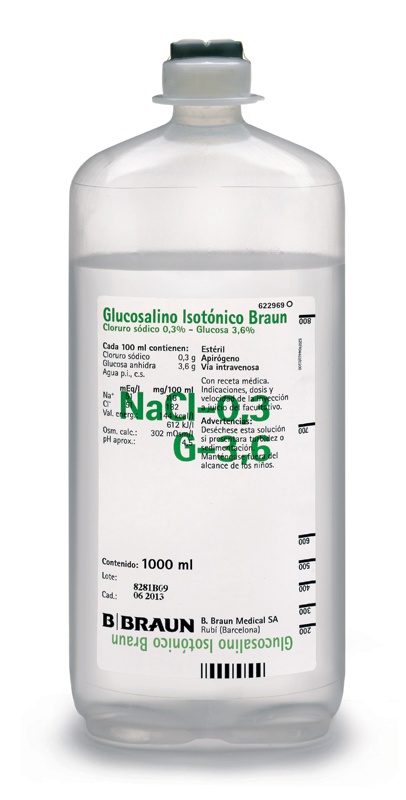
- Country of registration
- Dosage formINJECTABLE INFUSION, 3.96 g glucose monohydrate; 0.3 g sodium chloride
- ATC codeB05BB92
- Active substance
- Prescription requiredYes
- Manufacturer
- This information is for reference only and does not constitute medical advice. Always consult a doctor before taking any medication. Oladoctor is not responsible for medical decisions based on this content.
- Alternatives to GLUCOSALINO ISOTONIC BRAUNDosage form: INJECTABLE PERFUSION, 4.7 g / 0.18 gActive substance: Solutions affecting the electrolyte balanceManufacturer: Fresenius Kabi España, S.A.U.Prescription requiredDosage form: INJECTABLE INFUSION, 100mlActive substance: Solutions affecting the electrolyte balanceManufacturer: Fresenius Kabi España, S.A.U.Prescription requiredDosage form: INJECTABLE PERFUSION, 3660 mg / 300 mgActive substance: Solutions affecting the electrolyte balanceManufacturer: Baxter S.L.Prescription required
Online doctors for GLUCOSALINO ISOTONIC BRAUN
Discuss questions about GLUCOSALINO ISOTONIC BRAUN, including use, safety considerations and prescription review, subject to medical assessment and local regulations.









Get GLUCOSALINO ISOTONIC BRAUN Prescription Online
Fill in a 2-min form
Tell us your symptoms, history, and what medicine you're requesting.
Pick a doctor or let us assign
Choose a specialist or we'll match you with the next available doctor.
Doctor reviews your case
Usually within 30 minutes. They may ask follow-up questions via chat.
Collect from any pharmacy
Electronic prescription sent to your email — valid across Spain.
Frequently Asked Questions
GLUCOSALINO ISOTONIC BRAUN requires a prescription in Spain. You can check with a doctor online whether this medicine may be appropriate for your situation.
The active ingredient in GLUCOSALINO ISOTONIC BRAUN is Solutions affecting the electrolyte balance. This information helps identify medicines with the same composition but different brand names.
GLUCOSALINO ISOTONIC BRAUN is manufactured by B Braun Medical S.A.. Pharmacy brands and packaging may differ depending on the distributor.
Doctors such as Family doctors, Psychiatrists, Dermatologists, Cardiologists, Endocrinologists, Gastroenterologists, Pulmonologists, Nephrologists, Rheumatologists, Hematologists, Infectious disease physicians, Allergists, Geriatricians, Paediatricians, Oncologists may assess whether GLUCOSALINO ISOTONIC BRAUN is appropriate, depending on your situation and local regulations. You can book an online consultation to discuss your symptoms and possible next steps.
Spain has a well-developed healthcare infrastructure across major cities such as Madrid, Barcelona, Valencia, and Seville. Pharmacies are widely available and operate under strict regulations, ensuring access to prescribed medications.
You can buy GLUCOSALINO ISOTONIC BRAUN in Madrid, Barcelona, Seville, or Valencia at any local pharmacy with a valid prescription.
To obtain a prescription, you can use Oladoctor:
Other medicines with the same active substance (Solutions affecting the electrolyte balance) include APIROSERUM GLUCOSALINE 1/5 SOLUTION FOR INFUSION, FREEFLEX GLUCOSALINA SOLUTION FOR INFUSION, GLUCOSE 3.33% & SODIUM CHLORIDE 0.3% BAXTER SOLUTION FOR INFUSION. These may have different brand names or formulations but contain the same therapeutic ingredient. Always consult a doctor before switching or starting a new medicine.
