



GLUCOSA 20 mg /100 Ml Injectable Infusion

Prescription review online
A doctor will review your case and decide whether a prescription is medically appropriate.

Talk to a doctor about this medicine
Discuss your symptoms and possible next steps in a quick online consultation.



How to use GLUCOSA PHYSAN 20% SOLUTION FOR INFUSION
Contents of the leaflet
- Introduction
- What is Glucosa Physan 20% and what is it used for
- What you need to know before you start using Glucosa Physan 20%
- How to use Glucosa Physan 20%
- Possible Side Effects
- Storage of Glucosa Physan 20%
- Contents of the Pack and Other Information
- Marketing Authorization Holder and Manufacturer
Introduction
Package Leaflet: Information for the User
Glucosa Physan 20% Solution for Infusion
Anhydrous Glucose
Read all of this leaflet carefully before you start using this medicine because it contains important information for you.
- Keep this leaflet, you may need to read it again.
- If you have any further questions, ask your doctor, pharmacist, or nurse.
- If you experience any side effects, talk to your doctor, pharmacist, or nurse, even if they are not listed in this leaflet. See section 4.
Contents of the Package Leaflet
- What is Glucosa Physan 20% and what is it used for.
- What you need to know before you start using Glucosa Physan 20%.
- How to use Glucosa Physan 20%.
- Possible side effects.
- Storage of Glucosa Physan 20%.
- Contents of the pack and other information.
1. What is Glucosa Physan 20% and what is it used for
Glucosa Physan 20% belongs to the group of solutions for parenteral nutrition intended for the supply of water and energy.
It is indicated for the treatment of hypertonic dehydration (vomiting, diarrhea, profuse sweating, gastrointestinal fistulas), as an energy supplement in parenteral nutrition, and in carbohydrate metabolism disorders (hypoglycemia, insulin coma, hepatic coma, acetonemic vomiting).

Not sure if this medicine is right for you?
Discuss your symptoms and treatment with a doctor online.
2. What you need to know before you start using Glucosa Physan 20%
Do not use Glucosa Physan 20%:
If you are allergic to anhydrous glucose or to any of the other components of this medicine (listed in section 6).
- If you have been detected with hypotonic dehydration, loss of salts, or decreased urine volume.
- In the first 24 hours after a head trauma.
- In states of hyperglycemia.
- In states of hyperhydration, generalized edema.
- If you have hyperlactacidemia.
- If you suffer from significant glucose tolerance disorders, including hyperosmolar coma.
Warnings and Precautions
Consult your doctor, pharmacist, or nurse before starting to use Glucosa Physan 20%.
- Blood glucose concentration should be carefully monitored in cases of intracranial hypertension.
- In case of having suffered acute ischemic attacks (decreased or absent circulation in arteries), since hyperglycemia has been related to an increase in cerebral ischemic damage and difficulty in recovery.
- In case of shock and acid-base balance disorders, patients should be treated by administering electrolytes before the administration of glucose solutions. In patients with sodium deficiency, the administration of sodium-free solutions may cause peripheral circulatory collapse and oliguria (scant urine excretion).
- It is recommended that regular checks of blood glucose, serum electrolytes, water balance, and acid-base balance be performed, as frequent and massive administration of parenteral glucose solutions can cause fluid overload (hyperhydration) and significant ionic depletions. In this case, it will be necessary to administer electrolyte supplements.
- To avoid hypokalemia produced during prolonged parenteral nutrition with glucose, potassium may be added to the glucose solution as a safety measure.
- If you have malnutrition, you may have a vitamin B1 deficiency. This vitamin is essential for glucose metabolism, so if necessary, this deficiency should be corrected first.
- If you have diabetes. In this case, glucose solutions can be used as long as you have initially been given the appropriate treatment (insulin). Blood glucose should be regularly monitored in diabetic patients and insulin requirements modified.
- Do not administer blood simultaneously using the same infusion equipment due to the risk of pseudoagglutination and/or hemolysis.
- If administered continuously in the same infusion site, thrombophlebitis (inflammation of the veins) may occur.
- Special attention should be paid if used in elderly patients, as they may have affected liver and/or kidney function.
- Do not administer intramuscularly.
Glucose solutions for intravenous infusion are generally isotonic. However, in the body, glucose solutions can become extremely hypotonic physiologically due to the rapid metabolism of glucose.
Depending on the tonicity of the solution, the volume and rate of infusion, and the patient's initial clinical condition and ability to metabolize glucose, intravenous glucose administration can cause electrolyte disturbances, the most important of which is hyperosmolar hyponatremia.
Hyponatremia:
Patient with non-osmotic release of vasopressin (e.g., in critical states, pain, postoperative stress, infections, burns, and CNS diseases), patients with heart, liver, and kidney diseases, and patients exposed to vasopressin agonists have a special risk of experiencing acute hyponatremia after infusion of hypotonic solutions.
Acute hyponatremia can cause acute hyponatremic encephalopathy (cerebral edema) characterized by headache, nausea, seizures, lethargy, and vomiting. Patients with cerebral edema have a special risk of suffering severe, irreversible, and potentially fatal brain damage.
Children, women of childbearing age, and patients with reduced cerebral distensibility (e.g., in case of meningitis, intracranial hemorrhage, and cerebral contusion) have a special risk of suffering severe and potentially fatal cerebral edema caused by acute hyponatremia.
Using Glucosa Physan 20% with other medicines
Tell your doctor or pharmacist if you are using, have recently used, or might use any other medicines.
It is important that you inform your doctor if you are using any of the following medicines:
- Insulin or oral antidiabetics (biguanides, sulfonylureas): Intravenous glucose administration in patients treated with insulin or oral antidiabetics may decrease their effectiveness (antagonistic action).
- Corticosteroids: Intravenous administration of glucose solutions in patients treated with systemic corticosteroids with glucocorticoid activity (cortisol) may result in a significant increase in plasma glucose levels due to the hyperglycemic action of these latter. As for corticosteroids with mineralocorticoid activity, they should be administered with caution due to their ability to retain water and sodium.
- Digitalis glycosides (digoxin): If intravenous glucose administration coincides with treatment with digitalis glycosides (digoxin), an increase in digitalis activity may occur, with the risk of developing intoxication with these medicines. This is due to the hypokalemia that can be caused by glucose administration if potassium is not added to the solution.
- Erythromycin: Glucose increases its degradation rate.
In any case, the doctor should check the compatibility of the added medicines.
Medicines that potentiate the effect of vasopressin:
The following medicines increase the effect of vasopressin, which reduces the renal excretion of water without electrolytes and increases the risk of hospital hyponatremia after inadequately balanced treatment with intravenous infusion solutions.
- Medicines that stimulate the release of vasopressin; e.g.: chlorpropamide, clofibrate, carbamazepine, vincristine, selective serotonin reuptake inhibitors, 3,4-methylenedioxymethamphetamine, ifosfamide, antipsychotics, narcotics.
- Medicines that potentiate the action of vasopressin; e.g.: chlorpropamide, NSAIDs, cyclophosphamide.
- Vasopressin analogs; e.g.: desmopressin, oxytocin, vasopressin, terlipressin.
Other medicines that are known to increase the risk of hyponatremia are diuretics in general and antiepileptics such as oxcarbazepine.
Pregnancy, Breast-feeding, and Fertility
If you are pregnant or breast-feeding, think you may be pregnant, or are planning to have a baby, ask your doctor or pharmacist for advice before using any medicine.
In case of pregnancy, your doctor will decide whether to use a 20% glucose solution, as it should be used with caution in this case. The administration of glucose intravenously during pregnancy may increase glucose and insulin levels, as well as acidic components in the fetal blood.
There is no evidence to suggest that 20% Glucose may cause adverse effects during the lactation period in the neonate. However, it is recommended to use with caution during this period.
Glucosa Physan 20% should be administered with special caution in pregnant women during labor, especially if administered in combination with oxytocin, due to the risk of hyponatremia.
Driving and Using Machines
Not applicable.
3. How to use Glucosa Physan 20%
Intravenous drip administration, according to the clinical situation and input/output balance (see section 6).
Hypertonic solutions should be administered preferably through a central vein. In case of emergency treatment of hypoglycemia, it can be infused slowly into peripheral veins.
Dosage will be established according to medical criteria. In general, it is recommended to administer 250-1,500 ml per day, at a rate of 20-40 drops per minute. It should not exceed 100 drops per minute.
If you have been administered more Glucosa Physan 20% than you should have:
In case of overdose, hyperglycemia, glucosuria, hyperhydration, or electrolyte disorders may appear. Administration will be discontinued and symptomatic treatment will be provided.
In case of overdose, consult the Toxicology Information Service. Phone: 91 562 04 20.

Started taking the medicine and have questions?
Discuss your symptoms and treatment with a doctor online.
4. Possible Side Effects
Like all medicines, this medicine can cause side effects, although not everybody gets them.
Hyperglycemia, glucosuria (glucose in urine), or disturbances in fluid or electrolyte balance may occur if administered too quickly or if the fluid volume is excessive, or in cases of metabolic insufficiency.
On the other hand, the hyperglycemia resulting from rapid or excessive infusion should be monitored in severe cases of diabetes mellitus, and can be avoided by reducing the dose and rate of infusion or by administering insulin.
A local reaction may occur at the injection site.
Whenever any of these adverse reactions occur, you should inform your doctor, who will assess whether or not to discontinue the medication.
If you experience any of these side effects or any other not listed in this leaflet, consult your doctor or pharmacist.
Adverse Reactions
Metabolic and nutritional disorders with hospital hyponatremia** of unknown frequency.
Nervous system disorders with hyponatremic encephalopathy** of unknown frequency.
** Hospital hyponatremia can cause irreversible brain damage and death due to the occurrence of acute hyponatremic encephalopathy.
Reporting of Side Effects
If you experience any side effects, talk to your doctor, pharmacist, or nurse, even if they are not listed in this leaflet. You can also report side effects directly through the Spanish Medicines Monitoring System: www.notificaRAM.es. By reporting side effects, you can help provide more information on the safety of this medicine.
5. Storage of Glucosa Physan 20%
Keep this medicine out of the sight and reach of children.
Do not store above 30°C.
Do not use this medicine after the expiry date which is stated on the label after EXP. The expiry date is the last day of the month shown.
Do not use this medicine if you notice visible signs of deterioration.
Medicines should not be disposed of via wastewater or household waste. Ask your pharmacist how to dispose of medicines no longer required. This will help protect the environment.
6. Contents of the Pack and Other Information
Composition of Glucosa Physan 20%
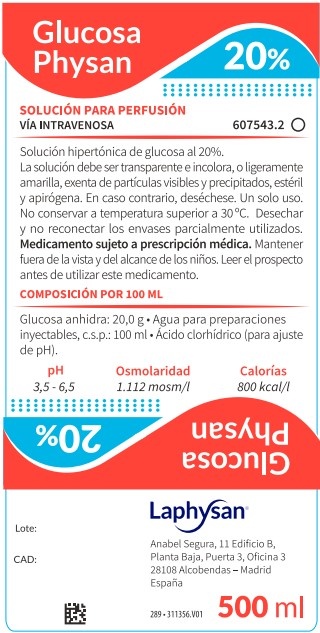
- The active substance is glucose. Each 100 ml of solution contains 20 g of anhydrous glucose (22 g as glucose monohydrate).
- The other ingredients (excipients) are: water for injectable preparations, hydrochloric acid (for pH adjustment).
Theoretical osmolality: 1.112 mosm/l.
Theoretical calories: 800 kcal/l.
pH: 3.5-6.5.
Appearance of the Product and Contents of the Pack
Clear, colorless to slightly yellowish, hypertonic, apyrogenic, and sterile solution.
Glucosa Physan 20% is a solution for intravenous infusion presented in 250 ml and 500 ml containers.
Glucosa Laphysan 20% solution for infusion is presented in type II glass vials of the following capacities:
- 250 ml vials.
- 500 ml vials.
For Clinical Containers:
1. Glass Vials:
- 24 vials of 250 ml.
- 10 vials of 500 ml.
2. PP Vials:
- 20 vials of 500 ml.
Marketing Authorization Holder and Manufacturer
Marketing Authorization Holder:
LAPHYSAN, S.A.U.
Anabel Segura, 11 Edificio A, Planta 4, Puerta D
28108 Alcobendas – Madrid, Spain
Manufacturer:
S.M. FARMACEUTICI SRL
Zona industriale
85050 TITO – POTENZA, Italy
or
LABORATORIOS BASI – INDUSTRIA FARMACÉUTICA, S.A.
Parque Industrial Manuel Lourenço Ferreira,
Nº 8, Nº 15 y Nº 16
3450-232 Mortágua - Portugal
Date of the Last Revision of this Leaflet: October 2022
--------------------------------------------------------------------------------------------------------------
This information is intended only for healthcare professionals:
This medicine will always be administered by specialized personnel. It will be administered by intravenous infusion. If administered directly, it will be through a central vein. When administered diluted to a concentration of 10% or less, a peripheral vein can be used.
The solution must be transparent and not contain precipitates. Do not administer otherwise. The contents of each vial are for single infusion; the unused fraction must be discarded.
An aseptic method should be used to administer the solution and in the preparation of mixtures.
Before adding medicines to the solution or administering them simultaneously with other medicines, it should be checked that there are no incompatibilities.
It may be necessary to monitor fluid balance, blood glucose, serum sodium, and other electrolytes before and during administration, especially in patients with increased non-osmotic release of vasopressin (syndrome of inappropriate antidiuretic hormone secretion, SIADH) and in patients receiving concomitant medication with vasopressin agonists due to the risk of hyponatremia.
Monitoring of serum sodium is especially important when administering physiologically hypotonic solutions. Glucosa Physan 20% solution for infusion can become extremely hypotonic after administration due to glucose metabolism in the body.
- Country of registration
- Dosage formINJECTABLE INFUSION, 20,000 mg / 100 ml
- ATC codeB05BA03
- Availability in pharmaciesSupply issue reported
- Active substance
- Prescription requiredYes
- Manufacturer
- This information is for reference only and does not constitute medical advice. Always consult a doctor before taking any medication. Oladoctor is not responsible for medical decisions based on this content.
- Alternatives to GLUCOSA PHYSAN 20% SOLUTION FOR INFUSIONDosage form: INJECTABLE INFUSION, 50 g glucoseActive substance: carbohydratesManufacturer: Fresenius Kabi España, S.A.U.Prescription requiredDosage form: INJECTABLE PERFUSION, 11 gActive substance: carbohydratesManufacturer: Fresenius Kabi España, S.A.U.Prescription requiredDosage form: INJECTABLE INFUSION, Glucose Monohydrate 5.5 gActive substance: carbohydratesManufacturer: Fresenius Kabi España, S.A.U.Prescription required
Online doctors for GLUCOSA PHYSAN 20% SOLUTION FOR INFUSION
Discuss questions about GLUCOSA PHYSAN 20% SOLUTION FOR INFUSION, including use, safety considerations and prescription review, subject to medical assessment and local regulations.









Get GLUCOSA PHYSAN 20% SOLUTION FOR INFUSION Prescription Online
Fill in a 2-min form
Tell us your symptoms, history, and what medicine you're requesting.
Pick a doctor or let us assign
Choose a specialist or we'll match you with the next available doctor.
Doctor reviews your case
Usually within 30 minutes. They may ask follow-up questions via chat.
Collect from any pharmacy
Electronic prescription sent to your email — valid across Spain.
Frequently Asked Questions
GLUCOSA PHYSAN 20% SOLUTION FOR INFUSION requires a prescription in Spain. You can check with a doctor online whether this medicine may be appropriate for your situation.
The active ingredient in GLUCOSA PHYSAN 20% SOLUTION FOR INFUSION is carbohydrates. This information helps identify medicines with the same composition but different brand names.
GLUCOSA PHYSAN 20% SOLUTION FOR INFUSION is manufactured by Laphysan S.A.U.. Pharmacy brands and packaging may differ depending on the distributor.
Doctors such as Family doctors, Psychiatrists, Dermatologists, Cardiologists, Endocrinologists, Gastroenterologists, Pulmonologists, Nephrologists, Rheumatologists, Hematologists, Infectious disease physicians, Allergists, Geriatricians, Paediatricians, Oncologists may assess whether GLUCOSA PHYSAN 20% SOLUTION FOR INFUSION is appropriate, depending on your situation and local regulations. You can book an online consultation to discuss your symptoms and possible next steps.
Spain has a well-developed healthcare infrastructure across major cities such as Madrid, Barcelona, Valencia, and Seville. Pharmacies are widely available and operate under strict regulations, ensuring access to prescribed medications.
You can buy GLUCOSA PHYSAN 20% SOLUTION FOR INFUSION in Madrid, Barcelona, Seville, or Valencia at any local pharmacy with a valid prescription.
To obtain a prescription, you can use Oladoctor:
Other medicines with the same active substance (carbohydrates) include DEXTROSE FRESENIUS KABI 50% SOLUTION FOR INFUSION, FREEFLEX GLUCOSA 10% SOLUTION FOR INFUSION, FREEFLEX GLUCOSA 5% SOLUTION FOR INFUSION. These may have different brand names or formulations but contain the same therapeutic ingredient. Always consult a doctor before switching or starting a new medicine.
