



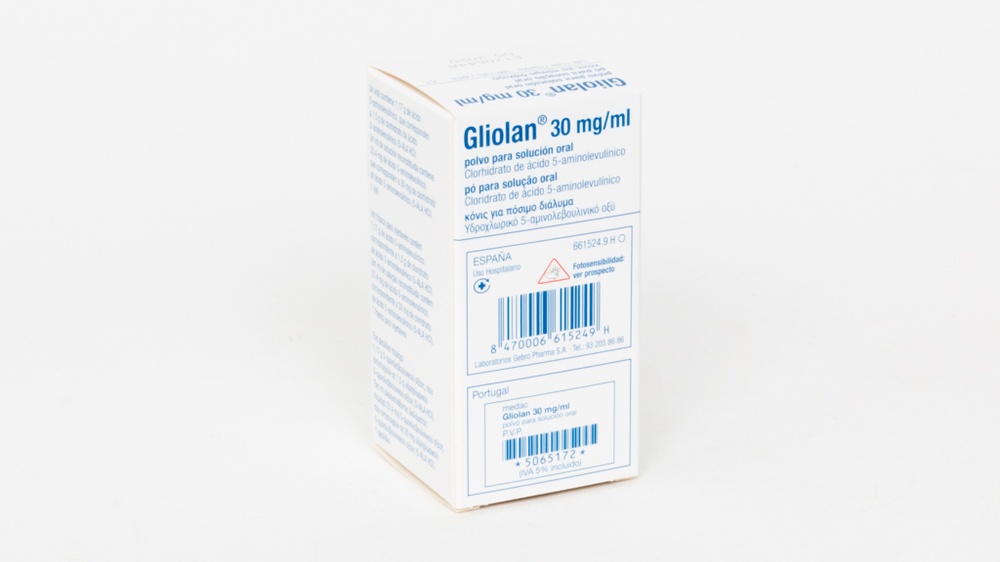
GLIOLAN 30 mg /Ml Powder For Oral Solution

Prescription review online
A doctor will review your case and decide whether a prescription is medically appropriate.

Talk to a doctor about this medicine
Discuss your symptoms and possible next steps in a quick online consultation.



How to use GLIOLAN 30 mg/ml POWDER FOR ORAL SOLUTION
Contents of the leaflet
- Introduction
- What is Gliolan and what is it used for
- What you need to know before you take Gliolan
- How to take Gliolan
- Possible side effects
- Storage of Gliolan
- Contents of the pack and further information
Introduction
Package Leaflet: Information for the User
Gliolan 30 mg/ml Powder for Oral Solution
5-aminolevulinic acid hydrochloride
Read all of this leaflet carefully before you start taking this medicine because it contains important information for you.
- Keep this leaflet, you may need to read it again.
- If you have any further questions, ask your doctor or pharmacist.
- If you experience any side effects, talk to your doctor or pharmacist, even if they are not listed in this leaflet. See section 4.
Contents of the Package Leaflet
- What is Gliolan and what is it used for
- What you need to know before you take Gliolan
- How to take Gliolan
- Possible side effects
- Storage of Gliolan
- Contents of the pack and further information
1. What is Gliolan and what is it used for
Gliolan is used for the visualization of certain brain tumors (called malignant gliomas) during tumor surgery.
Gliolan contains a substance called 5-aminolevulinic acid (5-ALA). The uptake of 5-ALA is greater in tumor cells, which transform it into another similar substance. If the tumor is then exposed to blue light, this new substance emits a red-violet light that helps to better distinguish between normal tissue and tumor tissue. This helps the surgeon to remove the tumor and spare healthy tissue at the same time.

Not sure if this medicine is right for you?
Discuss your symptoms and treatment with a doctor online.
2. What you need to know before you take Gliolan
Do not take Gliolan
- if you are allergic to 5-ALA or porphyrins;
- in case of acute or chronic porphyria, suspected or confirmed (inherited or acquired disorders of certain enzymes of the red blood cell pigment synthesis pathway);
- in case of pregnancy, suspected or confirmed.
Warnings and precautions
Consult your doctor or pharmacist before taking Gliolan.
- For 24 hours after administration of this medicine, protect your eyes and skin from intense light(e.g. surgical lighting, direct sunlight, or bright indoor lighting).
- If you have or have had a heart conditionin the past, you should inform your doctor. In this case, this medicine should be used with caution because it may cause a drop in blood pressure.
Renal or hepatic impairment
No trials have been conducted in patients with hepatic or renal impairment. Consequently, this medicine should be used with caution in such patients.
Elderly patients
There are no special instructions for the use of this medicine in elderly patients with normal organic function.
Children and adolescents (<18 years)
There is no experience with Gliolan in children and adolescents. Therefore, this medicine is not recommended in this age group.
Other medicines and Gliolan
Tell your doctor or pharmacist if you are taking, have recently taken, or might take any other medicines, especially those that can cause skin problems when exposed to intense light (e.g. certain types of antibiotics), but also those available without a prescription (e.g. St. John's Wort extracts or Hypericum perforatum).
A case of severe sunburn lasting 5 days has been reported in a patient after using this medicine and a St. John's Wort extract. You should not take any of these products during the 2 weeks following the use of Gliolan.
During the 24 hours following the intake of Gliolan, avoid the use of any other medicine that may cause liver damage.
Taking Gliolan with food and drinks
Generally, this medicine is used once, specifically 2-4 hours before anesthesia for the surgery of certain brain tumors called gliomas. You should not eat or drink for at least 6 hours before the start of anesthesia.
Pregnancy and breastfeeding
Pregnancy
It is not known whether Gliolan can cause harm to the embryo or fetus. Do not use this medicine if you are pregnant.
Breastfeeding
It is not known whether this medicine passes into breast milk. Mothers who are breastfeeding a baby should not do so during the 24 hours following treatment with this medicine.
Driving and using machines
The influence of this medicine on the ability to drive and use machines is negligible.
3. How to take Gliolan

Started taking the medicine and have questions?
Discuss your symptoms and treatment with a doctor online.
This medicine is a powder that must be mixed first, before use, with drinking water. This procedure will always be performed by a pharmacist or a nursing professional and never by you. The usual dose is 20 mg of 5-ALA HCl per kilogram of body weight. The pharmacist or nursing professional will calculate the exact dose you need and the amount of solution (in ml) you need to drink. You will have to drink the prepared solution 2-4 hours before anesthesia.
If the surgery is postponed for more than 12 hours, it should be rescheduled for the next day or later. You can take another dose of this medicine 2-4 hours before anesthesia.
If you take more Gliolan than you should
If you have taken more Gliolan than you should, your doctor will decide what measures are necessary to avoid any problems, including sufficient protection from intense light (e.g. direct sunlight).
If you forget to take Gliolan
This medicine is administered once, on the day of surgery, 2-4 hours before the start of anesthesia. If you have forgotten to take this medicine during this time period, it is not recommended to take it just before the start of anesthesia. In this case, both anesthesia and surgery should be postponed for at least 2 hours, if possible.
If you have any other questions about the use of this medicine, ask your doctor or pharmacist.
4. Possible side effects
Like all medicines, this medicine can cause side effects, although not everybody gets them.
The most serious side effects include mild changes in blood cell counts (red and white blood cells, platelets), disorders affecting the nervous system (neurological disorders) such as partial paralysis affecting one side of the body (hemiparesis) and blood clots that can block blood vessels (thromboembolism). More frequently observed side effects are feeling unwell (vomiting), feeling sick (nausea), and a slight increase in some enzymes (transaminases, γ-GT, amylase) or bilirubin (a bile pigment produced in the liver by the destruction of the red blood cell pigment) in the blood.
Tell your doctor immediately if you experience any discomfort.
Side effects are divided into the following two categories:
- side effects immediately after taking Gliolan and before anesthesia
- combined side effects of Gliolan, anesthesia, and tumor resection.
After taking Gliolan and before the start of anesthesia, the following side effects may occur:
Uncommon side effects (may affect up to 1 in 100 people):Feeling unwell (nausea), low blood pressure (hypotension), skin reactions (e.g. rash, similar to sunburn).
In combination with anesthesia and tumor resection, other side effects may occur:
Very common side effects (may affect more than 1 in 10 people):Mild changes in blood cell counts (red and white blood cells, platelets) and slight increase in some enzymes (transaminases, γ-GT, amylase) or bilirubin (a bile pigment produced in the liver as a result of the destruction of the red blood cell pigment) in the blood. These findings reach their maximum levels 7-14 days after surgery. The changes will resolve completely within a few weeks. You will usually not experience any symptoms when these changes occur.
Common side effects (may affect up to 1 in 10 people):
Feeling unwell (nausea), being sick (vomiting), disorders affecting the nervous system (neurological disorders), such as partial paralysis of one side of the body (hemiparesia), loss of total or partial ability to use or understand language (aphasia), epileptic seizures (convulsions), and blindness of half of the visual field in one or both eyes (hemianopsia), and blood clots that can block blood vessels (thromboembolism).
Uncommon side effects (may affect up to 1 in 100 people):
Low blood pressure (hypotension), brain swelling (cerebral edema).
Rare side effects (may affect up to 1 in 10,000 people) or unknown frequency (cannot be estimated from the available data):
Decreased sense of touch (hypoesthesia), and loose or watery stools (diarrhea).
Reporting of side effects
If you experience any side effects, talk to your doctor or pharmacist, even if they are not listed in this leaflet. You can also report them directly through the national reporting system listed in Annex V. By reporting side effects, you can help provide more information on the safety of this medicine.
5. Storage of Gliolan
Keep this medicine out of the sight and reach of children.
Do not use this medicine after the expiry date which is stated on the carton after EXP. The expiry date is the last day of the month stated.
Store the vial in the outer packaging to protect it from light.
The reconstituted solution is physically and chemically stable for 24 hours at 25°C.
Medicines should not be disposed of via wastewater or household waste. Ask your pharmacist how to dispose of medicines no longer required. This will help protect the environment.
6. Contents of the pack and further information
Composition of Gliolan
The active substance is 5-aminolevulinic acid hydrochloride (5-ALA HCl). One vial contains 1.17 g of 5-aminolevulinic acid (5-ALA), which corresponds to 1.5 g of 5-ALA HCl.
One ml of reconstituted solution contains 23.4 mg of 5-aminolevulinic acid (5-ALA), which corresponds to 30 mg of 5-ALA HCl.
Appearance of the product and pack contents
This medicine is a powder for oral solution. The powder is a compact white to off-white mass. The reconstituted solution is a clear liquid with a colorless to slightly yellowish appearance.
Gliolan is supplied in a glass vial and is available in packs of 1, 2, and 10 vials. Not all pack sizes may be marketed.
Marketing authorisation holder
photonamic GmbH & Co. KG
Eggerstedter Weg 12
25421 Pinneberg
Germany
Manufacturer
Lyocontract GmbH
Pulverwiese 1
38871 Ilsenburg
Germany
You can request more information about this medicine from the local representative of the marketing authorisation holder:
Laboratorios Gebro Pharma, S.A.
Tel: + 34 93 205 86 86
Date of last revision of this leaflet:
Detailed information on this medicine is available on the European Medicines Agency website: http://www.ema.europa.eu.
This leaflet can be found on the European Medicines Agency website in all languages of the European Union/European Economic Area.
- Country of registration
- Dosage formORAL SOLUTION/SUSPENSION, 30 mg/ml
- ATC codeL01XD04
- Active substance
- Prescription requiredYes
- Manufacturer
- This information is for reference only and does not constitute medical advice. Always consult a doctor before taking any medication. Oladoctor is not responsible for medical decisions based on this content.
- Alternatives to GLIOLAN 30 mg/ml POWDER FOR ORAL SOLUTIONDosage form: GEL, 78 mg aminolevulinic acid/gActive substance: aminolevulinic acidManufacturer: Biofrontera Bioscience GmbhPrescription requiredDosage form: INJECTABLE, 1 mg/mlActive substance: temoporfinManufacturer: Biolitec Pharma LimitedPrescription requiredDosage form: INJECTABLE, 1 mgActive substance: temoporfinManufacturer: Biolitec Pharma LimitedPrescription required
Online doctors for GLIOLAN 30 mg/ml POWDER FOR ORAL SOLUTION
Discuss questions about GLIOLAN 30 mg/ml POWDER FOR ORAL SOLUTION, including use, safety considerations and prescription review, subject to medical assessment and local regulations.
Get GLIOLAN 30 mg/ml POWDER FOR ORAL SOLUTION Prescription Online
Fill in a 2-min form
Tell us your symptoms, history, and what medicine you're requesting.
Pick a doctor or let us assign
Choose a specialist or we'll match you with the next available doctor.
Doctor reviews your case
Usually within 30 minutes. They may ask follow-up questions via chat.
Collect from any pharmacy
Electronic prescription sent to your email — valid across Spain.
Frequently Asked Questions
GLIOLAN 30 mg/ml POWDER FOR ORAL SOLUTION requires a prescription in Spain. You can check with a doctor online whether this medicine may be appropriate for your situation.
The active ingredient in GLIOLAN 30 mg/ml POWDER FOR ORAL SOLUTION is aminolevulinic acid. This information helps identify medicines with the same composition but different brand names.
GLIOLAN 30 mg/ml POWDER FOR ORAL SOLUTION is manufactured by Photonamic Gmbh & Co. Kg. Pharmacy brands and packaging may differ depending on the distributor.
Doctors such as Family doctors, Psychiatrists, Dermatologists, Cardiologists, Endocrinologists, Gastroenterologists, Pulmonologists, Nephrologists, Rheumatologists, Hematologists, Infectious disease physicians, Allergists, Geriatricians, Paediatricians, Oncologists may assess whether GLIOLAN 30 mg/ml POWDER FOR ORAL SOLUTION is appropriate, depending on your situation and local regulations. You can book an online consultation to discuss your symptoms and possible next steps.
Spain has a well-developed healthcare infrastructure across major cities such as Madrid, Barcelona, Valencia, and Seville. Pharmacies are widely available and operate under strict regulations, ensuring access to prescribed medications.
You can buy GLIOLAN 30 mg/ml POWDER FOR ORAL SOLUTION in Madrid, Barcelona, Seville, or Valencia at any local pharmacy with a valid prescription.
To obtain a prescription, you can use Oladoctor:
Other medicines with the same active substance (aminolevulinic acid) include AMELUZ 78 mg/g GEL, FOSCAN 1 mg/ml INJECTABLE SOLUTION, FOSCAN 1 mg/ml INJECTABLE SOLUTION. These may have different brand names or formulations but contain the same therapeutic ingredient. Always consult a doctor before switching or starting a new medicine.
