



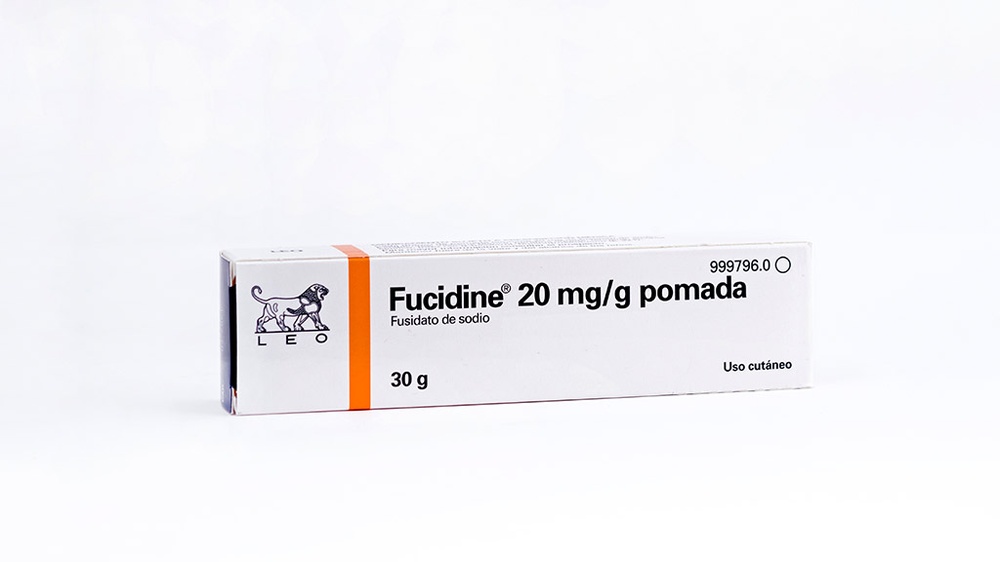
FUCIDINE 20 mg /G Ointment

Prescription review online
A doctor will review your case and decide whether a prescription is medically appropriate.

Talk to a doctor about this medicine
Discuss your symptoms and possible next steps in a quick online consultation.



How to use FUCIDINE 20 mg/g OINTMENT
Contents of the leaflet
- Introduction
- What is Fucidine Ointment and what is it used for
- What you need to know before you use Fucidine Ointment
- How to use Fucidine Ointment
- Possible side effects
- Storage of Fucidine Ointment
- Contents of the pack and other information
Introduction
Package Leaflet: Information for the Patient
Fucidine 20 mg/g Ointment
Sodium Fusidate
Read all of this leaflet carefully before you start using this medicine because it contains important information for you.
- Keep this leaflet, you may need to read it again.
- If you have any further questions, ask your doctor or pharmacist.
- This medicine has been prescribed for you only. Do not pass it on to others. It may harm them, even if their symptoms are the same as yours.
- If you get any side effects, talk to your doctor or pharmacist. This includes any possible side effects not listed in this leaflet.
Contents of the Package Leaflet
- What is Fucidine Ointment and what is it used for
- What you need to know before you use Fucidine Ointment
- How to use Fucidine Ointment
- Possible side effects
- Storage of Fucidine Ointment
- Contents of the pack and other information
1. What is Fucidine Ointment and what is it used for
Fucidine belongs to a group of medicines called antibiotics that act on bacteria that cause skin infections.
Antibiotics are used to treat bacterial infections and are not effective against viral infections. It is important that you follow the instructions regarding dosage, administration interval, and treatment duration indicated by your doctor. Do not store or reuse this medicine. If you have any leftover antibiotic after finishing the treatment, return it to the pharmacy for proper disposal. Do not throw away medicines via wastewater or household waste. |
Fucidine Ointment is indicated for the local treatment of skin infections, such as impetigo (a condition that causes small, infected blisters and crusts on the skin), or infected eczema (a skin condition characterized by inflammation, redness, exudation, or crusts and itching) and for skin disinfection when indicated by your doctor.

Not sure if this medicine is right for you?
Discuss your symptoms and treatment with a doctor online.
2. What you need to know before you use Fucidine Ointment
Do not use Fucidine Ointment:
- if you are allergic to sodium fusidate or any of the other ingredients of this medicine, listed in section 6 of this leaflet.
Warnings and Precautions
This medicine should not be applied to the eyes or mucous membranes. Therefore, it should be used with caution when applied near the eyes. If it comes into contact with the eyes, rinse them with water.
Follow your doctor's instructions regarding treatment duration. As with all antibiotics, widespread or repeated use may increase the risk of antibiotic resistance.
Using Fucidine Ointment with other medicines
Tell your doctor or pharmacist if you are using, have recently used, or might use any other medicines.
Pregnancy, Breastfeeding, and Fertility
If you are pregnant or breastfeeding, think you might be pregnant, or plan to become pregnant, consult your doctor or pharmacist before using this medicine.
Fucidine Ointment can be used during pregnancy and breastfeeding, but application to the breasts should be avoided during the breastfeeding period.
Driving and Using Machines
Topical treatment with Fucidine does not affect the ability to drive or use machines.
Fucidine Ointment contains cetyl alcohol, lanolin, and butylhydroxytoluene
This medicine may cause local skin reactions (such as contact dermatitis) because it contains cetyl alcohol, lanolin, and butylhydroxytoluene. Additionally, it may cause eye and mucous membrane irritation because it contains butylhydroxytoluene. Therefore, it should be used with caution when applied near the eyes.
3. How to use Fucidine Ointment
Follow your doctor's instructions for using this medicine exactly. If in doubt, consult your doctor or pharmacist again.
Adults and children (0 – 17 years):
Apply a thin layer of ointment carefully to the affected area, previously cleaned, two or three times a day for a period of 7 to 10 days.
After each application of the ointment, wash your hands carefully, unless they are to be treated.
Fucidine Ointment is not suitable for the treatment of macerated and infiltrating lesions (wet and deep lesions) and skin folds.
In elderly patients, there is no need to modify the dose indicated above or take additional precautions.
If you use more Fucidine Ointment than you should
If you have applied more ointment than you should, consult your doctor or pharmacist.
In case of overdose or accidental ingestion, contact the Toxicology Information Service, phone 91 562 04 20, indicating the medicine and the amount used.
If you forget to use Fucidine Ointment
If you forget to apply the ointment at the scheduled time, apply it as soon as possible and continue with the usual routine.
If you have any further questions on the use of this product, ask your doctor or pharmacist.

Started taking the medicine and have questions?
Discuss your symptoms and treatment with a doctor online.
4. Possible side effects
Like all medicines, Fucidine Ointment can cause side effects, although not everybody gets them.
The following side effects have been observed with the use of this medicine:
Uncommon side effects(may affect up to 1 in 100 people):
- dermatitis (including contact dermatitis and eczema)
- skin rash
- itching
- erythema
- pain at the application site (including burning sensation)
- irritation at the application site
Rare side effects(may affect up to 1 in 1,000 people):
- allergic reactions
- conjunctivitis
- facial/ganglionic swelling and respiratory problems (angioedema)
- urticaria
- skin blisters
If you experience side effects, consult your doctor or pharmacist, even if they are not listed in this leaflet.
5. Storage of Fucidine Ointment
Keep this medicine out of the sight and reach of children.
Do not use this medicine after the expiry date which is stated on the packaging after EXP. The expiry date is the last day of the month shown.
This medicine does not require any special storage conditions.
Medicines should not be disposed of via wastewater or household waste. Place the packaging and any unused medicine in the pharmacy's SIGRE collection point. If in doubt, ask your pharmacist how to dispose of the packaging and any unused medicine. This will help protect the environment.
6. Contents of the pack and other information
Composition of Fucidine Ointment
- The active ingredient is sodium fusidate.
Each gram of ointment contains 20 mg of sodium fusidate.
- The other ingredients are white petrolatum, liquid paraffin, lanolin, cetyl alcohol, all-rac-α-tocopherol, butylhydroxytoluene (E-321).
Appearance of the product and pack contents
Fucidine is a translucent ointment with a white to yellowish color.
Each pack contains a tube with 15 or 30 grams of ointment.
Marketing Authorization Holder
LEO Pharma S.A.,
Via Laietana 33, 7th floor,
08003 Barcelona
Spain
Manufacturer
LEO Laboratories Limited,
Cashel Road,
Dublin 12 (Ireland).
Or
LEO Pharma Manufacturing Italy S.r.l.
Via E. Schering 21
20054 Segrate (MI)
Italy
Date of the last revision of this leaflet July 2012
Detailed and updated information on this medicine is available on the website of the Spanish Agency for Medicines and Health Products (AEMPS) http://www.aemps.gob.es/.
- Country of registration
- Dosage formOINTMENT, 2 %
- ATC codeD06AX01
- Average pharmacy price2.56 EUR
- Active substance
- Prescription requiredYes
- Manufacturer
- CompositionLANOLINA (4,6 g mg), CETILICO, ALCOHOL (0,400 g mg)
- This information is for reference only and does not constitute medical advice. Always consult a doctor before taking any medication. Oladoctor is not responsible for medical decisions based on this content.
- Alternatives to FUCIDINE 20 mg/g OINTMENTDosage form: CREAM, 2%Active substance: fusidic acidManufacturer: Isdin S.A.Prescription requiredDosage form: CREAM, 20 mg/gActive substance: fusidic acidManufacturer: Redox Farma S.L.U.Prescription requiredDosage form: CREAM, 2 %Active substance: fusidic acidManufacturer: Laboratorios Leo Pharma S.A.Prescription required
Online doctors for FUCIDINE 20 mg/g OINTMENT
Discuss questions about FUCIDINE 20 mg/g OINTMENT, including use, safety considerations and prescription review, subject to medical assessment and local regulations.



Get FUCIDINE 20 mg/g OINTMENT Prescription Online
Fill in a 2-min form
Tell us your symptoms, history, and what medicine you're requesting.
Pick a doctor or let us assign
Choose a specialist or we'll match you with the next available doctor.
Doctor reviews your case
Usually within 30 minutes. They may ask follow-up questions via chat.
Collect from any pharmacy
Electronic prescription sent to your email — valid across Spain.
Frequently Asked Questions
FUCIDINE 20 mg/g OINTMENT requires a prescription in Spain. You can check with a doctor online whether this medicine may be appropriate for your situation.
The active ingredient in FUCIDINE 20 mg/g OINTMENT is fusidic acid. This information helps identify medicines with the same composition but different brand names.
The average pharmacy price for FUCIDINE 20 mg/g OINTMENT is around 2.56 EUR. Prices may vary depending on the manufacturer and dosage form.
FUCIDINE 20 mg/g OINTMENT is manufactured by Laboratorios Leo Pharma S.A.. Pharmacy brands and packaging may differ depending on the distributor.
Doctors such as Family doctors, Psychiatrists, Dermatologists, Cardiologists, Endocrinologists, Gastroenterologists, Pulmonologists, Nephrologists, Rheumatologists, Hematologists, Infectious disease physicians, Allergists, Geriatricians, Paediatricians, Oncologists may assess whether FUCIDINE 20 mg/g OINTMENT is appropriate, depending on your situation and local regulations. You can book an online consultation to discuss your symptoms and possible next steps.
Spain has a well-developed healthcare infrastructure across major cities such as Madrid, Barcelona, Valencia, and Seville. Pharmacies are widely available and operate under strict regulations, ensuring access to prescribed medications.
You can buy FUCIDINE 20 mg/g OINTMENT in Madrid, Barcelona, Seville, or Valencia at any local pharmacy with a valid prescription.
To obtain a prescription, you can use Oladoctor:
Other medicines with the same active substance (fusidic acid) include FUSIDIC ACID ISDIN 20 mg/g CREAM, FUSIDIC ACID REDOXFARMA 20 mg/g CREAM, FUCIDINE 20 mg/g CREAM. These may have different brand names or formulations but contain the same therapeutic ingredient. Always consult a doctor before switching or starting a new medicine.
