



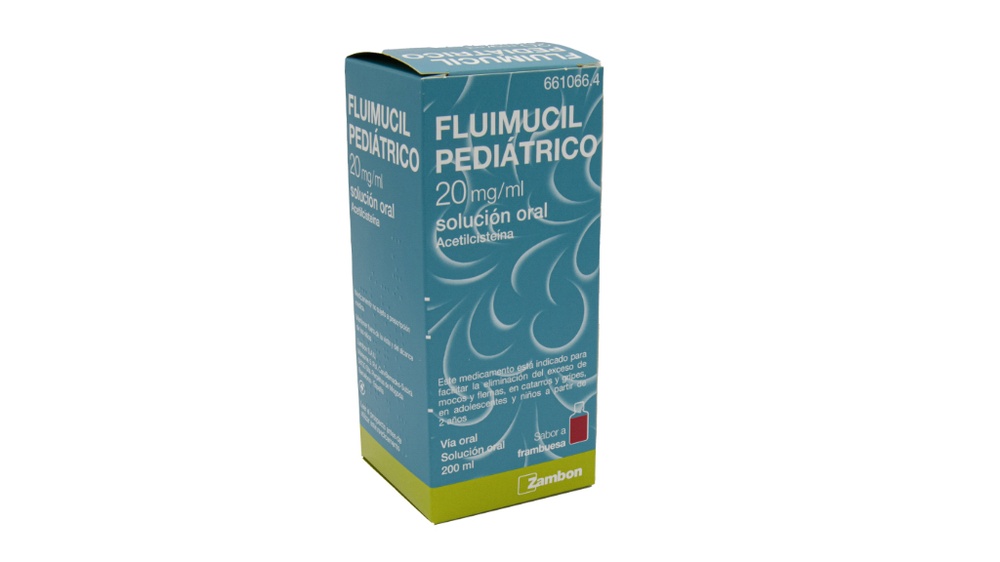
FLUIMUCIL 20 mg /Ml Oral Solution

Prescription review online
A doctor will review your case and decide whether a prescription is medically appropriate.

Talk to a doctor about this medicine
Discuss your symptoms and possible next steps in a quick online consultation.



How to use FLUIMUCIL PEDIATRIC 20 mg/ml ORAL SOLUTION
Contents of the leaflet
- Introduction
- What is Fluimucil pediatric and what is it used for
- What you need to know before taking Fluimucil pediatric
- How to take Fluimucil pediatric
- Possible side effects
- Storage of Fluimucil pediatric
- Package contents and additional information
Introduction
Leaflet: information for the user
Fluimucil pediatric 20 mg/ml oral solution
Acetylcysteine
Read the entire leaflet carefully before starting to take this medication, as it contains important information for you.
- Follow the administration instructions for the medication contained in this leaflet or as indicated by your doctor or pharmacist. Keep this leaflet, as you may need to read it again.
- If you need advice or more information, consult your pharmacist.
- If you experience side effects, consult your doctor or pharmacist, even if they are not listed in this leaflet. See section 4.
- You should consult a doctor if your condition worsens or does not improve after 5 days.
Contents of the leaflet
- What is Fluimucil pediatric and what is it used for
- What you need to know before taking Fluimucil pediatric
- How to take Fluimucil pediatric
- Possible side effects
- Storage of Fluimucil pediatric
- Package contents and additional information
1. What is Fluimucil pediatric and what is it used for
Acetylcysteine, the active ingredient of this medication, belongs to a group of medications called mucolytics, which act by decreasing the viscosity of mucus, making it more fluid and facilitating its elimination.
This medication is indicated to facilitate the elimination of excess mucus and phlegm in colds and flu, in adolescents and children from 2 years of age.
You should consult a doctor if your condition worsens or does not improve after 5 days.

Not sure if this medicine is right for you?
Discuss your symptoms and treatment with a doctor online.
2. What you need to know before taking Fluimucil pediatric
Do not take Fluimucil pediatric:
- If you are allergic to the active ingredient or to any of the other components of this medication (listed in section 6).
- Do not administer to children under 2 years of age.
Warnings and precautions
Consult your doctor or pharmacist before starting to take Fluimucil pediatric.
If you have asthma or a severe respiratory disease, you should consult your doctor before taking this medication.
The possible sulfurous odor (like rotten eggs) of the medication is characteristic of the active ingredient, but it does not indicate that the medication is in poor condition.
If you experience stomach discomfort when taking the medication, you should stop treatment and consult your doctor. Caution is recommended in patients with peptic ulcer or history of peptic ulcer.
During the first days of treatment, you may notice an increase in mucus and phlegm, which will decrease throughout the treatment.
Children
It is contraindicated in children under 2 years of age.
In children from 2 to 6 years of age, consult a doctor.
Taking Fluimucil pediatric with other medications
Tell your doctor or pharmacist if you are using, have recently used, or may need to use any other medication.
Concomitant therapy with nitroglycerin may cause headache and hypotension should be monitored, which can be severe.
Concomitant administration with the antiepileptic carbamazepine may cause a decrease in the efficacy of carbamazepine.
Do not administer concomitantly with antitussive medications (for cough) or with those that decrease bronchial secretions (such as antihistamines and anticholinergics), as it may cause an accumulation of fluidified mucus.
When taking any medication that contains minerals such as iron or calcium, or any medication with antibiotics such as amphotericin B, ampicillin sodium, cephalosporins, lactobionate, erythromycin, and some tetracyclines, you should separate the intake of Fluimucil pediatric by at least 2 hours.
It is not recommended to dissolve Fluimucil pediatric with other medications.
Taking Fluimucil pediatric with food and drinks
The intake of food and drinks does not affect the efficacy of this medication.
Pregnancy and lactation
If you are pregnant or breastfeeding, think you may be pregnant, or plan to become pregnant, consult your doctor or pharmacist before using this medication.
As a precaution, it is preferable to avoid its use during pregnancy.
Its intake should be avoided during breastfeeding.
Driving and using machines
There is no evidence of effects on the ability to drive and use machines.
Fluimucil pediatric contains methyl p-hydroxybenzoate, sodium benzoate, sodium, propylene glycol, and ethanol.
It may cause allergic reactions (possibly delayed) because it contains methyl p-hydroxybenzoate.
This medication contains 15 mg of sodium benzoate in each 10 ml.
Sodium benzoate may increase the risk of jaundice (yellowing of the skin and eyes) in newborns (up to 4 weeks of age).
This medication contains 38.21 mg of sodium (main component of table salt) in each 10 ml. This is equivalent to 1.9% of the maximum daily sodium intake recommended for an adult.
This medication contains 23.4 mg of propylene glycol in each 10 ml. If you are pregnant or breastfeeding, do not take this medication unless it is recommended by your doctor. Your doctor may perform additional checks while you are taking this medication.
If you have liver or kidney failure, do not take this medication unless it is recommended by your doctor. Your doctor may perform additional checks while you are taking this medication.
If the child is under 5 years of age, consult your doctor or pharmacist, especially if they have been given other medications that contain propylene glycol or alcohol.
This medication contains 3.85 mg of alcohol (ethanol) in each 100 ml, which is equivalent to 0.04% p/v. The amount per dose of this medication is equivalent to less than 1 ml of beer or 1 ml of wine. The small amount of alcohol in this medication does not produce any noticeable effect.
.
3. How to take Fluimucil pediatric
Follow the administration instructions for the medication contained in this leaflet or as indicated by your doctor or pharmacist. In case of doubt, ask your doctor or pharmacist.
The recommended dose is:
In children between 2 and 7 years of age: 5 ml of oral solution (100 mg of acetylcysteine) every 8 hours. Do not exceed the dose of 15 ml (300 mg of acetylcysteine) per day.
Adolescents and children over 7 years of age: 10 ml of oral solution (200 mg of acetylcysteine) every 8 hours. Do not exceed the dose of 30 ml (600 mg of acetylcysteine) per day.
How to take:
Fluimucil pediatric is taken orally.
Measure the amount of medication to be taken with the dosing cup included in the box and ingest it directly. It is recommended to drink a glass of water after each dose and a large amount of liquid throughout the day.
You should consult a doctor if your condition worsens or does not improve after 5 days of treatment.
Use in children
It is contraindicated in children under 2 years of age.
In children from 2 to 6 years of age, consult a doctor.
If you take more Fluimucil pediatric than you should
If you take more Fluimucil pediatric than you should, you may notice: nausea, vomiting, burning and stomach pain, diarrhea, or any other side effect described in section 4. Possible side effects. In case of overdose or accidental ingestion, consult your doctor or pharmacist immediately, or call the Toxicology Information Service, phone: 91.562.04.20, indicating the medication and the amount taken. In case of massive accidental administration, symptomatic treatment is recommended.
If you have any other doubts about the use of this medication, ask your doctor or pharmacist.

Started taking the medicine and have questions?
Discuss your symptoms and treatment with a doctor online.
4. Possible side effects
Like all medications, this medication can cause side effects, although not everyone experiences them.
The following side effects may occur:
Uncommon (may affect up to 1 in 100 patients): hypersensitivity, headache, tinnitus, tachycardia, vomiting, diarrhea, stomatitis, abdominal pain, nausea, urticaria, skin rash, angioedema, pruritus, increased body temperature, hypotension.
Rare (may affect up to 1 in 1,000 patients): somnolence, bronchospasm, respiratory distress, gastrointestinal disorders.
Very rare (may affect up to 1 in 10,000 patients): allergic reactions, anaphylactic shock, hemorrhage, severe skin reactions such as Stevens-Johnson syndrome and Lyell syndrome, sometimes identified with the concomitant use of another medication.
Frequency not known (cannot be estimated from available data): facial swelling.
In case of any alteration in the skin or mucous membranes, the administration of acetylcysteine should be interrupted immediately and medical assistance sought.
Reporting of side effects
If you experience any type of side effect, consult your doctor or pharmacist, even if it is not listed in this leaflet. You can also report them directly through the Spanish Medication Surveillance System for Human Use: https://www.notificaram.es.
By reporting side effects, you can contribute to providing more information on the safety of this medication.
5. Storage of Fluimucil pediatric
Keep this medication out of the sight and reach of children.
No special storage conditions are required.
Do not use this medication after the expiration date shown on the packaging after CAD. The expiration date is the last day of the month indicated.
Discard the packaging 15 days after opening.
Medications should not be thrown down the drain or into the trash. Deposit the packaging and medications you no longer need in the SIGRE Point of the pharmacy. If in doubt, ask your pharmacist how to dispose of the packaging and medications you no longer need. This will help protect the environment.
6. Package contents and additional information
Composition of Fluimucil pediatric
The active ingredient is acetylcysteine. Each ml contains 20 mg of acetylcysteine.
The other components are: methyl p-hydroxybenzoate (E218), sodium benzoate (E211), disodium edetate, sodium carmellose, sodium saccharin, sodium cyclamate, sucralose, raspberry flavor (propylene glycol, ethanol), sodium hydroxide, and purified water.
Appearance of the product and package contents
Fluimucil pediatric is presented in amber glass bottles with 100 or 200 ml of oral solution. Its appearance is that of a clear and colorless solution. It has a fruity raspberry odor. A graduated plastic dosing cup is included for the correct dosing of the medication.
Marketing authorization holder and manufacturer
Marketing authorization holder:
Zambon S.A.U.
Maresme 5. Polígono Can Bernades-Subirà
08130 Sta. Perpètua de Mogoda-Barcelona
(Spain)
Manufacturer:
Zambon, S.p.A.
Via della Chimica, 9
36100-Vicenza (Italy)
Date of the last revision of this leaflet: September 2020
Detailed and updated information on this medication is available on the website of the Spanish Agency for Medicines and Health Products (AEMPS) http://www.aemps.gob.es/.
- Country of registration
- Dosage formORAL SOLUTION/SUSPENSION, 2% acetylcysteine / 100 ml
- ATC codeR05CB01
- Active substance
- Prescription requiredNo
- Manufacturer
- CompositionHIDROXIDO DE SODIO (E 524) (0,507 g mg), EDETATO DE DISODIO (0,100 g mg), CICLAMATO DE SODIO (0,130 g mg), CARMELOSA SODICA (0,400 g mg), BENZOATO DE SODIO (E 211) (0,150 g mg), SACARINA SODICA (0,040 g mg), PARAHIDROXIBENZOATO DE METILO (E-218) (0,100 g mg)
- This information is for reference only and does not constitute medical advice. Always consult a doctor before taking any medication. Oladoctor is not responsible for medical decisions based on this content.
- Alternatives to FLUIMUCIL PEDIATRIC 20 mg/ml ORAL SOLUTIONDosage form: EFFERVESCENT TABLET, 600 mgActive substance: acetylcysteineManufacturer: Kern Pharma S.L.Prescription not requiredDosage form: EFFERVESCENT TABLET, 600 mgActive substance: acetylcysteineManufacturer: Laboratorios Alter S.A.Prescription requiredDosage form: EFFERVESCENT TABLET, 200 mgActive substance: acetylcysteineManufacturer: Aurovitas Spain, S.A.U.Prescription required
Online doctors for FLUIMUCIL PEDIATRIC 20 mg/ml ORAL SOLUTION
Discuss questions about FLUIMUCIL PEDIATRIC 20 mg/ml ORAL SOLUTION, including use, safety considerations and prescription review, subject to medical assessment and local regulations.









Get FLUIMUCIL PEDIATRIC 20 mg/ml ORAL SOLUTION Prescription Online
Fill in a 2-min form
Tell us your symptoms, history, and what medicine you're requesting.
Pick a doctor or let us assign
Choose a specialist or we'll match you with the next available doctor.
Doctor reviews your case
Usually within 30 minutes. They may ask follow-up questions via chat.
Collect from any pharmacy
Electronic prescription sent to your email — valid across Spain.
Frequently Asked Questions
FLUIMUCIL PEDIATRIC 20 mg/ml ORAL SOLUTION does not require a prescription in Spain. You can check with a doctor online whether this medicine may be appropriate for your situation.
The active ingredient in FLUIMUCIL PEDIATRIC 20 mg/ml ORAL SOLUTION is acetylcysteine. This information helps identify medicines with the same composition but different brand names.
FLUIMUCIL PEDIATRIC 20 mg/ml ORAL SOLUTION is manufactured by Zambon S.A.U.. Pharmacy brands and packaging may differ depending on the distributor.
Doctors such as Family doctors, Psychiatrists, Dermatologists, Cardiologists, Endocrinologists, Gastroenterologists, Pulmonologists, Nephrologists, Rheumatologists, Hematologists, Infectious disease physicians, Allergists, Geriatricians, Paediatricians, Oncologists may assess whether FLUIMUCIL PEDIATRIC 20 mg/ml ORAL SOLUTION is appropriate, depending on your situation and local regulations. You can book an online consultation to discuss your symptoms and possible next steps.
Spain has a well-developed healthcare infrastructure across major cities such as Madrid, Barcelona, Valencia, and Seville. Pharmacies are widely available and operate under strict regulations, ensuring access to prescribed medications.
You can buy FLUIMUCIL PEDIATRIC 20 mg/ml ORAL SOLUTION in Madrid, Barcelona, Seville, or Valencia at any local pharmacy with a valid prescription.
To obtain a prescription, you can use Oladoctor:
Other medicines with the same active substance (acetylcysteine) include ACETYLCYSTEINE ABEX 600 mg EFFERVSCENT TABLETS, ACETYLCYSTEINE ALTER 600 mg EFFERVSCENT TABLETS, ACETYLCYSTEINE AUROVITAS 200 mg EFFERVSCENT TABLETS. These may have different brand names or formulations but contain the same therapeutic ingredient. Always consult a doctor before switching or starting a new medicine.
