






How to use FIBRYGA 1 g POWDER AND SOLVENT FOR INJECTABLE SOLUTION AND FOR INFUSION
Translated with AI
This page provides general information and does not replace a doctor’s consultation. Always consult a doctor before taking any medication. Seek urgent medical care if symptoms are severe.
Show originalContents of the leaflet
Introduction
Package Leaflet: Information for the User
Fibryga 1g
Powder and solvent for solution for injection and infusion
Human fibrinogen

Read all of this leaflet carefully before you start using this medicine because it contains important information for you.
- Keep this leaflet, you may need to read it again.
- If you have any further questions, ask your doctor or pharmacist.
- This medicine has been prescribed for you only. Do not pass it on to others. It may harm them, even if their signs of illness are the same as yours.
- If you get any side effects, talk to your doctor or pharmacist. This includes any possible side effects not listed in this leaflet. See section 4.
Contents of the pack
- What Fibryga is and what it is used for
- What you need to know before you use Fibryga
- How to use Fibryga
- Possible side effects
- Storage of Fibryga
- Contents of the pack and other information
1. What Fibryga is and what it is used for
Fibryga contains human fibrinogen, which is an important protein for blood clotting. Lack of fibrinogen means that the blood does not clot as well as it should, leading to a greater tendency to bleed. Replacement of human fibrinogen with Fibryga will correct the clotting defect.
What Fibryga is used for
Fibryga is used for:
- treatment of bleeding episodes and prophylaxis for surgery in patients with congenital lack of fibrinogen (hypofibrinogenemia or afibrinogenemia) with a tendency to bleeding.
- supplementation of fibrinogen in patients with severe uncontrolled bleeding accompanied by acquired lack of fibrinogen during surgery.
.

2. What you need to know before you use Fibryga
Do not use Fibryga:
- if you are allergic to human fibrinogen or any of the other components of this medicine (listed in section 6).
- if you have experienced allergic reactions to Fibryga in the past.
Please inform your doctor if you are allergic to any medicine.
Warnings and precautions
Consult your doctor or pharmacist before starting treatment with Fibryga.
Risk of blood clots in blood vessels
Your doctor should weigh the benefits of this medicine against the risk of blood clots in blood vessels, particularly if:
- you have received a high dose or repeated doses of this medicine
- you have had a heart attack (history of coronary heart disease or myocardial infarction)
- you have liver disease
- you have recently undergone surgery (postoperative patients)
- you are about to undergo surgery (preoperative patients)
- you are a newborn (neonates)
- you are likely to suffer from blood clots or coagulation problems in blood vessels (patients at risk of thromboembolic events or disseminated intravascular coagulation).
Your doctor may ask you to have additional coagulation tests to monitor the risk.
Allergic reactions and anaphylactic reactions
Any medicine, such as Fibryga, that is prepared from human blood (containing proteins) and is injected into a vein (administered intravenously) can cause allergic reactions. If you have experienced allergic reactions to Fibryga in the past, your doctor will advise you whether it is necessary to take antihistamines.
Your doctor will explain the warning signs of allergic reactions or anaphylactic reactions.
Please pay attention to the first symptoms of allergic reactions (hypersensitivity), such as:
- rash
- skin eruption
- chest tightness
- wheezing
- hypotension,
- or anaphylaxis (when any or all of the above symptoms develop rapidly and are intense).
If they occur, the injection or infusion of Fibryga should be stopped immediately (i.e., interrupt the injection).
Viral safety
When medicines are manufactured from human blood or plasma, certain measures are taken to prevent the transmission of infections to patients. These include:
- careful selection of blood and plasma donors to ensure that those at risk of carrying infections are excluded
- testing of each donation and plasma pools for signs of viruses or infections
- inclusion of steps in the processing of blood or plasma that can inactivate or eliminate viruses.
Despite these measures, when medicines prepared from human blood or plasma are administered, the possibility of transmitting an infection cannot be totally excluded. This also applies to any unknown or emerging virus and other types of infections.
The measures taken are considered effective against enveloped viruses such as human immunodeficiency virus (HIV), hepatitis B virus, and hepatitis C virus, and against the non-enveloped hepatitis A virus. The measures taken may have limited value against non-enveloped viruses such as parvovirus B19.
Parvovirus B19 infection can be severe in pregnant women (fetal infection) and for individuals whose immune system is depressed or who have certain types of anemia (e.g., sickle cell anemia or abnormal breakdown of red blood cells).
It is strongly recommended that each time you receive a dose of Fibryga, the name and batch number of the product should be recorded to keep a record of the batches used.
Your doctor may recommend that you consider being vaccinated against hepatitis A and B if you receive Fibryga regularly or repeatedly.
Children and adolescents
There are no specific or additional warnings or precautions applicable to children and adolescents.
Using Fibryga with other medicines
Tell your doctor or pharmacist if you are using, have recently used, or might use any other medicines.
Fibryga should not be mixed with other medicines, except those mentioned in the section “This information is intended only for healthcare professionals / Reconstitution”.
Pregnancy, breast-feeding, and fertility
If you are pregnant or breast-feeding, think you may be pregnant, or are planning to have a baby, ask your doctor or pharmacist for advice before using this medicine. This medicine should only be used during pregnancy or breast-feeding after consulting your doctor or pharmacist.
Driving and using machines
Fibryga has no influence on the ability to drive and use machines.
Fibryga contains sodium
This medicine contains 132 mg of sodium (main component of cooking/table salt) in each vial. This is equivalent to 6.6% of the maximum recommended daily intake of sodium for an adult. Be aware of this if you are on a low-sodium diet.
3. How to use Fibryga
Follow exactly the administration instructions of this medicine given by your doctor. If you are unsure, consult your doctor again.
Fibryga is administered as an intravenous infusion (drip into a vein) by healthcare professionals.
The dose and dosing regimen depend on:
- your weight
- the severity of your disease
- the location of the bleeding or
- the nature of your surgery and
- your state of health
Use in children and adolescents
Administration of Fibryga in children and adolescents (intravenously) does not differ from administration in adults.
If you use more Fibryga than you should
To avoid the risk of overdose, your doctor will perform regular blood tests to measure your fibrinogen level.
In case of overdose, the risk of abnormal blood clots in blood vessels may increase.
If you have any further questions on the use of this medicine, ask your doctor or pharmacist.
Method of administration
This medicine should be injected or infused into the veins after reconstitution with the supplied solvent. If you have any further questions on the use of this product, ask your doctor or pharmacist.

4. Possible side effects
Like all medicines, this medicine can cause side effects, although not everybody gets them.
Please consult your doctor immediately:
- if you experience any of the side effects
- if you notice any side effect not listed in this leaflet
The following side effects have been reported for Fibryga and other fibrinogen medicines (frequency of side effects unknown):
- Allergic reactions and anaphylactic reactions: skin reactions such as rash or redness of the skin (see section 2 “Warnings and precautions”)
- Cardiovascular: inflammation of the veins and formation of blood clots (see section 2 “Warnings and precautions”)
- Increased body temperature
If you experience any of these symptoms, consult your doctor as soon as possible.
Reporting of side effects
If you experience any side effects, talk to your doctor or pharmacist. This includes any possible side effects not listed in this leaflet. You can also report side effects directly through the Spanish Medicines Monitoring System: www.notificaRAM.es
By reporting side effects, you can help provide more information on the safety of this medicine.
5. Storage of Fibryga
Keep this medicine out of the sight and reach of children.
Do not use this medicine after the expiry date which is stated on the label and carton. The expiry date is the last day of the month stated.
Do not store above 25°C. Do not freeze. Store the vial in the outer packaging to protect from light.
The powder should only be dissolved immediately before injection or infusion. The stability of the reconstituted solution has been demonstrated for 24 hours at room temperature (max. 25°C). However, to avoid contamination, the solution should be used immediately and only once. The reconstituted product should not be stored in the refrigerator or freezer.
Medicines should not be disposed of via wastewater or household waste. Ask your pharmacist how to dispose of medicines no longer required. This will help protect the environment.
6. Container Contents and Additional Information
Composition of Fibryga
- The active ingredient is human fibrinogen.
- Fibryga contains 1 g of human fibrinogen per vial or 20 mg/ml of human fibrinogen after reconstitution with the supplied solvent (50 ml of water for injections).
- The other components are L-arginine hydrochloride, glycine, sodium chloride, and sodium citrate dihydrate.
Appearance of the Product and Container Contents
Fibryga is presented as a powder and solvent for solution for injection and infusion, and is available in glass vials.
The powder is white or pale yellow and hygroscopic, with a friable mass appearance.
The solvent is a clear and colorless liquid.
The reconstituted solution is practically colorless and slightly opalescent.
Fibryga is supplied in a box containing:
- 1 vial with the powder for solution for injection and infusion
- 1 vial with the solvent (water for injections)
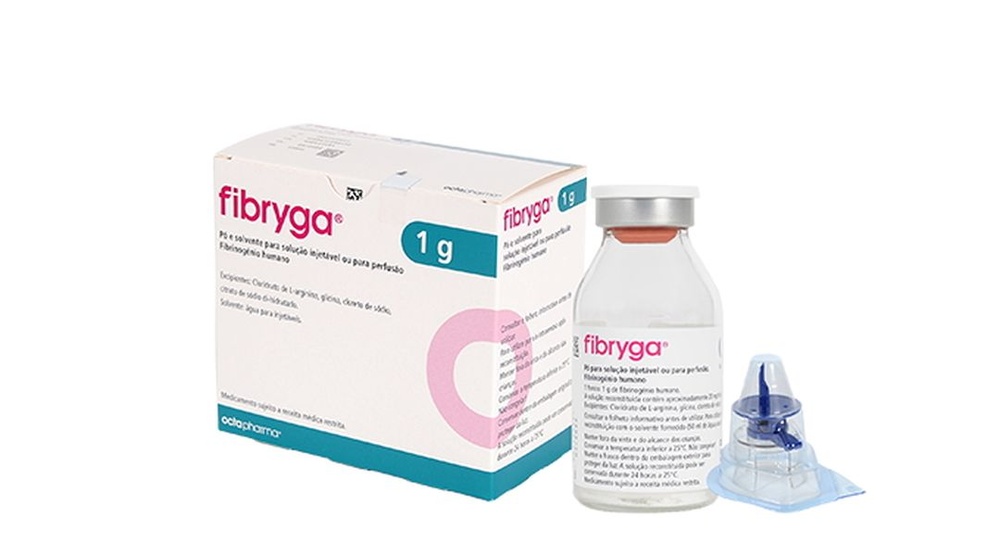
- 1 nextaro transfer device
Marketing Authorization Holder
Octapharma, S.A.
Av. Castilla, 2 (P.E. San Fernando)
Ed. Dublín - 2ª Planta
28830 San Fernando de Henares
Madrid
Manufacturer
Octapharma Pharmazeutika Produktionsges.m.b.H.,
Oberlaaer Strasse 235, 1100 Vienna, Austria
or
Octapharma AB,
Lars Forssells gata 23, 112 75 Stockholm, Sweden
or
Octapharma GmbH
Elisabeth-Selbert-Str. 11, 40764 Langenfeld, Germany
This medicinal product is authorized in the Member States of the European Economic Area and in the United Kingdom (Northern Ireland) under the following names:
Fibryga®: Germany, Austria, Belgium, Bulgaria, Cyprus, Croatia, Denmark, Slovakia, Spain, Estonia, Finland, France, Hungary, Ireland, Iceland, Italy, Latvia, Lithuania, Luxembourg, Malta, Norway, Netherlands, Poland, Portugal, United Kingdom (Northern Ireland), Czech Republic, Romania, Sweden,
Fibrema®: Slovenia
Date of the Last Revision of this Leaflet: 11/2023
Other Sources of Information
Detailed information on this medicinal product is available on the website of the Spanish Agency for Medicines and Health Products (AEMPS) (http://www.aemps.gob.es/).
This information is intended solely for healthcare professionals:
Dosage
The dose and duration of replacement treatment depend on the severity of the disorder, as well as the location and extent of bleeding and the patient's clinical condition.
The fibrinogen level (functional) must be determined to calculate the individual dose, and the amount and frequency of administration must be determined for each patient by regular measurement of plasma fibrinogen levels and continuous monitoring of the patient's clinical condition and other replacement treatments used.
In the case of major surgical interventions, precise monitoring of replacement treatment through coagulation analysis is essential.
- Prophylaxis in patients with congenital hypo or afibrinogenemia and known bleeding tendency.
To prevent excessive bleeding during surgical procedures, prophylactic treatment is recommended to raise fibrinogen levels to 1 g/l and maintain fibrinogen at this level until hemostasis is ensured and above 0.5 g/l until wound healing is complete.
In the case of surgical procedure or treatment of a bleeding episode, the dose should be calculated as follows:
Dose (mg/kg body weight) = [Target level (g/l) - measured level (g/l)]
0.018 (g/l per mg/kg body weight)
Subsequent dosing (dose and frequency of injections) should be adapted based on the patient's clinical condition and laboratory results.
The biological half-life of fibrinogen is 3-4 days. Therefore, in the absence of consumption, it is usually not necessary to repeat treatment with human fibrinogen. Given the accumulation that occurs with repeated administration for prophylactic use, the dose and frequency should be determined according to the therapeutic objectives of the physician for each individual patient.
Pediatric Population
In the case of surgical procedure or treatment of a bleeding episode, the dose in adolescents should be calculated according to the formula described above for adults, while the dose in children <12 years of age should be calculated as follows:< p>
Dose (mg/kg body weight) = [Target level (g/l) – measured level (g/l)]
0.014 (g/l per mg/kg body weight)
Subsequent dosing should be adapted based on the patient's clinical condition and laboratory results.
Elderly Patients
Clinical studies with Fibryga did not include patients aged 65 or older to provide conclusive evidence of whether these patients respond differently to younger patients.
- Treatment of bleeding
Bleeding in patients with congenital hypo or afibrinogenemia
Bleeding episodes should be treated according to the formulas indicated above for adults/adolescents and children, respectively, until a recommended target plasma fibrinogen level of 1 g/l is reached. This level should be maintained until hemostasis is ensured.
Bleeding in patients with acquired fibrinogen deficiency
Adults
Generally, 1-2 g is administered initially, with subsequent infusions as needed. In the case of severe bleeding, for example during major surgery, larger amounts (4-8 g) of fibrinogen may be required.
Pediatric Population
The dose should be determined based on body weight and clinical needs, although it is usually 20-30 mg/kg.
Instructions for Preparation and Administration
General Instructions
- The reconstituted solution should be practically colorless and slightly opalescent. Do not use turbid or sediment-containing solutions.
- Fibryga is only valid for single use. Do not reuse any of the components.
- For microbiological safety reasons, the solution should be administered immediately after reconstitution. Chemical and physical stability of the reconstituted solution has been demonstrated for 24 hours at room temperature (max. 25 °C). After reconstitution, do not refrigerate or freeze the Fibryga solution.
Reconstitution
- Ensure that the powder vial (Fibryga) and the solvent vial are at room temperature. This temperature should be maintained during reconstitution. If a water bath is used for heating, care should be taken to avoid water coming into contact with the rubber stoppers or the flip-off caps of the containers. The water temperature should not exceed +37 °C.
- Remove the flip-off caps from the powder vial (Fibryga) and the solvent vial to expose the central part of the injection stopper. Clean the rubber stoppers with an alcohol swab and let them dry.
- Remove the cap from the nextaro transfer device container (Fig. 1). To maintain sterility, do not remove the transfer device from the transparent blister. Do not touch the spike.
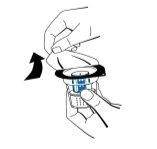


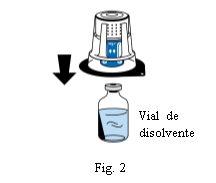
 Place the solvent vial on a flat and clean surface and hold it firmly. Without removing the blister, place the blue part of the transfer device over the solvent vial. Press firmly in a straight line downwards until it clicks into position (Fig. 2). Do not twist it when attaching.
Note:The transfer device should be attached first to the solvent vial and then to the lyophilized powder vial. Otherwise, the vacuum will be lost and the transfer of solvent will not take place.
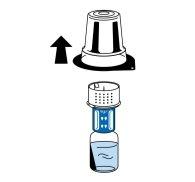
- While holding the solvent vial, carefully remove the blister from the transfer device (nextaro) by pulling it upwards vertically. Ensure that the transfer device remains firmly attached to the solvent vial (Fig. 3).

- Place the powder vial (Fibryga) on a flat and clean surface and hold it firmly. Take the solvent vial with the attached transfer device and invert it. Place the white connector of the transfer device over the powder vial (Fibryga) and press firmly downwards until it clicks into position (Fig. 4). Do not twist it when attaching. The solvent will flow automatically into the powder vial (Fibryga).
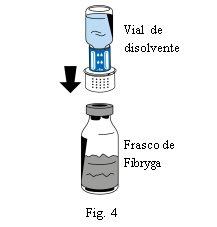
- With the solvent vial still attached, gently rotate the Fibryga vial until the powder is completely dissolved. To avoid foam formation, do not shake the vial. The powder should dissolve completely within 5 minutes. The powder should not take more than 20 minutes to dissolve. If it does not dissolve within 20 minutes, the product should be discarded.
- In the rare cases where undissolved powder is observed floating during the transfer of water for injections or when the reconstitution time is unexpectedly prolonged, the dissolution process can be facilitated by horizontally shaking the vial more vigorously.
- Once reconstitution is complete, unscrew the transfer device (blue part) in a counterclockwise direction in two parts (Fig. 5). Do not touch the Luer connector of the white part of the transfer device.
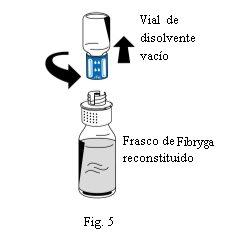
- Discard the empty solvent vial along with the blue part of the transfer device.
Administration
- Carefully attach a syringe to the Luer connector of the white part of the transfer device (Fig. 6).
- Invert the Fibryga vial and withdraw the solution into the syringe (Fig. 7).
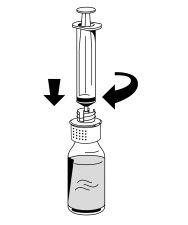
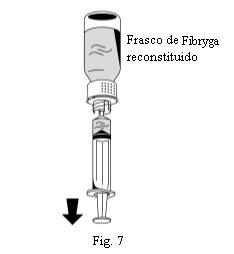
- Once the solution is transferred, firmly hold the syringe body (keeping the syringe plunger oriented downwards) and remove the syringe from the transfer device (Fig. 8).
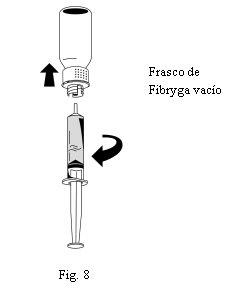
- Discard the white part of the transfer device along with the empty Fibryga vial.
A standard infusion set is recommended for the intravenous administration of the reconstituted solution at room temperature.
Disposal of unused medicinal products and all materials that have come into contact with them should be carried out in accordance with local regulations.
Method of Administration
Infusion or intravenous injection.
Fibryga should be administered slowly by intravenous route at a maximum recommended rate of 5 ml per minute in patients with congenital hypo or afibrinogenemia, and at a maximum recommended rate of 10 ml per minute in patients with acquired fibrinogen deficiency.
Incompatibilities
This medicinal product must not be mixed with others.
-

- Country of registration
- Dosage formINJECTABLE, 1 g
- ATC codeB02BB01
- Active substance
- Prescription requiredYes
- Manufacturer
- This information is for reference only and does not constitute medical advice. Always consult a doctor before taking any medication. Oladoctor is not responsible for medical decisions based on this content.
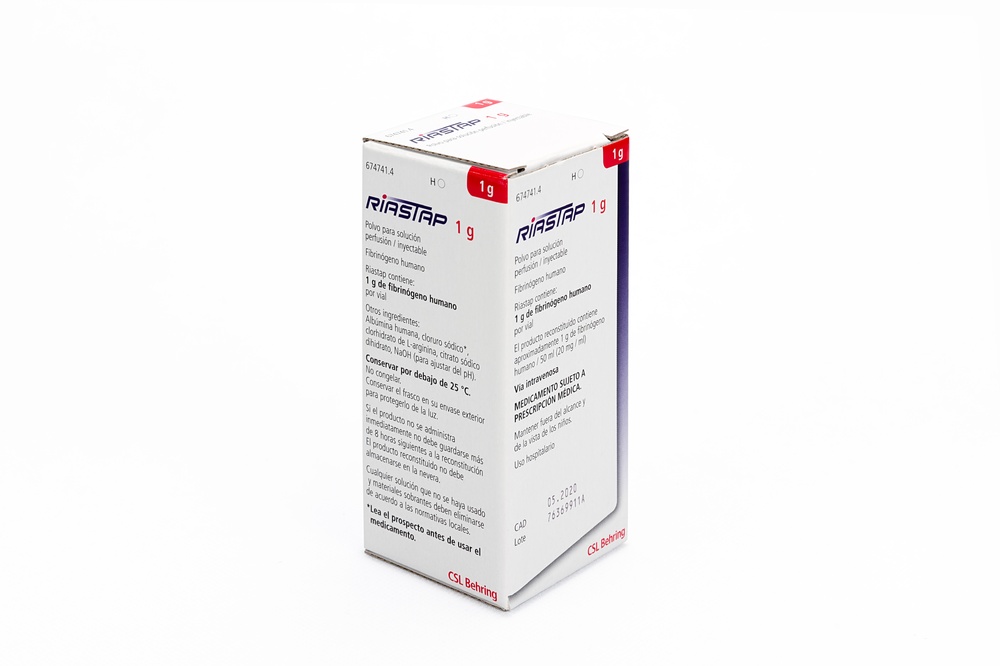
- Alternatives to FIBRYGA 1 g POWDER AND SOLVENT FOR INJECTABLE SOLUTION AND FOR INFUSIONDosage form: INJECTABLE, 1.5 gActive substance: fibrinogen, humanPrescription requiredDosage form: INJECTABLE, 1 g (20 mg/mL)Active substance: fibrinogen, humanManufacturer: Csl Behring GmbhPrescription requiredDosage form: INJECTABLE, 1,000 IUActive substance: coagulation factor VIIIManufacturer: Takeda Manufacturing Austria AgPrescription required
Online doctors for FIBRYGA 1 g POWDER AND SOLVENT FOR INJECTABLE SOLUTION AND FOR INFUSION
Discuss questions about FIBRYGA 1 g POWDER AND SOLVENT FOR INJECTABLE SOLUTION AND FOR INFUSION, including use, safety considerations and prescription review, subject to medical assessment and local regulations.









Get FIBRYGA 1 g POWDER AND SOLVENT FOR INJECTABLE SOLUTION AND FOR INFUSION Prescription Online
Fill in a 2-min form
Tell us your symptoms, history, and what medicine you're requesting.
Pick a doctor or let us assign
Choose a specialist or we'll match you with the next available doctor.
Doctor reviews your case
Usually within 30 minutes. They may ask follow-up questions via chat.
Collect from any pharmacy
Electronic prescription sent to your email — valid across Spain.
Frequently Asked Questions
FIBRYGA 1 g POWDER AND SOLVENT FOR INJECTABLE SOLUTION AND FOR INFUSION requires a prescription in Spain. You can check with a doctor online whether this medicine may be appropriate for your situation.
The active ingredient in FIBRYGA 1 g POWDER AND SOLVENT FOR INJECTABLE SOLUTION AND FOR INFUSION is fibrinogen, human. This information helps identify medicines with the same composition but different brand names.
FIBRYGA 1 g POWDER AND SOLVENT FOR INJECTABLE SOLUTION AND FOR INFUSION is manufactured by Octapharma S.A.. Pharmacy brands and packaging may differ depending on the distributor.
Doctors such as Family doctors, Psychiatrists, Dermatologists, Cardiologists, Endocrinologists, Gastroenterologists, Pulmonologists, Nephrologists, Rheumatologists, Hematologists, Infectious disease physicians, Allergists, Geriatricians, Paediatricians, Oncologists may assess whether FIBRYGA 1 g POWDER AND SOLVENT FOR INJECTABLE SOLUTION AND FOR INFUSION is appropriate, depending on your situation and local regulations. You can book an online consultation to discuss your symptoms and possible next steps.
Spain has a well-developed healthcare infrastructure across major cities such as Madrid, Barcelona, Valencia, and Seville. Pharmacies are widely available and operate under strict regulations, ensuring access to prescribed medications.
You can buy FIBRYGA 1 g POWDER AND SOLVENT FOR INJECTABLE SOLUTION AND FOR INFUSION in Madrid, Barcelona, Seville, or Valencia at any local pharmacy with a valid prescription.
To obtain a prescription, you can use Oladoctor:
Other medicines with the same active substance (fibrinogen, human) include FIBCLOT 1.5 g POWDER AND SOLVENT FOR INJECTABLE SOLUTION AND FOR INFUSION, RIASTAP 1 g POWDER FOR INJECTABLE SOLUTION OR INFUSION, ADVATE 1,000 IU POWDER AND SOLVENT FOR INJECTABLE SOLUTION. These may have different brand names or formulations but contain the same therapeutic ingredient. Always consult a doctor before switching or starting a new medicine.
