



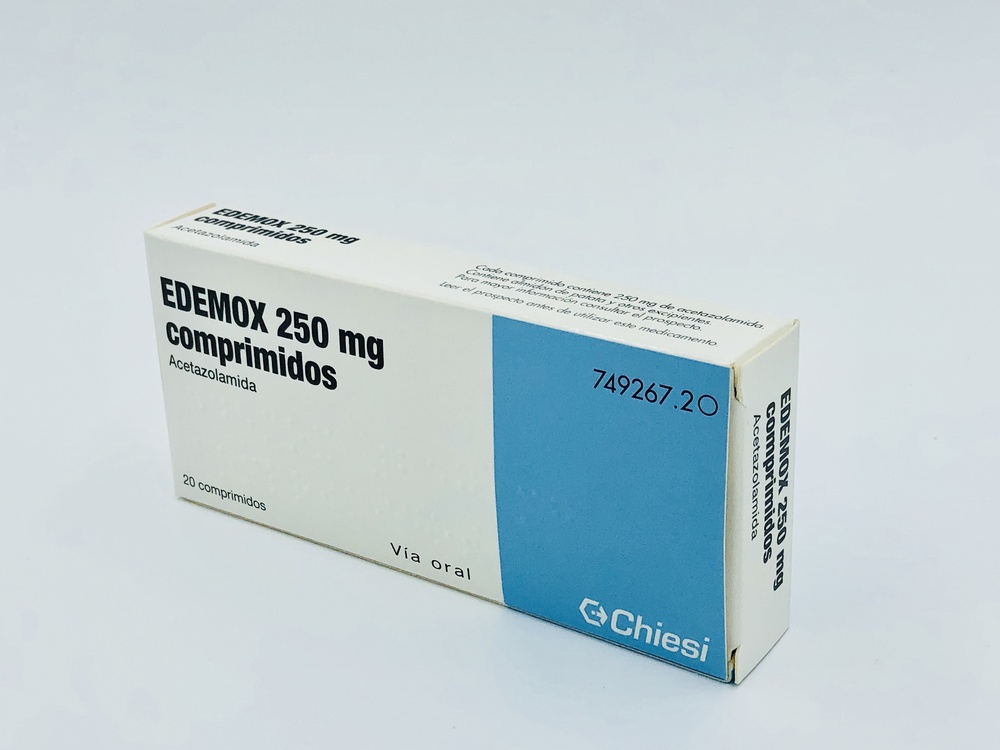
EDEMOX 250 mg Tablets

Prescription review online
A doctor will review your case and decide whether a prescription is medically appropriate.

Talk to a doctor about this medicine
Discuss your symptoms and possible next steps in a quick online consultation.



How to use EDEMOX 250 mg TABLETS
Contents of the leaflet
- Introduction
- What is Edemox and what is it used for
- What you need to know before you take Edemox
- How to take Edemox
- Possible side effects
- Storage of Edemox
- Container Content and Additional Information
Introduction
Package Leaflet: Information for the User
Edemox 250 mg Tablets
Acetazolamide
Read all of this leaflet carefully before you start taking this medicine because it contains important information for you.
- Keep this leaflet, you may need to read it again.
- If you have any further questions, ask your doctor or pharmacist.
- This medicine has been prescribed for you only. Do not pass it on to others. It may harm them, even if their signs of illness are the same as yours.
- If you get any side effects, talk to your doctor or pharmacist. This includes any possible side effects not listed in this leaflet. See section 4.
Contents of the Package Leaflet
- What is Edemox and what is it used for
- What you need to know before you take Edemox
- How to take Edemox
- Possible side effects
- Storage of Edemox
- Contents of the pack and other information
1. What is Edemox and what is it used for
Edemox is a medicine that contains acetazolamide as the active ingredient. Acetazolamide is a medicine with diuretic action (a medicine that increases urine elimination) that belongs to the group of sulfonamides. Acetazolamide helps reduce edema (fluid concentration) by helping to reduce pressure.
This medicine is used for:
- Treating fluid accumulation due to heart problems, medication, or other reasons, usually along with other diuretics.
- Treating, along with other medications, open-angle glaucoma (an eye disease characterized by increased ocular pressure) and secondary glaucoma.
- Preoperative treatment of acute closed-angle glaucoma.
- Treating, along with other medications, petit mal epilepsy (epilepsy with mild seizures).

Not sure if this medicine is right for you?
Discuss your symptoms and treatment with a doctor online.
2. What you need to know before you take Edemox
Do not take Edemox
- If you are allergic to acetazolamide or any of the other ingredients of this medicine (listed in section 6).
- If you are allergic to sulfonamides.
- If you suffer from:
- severe renal insufficiency (severe kidney problems)
- severe hepatic insufficiency (severe liver problems)
- liver cirrhosis (a disease characterized by liver degeneration)
- sodium or potassium depletion (decrease in sodium or potassium levels)
- hyperchloremic acidosis (increased acidity in fluids and tissues)
- adrenal failure (a hormonal deficiency)
- a special type of glaucoma known as chronic non-congestive closed-angle glaucoma, in long-term therapy.
- If you are in the first trimester of your pregnancy.
Warnings and precautions
Consult your doctor before starting to take this medicine.
- If you have experienced lung or respiratory problems (fluid in the lungs) after taking acetazolamide in the past.
Be especially cautious if:
- you are an elderly patient
- you suffer from renal insufficiency (the kidney does not function correctly)
- you suffer from hepatic insufficiency (the liver does not function correctly)
- you use medications to treat epilepsy, as cases of suicidal tendencies have been described. Patients and their caregivers should seek medical advice if signs of suicidal behavior appear
- you suffer from pulmonary obstruction or emphysema (excessive air in the lungs)
- you suffer from heart failure (the heart does not function correctly)
- you experience a skin rash without a known cause
- you temporarily lose your hearing
- your blood test results for blood elements (white blood cells, red blood cells, and platelets) suddenly decrease
- you suffer from diabetes, as it may increase or decrease blood glucose and urine levels, so it should be taken into account in patients with glucose intolerance or diabetes mellitus.
- you have a history of kidney stones, the benefit should be weighed against the risk of forming new stones.
- you are going to be exposed to the sun. You should avoid prolonged sun exposure.
- if you experience shortness of breath or difficulty breathing after taking Edemox, seek medical attention immediately (see also section 4).
The decrease in vision or eye pain may be symptoms of fluid accumulation in the vascular layer of the eye (choroidal effusion or detachment). This can occur in the hours following the intake of Edemox. Consult your doctor as soon as possible if you experience these symptoms.
Using Edemox with other medicines
Tell your doctor or pharmacist if you are using, have recently used, or might use any other medicines.
The following medicines may interact with Edemox when used at the same time:
- Oral anticoagulants (medicines for the treatment and prevention of blood clots, such as aspirin): may produce severe acidosis and increase toxicity to the central nervous system.
- Hypertensive agents (medicines to increase blood pressure): may require adjustment of the acetazolamide dose.
- Cardiac glycosides (medicines used to treat heart conditions): may require adjustment of the acetazolamide dose.
- Other carbonic anhydrase inhibitors (medicines to reduce edema): concomitant use is not recommended due to possible additive effects.
- Topiramate (to treat certain types of seizures in epileptic patients): may increase the risk of kidney stone formation associated with topiramate use.
- Antidiabetics (medicines for diabetes): may potentiate the effect of these medicines.
- Amphetamines (central nervous system stimulants): may potentiate amphetamine action and/or toxicity.
- Antiepileptics (medicines for epilepsy): may increase or decrease blood levels of these medicines.
- Benzodiazepines (such as triazolam, used to treat insomnia or difficulty sleeping): may register breathing difficulties.
- Cyclosporin (an immunosuppressive medicine used in transplanted patients): may elevate cyclosporin blood levels, potentiating its action and/or toxicity.
- Ciprofloxacin (for the treatment of infections): may produce kidney stones and nephrotoxicity.
- Corticosteroids (substances with anti-inflammatory, immunosuppressive, and metabolic effects): acetazolamide may cause low potassium levels in the blood.
- Digoxin (to treat certain heart problems): risk of digitalis toxicity if low potassium levels occur in the blood during treatment.
- Ephedrine and pseudoephedrine (potent central nervous system stimulants): may potentiate ephedrine toxicity.
- Erythromycin (for the treatment of infections): may potentiate the effect of the antibiotic.
- Memantine (to treat symptoms of Alzheimer's disease): may reduce memantine elimination.
- Methenamine (for the treatment of urinary tract infections): may reduce the antisepsis effect of methenamine in the urine.
- Other diuretics (thiazides): may increase hypokalemic and hyperuricemic effects.
- Procaine (a short-acting local anesthetic): may potentiate anesthetic toxicity.
- Quinidine (to treat abnormal heart rhythm): may potentiate quinidine toxicity.
- Lithium salts (antidepressant): acetazolamide may cause a loss of efficacy as an antidepressant.
- Salicylates (medicines with anti-inflammatory, analgesic, and antipyretic properties): during concomitant treatment with high doses of salicylates, the risk of salicylate intoxication may increase, leading to metabolic acidosis and increased tissue penetration of salicylates.
- Timolol (to reduce ocular pressure): may potentiate betablocker toxicity, worsening pre-existing respiratory insufficiency.
Interference with laboratory tests and other diagnostic tests
If you are going to have any diagnostic tests (including blood tests, urine tests, etc.), inform your doctor that you are using this medicine, as it may alter the results.
- Acetazolamide decreases potassium and increases uric acid in blood, serum, or plasma tests and may alter the urine protein test.
- Acetazolamide interferes with the analysis method (HPLC) for the evaluation of theophylline in blood.
Using Edemox with alcohol
Avoid consuming alcohol while being treated with this medicine.
Pregnancy and breastfeeding
If you are pregnant or breastfeeding, think you may be pregnant, or plan to become pregnant, consult your doctor or pharmacist before using this medicine.
This medicine should not be taken during the first trimester of pregnancy; it is contraindicated. During the rest of pregnancy, it is only recommended to administer it if there are no safer therapeutic alternatives.
Its use is not recommended in breastfeeding mothers.
Driving and using machines
Some adverse reactions, such as drowsiness, fatigue, and transient myopia, may affect the ability to drive or operate machines. If you experience these effects, you should avoid driving and using machines.
Use in athletes
Athletes are informed that acetazolamide is a prohibited substance in competitive sports, susceptible to producing a positive result in a doping test.
3. How to take Edemox
Follow exactly the administration instructions of this medicine indicated by your doctor. In case of doubt, consult your doctor or pharmacist.
The recommended doses are:
Adults:
- Diuretic:
The initial dose is usually 250 mg/day (1 tablet per day) in the morning. If the response is not satisfactory, the dose can be changed to 250 mg (1 tablet) on alternate days or 250 mg/day (1 tablet per day) for two consecutive days and one day of rest.
- Glaucoma:
It is usually necessary to use this medicine as an aid to other treatments.
In the treatment of open-angle glaucoma, it should be administered from one to four daily doses of 250 mg (from 1 to 4 tablets per day). Doses higher than 1 g (4 tablets) per day do not usually increase the response.
Secondary glaucoma and preoperative treatment of acute closed-angle glaucoma: 250-1,000 mg/day (from 1 to 4 tablets per day) divided into several doses (250 mg (1 tablet) every four hours).
- Epilepsy:
From 250-1,000 mg/day (from 1 to 4 tablets per day), in several doses, according to the severity of the condition. Doses higher than 1 g (4 tablets) per day may not increase the response.
It is recommended to start with 250 mg (1 tablet) once a day, maintaining the usual dose of the other antiepileptic.
Elderly patients:
Although no specific geriatric problems have been described in this age group, the dose in elderly patients should be established with caution, starting treatment with the lowest effective dose.
Renal insufficiency:
Acetazolamide is excreted by the kidneys, so it may be necessary to reduce the dose, especially in patients whose analytical results show creatinine clearance values of <60 ml min. in patients with moderate to severe renal disorders, the dose should be reduced by half or administration interval between doses increased, going from every six eight hours taking medicine twelve hours.< p>
Use in children and adolescents
The safety and efficacy of acetazolamide have not been established in patients 12 years of age and younger.
- Diuretic:
Adolescents over 12 years: 5 mg/kg, once a day in the morning.
- Epilepsy and Glaucoma:
The daily dose for children depends on the child's weight. It is usually 8 to 30 mg per kilogram in separate doses up to a maximum daily dose of 750 mg (3 tablets), in several doses.
Method of administration
The tablets should be taken orally.
Acetazolamide should be administered preferably on an empty stomach, although if nausea or vomiting appears, it can be administered with milk or food to reduce gastrointestinal intolerance. Food does not delay or reduce the absorption rate.
Due to its diuretic effect, if given in a single dose, it should be administered in the morning, and if administered in more than one dose, the last dose should be given before 6-8 pm to avoid interfering with the patient's nighttime rest.
If you take more Edemox than you should
Do not take more than 1.5 g/day (6 tablets per day).
In case of overdose or accidental ingestion, consult your doctor or pharmacist immediately or call the Toxicology Information Service, phone 91 562 04 20, indicating the medicine and the amount ingested.
In case of overdose, treatment should be discontinued, and symptomatic and supportive treatment should be initiated, especially taking care to maintain hydroelectrolytic balance and sufficient fluid intake. Blood electrolyte levels (especially potassium) and blood pH should be monitored. Acetazolamide may be dialyzable, especially in cases of overdose and renal insufficiency.
There is no specific antidote.
If you forget to take Edemox
Do not take a double dose to make up for forgotten doses.
If you have any other questions about the use of this medicine, ask your doctor or pharmacist.

Started taking the medicine and have questions?
Discuss your symptoms and treatment with a doctor online.
4. Possible side effects
Like all medicines, this medicine can cause side effects, although not everybody gets them.
In short-term therapies, they consist of a tingling sensation in the face, hands, and feet, ringing in the ears, and hearing disorders, loss of appetite and weight, taste alterations, and gastrointestinal disorders (nausea, vomiting, and diarrhea), increased urination frequency, flushing, thirst, headache, dizziness, fatigue, irritability, agitation, lack of coordination, general malaise, depression, decreased libido, and occasionally, transient somnolence or confusion, blurred vision that always reverses when treatment is discontinued. Photosensitivity has also been reported.
In long-term therapies, metabolic acidosis (excessive acidity in the blood) and electrolyte balance alteration, including hypokalemia (low potassium levels in the blood) and hyponatremia (low sodium levels in the blood), may occur. Dizziness, transient myopia, dark stools containing blood, presence of sugar, blood, and crystals in the urine, gastrointestinal bleeding, pain, and increased urination frequency, yellowish skin and eye discoloration, growth retardation (in children), altered liver function, muscle weakness or convulsions, gastrointestinal disorders (nausea, vomiting, and diarrhea), fever, low blood levels of red blood cells, white blood cells, and platelets, allergic skin reactions, and acute inflammatory diseases (such as erythema multiforme, Stevens-Johnson syndrome, toxic epidermal necrolysis), or kidney damage. Acetazolamide may induce osteomalacia (weak bones) in patients treated with carbamazepine, primidone, or phenytoin. In rare cases, fulminant hepatic necrosis (severe liver disorder). Long-term therapy with acetazolamide increases the risk of nephrolithiasis (kidney stones). All these manifestations cease when the dose is reduced or treatment is discontinued.
Contact a doctor immediately if you experience any of the following symptoms:
- If you experience a severe skin reaction: a red and scaly rash with bumps under the skin and blisters (pustular exanthematous eruption). The frequency of this adverse effect is considered unknown (cannot be estimated from available data).
- If you experience breathing difficulties or difficulty breathing. These may be symptoms of fluid accumulation in the lungs (pulmonary edema). The frequency of this adverse effect cannot be estimated from available data (unknown frequency).
Frequency "unknown": Decreased vision or eye pain due to fluid accumulation in the vascular layer of the eye (choroidal effusion or detachment).
Reporting of side effects
If you experience any side effects, talk to your doctor or pharmacist, even if it is possible side effects not listed in this leaflet. You can also report them directly through the Spanish Pharmacovigilance System for Human Use Medicines: www.notificaRAM.es.
By reporting side effects, you can help provide more information on the safety of this medicine.
5. Storage of Edemox
No special storage conditions are required.
Keep this medicine out of the sight and reach of children.
Do not use this medicine after the expiration date that appears on the packaging after CAD. The expiration date is the last day of the month indicated.
Medicines should not be disposed of via wastewater or household waste. Deposit the packaging and medicines you no longer need at the pharmacy's SIGRE point  . If in doubt, ask your pharmacist how to dispose of the packaging and medicines you no longer need. This will help protect the environment.
6. Container Content and Additional Information
Composition of Edemox
- The active ingredient is acetazolamide. Each tablet contains 250 mg of acetazolamide.
- The other components are calcium sulfate dihydrate, sodium carboxymethyl starch (type A) (derived from potato starch), talc, and povidone.
Appearance of the Product and Container Content
Cylindrical white tablets with beveled edges, with the anagram W.
The container content is 20 tablets.
Marketing Authorization Holder and Manufacturer
Marketing Authorization Holder
CHIESI ESPAÑA, S.A.U.
Plaça d’Europa, 41-43, 10th floor
08908 L’Hospitalet de Llobregat (Barcelona)
Manufacturer
LABORATORIOS ALCALA FARMA S.L.
Avenida de Madrid, 82
28802 - Alcalá de Henares (Madrid)
Date of the Last Revision of this Leaflet: August 2024.
Detailed information about this medication is available on the website of the Spanish Agency for Medicines and Health Products (AEMPS) http://www.aemps.gob.es.
- Country of registration
- Dosage formTABLET, 250 mg
- ATC codeS01EC01
- Average pharmacy price1.98 EUR
- Active substance
- Prescription requiredYes
- Manufacturer
- This information is for reference only and does not constitute medical advice. Always consult a doctor before taking any medication. Oladoctor is not responsible for medical decisions based on this content.
- Alternatives to EDEMOX 250 mg TABLETSDosage form: EYE DROP, 20 mg/mlActive substance: dorzolamideManufacturer: Tiedra Farmaceutica S.L.Prescription requiredDosage form: EYEDROP, UnknownActive substance: brinzolamideManufacturer: Novartis Europharm LimitedPrescription requiredDosage form: EYE DROP, 10 mg/mlActive substance: brinzolamideManufacturer: Laboratorio Stada S.L.Prescription required
Online doctors for EDEMOX 250 mg TABLETS
Discuss questions about EDEMOX 250 mg TABLETS, including use, safety considerations and prescription review, subject to medical assessment and local regulations.









Get EDEMOX 250 mg TABLETS Prescription Online
Fill in a 2-min form
Tell us your symptoms, history, and what medicine you're requesting.
Pick a doctor or let us assign
Choose a specialist or we'll match you with the next available doctor.
Doctor reviews your case
Usually within 30 minutes. They may ask follow-up questions via chat.
Collect from any pharmacy
Electronic prescription sent to your email — valid across Spain.
Frequently Asked Questions
EDEMOX 250 mg TABLETS requires a prescription in Spain. You can check with a doctor online whether this medicine may be appropriate for your situation.
The active ingredient in EDEMOX 250 mg TABLETS is acetazolamide. This information helps identify medicines with the same composition but different brand names.
The average pharmacy price for EDEMOX 250 mg TABLETS is around 1.98 EUR. Prices may vary depending on the manufacturer and dosage form.
EDEMOX 250 mg TABLETS is manufactured by Chiesi España S.A.U.. Pharmacy brands and packaging may differ depending on the distributor.
Doctors such as Family doctors, Psychiatrists, Dermatologists, Cardiologists, Endocrinologists, Gastroenterologists, Pulmonologists, Nephrologists, Rheumatologists, Hematologists, Infectious disease physicians, Allergists, Geriatricians, Paediatricians, Oncologists may assess whether EDEMOX 250 mg TABLETS is appropriate, depending on your situation and local regulations. You can book an online consultation to discuss your symptoms and possible next steps.
Spain has a well-developed healthcare infrastructure across major cities such as Madrid, Barcelona, Valencia, and Seville. Pharmacies are widely available and operate under strict regulations, ensuring access to prescribed medications.
You can buy EDEMOX 250 mg TABLETS in Madrid, Barcelona, Seville, or Valencia at any local pharmacy with a valid prescription.
To obtain a prescription, you can use Oladoctor:
Other medicines with the same active substance (acetazolamide) include ARZOLAN 20 mg/ml EYE DROPS SOLUTION, AZOPT 10 mg/ml EYE DROPS IN SUSPENSION, BRINZOLAMIDE STADA 10 mg/ml EYE DROPS, SUSPENSION. These may have different brand names or formulations but contain the same therapeutic ingredient. Always consult a doctor before switching or starting a new medicine.
