



EBILFUMIN 30 mg Hard Capsules

Prescription review online
A doctor will review your case and decide whether a prescription is medically appropriate.

Talk to a doctor about this medicine
Discuss your symptoms and possible next steps in a quick online consultation.



How to use EBILFUMIN 30 mg HARD CAPSULES
Contents of the leaflet
- Introduction
- What is Ebilfumin and what is it used for
- What you need to know before you take Ebilfumin
- How to take Ebilfumin
- Possible side effects
- Storage of Ebilfumin
- Container Contents and Additional Information
Introduction
Package Leaflet: Information for the User
Ebilfumin 30 mg Hard Capsules EFG
oseltamivir
Read all of this leaflet carefully before you start taking this medicine because it contains important information for you.
- Keep this leaflet, you may need to read it again.
- If you have any further questions, ask your doctor or pharmacist.
- This medicine has been prescribed for you only. Do not pass it on to others. It may harm them, even if their signs of illness are the same as yours.
- If you get any side effects, talk to your doctor or pharmacist. This includes any possible side effects not listed in this leaflet. See section 4.
Contents of the pack and other information:
- What is Ebilfumin and what is it used for
- What you need to know before you take Ebilfumin
- How to take Ebilfumin
- Possible side effects
- Storage of Ebilfumin
- Contents of the pack and other information
1. What is Ebilfumin and what is it used for
- Ebilfumin is used in adults, adolescents, children, and infants (including full-term newborn babies) to treat the flu(influenza). It can be used when you have flu symptoms and it is known that the flu virus is present in the population.
- Ebilfumin may also be prescribed for adults, adolescents, children, and infants over 1 year of age to prevent the fluon a case-by-case basis, for example, if you have been in contact with someone who has the flu.
- Ebilfumin may be prescribed for adults, adolescents, children, and infants (including full-term newborn babies) as preventive treatmentin exceptional circumstances, for example, if there is a global flu epidemic (a flu pandemic) and the seasonal flu vaccine cannot provide sufficient protection.
Ebilfumin contains oseltamivir, which belongs to a group of medicines called neuraminidase inhibitors. These medicines prevent the flu virus from spreading inside the body. They help to relieve or prevent the symptoms of flu virus infection.
Flu is an infection caused by a virus. The signs of flu often include sudden fever (over 37.8 °C), cough, runny or stuffy nose, headache, muscle pain, and extreme tiredness. These symptoms can also be caused by other infections. A true flu infection only occurs during annual outbreaks (epidemics), when flu viruses are widespread in the population. Outside of epidemic periods, flu-like symptoms are usually caused by another type of illness.

Not sure if this medicine is right for you?
Discuss your symptoms and treatment with a doctor online.
2. What you need to know before you take Ebilfumin
Do not take Ebilfumin
If this happens to you, consult your doctor. Do not take Ebilfumin.
Warnings and precautions
Consult your doctor or pharmacist before starting to take Ebilfumin.
Before taking Ebilfumin, make sure your doctor knows
During treatment with Ebilfumin, tell a doctor immediately
Ebilfumin is not a vaccine
Ebilfumin is not a vaccine: it is used to treat the infection or prevent the spread of the flu virus. A vaccine provides you with antibodies against the virus. Ebilfumin does not affect the effectiveness of the flu vaccine, and your doctor may prescribe both.
Using Ebilfumin with other medicines
Tell your doctor or pharmacist if you are taking, have recently taken, or might take any other medicines. This includes medicines obtained without a prescription. The following medicines are particularly important:
- chlorpropamide (used to treat diabetes)
- methotrexate (used to treat, for example, rheumatoid arthritis)
- phenylbutazone (used to treat pain and inflammation)
- probenecid (used to treat gout)
Pregnancy and breastfeeding
You should inform your doctor if you are pregnant, think you may be pregnant, or plan to become pregnant so that your doctor can decide if Ebilfumin is suitable for you.
The effects on breastfed infants are unknown. You should inform your doctor if you are breastfeeding so that they can decide if Ebilfumin is suitable for you.
Consult your doctor or pharmacist before using this medicine.
Driving and using machines
Ebilfumin has no effect on your ability to drive or use machines.
Ebilfumin contains sodium
This medicine contains less than 1 mmol of sodium (23 mg) per capsule; this is essentially “sodium-free”.
3. How to take Ebilfumin
Follow the instructions for administration of this medicine exactly as indicated by your doctor.
In case of doubt, consult your doctor or pharmacist again.
Take Ebilfumin as soon as possible, ideally within two days of starting to have flu symptoms.
Recommended doses
For the treatment of flu, take two doses daily. It is usually convenient to take one dose in the morning and one at night. It is important to complete the entire 5-day treatment, even if you start to feel better quickly.
For adult patients with a weakened immune system, treatment will continue for 10 days.
For the prevention of flu or after being in contact with an infected person, take one dose daily for 10 days. It is best to take this dose in the morning with breakfast.
In special situations, such as widespread flu or patients with a weakened immune system, treatment will continue for up to 6 or 12 weeks.
The recommended dose depends on the patient's body weight.You should use the amount of capsules or oral suspension prescribed by your doctor.
Adults and adolescents 13 years and older
Body weight | Flu treatment: dose for 5 days | Flu prevention: dose for 10 days |
40 kg or more | 75 mg twice a day | 75 mg once a day |
75 mg can be obtained with one 30 mg capsule and one 45 mg capsule
Children from 1 to 12 years
Body weight | Flu treatment: dose for 5 days | Flu prevention: dose for 10 days |
10 to 15 kg | 30 mg twice a day | 30 mg once a day |
More than 15 kg and up to 23 kg | 45 mg twice a day | 45 mg once a day |
More than 23 kg and up to 40 kg | 60 mg twice a day | 60 mg once a day |
More than 40 kg | 75 mg twice a day | 75 mg once a day |
75 mg can be obtained with one 30 mg capsule and one 45 mg capsule
Infants under 1 year (from 0 to 12 months)
The administration of Ebilfumin to infants under 1 year of age to prevent flu during a pandemic should be done based on the doctor's judgment after considering the potential benefit versus any potential risk to the infant.
Body weight | Flu treatment: dose for 5 days | Flu prevention: dose for 10 days |
From 3 kg to more than 10 kg | 3 mg per kg of body weight, twice a day | 3 mg per kg of body weight, once a day |
mg per kg = mg per kilogram of the child's body weight. For example:
If a 6-month-old child weighs 8 kg, the dose is
8 kg x 3 mg per kg = 24 mg
Method of administration
Swallow the capsules whole with water. Do not break or chew the capsules.
Ebilfumin can be taken with or without food, although taking it with food may reduce the chance of feeling or having discomfort (nausea and vomiting).
People who have difficulty swallowing the capsulescan use a liquid medicine (oral suspension). If this is not available at your pharmacy, you can prepare a liquid form of Ebilfumin from the capsules. See the instructions in the sectionPreparing Ebilfumin liquid at home.
If you take more Ebilfumin than you should
Stop taking Ebilfumin and consult your doctor or pharmacist immediately.
In most cases of overdose, no adverse effects were reported. When adverse effects were reported, they were similar to those that occurred with normal doses and are included in section 4.
Overdose cases with oseltamivir have been reported more frequently in children than in adults and adolescents. Caution should be exercised when preparing Ebilfumin liquid for children and when administering the capsules or Ebilfumin liquid to children.
If you stop taking Ebilfumin
Do not take a double dose to make up for forgotten doses.
If you stop treatment with Ebilfumin
No adverse effects occur when you stop taking Ebilfumin. However, if you stop taking Ebilfumin before your doctor told you to, the flu symptoms may return. Always complete the treatment period that your doctor has prescribed.
If you have any further questions on the use of this product, ask your doctor or pharmacist.

Started taking the medicine and have questions?
Discuss your symptoms and treatment with a doctor online.
4. Possible side effects
Like all medicines, this medicine can cause side effects, although not everybody gets them.
Since the marketing of oseltamivir, the following serious side effects have been rarely reported:
- Anaphylactic and anaphylactoid reactions: severe allergic reactions, with swelling of the face and skin, itchy rash, low blood pressure, and difficulty breathing
- Hepatic disorders (fulminant hepatitis, hepatic function disorder, and jaundice): yellowing of the skin and whites of the eyes, change in stool color, changes in behavior
- Angioedema: severe sudden swelling of the skin mainly around the head and neck area, including eyes and tongue, with difficulty breathing.
- Stevens-Johnson syndrome and toxic epidermal necrolysis: a complicated allergic reaction with possible life-threatening, severe inflammation of the outer and possibly inner skin, initially with fever, sore throat, and fatigue, rash on the skin, with blistering, peeling, and large areas of skin peeled, possible difficulty breathing and low blood pressure
- Gastrointestinal hemorrhage: prolonged bleeding from the large intestine or vomiting blood
- Neuropsychiatric disorders, as described below.
If you notice any of these symptoms, seek medical help immediately.
The most frequently reported side effects (very common and common) for Ebilfumin are feeling unwell or discomfort (nausea, vomiting), stomach pain, stomach discomfort, headache, and pain. These side effects usually occur after the first dose of the medicine and generally tend to disappear during treatment. The frequency with which these effects occur is reduced if the medicine is taken with food.
Rare but serious side effects: seek medical help immediately
(These can affect up to 1 in 1,000 people)
During treatment with oseltamivir, rare side effects have been reported, including
- Seizures and delirium, including altered levels of consciousness
- Confusion, abnormal behavior
- Delirious disorders, hallucinations, agitation, anxiety, nightmares
These events were mainly reported in children and adolescents and often began suddenly and had a rapid resolution. In very rare cases, these events resulted in self-injury, some with a fatal outcome. These neuropsychiatric events have also been reported in patients with flu who were not taking oseltamivir.
- Patient, especially children and adolescents, should be closely monitored to detect changes in behavior described above.
If you notice any of these symptoms, especially in younger patients, seek medical help immediately.
Adults and adolescents 13 years and older
Very common side effects
(can affect more than 1 in 10 people)
- Headache
- Nausea
Common side effects
(can affect up to 1 in 10 people)
- Bronchitis
- Fever
- Cough
- Dizziness
- Fever
- Pain
- Pain in the limbs
- Runny nose
- Difficulty sleeping
- Sore throat
- Stomach pain
- Tiredness
- Feeling of fullness in the upper abdomen
- Upper respiratory tract infections (inflammation of the nose, throat, and sinuses)
- Stomach discomfort
- Vomiting
Uncommon side effects
(can affect up to 1 in 100 people)
- Allergic reactions
- Altered level of consciousness
- Seizure
- Heart rhythm disorders
- Mild to severe liver function disorders
- Skin reactions (skin inflammation, red and itchy rash, scaly skin)
Rare side effects
(can affect up to 1 in 1,000 people)
- Thrombocytopenia (low platelet count)
- Vision disorders
Children from 1 to 12 years
Very common side effects:
(can affect 1 in 10 people)
- Cough
- Nasal congestion
- Vomiting
Common side effects:
(can affect up to 1 in 10 people)
- Conjunctivitis (red and teary eyes or eye pain)
- Ear infections and other ear disorders
- Headache
- Nausea
- Runny nose
- Stomach pain
- Feeling of fullness in the upper abdomen
- Stomach discomfort
Uncommon side effects:
(can affect up to 1 in 100 people)
- Skin inflammation
- Eardrum disorder (tympanic membrane disorder)
Infants under 1 year
The side effects observed in infants from 0 to 12 months of age are mostly similar to the side effects reported in older children (from 1 year onwards). Additionally, diarrhea and diaper dermatitis have been reported.
If you think any of the side effects you are experiencing are serious, or if you notice any side effects not mentioned in this leaflet, tell your doctor or pharmacist. However,
Reporting of side effects
If you experience side effects, consult your doctor, pharmacist, or nurse, even if they are not listed in this leaflet. You can also report them directly through the national reporting system included in Annex V. By reporting side effects, you can help provide more information on the safety of this medicine.
5. Storage of Ebilfumin
Keep this medicine out of the sight and reach of children.
Do not use this medicine after the expiry date which is stated on the carton and blister after EXP. The expiry date is the last day of the month stated.
Do not store above 25 °C.
Medicines should not be disposed of via wastewater or household waste. Ask your pharmacist how to dispose of medicines no longer required. This will help protect the environment.
6. Container Contents and Additional Information
Ebilfumin Composition
- Each hard capsule contains oseltamivir phosphate equivalent to 30 mg of oseltamivir.
- The other ingredients are:
capsule content: pregelatinized starch (derived from corn starch), talc, povidone (K-29/32), sodium croscarmellose, and sodium stearyl fumarate
capsule shell: gelatin, yellow iron oxide (E172), and titanium dioxide (E171)
printing ink: 45% shellac (20% esterified), black iron oxide (E172), propylene glycol (E1520), and 28% ammonia hydroxide (E527)
Product Appearance and Container Contents
The hard capsule is formed by a body and a cap of strong yellow color, with black printing "OS 30". Capsule size: 4.
Ebilfumin 30 mg hard capsules EFG are available in blisters of 10 capsules.
Marketing Authorization Holder
Actavis Group PTC ehf.
Reykjavíkurvegi 76-78
220 Hafnarfjördur
Iceland
Manufacturer
Balkanpharma-Dupnitsa AD
3 Samokovsko Shosse Str.
Dupnitsa 2600
Bulgaria
You can request more information about this medication by contacting the local representative of the marketing authorization holder:
Belgium/Belgique/Belgien Actavis Group PTC ehf. Iceland/Islande/Island Tel: +354 5503300 | Lithuania UAB Teva Baltics Tel: +370 52660203 |
Bulgaria Actavis Group PTC ehf. Tel: +359 24899585 | Luxembourg/Luxemburg Actavis Group PTC ehf. Islande/Island Tel: +354 5503300 |
Czech Republic Teva Pharmaceuticals CR, s.r.o. Tel: +420 251007111 | Hungary Teva Gyógyszergyár Zrt. Tel: +36 12886400 |
Denmark Teva Denmark A/S Tlf: +45 44985511 | Malta Actavis Ltd. Tel: +356 21693533 |
Germany TEVA GmbH Tel: +49 73140208 | Netherlands Teva Nederland B.V. Tel: +31 8000228400 |
Estonia UAB Teva Baltics Tel: +372 6610801 | Norway Teva Norway AS Tlf: +47 66775590 |
Greece Specifar A.B.E.E Tel: +30 2118805000 | Austria ratiopharm Arzneimittel Vertriebs-GmbH Tel: +43 1970070 |
Spain Teva Pharma, S.L.U. Tel: +34 913873280 | Poland Teva Pharmaceuticals Polska Sp. z o.o. Tel: +48 223459300 |
France Teva Santé Tél: +33 155917800 | Portugal Actavis Group PTC ehf. Islândia Tel: +354 5503300 |
Croatia Pliva Hrvatska d.o.o. Tel: +385 13720000 | Romania Teva Pharmaceuticals S.R.L. Tel: +40 212306524 |
Ireland Teva Pharmaceuticals Ireland Tel: +353 19127700 | Slovenia Pliva Ljubljana d.o.o. Tel: +386 15890390 |
Iceland Actavis Group PTC ehf. Tel: +354 5503300 | Slovakia TEVA Pharmaceuticals Slovakia s.r.o. Tel: +421 257267911 |
Italy Actavis Group PTC ehf. Islanda Tel: +354 5503300 | Finland Teva Finland Oy Tel: +358 201805900 |
Cyprus Specifar A.B.E.E. Tel: +30 2118805000 Greece | Sweden Teva Sweden AB Tel: +46 42121100 |
Latvia UAB Teva Baltics filiale Latvija Tel: +371 67323666 | United Kingdom Teva UK Limited Tel: +44 1977628500 |
Date of Last Revision of this Prospectus: {MM/AAAA} {month AAAA}.
Detailed information on this medication is available on the European Medicines Agency website http://www.ema.europa.eu.
-------------------------------------------------------------------------------------------------------------------------
Information for the User
For people who find it difficult to swallow the capsules, including very young children, a liquid medication may be available.
If you need a liquid medication, but it is not available, a suspension can be prepared in the pharmacy from Ebilfumin capsules (see Information for Healthcare Professionals). The pharmacy-prepared preparation is the recommended option.
If the pharmacy preparation is also not available, you can prepare a suspension of Ebilfumin at home from these capsules.
The dose is the same for treatment as for flu prevention. The difference is the frequency of administration.
Preparing Ebilfumin Liquid at Home
- If you have the correct capsulefor the necessary dose (a dose of 30 mg or 60 mg), open the capsule and mix its contents in a teaspoon (or less) of suitable sweetened food. This is usually suitable for children over 1 year old. See the top part of the instructions.
- If you need smaller doses, preparing the Ebilfumin suspension from the capsules requires more steps. This is suitable for young children and babies: they usually need a dose of Ebilfumin of less than 30 mg. See the lower part of the instructions.
Children from 1 to 12 years old
To make a dose of 30 mg or 60 mg, you will need:
- One or two 30 mg Ebilfumin capsules
- Sharp scissors
- A small container
- A spoon (5 ml spoon)
- Water
- Sweetened foodto mask the bitter taste of the powder.
Examples: chocolate or cherry syrup and dessert sauces, such as caramel or condensed milk. Or you can prepare sugared water by mixing one spoon of water with three-quarters (3/4) of a spoon of sugar.
Step 1: Check the Correct Dose
To know the correct amount to use, look for the patient's weight on the left side of the table.
Look at the right column to see the number of capsules you will need to give the patient for a single dose. The amount is the same for treatment as for flu prevention.
You should only use the 30 mg capsules for 30 and 60 mg doses. Do not try to prepare 45 mg or 75 mg doses using the contents of the 30 mg capsules. Instead, use the capsule with the appropriate dose.
Weight | Ebilfumin Dose | Number of Capsules |
Up to 15 kg | 30 mg | 1 capsule |
15 kg to 23 kg | 45 mg | Do not use 30 mg capsules |
23 kg to 40 kg | 60 mg | 2 capsules |
Step 2: Pour All the Powder into the Container
Hold a 30 mg capsulevertically over a container and carefully cut off the rounded end with scissors.
Pour all the powder into the container.
For a 60 mg dose, open a second capsule. Pour all the powder into the container.
Be careful with the powder, as it can be irritating to the skin and eyes.
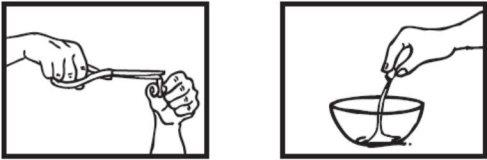
Step 3: Sweeten the Powder and Give the Dose
Add a small amount - no more than one spoon - of sweetened food to the powder in the container.
This is to mask the bitter taste of the Ebilfumin powder.
Mix well.
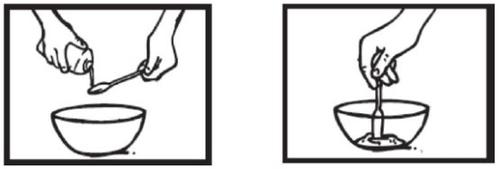
Give the patient the entire contentsof the container immediately.
If any mixture remainsin the container, rinse the container with a small amount of water and give it to the patient to drink all of it. Repeat this procedure each time you need to give the medication.
Infants under 1 year old
To make a smaller single dose, you will need:
- A 30 mg Ebilfumin capsule
- Sharp scissors
- Two small containers(use different pairs of containers for each child)
- A large oral dosing dispenserto measure the water - a 5 or 10 ml dispenser
- A small oral dosing dispenserthat shows 0.1 ml measurements to give the dose
- A spoon (5 ml spoon)
- Water
- Sweetened foodto mask the bitter taste of Ebilfumin.
Examples: chocolate or cherry syrup and dessert sauces, such as caramel or condensed milk. Or you can prepare sugared water: mix one spoon of water with three-quarters (3/4) of a spoon of sugar.
Step 1: Pour All the Powder into a Container
Hold a 30 mg capsulevertically over one of the containers and carefully cut off the rounded end with scissors. Be careful with the powder: it can be irritating to the skin and eyes.
Pour all the powder into the container, regardless of the dose you are preparing.
The amount is the same for treatment as for flu prevention.
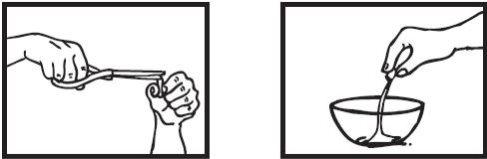
Step 2: Add Water to Dilute the Medication
Use the larger dispenser to draw 5 mlof water. Add the water to the powder in the container. Mix the suspension with a spoon for 2 minutes. |
|
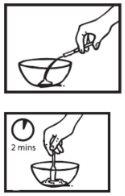
Do not worry if not all the powder dissolves. The undissolved powder corresponds to inactive ingredients.
Step 3: Choose the Correct Amount for the Child's Weight
Look for the child's weight in the left column of the table.
The right column of the table shows how much of the liquid mixture you will need to prepare.
Infants under 1 year old (including full-term newborns)
Child's Weight (closest) | Amount of Ebilfumin Mixture to Prepare |
3 kg | 1.5 ml |
3.5 kg | 1.8 ml |
4 kg | 2.0 ml |
4.5 kg | 2.3 ml |
5 kg | 2.5 ml |
5.5 kg | 2.8 ml |
6 kg | 3.0 ml |
6.5 kg | 3.3 ml |
7 kg | 3.5 ml |
7.5 kg | 3.8 ml |
8 kg | 4.0 ml |
8.5 kg | 4.3 ml |
9 kg | 4.5 ml |
9.5 kg | 4.8 ml |
10 kg or more | 5.0 ml |
Step 4: Prepare the Liquid Mixture
Make sure you have the correct dispenser size.
Carefully prepare the correct amount of liquid mixture from the first container.
Prepare it carefully to avoid taking air bubbles.
Gently add the correct dose to the second container.
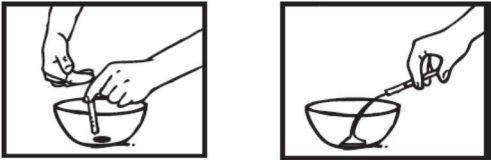
Step 5: Sweeten and Give to the Child
Add a small amount - no more than one spoon - of sweetened food to the second container.
This is to mask the bitter taste of the Ebilfumin suspension.
Mix the sweetened food well with the Ebilfumin liquid.
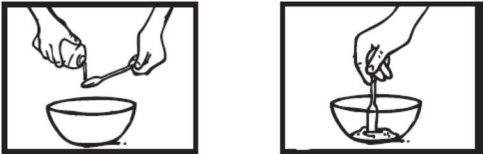
Give the child the entire contentsof the second container (sweetened food with the Ebilfumin suspension) immediately.
If any remains in the second container, rinse the container with a small amount of water and have the child drink all of it. For children who cannot drink directly from the container, give it to them with a spoon or use an appropriate bottle to give the child the remaining liquid.
Give the child something to drink.
Discard any remaining liquid from the first container.
Repeat this procedure each time you need to give the medication.
-------------------------------------------------------------------------------------------------------------------
Information for Healthcare Professionals Only:
Patients Who Cannot Swallow Capsules:
The commercially available oseltamivir powder for oral suspension (6 mg/ml) is the medication of choice for pediatric and adult patients who have difficulty swallowing capsules or need lower doses. If oseltamivir powder for oral suspension is not available, the pharmacist can prepare a suspension (6 mg/ml) from Ebilfumin capsules. If the pharmacy-prepared suspension is also not available, patients can prepare the suspension at home from the capsules.
Oral dosing dispensers(oral syringes) with the correct volume and graduation should be provided to administer the prepared suspension in the pharmacy and for the procedures to follow for home preparation. In both cases, the volumes needed should preferably be marked on the dispensers. For home preparation, dispensers to take the correct volume of water and to measure the Ebilfumin mixture with water should be provided separately. For measuring 5.0 ml of water, 5 ml or 10 ml dispensers should be used.
The following shows the suitable dispenser size to draw the correct volume of the Ebilfumin suspension (6 mg/ml).
Infants under 1 year old (including full-term newborns):
Ebilfumin Dose | Ebilfumin Suspension Amount | Dispenser Size to Use (graduated in 0.1 ml) |
9 mg | 1.5 ml | 2.0 ml (or 3.0 ml) |
10 mg | 1.7 ml | 2.0 ml (or 3.0 ml) |
11.25 mg | 1.9 ml | 2.0 ml (or 3.0 ml) |
12.5 mg | 2.1 ml | 3.0 ml |
13.75 mg | 2.3 ml | 3.0 ml |
15 mg | 2.5 ml | 3.0 ml |
16.25 mg | 2.7 ml | 3.0 ml |
18 mg | 3.0 ml | 3.0 ml (or 5.0 ml) |
19.5 mg | 3.3 ml | 5.0 ml |
21 mg | 3.5 ml | 5.0 ml |
22.5 mg | 3.8 ml | 5.0 ml |
24 mg | 4.0 ml | 5.0 ml |
25.5 mg | 4.3 ml | 5.0 ml |
27 mg | 4.5 ml | 5.0 ml |
28.5 mg | 4.8 ml | 5.0 ml |
30 mg | 5.0 ml | 5.0 ml |
- Country of registration
- Dosage formCAPSULE, 30 mg
- ATC codeJ05AH02
- Active substance
- Prescription requiredYes
- Manufacturer
- CompositionCROSCARMELOSA SODICA (2.0 mg mg), FUMARATO DE ESTEARILO Y SODIO (1.0 mg mg), PROPILENGLICOL (CSP Cantidad suficiente mg)
- This information is for reference only and does not constitute medical advice. Always consult a doctor before taking any medication. Oladoctor is not responsible for medical decisions based on this content.
- Alternatives to EBILFUMIN 30 mg HARD CAPSULESDosage form: CAPSULE, 75 mgActive substance: oseltamivirManufacturer: Actavis Group Ptc Ehf.Prescription requiredDosage form: CAPSULE, 30 mgActive substance: oseltamivirManufacturer: Accord Healthcare S.L.U.Prescription requiredDosage form: CAPSULE, 45 mgActive substance: oseltamivirManufacturer: Accord Healthcare S.L.U.Prescription required
Online doctors for EBILFUMIN 30 mg HARD CAPSULES
Discuss questions about EBILFUMIN 30 mg HARD CAPSULES, including use, safety considerations and prescription review, subject to medical assessment and local regulations.









Get EBILFUMIN 30 mg HARD CAPSULES Prescription Online
Fill in a 2-min form
Tell us your symptoms, history, and what medicine you're requesting.
Pick a doctor or let us assign
Choose a specialist or we'll match you with the next available doctor.
Doctor reviews your case
Usually within 30 minutes. They may ask follow-up questions via chat.
Collect from any pharmacy
Electronic prescription sent to your email — valid across Spain.
Frequently Asked Questions
EBILFUMIN 30 mg HARD CAPSULES requires a prescription in Spain. You can check with a doctor online whether this medicine may be appropriate for your situation.
The active ingredient in EBILFUMIN 30 mg HARD CAPSULES is oseltamivir. This information helps identify medicines with the same composition but different brand names.
EBILFUMIN 30 mg HARD CAPSULES is manufactured by Actavis Group Ptc Ehf.. Pharmacy brands and packaging may differ depending on the distributor.
Doctors such as Family doctors, Psychiatrists, Dermatologists, Cardiologists, Endocrinologists, Gastroenterologists, Pulmonologists, Nephrologists, Rheumatologists, Hematologists, Infectious disease physicians, Allergists, Geriatricians, Paediatricians, Oncologists may assess whether EBILFUMIN 30 mg HARD CAPSULES is appropriate, depending on your situation and local regulations. You can book an online consultation to discuss your symptoms and possible next steps.
Spain has a well-developed healthcare infrastructure across major cities such as Madrid, Barcelona, Valencia, and Seville. Pharmacies are widely available and operate under strict regulations, ensuring access to prescribed medications.
You can buy EBILFUMIN 30 mg HARD CAPSULES in Madrid, Barcelona, Seville, or Valencia at any local pharmacy with a valid prescription.
To obtain a prescription, you can use Oladoctor:
Other medicines with the same active substance (oseltamivir) include EBILFUMIN 75 mg HARD CAPSULES, OSELTAMIVIR ACCORD 30 mg HARD CAPSULES, OSELTAMIVIR ACCORD 45 mg HARD CAPSULES. These may have different brand names or formulations but contain the same therapeutic ingredient. Always consult a doctor before switching or starting a new medicine.
