



DYSPORT 500 U POWDER FOR INJECTABLE SOLUTION

Prescription review online
A doctor will review your case and decide whether a prescription is medically appropriate.

Talk to a doctor about this medicine
Discuss your symptoms and possible next steps in a quick online consultation.



How to use DYSPORT 500 U POWDER FOR INJECTABLE SOLUTION
Contents of the leaflet
- Introduction
- What Dysport is and what it is used for
- What you need to know before using Dysport
- Children and adolescents
- Dysport will only be used in children aged 2 years or older for the treatment of spasticity of the legs in children. The safety and efficacy of the specialty for treatment in children for other indications have not been demonstrated.
- Pregnancy, breastfeeding, and fertility
- How to use Dysport
- For the treatment of arm muscle spasms after a stroke
- For the treatment of leg muscle spasms after a stroke
- Possible side effects
- Arm spasticity in children with cerebral palsy
- Treatment of Arms and Legs in Children with Cerebral Palsy
- Storage of Dysport
- Packaging Contents and Additional Information
Introduction
Package Leaflet: Information for the User
Dysport500 U powder for solution for injection
Complex of botulinum toxin type A (Clostridium botulinum)
Read all of this leaflet carefully before you start using this medicine because it contains important information for you.
- Keep this leaflet, you may need to read it again.
- If you have any further questions, ask your doctor or pharmacist.
- This medicine has been prescribed for you only. Do not pass it on to others. It may harm them, even if their signs of illness are the same as yours.
- If you experience any side effects, talk to your doctor or pharmacist. This includes any possible side effects not listed in this leaflet. See section 4.
Contents of the pack
- What Dysport is and what it is used for
- What you need to know before you use Dysport
- How to use Dysport
- Possible side effects
- Storing Dysport
- Contents of the pack and other information
1. What Dysport is and what it is used for
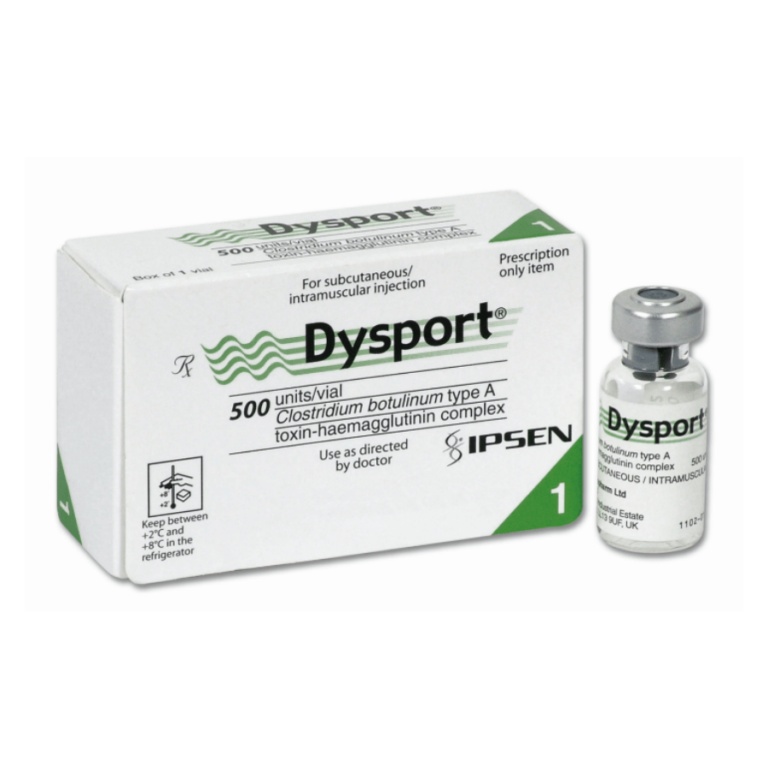
Dysport is presented as a powder for solution for injection. Each vial contains 500 units of botulinum toxin type A.
Dysport belongs to a group of medicines called other peripheral muscle relaxants. It is a toxin produced by a bacterium, Clostridium botulinum, which acts by blocking nerve impulses to the muscles injected, causing the muscle to stop contracting.
Dysport will be administered by your doctor. In adults, it will be administered to control muscle spasms of the eyelids, face, neck, and shoulders, as well as the arm and leg in people who have suffered a stroke. In children aged 2 years or older with cerebral palsy, it will be administered to control spasticity in the leg muscles associated with deformity and to control spasticity in the arm muscles.
Dysport is also used in adults for the treatment of urinary incontinence (loss of bladder control) due to bladder problems associated with spinal cord injury or multiple sclerosis in patients who regularly perform clean intermittent catheterization.

Not sure if this medicine is right for you?
Discuss your symptoms and treatment with a doctor online.
2. What you need to know before using Dysport
Do not use Dysport:
- If you are allergic (hypersensitive) to botulinum toxin or any of the other ingredients of Dysport (listed in section 6).
- If you have a urinary tract infection at the time of receiving treatment for urinary incontinence.
Warnings and precautions:
Talk to your doctor, pharmacist, or nurse before using Dysport, especially in the following situations:
- If you notice problems swallowing, speaking, or breathing, contact your doctor immediately or go to the emergency room. In a small number of cases, these side effects could be serious or even fatal.
- If you have had an adverse reaction to a medicine that contained botulinum toxin.
- If you have a neuromuscular transmission disorder (e.g., myasthenia gravis); this may make you more sensitive to the effect of Dysport, which may result in excessive muscle weakness.
- If you have weakness or atrophy of the muscles into which your doctor intends to inject the product.
- If you have bleeding problems or have an infection or inflammation in the muscles into which your doctor needs to inject Dysport.
- Be careful if you receive treatment for muscle spasms of the leg due to a higher risk of falls in adults, especially in older people.
- If the muscles at the proposed injection sites show signs of wear.
When Dysport is used in the muscles surrounding the eye, your eyes may become dry (see section 4), which could damage the surface of your eyes. To avoid this, you may need treatment with protective drops, ointments, or a protective cover that closes the eye. Your doctor will indicate its use if necessary.
At the time of injection into the bladder to treat urinary incontinence, due to the procedure by which the injection is administered, you may experience an uncontrolled reflex reaction of your body (autonomic dysreflexia, e.g., profuse sweating, sharp headache, increased blood pressure or pulse).
Children and adolescents

Started taking the medicine and have questions?
Discuss your symptoms and treatment with a doctor online.
Dysport will only be used in children aged 2 years or older for the treatment of spasticity of the legs in children. The safety and efficacy of the specialty for treatment in children for other indications have not been demonstrated.
Use of other medicines:
Tell your doctor or pharmacist if you are taking, have recently taken, or might take any other medicines.
You should be careful when taking antibiotics to treat an infection or muscle relaxants. Some of these medicines may increase the effect of Dysport.
Pregnancy, breastfeeding, and fertility
If you are pregnant or breastfeeding, think you may be pregnant, or are planning to have a baby, ask your doctor or pharmacist for advice before using this medicine.
You should not use Dysport during pregnancy unless it is clearly necessary and the benefits outweigh any possible risks to the fetus.
Treatment with Dysport is not recommended if you are breastfeeding, as it is not known whether Dysport passes into breast milk.
Driving and using machines
You may experience blurred vision or temporary muscle weakness after treatment with Dysport. If this happens, do not drive or use machines.
Important information about some of the ingredients of Dysport:
This medicine contains human albumin in very small amounts. It meets all current requirements for quality and safety, but it cannot be completely ruled out that there is a risk of transmitting viral infections.
3. How to use Dysport
The Dysport vial will only be used for you and only for one treatment session.
This medicine will always be administered by your doctor; therefore, you will never self-administer it. Your doctor will determine the dose you need, the muscles to be injected, and the number and frequency of injections.
For the treatment of neck and shoulder muscle spasms
The recommended dose will be a total of 500 units, which the doctor will divide between the most affected muscles to be injected. Injections will be given approximately every 12 weeks, depending on the relaxation achieved with previous administrations. The maximum dose should not exceed 1000 units.
For the treatment of eyelid and facial muscle spasms
For eyelid spasms, if both eyelids are affected, approximately 40 units will be injected per eye. Injections will be given approximately every 12 weeks, when the relaxing effect starts to disappear. In subsequent visits, the dose may be increased up to a maximum of 120 units per eye. The medicine will be injected under the skin at different points around the eye.
If you have a facial spasm, it will be treated as if you had a spasm of a single eyelid.
For the treatment of arm muscle spasms after a stroke
The recommended dose, which should not be exceeded, will be 1000 units, but when the shoulder muscles are also injected, the dose may be increased up to 1500 units. Your doctor may divide the total dose between the affected arm and shoulder muscles. Improvement in muscle spasms will usually be observed within 1 week after administration. Injections may be repeated with a frequency of 12 to 16 weeks.
For the treatment of leg muscle spasms after a stroke
The recommended dose, which should not be exceeded, will be 1500 units. The doctor may divide the dose between the affected leg muscles. Injections may be repeated with a frequency of 12 to 16 weeks.
For the treatment of arm and leg muscle spasms
If you need to receive injections in the arm and leg during the same treatment session, your doctor may divide the dose between your arm and leg, but the total dose should not exceed 1500 units.
For the treatment of muscle spasms in the legs in children with cerebral palsy
For children aged 2 years or older: the doctor will decide the dose. Dysport will be injected into the affected leg muscles. The dose should not be greater than 1000 units or 30 units/kg per treatment session, repeated every 16-22 weeks, or as needed, but never less than 12 weeks.
For the treatment of muscle spasms in the arms in children with cerebral palsy
For children aged 2 years or older: the doctor will decide the dose. Dysport will be injected into the affected arm muscles. If the treatment is injected into one arm, the dose should not be greater than 640 units or 16 units/kg per treatment session, whichever is lower. If the treatment is injected into both arms, the dose should not be greater than 840 units or 21 units/kg per treatment session, whichever is lower. Muscle spasms should improve in the weeks following treatment, and this improvement may last up to 34 weeks. Your doctor will repeat the treatment approximately every 16-28 weeks, or as needed, but never less than 16 weeks.
For the treatment of muscle spasms in the arms and legs in children with cerebral palsy
If you need to receive injections in the arms and legs during the same treatment session, the dose of Dysport to be injected into each limb will be decided by the doctor, but the total dose should not exceed 1000 units per session or 30 units/kg, whichever is lower. The treatment may be repeated no sooner than 12-16 weeks after the previous treatment session.
For the treatment of urinary incontinence
The first dose administered into the bladder muscle will be 600 units, but your doctor may decide to increase the dose to 800 units in subsequent injections.
Dysport will be administered through a procedure called cystoscopy. An instrument with a light source at the end will be inserted into the bladder through the opening through which urine is expelled (called the urethra). This allows the doctor to see the inside of the bladder and administer the Dysport injections into the bladder wall. You will only be given Dysport if you are already performing clean intermittent catheterization (CIC). CIC is a procedure during which a catheter (a soft, hollow tube that is inserted into the urethra to help empty the urine from the bladder) is temporarily inserted into the bladder and removed once the bladder is empty. Ask your doctor to explain more details about the procedure.
You will need to take antibiotics to prevent a urinary tract infection. If you are taking anticoagulant medicines, your doctor will adjust your treatment before and after the Dysport injections. You may be given a local or general anesthetic or a sedative before the injections. You will be observed for at least 30 minutes after the injections. Symptoms usually improve within two weeks, and the improvement may last up to 48 weeks. Your doctor will repeat the treatment as needed, but no more frequently than every 12 weeks.
If you use more Dysport than you should:
If you receive more Dysport than you should, other muscles different from those injected may start to weaken. This may not happen immediately. If it happens, tell your doctor as soon as possible. If you have difficulty swallowing, breathing, or speaking, go to the emergency room urgently.
In case of overdose or accidental ingestion, consult the Toxicology Information Service, telephone 91.562.04.20.
If you miss a dose of Dysport:
If you forget to go to the hospital for the next Dysport injection, nothing will happen to you, except that you may notice that muscle stiffness or spasms return to what they were before treatment with Dysport. Consult your doctor, and they will decide when you need the next injection.
If you stop treatment with Dysport:
The relaxing effect may eventually disappear, and muscle contractions will return to what they were before treatment.
If you have any further questions on the use of this product, ask your doctor or pharmacist.
4. Possible side effects
Like all medicines, Dysport can cause side effects, although not everybody gets them.
If you think any of the side effects you are experiencing are serious, or if you notice any side effects not listed in this leaflet, please tell your doctor or pharmacist.
Contact your doctor immediately or go to the emergency room if:
You have difficulty breathing with or without facial swelling, lips, tongue, and/or throat, skin redness, or hives with itching (urticaria). You may be suffering an allergic reaction to Dysport.
Of the patients treated with Dysport in the clinical trial program, approximately 25% experienced an adverse event.
The frequency of side effects is classified as follows:
very common(may affect more than 1 in 10 people)
common(may affect up to 1 in 10 people)
uncommon(may affect up to 1 in 100 people)
rare(may affect up to 1 in 1,000 people)
Adverse reactions that were general to all indications were as follows:
Common:
- Generalized weakness, fatigue, flu-like symptoms, pain and/or hematoma at the injection site
Uncommon:
- Itching
Rare:
- Muscle mass and tone decrease
- Skin rash
The frequency of numbness and muscle mass loss (could not be estimated from the available data) is unknown.
In addition to the general adverse reactions, the specific adverse reactions for each indication were as follows:
Spasmodic torticollis
Very common:
- Difficulty swallowing, dry mouth
- Muscle weakness
Common:
- Headache, dizziness, mild facial nerve paralysis
- Blurred vision, difficulty seeing clearly
- Voice change, difficulty breathing
- Neck pain, muscle and bone pain, muscle pain, pain in hands and fingers, muscle stiffness
Uncommon:
- Double vision, eyelid drooping
- Nausea
- Muscle tissue loss, jaw muscle disorder
Rare:
- Aspiration
Blepharospasm and hemifacial spasm
Very common:
- Eyelid drooping
Common:
- Facial muscle weakness
- Double vision, dry eyes, tearing
- Swelling of the eyelids
Uncommon:
- Facial paralysis
Rare:
- Eye muscle paralysis
- Eyelid folded towards the eyeball
Arm spasticity in adults
Common:
- Injection site reactions (e.g., pain, redness, swelling, etc.), weakness, fatigue, flu-like illness
- Muscle weakness, musculoskeletal pain, pain in limbs
Uncommon:
- Difficulty swallowing
Leg spasticity in adults
Common:
- Asthenia, fatigue, flu-like illness, injection site reactions (e.g., pain, hematoma, erythema, itching)
- Falls
- Leg muscle weakness, muscle pain
- Difficulty swallowing
Leg spasticity in children with cerebral palsy
Common:
- Leg muscle weakness, muscle pain
- Urinary incontinence
- Flu-like illness, pain, redness, and/or hematoma at the injection site, abnormal gait, fatigue
- Falls
Uncommon:
- Tiredness, weakness
Arm spasticity in children with cerebral palsy
Common:
- Muscle weakness, muscle pain
- Flu-like symptoms, tiredness, itching, hematoma, pain, swelling, or redness at the injection site
- Redness of the skin
Uncommon:
- Loss of strength, weakness
Treatment of Arms and Legs in Children with Cerebral Palsy
There are no specific findings for the administration of Dysport in the same treatment session in the arm and leg compared to those expected when treating the arm or leg separately.
Excessive weakening of the affected muscle and/or localized diffusion of Dysport to other muscles may result in accidental injuries from falls and abnormal gait.
All these effects, if they occur, would be noticeable a few days after injection and normally disappear within 2 to 4 weeks. If any of these adverse effects become bothersome or concern you, tell your doctor.
Treatment of Urinary Incontinence due to Uncontrolled Contractions of the Bladder Muscle
Frequent:
- Blood in the urine *
- Constipation
- Bacteria in the urine*.
- Erectile dysfunction, sometimes known as impotence
- Urinary tract infection*
- Headache
- Fever
Infrequent:
- Numbness
- Muscle weakness
- Pain in the bladder*.
- Uncontrolled reflex response of the body (autonomic dysreflexia)*
- Inability to empty the bladder (urinary retention)
- Bleeding from the bladder or the urethra (the tube that carries urine from the bladder to the outside of the body)
*This adverse effect may be related to the procedure
Post-Marketing Experience
The profile of adverse reactions reported to the Company during the use of the medication after its market release corresponds to that observed during clinical trials. Sporadically, cases of hypersensitivity (allergy) have been reported.
Very rarely, adverse reactions resulting from the onset of toxin effects at remote sites from the injection site (excessive muscle weakness, difficulty swallowing, aspiration pneumonia that can be fatal) have been reported.
Reporting of Adverse Effects:
If you experience any type of adverse effect, consult your doctor, even if it is a possible adverse effect that does not appear in this prospectus. You can also report them directly through the Spanish Pharmacovigilance System for Human Use Medicines: https://www.notificaRAM.es. By reporting adverse effects, you can contribute to providing more information on the safety of this medication.
5. Storage of Dysport
Store in the refrigerator (between 2°C and 8°C), in the hospital where the injections will be given. Do not freeze.
It is recommended that the reconstituted solution be used immediately; however, it can be stored in the refrigerator (between 2°C and 8°C) for a maximum of 24 hours.
This medication should never be given to patients for their use or storage.
Keep this medication out of sight and reach of children.
Do not use this medication after the expiration date that appears on the packaging after CAD. The expiration date is the last day of the month indicated.
Immediately after administering Dysport, any residue that may remain in the vial or syringe must be inactivated using a diluted solution of hypochlorite (1% available chlorine). Then, all used material will be eliminated according to standard hospital practices. Any spilled Dysport should be rinsed with an absorbent cloth soaked in a diluted solution of hypochlorite.
6. Packaging Contents and Additional Information
Composition of DYSPORT
The active ingredient is: type A toxin complex of Clostridium botulinum,500 units.
The other components are lactose and human albumin.
Appearance of the Product and Packaging Contents
In the Dysport packaging, there are two vials containing the white lyophilized powder in the form of a tablet, for reconstitution.
Marketing Authorization Holder and Manufacturer
Marketing Authorization Holder:
IPSEN PHARMA, S.A.U.
Gran Via de les Corts Catalanes 130-136. 08038 Barcelona - Spain.
Manufacturer:
Ipsen Manufacturing Ireland Limited
Blanchardstown Industrial Park
Blanchardstown, Dublin 15, Ireland
Date of the Last Revision of this Prospectus: February 2025
Detailed and updated information on this medication is available on the website of the Spanish Agency for Medicines and Health Products (AEMPS) http://www.aemps.gob.es/.
- Country of registration
- Dosage formINJECTABLE, 500 units/vial
- ATC codeM03AX01
- Active substance
- Prescription requiredYes
- Manufacturer
- CompositionLACTOSA (2,5 mg mg)
- This information is for reference only and does not constitute medical advice. Always consult a doctor before taking any medication. Oladoctor is not responsible for medical decisions based on this content.
- Alternatives to DYSPORT 500 U POWDER FOR INJECTABLE SOLUTIONDosage form: INJECTABLE, 200 U/mlActive substance: botulinum toxinManufacturer: Ipsen PharmaPrescription requiredDosage form: INJECTABLE, 125 Speywood UnitsActive substance: botulinum toxinManufacturer: Ipsen Pharma S.A.U.Prescription requiredDosage form: INJECTABLE, 100 unitsActive substance: botulinum toxinManufacturer: Merz Pharmaceuticals GmbhPrescription required
Online doctors for DYSPORT 500 U POWDER FOR INJECTABLE SOLUTION
Discuss questions about DYSPORT 500 U POWDER FOR INJECTABLE SOLUTION, including use, safety considerations and prescription review, subject to medical assessment and local regulations.









Get DYSPORT 500 U POWDER FOR INJECTABLE SOLUTION Prescription Online
Fill in a 2-min form
Tell us your symptoms, history, and what medicine you're requesting.
Pick a doctor or let us assign
Choose a specialist or we'll match you with the next available doctor.
Doctor reviews your case
Usually within 30 minutes. They may ask follow-up questions via chat.
Collect from any pharmacy
Electronic prescription sent to your email — valid across Spain.
Frequently Asked Questions
DYSPORT 500 U POWDER FOR INJECTABLE SOLUTION requires a prescription in Spain. You can check with a doctor online whether this medicine may be appropriate for your situation.
The active ingredient in DYSPORT 500 U POWDER FOR INJECTABLE SOLUTION is botulinum toxin. This information helps identify medicines with the same composition but different brand names.
DYSPORT 500 U POWDER FOR INJECTABLE SOLUTION is manufactured by Ipsen Pharma S.A.. Pharmacy brands and packaging may differ depending on the distributor.
Doctors such as Family doctors, Psychiatrists, Dermatologists, Cardiologists, Endocrinologists, Gastroenterologists, Pulmonologists, Nephrologists, Rheumatologists, Hematologists, Infectious disease physicians, Allergists, Geriatricians, Paediatricians, Oncologists may assess whether DYSPORT 500 U POWDER FOR INJECTABLE SOLUTION is appropriate, depending on your situation and local regulations. You can book an online consultation to discuss your symptoms and possible next steps.
Spain has a well-developed healthcare infrastructure across major cities such as Madrid, Barcelona, Valencia, and Seville. Pharmacies are widely available and operate under strict regulations, ensuring access to prescribed medications.
You can buy DYSPORT 500 U POWDER FOR INJECTABLE SOLUTION in Madrid, Barcelona, Seville, or Valencia at any local pharmacy with a valid prescription.
To obtain a prescription, you can use Oladoctor:
Other medicines with the same active substance (botulinum toxin) include ALLUZIENCE 200 Units/mL Injectable Solution, AZZALURE 125 units SPEYWOOD powder for injectable solution, BOCOUTURE 100 units powder for injectable solution. These may have different brand names or formulations but contain the same therapeutic ingredient. Always consult a doctor before switching or starting a new medicine.
