



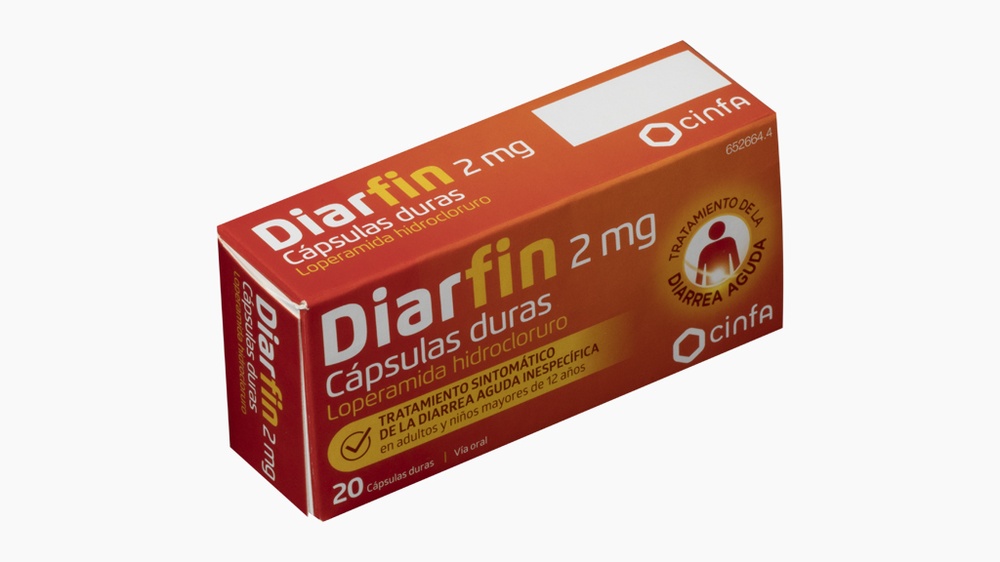
DIARFIN 2 mg Hard Capsules

Prescription review online
A doctor will review your case and decide whether a prescription is medically appropriate.

Talk to a doctor about this medicine
Discuss your symptoms and possible next steps in a quick online consultation.



How to use DIARFIN 2 mg HARD CAPSULES
Contents of the leaflet
- Introduction
- What is Diarfin and what is it used for
- What you need to know before taking Diarfin
- How to take Diarfin
- Possible side effects
- Storage of Diarfin
- Contents of the pack and further information
Introduction
Package Leaflet: Information for the User
Diarfin 2 mg Hard Capsules
loperamide hydrochloride
Read all of this leaflet carefully before you start taking this medicine because it contains important information for you.
Follow exactly the administration instructions of the medicine contained in this leaflet or as indicated by your doctor or pharmacist.
- Keep this leaflet, as you may need to read it again.
- If you need advice or more information, consult your pharmacist.
- If you experience side effects, consult your doctor or pharmacist, even if it is a side effect not listed in this leaflet. See section 4.
- You should consult a doctor if it worsens or does not improve after 2 days of treatment.
Contents of the Package Leaflet
- What is Diarfin and what is it used for
- What you need to know before taking Diarfin
- How to take Diarfin
- Possible side effects
- Storage of Diarfin
- Contents of the pack and further information
1. What is Diarfin and what is it used for
Diarfin is an antidiarrheal that reduces intestinal movements and secretions, resulting in a decrease in liquid stools.
Diarfin is used for the symptomatic treatment of acute non-specific diarrhea in adults and children over 12 years of age.
You should consult a doctor if it worsens or does not improve after 2 days.

Not sure if this medicine is right for you?
Discuss your symptoms and treatment with a doctor online.
2. What you need to know before taking Diarfin
Do not take Diarfin
- If you are allergic to loperamide hydrochloride or any of the other components of this medicine (listed in section 6).
- Do not administer to children under 2 years of age.
- If blood appears in the stool or high fever (above 38 °C).
- If you have been diagnosed with acute ulcerative colitis (inflammation of the intestine).
- If you suffer from severe diarrhea (pseudomembranous colitis) after taking antibiotics.
- If you suffer from diarrhea due to an infection caused by organisms such as Salmonella, Shigellaor Campylobacter.
Warnings and precautions
Consult your doctor or pharmacist before starting to take Diarfin.
- If there is no improvement within 48 hours or if fever, constipation, or other symptoms such as abdominal swelling or paralytic ileus (absence of intestinal movements) appear, discontinue treatment and consult your doctor.
- If you suffer from severe diarrhea, your body loses more fluids, sugars, and salts than usual, so you will need to replenish fluids by drinking more than usual. Dehydration is characterized by dry mouth, excessive thirst, decreased urine output, wrinkled skin, dizziness, and drowsiness. It is very important to prevent dehydration in children and elderly patients.
- Patient with AIDS should discontinue treatment when the first symptoms of abdominal swelling appear.
- If you have any liver or kidney disease or blood disorders, consult your doctor before taking this medicine.
- Since the treatment of diarrhea with Diarfin is only symptomatic, diarrhea should be treated from its cause, when possible.
- Do not take this medicine for a use other than indicated (see section 1) and never take more than the recommended amount (see section 3). Serious heart problems (whose symptoms include rapid or irregular heartbeats) have been reported in patients who have taken an excessive amount of loperamide, the active ingredient of Diarfin.
Children and adolescents
This medicine should not be administered to children under 12 years of age without consulting a doctor.
Other medicines and Diarfin
Tell your doctor or pharmacist if you are taking, have recently taken, or might take any other medicine.
In particular, inform your doctor or pharmacist if you are taking any of the following medicines:
- Ritonavir, saquinavir (used to treat HIV).
- Quinidine (used to treat heart rhythm disorders).
- Desmopressin (used to treat central diabetes insipidus and nocturnal urinary incontinence in children).
- Itraconazole or ketoconazole (used to treat fungal infections).
- Gemfibrozil (used to reduce cholesterol).
- St. John's Wort (used to improve mood and treat mild depression).
- Valerian (used to treat mild nervousness and anxiety).
- Opioid analgesics (used to treat intense pain) as it may increase the risk of severe constipation and central nervous system depression (e.g., drowsiness or decreased consciousness).
- Broad-spectrum antibiotics as it may worsen antibiotic-associated diarrhea.
Diarfin may enhance the effect of similar medicines.
Pregnancy and breastfeeding
If you are pregnant or breastfeeding, think you may be pregnant, or are planning to have a baby, ask your doctor or pharmacist for advice before taking this medicine.
Pregnancy
The safety of this medicine during pregnancy has not been established, so pregnant women should not take this medicine unless prescribed by a doctor.
Breastfeeding
Women who are breastfeeding should not use this medicine without consulting their doctor, as small amounts of it may pass into breast milk.
Driving and using machines
Drowsiness, dizziness, or drowsiness may occur during treatment with Diarfin, so it is advised not to use machinery or drive vehicles.
Diarfin contains lactose.If your doctor has told you that you have an intolerance to some sugars, consult with him before taking this medicine.
Diarfin contains the colorant Orange Yellow S (E-110).This medicine may cause allergic reactions because it contains Orange Yellow S (E-110). It can cause asthma, especially in patients allergic to acetylsalicylic acid.
3. How to take Diarfin
Follow exactly the administration instructions of the medicine contained in this leaflet or as indicated by your doctor or pharmacist. In case of doubt, ask your doctor or pharmacist.
The recommended dose is:
Adults
2 capsules (4 mg of loperamide hydrochloride) as an initial dose, followed by 1 capsule (2 mg of loperamide hydrochloride) after each diarrheal stool.
The maximum dose for adults is 8 capsules (16 mg of loperamide hydrochloride) per day.
Children over 12 years of age
1 capsule (2 mg of loperamide hydrochloride) as an initial dose, followed by 1 capsule (2 mg of loperamide hydrochloride) after each diarrheal stool.
In children, the maximum daily dose should be related to body weight:
Child's weight | Maximum number of capsules per day |
From 27 kg | Maximum 4 capsules |
From 34 kg | Maximum 5 capsules |
From 40 kg | Maximum 6 capsules |
From 47 kg | Maximum 7 capsules |
Patient with liver disease
They should consult their doctor before taking this medicine.
Method of administration
This medicine is taken orally. Swallow the capsules with a glass of water.
Do not exceed the recommended dose.
If you think the effect of Diarfin is too strong or too weak, tell your doctor or pharmacist.
If you take more Diarfin than you should
If you have taken too much Diarfin, contact a doctor or hospital as soon as possible for advice. The symptoms may include: increased heart rate, irregular heartbeats, cardiac arrhythmias (these symptoms can have potentially serious and life-threatening consequences), muscle stiffness, uncoordinated movements, drowsiness, difficulty urinating, or weak breathing.
Children react more severely to high amounts of Diarfin than adults. If a child takes an excessive amount or presents any of the above symptoms, call a doctor immediately.
In case of overdose or accidental ingestion, consult your doctor or pharmacist immediately or call the Toxicology Information Service, phone (91) 562 04 20, indicating the medicine and the amount taken.
If you forget to take Diarfin
Do not take a double dose to make up for the forgotten dose.
If you have any other doubts about the use of this medicine, ask your doctor or pharmacist.

Started taking the medicine and have questions?
Discuss your symptoms and treatment with a doctor online.
4. Possible side effects
Like all medicines, this medicine can cause side effects, although not everybody gets them.
If any of the following side effects occur, discontinue treatment and consult your doctor:
- Allergic reactions such as skin rash, swelling of the face, tongue, or throat that can cause difficulty swallowing or breathing (angioedema).
- Severe allergic reactions including anaphylactic shock.
- Severe abdominal pain.
- Blisters or significant skin peeling.
- Loss or decrease in level of consciousness.
Other side effects that may occur are:
Common side effects (may affect up to 1 in 10 people):
- Headache (cephalalgia).
- Dizziness.
- Constipation.
- Nausea.
- Gas (flatulence).
Uncommon side effects (may affect up to 1 in 100 people):
- Vomiting.
- Pain or discomfort in the upper-middle part of the stomach (dyspepsia).
- Dry mouth.
- Abdominal pain or discomfort.
- Skin discoloration (exanthema).
- Drowsiness.
Rare side effects (may affect up to 1 in 1,000 people):
- Intestinal paralysis (absence of intestinal movements or paralytic ileus).
- Abdominal swelling (distension).
- Dilation of the large intestine (megacolon).
- Loss or decrease in level of consciousness.
- Stupor (general unconsciousness).
- Muscle hypertonia.
- Abnormal coordination.
- Blisters on the skin (bullous eruptions, including Stevens-Johnson syndrome, erythema multiforme, and toxic epidermal necrolysis).
- Skin disorder that produces lesions and intense itching (urticaria).
- Decreased urine output (urinary retention).
- Fatigue.
- Pupillary constriction (miosis).
- Itching (pruritus).
Side effects of unknown frequency (cannot be estimated from the available data):
Upper abdominal pain, abdominal pain radiating to the back, abdominal tenderness, fever, rapid pulse, nausea, vomiting, which may be symptoms of pancreatitis (acute pancreatitis).
Reporting of side effects
If you experience any side effects, consult your doctor or pharmacist, even if it is a possible side effect not listed in this leaflet. You can also report them directly through the Spanish Medicines and Health Products Agency (AEMPS) https://www.notificaram.es. By reporting side effects, you can help provide more information on the safety of this medicine.
5. Storage of Diarfin
Keep this medicine out of the sight and reach of children.
This medicine does not require special storage conditions.
Do not use this medicine after the expiration date that appears on the packaging after CAD. The expiration date is the last day of the month indicated.
Medicines should not be disposed of via wastewater or household waste. Dispose of the packaging and any unused medicine in the pharmacy's SIGRE collection point. If in doubt, ask your pharmacist how to dispose of the packaging and any unused medicine. This will help protect the environment.
6. Contents of the pack and further information
Composition of Diarfin
- The active ingredient of Diarfin is loperamide hydrochloride. Each capsule contains 2 mg of loperamide hydrochloride.
- The other ingredients are:
Capsule content:pregelatinized corn starch, lactose monohydrate, anhydrous colloidal silica, and magnesium stearate.
Hard capsule:gelatin, orange yellow S (E-110), and titanium dioxide (E-171).
Appearance of the product and pack contents
Diarfin is presented in the form of hard gelatin capsules with an orange cap and orange body.
It is presented in PVC-PVDC/ALU blisters. Each pack of Diarfin contains 10 or 20 capsules.
Marketing authorization holder and manufacturer
Laboratorios Cinfa, S.A.
Carretera Olaz-Chipi, 10. Polígono Industrial Areta
31620 Huarte (Navarra) – Spain
Date of the last revision of this leaflet:July 2022
Detailed and updated information on this medicine is available on the website of the Spanish Agency for Medicines and Health Products (AEMPS) http://www.aemps.gob.es/
- Country of registration
- Dosage formCAPSULE, 2 mg loperamide hydrochloride
- ATC codeA07DA03
- Active substance
- Prescription requiredNo
- Manufacturer
- CompositionLACTOSA HIDRATADA (86 mg mg)
- This information is for reference only and does not constitute medical advice. Always consult a doctor before taking any medication. Oladoctor is not responsible for medical decisions based on this content.
- Alternatives to DIARFIN 2 mg HARD CAPSULESDosage form: TABLET, 2 mgActive substance: loperamideManufacturer: Uxa Farma S.A.Prescription not requiredDosage form: ORALLY DISINTEGRATING TABLET/LIOTAB, 2 mgActive substance: loperamideManufacturer: Laboratorios Cinfa S.A.Prescription not requiredDosage form: TABLET, 2 mgActive substance: loperamideManufacturer: Laboratorios Serra Pamies S.A.Prescription not required
Online doctors for DIARFIN 2 mg HARD CAPSULES
Discuss questions about DIARFIN 2 mg HARD CAPSULES, including use, safety considerations and prescription review, subject to medical assessment and local regulations.









Get DIARFIN 2 mg HARD CAPSULES Prescription Online
Fill in a 2-min form
Tell us your symptoms, history, and what medicine you're requesting.
Pick a doctor or let us assign
Choose a specialist or we'll match you with the next available doctor.
Doctor reviews your case
Usually within 30 minutes. They may ask follow-up questions via chat.
Collect from any pharmacy
Electronic prescription sent to your email — valid across Spain.
Frequently Asked Questions
DIARFIN 2 mg HARD CAPSULES does not require a prescription in Spain. You can check with a doctor online whether this medicine may be appropriate for your situation.
The active ingredient in DIARFIN 2 mg HARD CAPSULES is loperamide. This information helps identify medicines with the same composition but different brand names.
DIARFIN 2 mg HARD CAPSULES is manufactured by Laboratorios Cinfa S.A.. Pharmacy brands and packaging may differ depending on the distributor.
Doctors such as Family doctors, Psychiatrists, Dermatologists, Cardiologists, Endocrinologists, Gastroenterologists, Pulmonologists, Nephrologists, Rheumatologists, Hematologists, Infectious disease physicians, Allergists, Geriatricians, Paediatricians, Oncologists may assess whether DIARFIN 2 mg HARD CAPSULES is appropriate, depending on your situation and local regulations. You can book an online consultation to discuss your symptoms and possible next steps.
Spain has a well-developed healthcare infrastructure across major cities such as Madrid, Barcelona, Valencia, and Seville. Pharmacies are widely available and operate under strict regulations, ensuring access to prescribed medications.
You can buy DIARFIN 2 mg HARD CAPSULES in Madrid, Barcelona, Seville, or Valencia at any local pharmacy with a valid prescription.
To obtain a prescription, you can use Oladoctor:
Other medicines with the same active substance (loperamide) include ABECLIN 2 mg TABLETS, DIARFIN FLAS 2 mg ORAL LYOPHILIZED, ELISSAN 2 mg TABLETS. These may have different brand names or formulations but contain the same therapeutic ingredient. Always consult a doctor before switching or starting a new medicine.
