



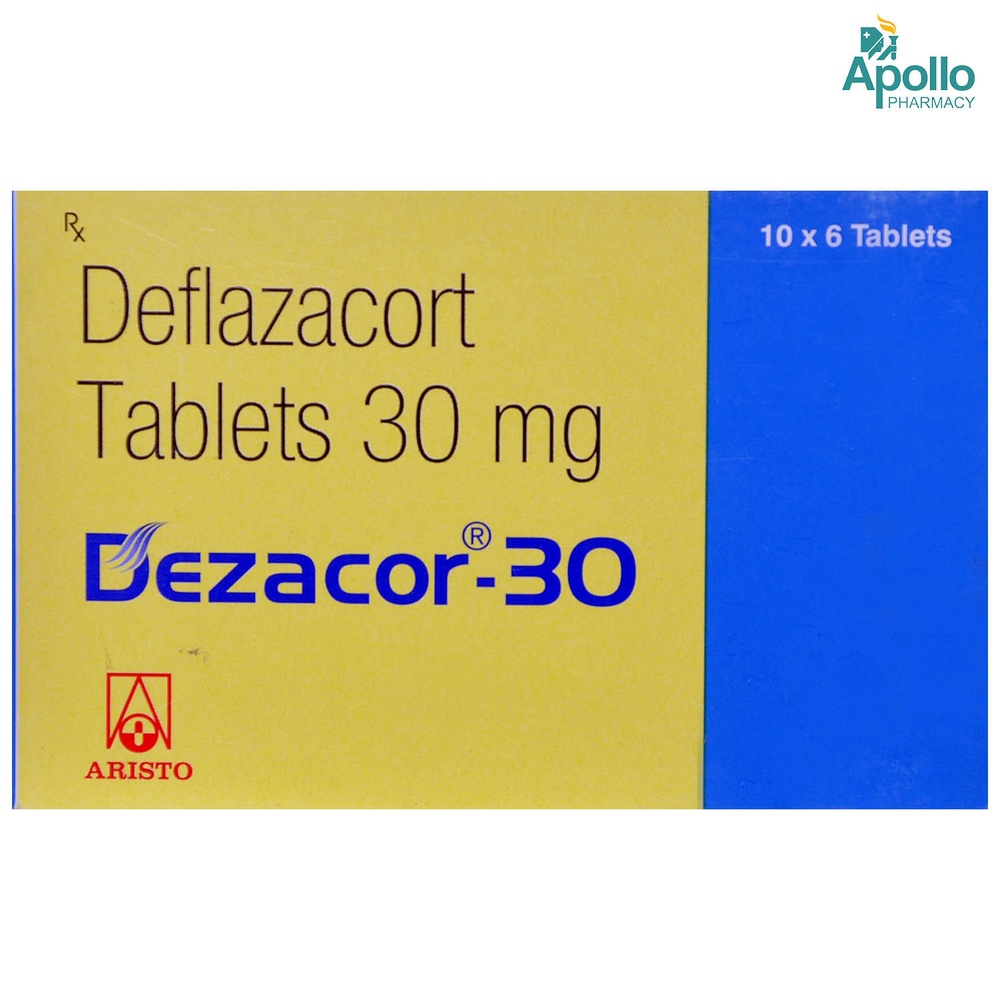
DEZACOR 30 mg Tablets

Prescription review online
A doctor will review your case and decide whether a prescription is medically appropriate.

Talk to a doctor about this medicine
Discuss your symptoms and possible next steps in a quick online consultation.



How to use DEZACOR 30 mg TABLETS
Contents of the leaflet
- Introduction
- What is Dezacor and what is it used for
- What you need to know before you take Dezacor
- How to take Dezacor
- Possible side effects
- Storage of Dezacor
- Contents of the pack and other information
Introduction
Package Leaflet: Information for the User
Dezacor 30 mg tablets
deflazacort
Read all of this leaflet carefully before you start taking this medicine because it contains important information for you.
- Keep this leaflet, you may need to read it again.
- If you have any further questions, ask your doctor or pharmacist.
- This medicine has been prescribed for you only. Do not pass it on to others. It may harm them, even if their signs of illness are the same as yours.
- If you get any side effects, talk to your doctor or pharmacist. This includes any possible side effects not listed in this leaflet. See section 4.
Contents of the package leaflet:
- What is Dezacor and what is it used for
- What you need to know before you take Dezacor
- How to take Dezacor
- Possible side effects
- Storage of Dezacor
- Contents of the pack and other information
1. What is Dezacor and what is it used for
Dezacor is a medicine that belongs to a group of medicines known as corticosteroids, which have anti-inflammatory and anti-allergic properties.
This medicine can be used to treat diseases whose severity requires immediate systemic treatment with glucocorticoids. These include:
- Rheumatic and collagen diseases: treatment of rheumatoid arthritis and psoriatic arthritis when conservative treatments have been shown to be ineffective; polymyalgia rheumatica; acute rheumatic fever; systemic lupus erythematosus; severe dermatomyositis; polyarteritis nodosa; cranial arteritis and Wegener's granulomatosis.
- Skin diseases: bullous pemphigoid, generalized exfoliative dermatitis, erythema multiforme, erythema nodosum, and severe psoriasis.
- Allergic diseases: bronchial asthma refractory to conventional therapy.
- Pulmonary diseases: sarcoidosis with pulmonary involvement, extrinsic allergic alveolitis (organic dust pneumoconiosis), desquamative interstitial pneumonia (idiopathic pulmonary fibrosis).
- Inflammatory eye diseases: choroiditis, chorioretinitis, iritis, and iridocyclitis.
- Hematological diseases: idiopathic thrombocytopenia, hemolytic anemias, and palliative treatment of leukemias and lymphomas.
- Diseases of the digestive system and liver: ulcerative colitis, Crohn's disease, and chronic active hepatitis.
- Kidney diseases: nephrotic syndrome.

Not sure if this medicine is right for you?
Discuss your symptoms and treatment with a doctor online.
2. What you need to know before you take Dezacor
Do not take Dezacor
- If you are allergic (hypersensitive) to deflazacort or any of the other ingredients of this medicine (listed in section 6).
- If you are receiving live virus vaccines.
- If you have a generalized infection without specific treatment.
- If you have a stomach ulcer.
- If you have bacterial infections (active tuberculosis) and viral infections (simple herpes, herpes zoster, chickenpox) or generalized fungal infections.
- If you are in the pre- or post-vaccination period.
Warnings and precautions
Consult your doctor before starting to take this medicine.
- It is essential that your doctor knows all the diseases you have or have had before they can advise you on this treatment. Especially, you must inform them of cardiovascular diseases (heart failure, high blood pressure), those produced by blood clots (thrombosis, embolism), digestive or intestinal diseases (stomach ulcer, intestinal inflammation, chronic diarrhea), significant liver or kidney diseases, diabetes, osteoporosis, behavioral disorders (mood changes, insomnia), epilepsy, glaucoma, thyroid gland insufficiency, muscle weakness, and certain acute or chronic infections. Previous or existing history of severe affective disorders or in first-degree relatives (depressive or manic-depressive illnesses and psychosis).
- The use of corticosteroids whose duration exceeds that of a short-term replacement or emergency treatment is contraindicated in the following cases: Peptic ulcer, bacterial and viral infections such as active tuberculosis, herpes simplex ocular, herpes zoster (viremic phase), as well as in systemic mycotic infections and in the pre- and post-vaccination period.
- In prolonged treatments, ocular alterations may appear, so your doctor may advise you to visit an ophthalmologist periodically.
- Contact your doctor if you experience blurred vision or other visual disturbances.
- It may be necessary to adjust the dose of corticosteroids in special situations (surgery, infections, and others). Inform your doctor if you present any of these processes during treatment with Dezacor.
- Treatment with deflazacort may cause irregular menstruation and leukocytosis.
- You should be especially careful to avoid exposure to measles and chickenpox, and go to the doctor immediately in case of exposure.
- In children, prolonged use of this medicine may stop their growth and development.
- Go to a doctor if you experience worrying psychological symptoms, especially if you suspect a depressive mood or suicidal ideas. You should be aware of possible psychiatric disorders that may appear during or immediately after reducing/stopping the dose of the medicine, although such reactions have been reported with low frequency.
- After long-term treatment, this medicine should never be stopped abruptly. Your doctor will indicate how to gradually decrease the dose. It is also essential that you remain in contact with your doctor at the end of the treatment so that they can act in case of symptom recurrence.
Use in athletes
Patients should be warned that this medicine contains deflazacort, which may produce a positive result in doping tests.
Other medicines and Dezacor
Tell your doctor or pharmacist if you are taking, have recently taken, or might take any other medicines.
Some medicines may increase the effects of Dezacor 30 mg tablets, so your doctor will perform thorough checks if you are taking these medicines (including some for HIV: ritonavir, cobicistat).
In particular, inform your doctor or pharmacist if you are taking any of the following medicines, as Dezacor may interact with them.
- Pain or inflammation medicines.
- Diabetes medicines: because a dose change may be necessary.
- Antihypertensives and diuretics: because a dose change may be necessary.
- Antibiotics (rifampicin): because they may decrease the effect of Dezacor.
- Estrogens or oral contraceptives: because the effect of Dezacor may be increased.
- Muscle relaxant medicines: because the relaxing effect may be prolonged.
- Anticholinesterase medicines used in myasthenia gravis.
- Medicines for the treatment of heart failure or coagulation disorders.
- Vaccines and toxoids: because corticosteroids decrease the immune response.
- Medicines for epilepsy and those used in psychiatric treatments (carbamazepine, phenytoin, phenobarbital): because they may decrease the effect of Dezacor.
- Anticoagulant medicines: because corticosteroids may increase or decrease their effects.
- Antacid medicines: because they may reduce the bioavailability of Dezacor.
Do not take any of these medicines at the same time as Dezacor without your doctor's knowledge.
Pregnancy, breastfeeding, and fertility
If you are pregnant or breastfeeding, think you may be pregnant, or plan to become pregnant, consult your doctor or pharmacist before using this medicine. Taking medicines during pregnancy can be hazardous to the embryo or fetus and should be monitored by your doctor.
Human experience is limited; therefore, deflazacort will only be used in cases where the risk/benefit assessment advises its use.
Dezacor is excreted in breast milk; therefore, its use is not recommended during breastfeeding. The use of deflazacort requires weighing the benefits of breastfeeding against the potential risks.
Driving and using machines
No data are available, although it is advisable that, until the response to treatment is satisfactory, you do not perform tasks that require special attention, such as driving vehicles or operating hazardous machinery.
Dezacor contains lactose
This medicine contains lactose. If your doctor has told you that you have an intolerance to certain sugars, consult them before taking this medicine.
3. How to take Dezacor
Follow exactly the administration instructions of this medicine indicated by your doctor. In case of doubt, consult your doctor or pharmacist again.
This medicine is administered orally. The tablets should be swallowed without chewing, with the help of a little liquid.
The dose must be individualized. Therefore, the number and frequency of tablets you should take will be determined by your doctor based on the type and severity of your disease, as well as the response to treatment.
The tablet can be divided into equal doses.
In adults, the dose may range from 6 to 90 mg per day, and in children from 0.25 to 1.5 mg/kg. It is essential that you fully understand your doctor's instructions regarding the administration of the medicine, and in case of doubt, do not hesitate to consult them.
In special situations (stress, significant infections, severe trauma, or surgical interventions), it may be necessary to adjust the dose. Consult your doctor so that they can explain the procedure to follow in these cases.
Your doctor will indicate the duration of the treatment. Do not stop it before without authorization, and never stop it abruptly.
After prolonged treatment, the administration of this medicine should never be interrupted abruptly. Your doctor will indicate how to gradually decrease the dose. It is also essential that you remain in contact with your doctor at the end of the treatment so that they can act in case of symptom recurrence.
If you take more Dezacor than you should
In case of overdose or accidental ingestion, consult your doctor or pharmacist immediately or call the Toxicology Information Service, phone 91 562 04 20, indicating the medicine and the amount ingested, and go to a hospital center for appropriate treatment.
If you forget to take Dezacor
Do not take a double dose to make up for forgotten doses.
If you stop taking Dezacor
Prolonged treatments that are interrupted abruptly can cause: fever, discomfort, and muscle and joint pain.
If you have any other doubts about the use of this medicine, ask your doctor or pharmacist.

Started taking the medicine and have questions?
Discuss your symptoms and treatment with a doctor online.
4. Possible side effects
Like all medicines, Dezacor can cause side effects, although not everybody gets them.
In short-term treatments, this medicine is well tolerated, and side effects are rare. However, in prolonged treatments, the following have been observed:
Common : may affect up to 1 in 10 people
- Weight gain
Uncommon: may affect up to 1 in 100 people
- Allergy or hypersensitivity to deflazacort
- Pain or discomfort in the abdomen, stomach ulcer, bleeding, nausea, heavy digestion
- Headache, dizziness.
- Depressed or unstable mood.
- Behavioral changes, mood swings (depression, euphoria)
- Hirsutism (excessive hair growth in women), stretch marks, and acne.
- Suppression of the hypothalamic-pituitary-adrenal axis (can cause impaired response to stress and inadequate defense against infections), Cushingoid face (moon face)
- Elevation of blood glucose (with onset or worsening of diabetes), sodium and water retention (with increased blood pressure), potassium loss in the urine when administered together with beta-agonist and xanthine medicines (salbutamol, isoprenaline, fluticasone, theophylline)
- Increased susceptibility to infections due to the reduction of the immune system's action.
- Osteoporosis, vertebral and long bone fractures
- Edema (swelling caused by fluid accumulation in body tissues)
Rare: may affect up to 1 in 1,000 people
- Bruises
- Muscle mass loss
Frequency not known (cannot be estimated from the available data):
- Leukocytosis (increase in the number of white blood cells in the blood)
- Clot formation, particularly in patients with pre-existing conditions associated with a higher tendency to develop thrombi.
- Perforation of peptic ulcer, acute pancreatitis (especially in children), candidiasis (fungal infection of the skin and mucous membranes)
- Restlessness, increased intracranial pressure in children (usually after treatment withdrawal), worsening of epilepsy.
- Irritability, euphoria, suicidal thoughts.
- Mania, delirium, hallucinations, worsening of schizophrenia.
- Anxiety, sleep disorders, and cognitive dysfunction (alteration of higher brain functions such as language, orientation, memory, interpretation of reality, or social behavior)
- Blurred vision, increased intraocular pressure, glaucoma, edema of the optic disc, cataracts (especially in children), chorioretinopathy (retinal alteration that can cause vision changes), corneal thinning, worsening of ocular infections caused by viruses or fungi.
- Thinning of the skin, appearance of small blood vessels in the skin (spider veins)
- Heart failure, hypertrophic cardiomyopathy in premature newborns
- Growth retardation in children
- Greater loss of proteins and calcium, increased appetite
- Avascular necrosis of bone (bone destruction due to insufficient blood supply), tendinitis, and tendon rupture when taken with quinolone-type antibiotics (ciprofloxacin, ofloxacin, levofloxacin), muscle alterations or weakness.
- Menstrual irregularity.
- Impaired wound healing.
- A too rapid reduction of the dose of this medicine after prolonged treatment can lead to acute adrenal insufficiency (a potentially life-threatening condition that occurs when there is a lack of cortisol), hypotension, and death.
The use of Dezacor together with muscle relaxant medicines, especially when administered at high doses and for extended periods, may cause severe muscle alterations.
During treatment with this medicine, your tendency to infections may increase, so if you notice any symptoms of disease that could be related to taking it, you should contact your doctor.
Reporting of side effects
If you experience any side effects, talk to your doctor or pharmacist, even if it is possible side effects not listed in this leaflet. You can also report them directly through the Spanish Pharmacovigilance System for Human Use Medicines: https://www.notificaram.es/. By reporting side effects, you can help provide more information on the safety of this medicine.
5. Storage of Dezacor
Keep out of sight and reach of children.
No special storage conditions are required.
Do not use this medicine after the expiry date stated on the carton after EXP. The expiry date is the last day of the month indicated.
Medicines should not be disposed of via wastewater or household waste. Place the empty packaging and any unused medicine in the SIGRE collection point at your pharmacy. If in doubt, ask your pharmacist how to dispose of unused medicines and packaging. This will help protect the environment.
6. Contents of the pack and other information
Composition of Dezacor
The active substance is deflazacort. Each tablet contains 30 mg of deflazacort.
The other ingredients are: lactose monohydrate, cornstarch, microcrystalline cellulose, and magnesium stearate.
Appearance of Dezacor and pack contents:
Round, uncoated, white tablets, scored on one side and with the number 30 on the other.
The tablets are packaged in PVC-Aluminum blisters and come in packs containing 10 tablets.
Other presentations
Dezacor 6 mg tablets: pack with 20 tablets of 6 mg of deflazacort.
Dezacor 22.75 mg/ml oral suspension: bottle with 13 ml of suspension and dropper.
Marketing authorization holder
Faes Farma, S.A.
Autonomia Etorbidea, 10
48940 Leioa (Bizkaia)
Spain
Manufacturer
Faes Farma, S.A.
Maximo Agirre Kalea, 14
48940 Leioa (Bizkaia)
Spain
Or
Faes Farma, S.A.
Parque Científico y Tecnológico de Bizkaia
Ibaizabal Bidea, Edificio 901
48160 Derio (Bizkaia)
Spain
Date of last revision of this leaflet: April 2025
Detailed and updated information on this medicine is available on the website of the Spanish Agency for Medicines and Health Products (AEMPS) http://www.aemps.gob.es/
- Country of registration
- Dosage formTABLET, 30 mg
- ATC codeH02AB13
- Average pharmacy price3.97 EUR
- Active substance
- Prescription requiredYes
- Manufacturer
- CompositionLACTOSA (313 mg mg)
- This information is for reference only and does not constitute medical advice. Always consult a doctor before taking any medication. Oladoctor is not responsible for medical decisions based on this content.
- Alternatives to DEZACOR 30 mg TABLETSDosage form: TABLET, 30 mgActive substance: deflazacortManufacturer: Faes Farma S.A.Prescription requiredDosage form: TABLET, 6 mgActive substance: deflazacortManufacturer: Faes Farma S.A.Prescription requiredDosage form: TABLET, 30 mgActive substance: deflazacortManufacturer: Laboratorios Alter S.A.Prescription required
Online doctors for DEZACOR 30 mg TABLETS
Discuss questions about DEZACOR 30 mg TABLETS, including use, safety considerations and prescription review, subject to medical assessment and local regulations.

Get DEZACOR 30 mg TABLETS Prescription Online
Fill in a 2-min form
Tell us your symptoms, history, and what medicine you're requesting.
Pick a doctor or let us assign
Choose a specialist or we'll match you with the next available doctor.
Doctor reviews your case
Usually within 30 minutes. They may ask follow-up questions via chat.
Collect from any pharmacy
Electronic prescription sent to your email — valid across Spain.
Frequently Asked Questions
DEZACOR 30 mg TABLETS requires a prescription in Spain. You can check with a doctor online whether this medicine may be appropriate for your situation.
The active ingredient in DEZACOR 30 mg TABLETS is deflazacort. This information helps identify medicines with the same composition but different brand names.
The average pharmacy price for DEZACOR 30 mg TABLETS is around 3.97 EUR. Prices may vary depending on the manufacturer and dosage form.
DEZACOR 30 mg TABLETS is manufactured by Faes Farma S.A.. Pharmacy brands and packaging may differ depending on the distributor.
Doctors such as Family doctors, Psychiatrists, Dermatologists, Cardiologists, Endocrinologists, Gastroenterologists, Pulmonologists, Nephrologists, Rheumatologists, Hematologists, Infectious disease physicians, Allergists, Geriatricians, Paediatricians, Oncologists may assess whether DEZACOR 30 mg TABLETS is appropriate, depending on your situation and local regulations. You can book an online consultation to discuss your symptoms and possible next steps.
Spain has a well-developed healthcare infrastructure across major cities such as Madrid, Barcelona, Valencia, and Seville. Pharmacies are widely available and operate under strict regulations, ensuring access to prescribed medications.
You can buy DEZACOR 30 mg TABLETS in Madrid, Barcelona, Seville, or Valencia at any local pharmacy with a valid prescription.
To obtain a prescription, you can use Oladoctor:
Other medicines with the same active substance (deflazacort) include DEFAL 30 mg TABLETS, DEFAL 6 mg TABLETS, DEFLAZACORT ALTER 30 mg TABLETS. These may have different brand names or formulations but contain the same therapeutic ingredient. Always consult a doctor before switching or starting a new medicine.
