



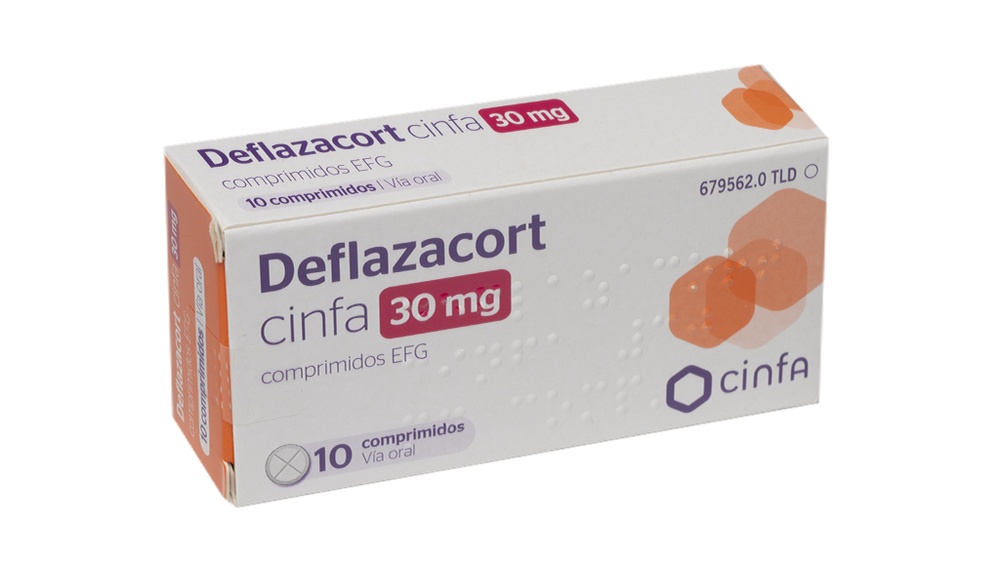
DEFLAZACORT 30 mg Tablets

Prescription review online
A doctor will review your case and decide whether a prescription is medically appropriate.

Talk to a doctor about this medicine
Discuss your symptoms and possible next steps in a quick online consultation.



How to use DEFLAZACORT CINFA 30 mg TABLETS
Contents of the leaflet
- Introduction
- What is deflazacort cinfa and what is it used for
- What you need to know before taking deflazacort cinfa
- How to take deflazacort cinfa
- Possible side effects
- Storage of deflazacort cinfa
- Contents of the pack and further information
Introduction
Package Leaflet: Information for the User
deflazacort cinfa 30 mg tablets EFG
Read this package leaflet carefully before you start taking this medicine, because it contains important information for you.
- Keep this package leaflet, you may need to read it again.
- If you have any further questions, ask your doctor or pharmacist.
- This medicine has been prescribed for you only. Do not pass it on to others, as it may harm them, even if their symptoms are the same as yours.
- If you experience any side effects, talk to your doctor or pharmacist. This includes any possible side effects not listed in this package leaflet. See section 4.
Contents of the package leaflet
- What is deflazacort cinfa and what is it used for
- What you need to know before taking deflazacort cinfa
- How to take deflazacort cinfa
- Possible side effects
- Storage of deflazacort cinfa
- Contents of the pack and further information
1. What is deflazacort cinfa and what is it used for
deflazacort cinfa is a medicine that belongs to a group of medicines known as corticosteroids, which have anti-inflammatory and anti-allergic properties. It has a distinct safety profile compared to other corticosteroids, with less activity on sugars and bone.
deflazacort cinfa is indicated for the treatment of:
- Rheumatic and collagen diseases: such as rheumatoid arthritis, psoriatic arthritis, and systemic lupus erythematosus.
- Skin diseases: such as pemphigus, generalized exfoliative dermatitis, and severe psoriasis.
- Allergic diseases: bronchial asthma that does not respond to conventional treatment.
- Pulmonary diseases: sarcoidosis, organic dust pneumoconiosis, idiopathic pulmonary fibrosis.
- Ocular diseases: choroiditis, chorioretinitis, iritis, and iridocyclitis.
- Blood diseases: idiopathic thrombocytopenia, hemolytic anemia, and palliative treatment of leukemia and lymphoma.
- Gastrointestinal and hepatic diseases: ulcerative colitis, Crohn's disease, and chronic active hepatitis.
- Kidney diseases: nephrotic syndrome.

Not sure if this medicine is right for you?
Discuss your symptoms and treatment with a doctor online.
2. What you need to know before taking deflazacort cinfa
Do not take deflazacort cinfa
- If you are allergic to deflazacort or any of the other ingredients of this medicine (listed in section 6).
- If you have a stomach ulcer.
- If you have bacterial infections (active tuberculosis) and viral infections (simple ocular herpes, herpes zoster, chickenpox) or generalized fungal infections.
- If you are in a pre- or post-vaccination period.
Warnings and precautions
Talk to your doctor or pharmacist before taking deflazacort cinfa.
- Tell your doctor if you have any heart disease, congestive heart failure, high blood pressure, thromboembolic diseases (those caused by blood clots), esophageal, stomach, or intestinal diseases, diabetes mellitus, emotional disorders, psychosis, epilepsy, glaucoma, hypothyroidism (thyroid gland insufficiency), and/or cirrhosis.
- It is necessary to adjust the dose of corticosteroids in special situations (surgery, infections, and others) and therefore the doctor should know if the patient has suffered from any other disease.
- In children, prolonged use of this medicine may stop their growth and development.
- After long-term treatment with deflazacort, it should be gradually discontinued. Do not stop taking this medicine without consulting your doctor first.
- Contact your doctor if you experience blurred vision or other visual disturbances.
Use in athletes
Patients should be warned that this medicine contains deflazacort, which may produce a positive result in doping tests.
Taking deflazacort cinfa with other medicines
Tell your doctor or pharmacist if you are taking, have recently taken, or might take any other medicines.
In particular, tell your doctor or pharmacist if you are taking any of the following medicines, as deflazacort may interact with them:
- Diabetes medicines: because a dose change may be necessary.
- Anti-infectives (rifampicin): because they may decrease the effect of deflazacort.
- Estrogens or oral contraceptives: because the effect of deflazacort may be increased.
- Muscle relaxants: because the relaxing effect may be prolonged.
- Anticholinesterase medicines used in myasthenia gravis.
- Vaccines and toxoids: because corticosteroids decrease the immune response.
- Medicines for epilepsy and those used in psychiatric treatments (phenytoin, phenobarbital): because they may decrease the effect of deflazacort.
- Some medicines may increase the effects of deflazacort, so your doctor will monitor you closely if you are taking these medicines (including some for HIV: ritonavir, cobicistat).
Pregnancy, breastfeeding, and fertility
If you are pregnant or breastfeeding, think you may be pregnant, or plan to become pregnant, consult your doctor or pharmacist before using this medicine.
Deflazacort should not be used during the first trimester of pregnancy unless the doctor considers the benefits to outweigh the potential risk.
Taking medicines during pregnancy can be hazardous to the embryo or fetus and should be monitored by your doctor.
Deflazacort passes into breast milk, so its use is not recommended during breastfeeding.
Driving and using machines
No data are available, although it is advisable that, until the response to treatment is satisfactory, you should not perform tasks that require special attention, such as driving vehicles or operating hazardous machinery.
deflazacort cinfa contains lactose
This medicine contains lactose. If your doctor has told you that you have an intolerance to some sugars, consult them before taking this medicine.
deflazacort cinfa contains sodium
This medicine contains less than 23 mg of sodium (1 mmol) per tablet; it is essentially "sodium-free".
3. How to take deflazacort cinfa
Follow exactly the administration instructions of this medicine given by your doctor or pharmacist. If you are unsure, consult your doctor or pharmacist again.
This medicine is administered orally. The tablets should be swallowed without chewing, with a little liquid.
The tablet can be divided into equal doses. The dose should be individualized. Therefore, the number and frequency of tablets you should take will be determined by your doctor based on the type and severity of your disease, as well as your response to treatment.
In adults, the dose may range from 6 to 90 mg per day, and in children from 0.25 to 1.15 mg/kg. It is essential that you fully understand your doctor's instructions regarding the administration of the medicine and, if in doubt, do not hesitate to consult them.
Your doctor will indicate the duration of treatment. Do not stop it before, or without authorization, and never stop it abruptly. In special situations (stress, significant infections, severe trauma, or surgical interventions), it may be necessary to adjust the dose. Consult your doctor to explain the procedure to follow in these cases.
After prolonged treatment, the administration of this medicine should never be stopped abruptly. Your doctor will indicate how to gradually decrease the dose. It is also important that you remain in contact with your doctor at the end of treatment so that they can act in case of symptom recurrence.
If you take more deflazacort cinfa than you should
In case of overdose or accidental ingestion, consult your doctor or pharmacist immediately or call the Toxicology Information Service, telephone 91 562 04 20, indicating the medicine and the amount taken.
If you forget to take deflazacort cinfa
Do not take a double dose to make up for forgotten doses.
If you stop taking deflazacort cinfa
After long-term treatment with deflazacort, it should be gradually discontinued. Prolonged treatments that are stopped abruptly can cause fever, malaise, and muscle and joint pain.
If you have any further questions about the use of this medicine, ask your doctor or pharmacist.

Started taking the medicine and have questions?
Discuss your symptoms and treatment with a doctor online.
4. Possible side effects
Like all medicines, this medicine can cause side effects, although not everybody gets them.
The side effects of deflazacort that have been observed, mainly in long-term treatments, are the following:
- Gastrointestinal disorders:gastrointestinal ulcers.
- Nervous system disorders:headache, dizziness, agitation, sleep disorders.
- Skin and subcutaneous tissue disorders:healing problems, skin lesions.
- Cardiac and vascular disorders:increased blood pressure (hypertension), water retention in tissues (edema).
- Endocrine disorders:weight gain, worsening of diabetes mellitus, disappearance of menstruation.
- Musculoskeletal and connective tissue disorders: muscle weakness, osteoporosis.
- Ocular disorders: ocular disturbances.
Frequency not known (cannot be estimated from available data): blurred vision.
The use of deflazacort together with muscle relaxants, especially when administered at high doses and for long periods, may cause severe muscle disorders.
Reporting of side effects
If you experience any side effects, talk to your doctor or pharmacist, even if they are possible side effects not listed in this package leaflet. You can also report them directly through the Spanish Medicines and Healthcare Products Agency (AEMPS) website: https://www.notificaram.es. By reporting side effects, you can help provide more information on the safety of this medicine.
5. Storage of deflazacort cinfa
Keep this medicine out of the sight and reach of children.
This medicine does not require special storage conditions.
Do not use this medicine after the expiry date stated on the packaging after EXP. The expiry date is the last day of the month indicated.
Medicines should not be disposed of via wastewater or household waste. Place the packaging and any unused medicine in the pharmacy's SIGRE collection point. If you are unsure, ask your pharmacist how to dispose of the packaging and any unused medicine. This will help protect the environment.
6. Contents of the pack and further information
Composition of deflazacort cinfa
The active ingredient is deflazacort. Each tablet contains 30 mg of deflazacort.
The other ingredients are: lactose monohydrate, microcrystalline cellulose (E-460), sodium croscarmellose, cornstarch, polysorbate 80 (E-433), and magnesium stearate.
Appearance of the product and pack contents
deflazacort cinfa 30 mg are tablets, cylindrical, uncoated, white, with a double score line in the shape of a cross on one face and the number 30 on the other.
They are presented in blister packs containing 10 tablets.
Marketing authorization holder and manufacturer
Laboratorios Cinfa, S.A.
Carretera Olaz-Chipi, 10. Polígono Industrial Areta.
31620 Huarte (Navarra) - Spain
Date of last revision of this package leaflet: July 2020
Detailed and updated information on this medicine is available on the website of the Spanish Agency for Medicines and Healthcare Products (AEMPS) http://www.aemps.gob.es
You can access detailed and updated information about this medicine by scanning the QR code included in the package leaflet and packaging with your smartphone. You can also access this information at the following internet address: https://cima.aemps.es/cima/dochtml/p/73873/P_73873.html
QR code to: https://cima.aemps.es/cima/dochtml/p/73873/P_73873.html
- Country of registration
- Dosage formTABLET, 30 mg
- ATC codeH02AB13
- Average pharmacy price2.67 EUR
- Active substance
- Prescription requiredYes
- Manufacturer
- CompositionLACTOSA MONOHIDRATO (80,0 mg mg), CROSCARMELOSA SODICA (16,0 mg mg), POLISORBATO 80 (1,0 mg mg)
- This information is for reference only and does not constitute medical advice. Always consult a doctor before taking any medication. Oladoctor is not responsible for medical decisions based on this content.
- Alternatives to DEFLAZACORT CINFA 30 mg TABLETSDosage form: TABLET, 30 mgActive substance: deflazacortManufacturer: Faes Farma S.A.Prescription requiredDosage form: TABLET, 6 mgActive substance: deflazacortManufacturer: Faes Farma S.A.Prescription requiredDosage form: TABLET, 30 mgActive substance: deflazacortManufacturer: Laboratorios Alter S.A.Prescription required
Online doctors for DEFLAZACORT CINFA 30 mg TABLETS
Discuss questions about DEFLAZACORT CINFA 30 mg TABLETS, including use, safety considerations and prescription review, subject to medical assessment and local regulations.

Get DEFLAZACORT CINFA 30 mg TABLETS Prescription Online
Fill in a 2-min form
Tell us your symptoms, history, and what medicine you're requesting.
Pick a doctor or let us assign
Choose a specialist or we'll match you with the next available doctor.
Doctor reviews your case
Usually within 30 minutes. They may ask follow-up questions via chat.
Collect from any pharmacy
Electronic prescription sent to your email — valid across Spain.
Frequently Asked Questions
DEFLAZACORT CINFA 30 mg TABLETS requires a prescription in Spain. You can check with a doctor online whether this medicine may be appropriate for your situation.
The active ingredient in DEFLAZACORT CINFA 30 mg TABLETS is deflazacort. This information helps identify medicines with the same composition but different brand names.
The average pharmacy price for DEFLAZACORT CINFA 30 mg TABLETS is around 2.67 EUR. Prices may vary depending on the manufacturer and dosage form.
DEFLAZACORT CINFA 30 mg TABLETS is manufactured by Laboratorios Cinfa S.A.. Pharmacy brands and packaging may differ depending on the distributor.
Doctors such as Family doctors, Psychiatrists, Dermatologists, Cardiologists, Endocrinologists, Gastroenterologists, Pulmonologists, Nephrologists, Rheumatologists, Hematologists, Infectious disease physicians, Allergists, Geriatricians, Paediatricians, Oncologists may assess whether DEFLAZACORT CINFA 30 mg TABLETS is appropriate, depending on your situation and local regulations. You can book an online consultation to discuss your symptoms and possible next steps.
Spain has a well-developed healthcare infrastructure across major cities such as Madrid, Barcelona, Valencia, and Seville. Pharmacies are widely available and operate under strict regulations, ensuring access to prescribed medications.
You can buy DEFLAZACORT CINFA 30 mg TABLETS in Madrid, Barcelona, Seville, or Valencia at any local pharmacy with a valid prescription.
To obtain a prescription, you can use Oladoctor:
Other medicines with the same active substance (deflazacort) include DEFAL 30 mg TABLETS, DEFAL 6 mg TABLETS, DEFLAZACORT ALTER 30 mg TABLETS. These may have different brand names or formulations but contain the same therapeutic ingredient. Always consult a doctor before switching or starting a new medicine.
