



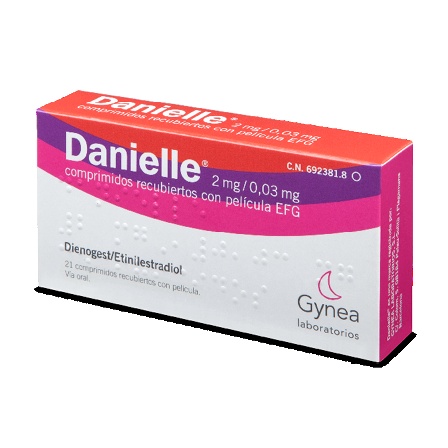
DANIELLE 2 mg /0.03 Mg Film-Coated Tablets

Prescription review online
A doctor will review your case and decide whether a prescription is medically appropriate.

Talk to a doctor about this medicine
Discuss your symptoms and possible next steps in a quick online consultation.



How to use DANIELLE 2mg/0.03mg FILM-COATED TABLETS
Contents of the leaflet
- Introduction
- What Danielle is and what it is used for
- What you need to know before starting to take Danielle
- How to take Danielle
- Possible Adverse Effects
- Storage of Danielle
- Package Contents and Additional Information
Introduction
Package Leaflet: Information for the User
Danielle 2 mg/0.03 mg film-coated tablets EFG
Dienogest and Ethinylestradiol
Important things to know about combined hormonal contraceptives (CHCs):
- They are one of the most reliable reversible contraceptive methods if used correctly.
- They slightly increase the risk of having a blood clot in the veins and arteries, especially in the first year or when restarting a combined hormonal contraceptive after a break of 4 weeks or more.
- Be alert and consult your doctor if you think you may have symptoms of a blood clot (see section 2 “Blood clots”).
Read the entire package leaflet carefully before starting to take this medication, as it contains important information for you.
- Keep this package leaflet, as you may need to read it again.
- If you have any questions, consult your doctor or pharmacist.
- This medication has been prescribed to you only, and you should not give it to others, even if they have the same symptoms as you, as it may harm them.
- If you experience side effects, consult your doctor or pharmacist, even if they are side effects not listed in this package leaflet. See section 4.
Contents of the package leaflet:
- What Danielle is and what it is used for
- What you need to know before you start taking Danielle
- How to take Danielle
- Possible side effects
- Storage of Danielle
- Package contents and additional information
1. What Danielle is and what it is used for
Danielle 2mg/0.03 mg film-coated tablets, also called Danielle, is an oral contraceptive that contains a combination of two hormones.
Danielle is a low-hormone contraceptive that contains two types of female sex hormones in small amounts, called ethinylestradiol (has effects similar to those of estrogens) and dienogest (has effects similar to those of the natural hormone progesterone). The tablets of Danielle are identical. The administration of Danielle improves symptoms such as acne development that can occur in women with increased male hormonal effect, called "androgenic effect".

Not sure if this medicine is right for you?
Discuss your symptoms and treatment with a doctor online.
2. What you need to know before starting to take Danielle
General considerations
Before starting to use Danielle, you should read the information about blood clots in section 2. It is particularly important that you read the symptoms of a blood clot (see section 2 "Blood clots").
In this prospectus, several situations are described in which you should interrupt the use of Danielle or in which its contraceptive effect may decrease. In such situations, you should not have intercourse or should use a non-hormonal contraceptive method (e.g., a condom) or another barrier method.
Danielle, like other combined oral contraceptives, does not protect against HIV (AIDS) or any other sexually transmitted disease.
Oral contraceptives and cancer risk
In studies conducted, it has been observed that breast cancer occurs more frequently in women taking oral contraceptives than in those who do not use them, but there is no evidence that the cause is the taking of these. Women who take oral contraceptives are examined more frequently, so breast cancer is detected at an earlier stage.
10 years after stopping oral contraceptives, this small difference disappears.
Benign liver tumors are rarely detected in users of oral contraceptives, and it is even rarer for malignant liver tumors to occur. These tumors can produce internal bleeding (abdominal). Contact your doctor immediately if you have pain in the upper abdomen.
Some studies have shown that there are more cases of cervical cancer among women who use oral contraceptives for a long time. However, it is not entirely certain that this is due to these, because the incidence of cervical cancer is affected by many other factors, for example, by sexual habits (e.g., frequent change of partner).
Ovarian cancer
Ovarian cancer occurs less frequently than breast cancer. The use of hormone replacement therapy (HRT) with estrogen alone or in combination with estrogen-progestin has been associated with a slightly increased risk of ovarian cancer.
The risk of ovarian cancer varies with age. For example, in women between 50 and 54 years of age who do not follow HRT, around 2 cases of ovarian cancer have been observed per 2,000 women over a 5-year period. In women treated with HRT for 5 years, around 3 cases have been observed per 2,000 patients (i.e., around 1 additional case).
When you should not use Danielle
You should not use Danielle if you have any of the conditions listed below.
Inform your doctor if you have any of the conditions listed below. Your doctor will discuss with you what other form of contraception would be more suitable.
- If you have (or have ever had) a blood clot in a blood vessel in your legs (deep vein thrombosis, DVT), in your lungs (pulmonary embolism, PE), or in other organs.
- If you know you have a disorder that affects blood clotting: for example, protein C deficiency, protein S deficiency, antithrombin III deficiency, factor V Leiden, or antiphospholipid antibodies.
- If you need an operation or spend a lot of time without getting up (see section "Blood clots").
- If you have ever had a heart attack or stroke.
- If you have (or have ever had) angina pectoris (a condition that causes severe chest pain and can be the first sign of a heart attack) or a transient ischemic attack (TIA, temporary stroke symptoms).
- If you have any of the following diseases that can increase your risk of forming a clot in the arteries:
- Severe diabetes with blood vessel damage.
- Very high blood pressure.
- Very high levels of fat in the blood (cholesterol or triglycerides).
- A condition called hyperhomocysteinemia.
- If you have (or have ever had) a type of migraine called "migraine with aura".
- If you are allergic to ethinylestradiol, dienogest, or any of the other components of Danielle;
- If you have severe active liver disease, family history, or jaundice, or itching all over your body, as these could be the first signs of liver disease;
- In the case of active liver tumor (benign or malignant) or family history for suffering from it.
- If you know or suspect tumors of genital organs or breasts.
- If you have had vaginal bleeding of unknown origin.
- If you have pancreatitis or have had it associated with severe hypertriglyceridemia.
- In the case of severe kidney failure or acute kidney failure.
- If you have hepatitis C and are taking medications that contain ombitasvir/paritaprevir/ritonavir and dasabuvir, glecaprevir/pibrentasvir, or sofosbuvir/velpatasvir/voxilaprevir (see also the section "Taking Danielle with other medications").
The risk of thromboembolism increases if the following conditions are present:
If you experience any of the disorders mentioned above while taking Danielle, stop taking the medication immediately and consult your doctor. In the meantime, you should use non-hormonal contraceptive methods.
If you are affected by any of the conditions mentioned above, inform your doctor before starting to take Danielle. Your doctor may recommend another type of oral contraceptive or a non-hormonal contraception method.
Warnings and precautions.
When should you consult your doctor? Seek urgent medical attention
To obtain a description of the symptoms of these serious side effects, see "How to recognize a blood clot". |
Tell your doctor if you suffer from any of the following conditions:
If the condition develops or worsens while you are using Danielle, you should also inform your doctor.
- If you have Crohn's disease or ulcerative colitis (chronic inflammatory bowel disease).
- If you have systemic lupus erythematosus (SLE, a disease that affects your natural defense system).
- If you have hemolytic uremic syndrome (HUS, a blood clotting disorder that causes kidney failure).
- If you have sickle cell anemia (a hereditary disease of red blood cells).
- If you have high levels of fat in the blood (hypertriglyceridemia) or known family history of this condition. Hypertriglyceridemia has been associated with an increased risk of pancreatitis (inflammation of the pancreas).
- If you need an operation or spend a lot of time without getting up (see section 2 "Blood clots").
- If you have just given birth, you are at a higher risk of suffering from blood clots. You should ask your doctor when you can start taking Danielle after childbirth.
- If you have inflammation of the veins that are under the skin (superficial thrombophlebitis).
- If you have varicose veins
- If you have diabetes mellitus;
- If you are obese (body mass index is greater than 30 kg/m2);
- If you have not reached your final adult height;
- If you have hypertension;
- If you have valvular heart disease or heart rhythm disorders;
- If any of your close relatives have had thrombosis, heart attack, or stroke;
- If you have migraine;
- If you have seizures ("Sydenham's chorea");
- If you or a close relative have high levels of cholesterol or triglycerides (fats in the blood);
- If you have liver disease or biliary complications;
- If you have jaundice and/or itching all over your body;
- If you have a rare disorder of hemoglobin metabolism (porphyria);
- If you have hereditary angioedema;
- If you have endogenous depression;
- If you had blisters similar to a rash in the late stages of your pregnancy (gestational herpes or gestational pemphigoid);
- If you have hearing loss due to otosclerosis (in the middle ear);
- If you have, or have had, brownish-yellow spots on the skin, especially on the face (chloasma), if this happens to you, you should avoid direct sunlight or ultraviolet light;
- If you smoke. Smoking cigarettes increases the risk of serious side effects with the use of oral contraceptives, such as heart attack and stroke. This risk increases even more the more tobacco you smoke and with age.
If you take the pill, stop smoking, especially if you are over 35 years old. If you do not stop smoking, you should use other contraceptive methods, especially if there are other risk factors.
When should you visit your doctor?
Your doctor will schedule regular check-ups while you are taking the pill. Depending on your situation and health status, your doctor will decide how often these exams are necessary and what type of tests will be performed.
Contact your doctor as soon as possible if you experience any of the following:
- before a planned major operation or immobilization (ask your doctor at least 4 weeks in advance);
PSYCHIATRIC DISORDERS
Some women who use hormonal contraceptives like Danielle have reported depression or a depressed mood. Depression can be severe and sometimes can induce suicidal thoughts. If you experience mood changes and depressive symptoms, contact your doctor for additional medical advice as soon as possible.
BLOOD CLOTS
The use of a combined hormonal contraceptive like Danielle increases your risk of suffering from a blood clot compared to not using it. In rare cases, a blood clot can block blood vessels and cause serious problems.
Blood clots can form:
- In the veins (which is called "venous thrombosis", "venous thromboembolism" or VTE).
- In the arteries (which is called "arterial thrombosis", "arterial thromboembolism" or ATE).
Recovery from blood clots is not always complete. In rare cases, there can be serious lasting effects or, very rarely, they can be fatal.
It is essential to remember that the overall risk of a harmful blood clot due to Danielle is small.
HOW TO RECOGNIZE A BLOOD CLOT
Seek urgent medical attention if you notice any of the following signs or symptoms.
Are you experiencing any of these signs? | What might you be suffering from? |
| Deep vein thrombosis |
If you are unsure, consult a doctor, as some of these symptoms, such as cough or shortness of breath, can be confused with a milder condition like a respiratory infection (e.g., a "common cold"). | Pulmonary embolism |
Symptoms that occur more frequently in one eye:
| Retinal vein thrombosis (blood clot in the eye). |
| Heart attack. |
Sometimes the symptoms of a stroke can be brief, with almost immediate and complete recovery, but you should still seek urgent medical attention, as you may be at risk of having another stroke. | Stroke |
| Blood clots that block other blood vessels. |
BLOOD CLOTS IN A VEIN
What can happen if a blood clot forms in a vein?
- The use of combined hormonal contraceptives has been associated with an increased risk of blood clots in the veins (venous thrombosis). However, these side effects are rare. They occur more frequently in the first year of use of a combined hormonal contraceptive.
- If a blood clot forms in a vein in the leg or foot, it can cause deep vein thrombosis (DVT).
- If a blood clot moves from the leg and lodges in the lung, it can cause a pulmonary embolism.
- In very rare cases, a clot can form in a vein of another organ, such as the eye (retinal vein thrombosis).
When is the risk of a blood clot in a vein higher?
The risk of a blood clot in a vein is higher during the first year in which you take a combined hormonal contraceptive for the first time. The risk may be higher if you start taking a combined hormonal contraceptive again (the same medication or a different one) after an interruption of 4 weeks or more.
After the first year, the risk decreases, but it is always slightly higher than if you were not taking a combined hormonal contraceptive.
When you stop taking Danielle, your risk of a blood clot returns to normal within a few weeks.
What is the risk of a blood clot?
The risk depends on your natural risk of VTE and the type of combined hormonal contraceptive you are taking.
The overall risk of a blood clot in the leg or lung (DVT or PE) with Danielle is small.
- Out of 10,000 women who do not use a combined hormonal contraceptive and are not pregnant, about 2 will develop a blood clot in a year.
- Out of 10,000 women who use a combined hormonal contraceptive that contains levonorgestrel or norethisterone or norgestimate, about 5-7 will develop a blood clot in a year.
- Out of 10,000 women who use a hormonal contraceptive that contains dienogest and ethinylestradiol, like Danielle, about 8-11 women will develop a blood clot in a year.
- The risk of a blood clot will depend on your personal history (see "Factors that increase your risk of a blood clot" below).
Risk of a blood clot in a year | |
Women who do not usea combined hormonal pill/patch/ring and who are not pregnant | About 2 out of 10,000 women |
Women who use a combined hormonal contraceptive pill that contains levonorgestrel, norethisterone, or norgestimate | About 5-7 out of 10,000 women |
Women who use Danielle | About 8-11 out of 10,000 women |
Factors that increase your risk of a blood clot in a vein
The risk of a blood clot with Danielle is small, but some conditions increase the risk. Your risk is higher:
- If you are overweight (body mass index or BMI greater than 30 kg/m2).
- If any of your close relatives have had a blood clot in the leg, lung, or other organ at a young age (i.e., before the age of 50 approximately). In this case, you may have a hereditary disorder of blood clotting.
- If you need an operation or spend a lot of time without getting up due to an injury or illness or if you have your leg in a cast. You may need to interrupt the use of Danielle several weeks before the operation or while you have less mobility. If you need to interrupt the use of Danielle, ask your doctor when you can start using it again.
3. How to take Danielle
Follow the instructions for taking Danielle exactly as indicated by your doctor. Consult your doctor or pharmacist if you have any doubts.
Each pack of Danielle contains 21, 3x21, or 6x21 film-coated tablets. The pack indicates the days of the week when you should take the tablets.
You should try to take the tablets at the same time every day, with some liquid if necessary. Take one tablet each day, following the direction of the arrows, until you have finished the pack. There are 7 days when you should not take any tablets. During this "tablet-free" period, you should have a bleed, usually 2-3 days after taking the last tablet.
You should start taking the next pack of Danielle on the 8th day after you took the last tablet. You should start taking the next pack of Danielle even if you are still bleeding. Each new pack will start on the same day of the week as you did with the previous pack, making it easier to remember when to start again, and your cycle will always be on the same day of the month.
If you follow the instructions, the contraceptive will protect you from unwanted pregnancy from the first day of treatment.
Taking your first pack of Danielle
If you have not been treated with hormonal contraception in the last month:
You will take a tablet from the first day of your menstrual cycle (the first day of menstruation counts as day 1), taking the tablet marked with the correct day of the week from the blister pack.
If you are switching to Danielle from a combined contraceptive (combined oral contraceptive, vaginal ring, transdermal patch):
The first tablet of Danielle should be taken following the usual tablet-free period or on the first day immediately after the last tablet of your previous contraceptive (without having a "tablet-free" period).
If your previous product had placebo tablets (without hormones), Danielle should be started following the usual placebo tablet interval or after the last active tablet (which contains hormones). If you are unsure which tablets are the active ones, ask your doctor or pharmacist.
If you were using a vaginal ring or transdermal patch, you should start taking Danielle on the day you remove the ring or patch, but no later than when the next application would be due.
If you are switching from a progestogen-only contraceptive:
Women who take only progestogen can switch to Danielle at any time and can take it the next day (within the usual time frame). They should use an additional contraceptive method, such as a barrier method (condom), for the next 7 days.
If you were using injectable contraceptives or an implant or IUD (intrauterine device) that releases progestogen:
Women who use implants or IUDs can start Danielle on the day the implant or IUD is removed. If you received injectable contraceptives, you can start taking Danielle when your next injection would be due. You should use an additional contraceptive method, such as a barrier method (condom), for the next 7 days.
After having a baby:
If you have just had a baby, your doctor may advise you to start taking Danielle after your first period. However, in some cases, you may start hormonal contraception before; please consult your doctor. You should not breastfeed your baby if you take Danielle, unless your doctor has told you to do so.
After an abortion or miscarriage: Follow your doctor's instructions.
Ask your doctor or pharmacist if you think Danielle is too strong or too weak for you.
If you take more Danielle than you should
There is no data available on the overdose of Danielle. Based on information from other combined oral contraceptives, the toxicity of an overdose is very low in both adults and children. An overdose may cause nausea, vomiting, and in young women, vaginal bleeding. If you have taken more Danielle than you should, please contact your doctor.
If you realize that a child has probably taken several tablets, consult your doctor immediately.
If you forget to take Danielle
Do not take a double dose to make up for forgotten doses.
If you take the tablet less than 12 hoursafter the time you should have taken it, no precautions are necessary; you should take the medicine as soon as possible and the next tablet should be taken at the usual time. The contraceptive protection of Danielle should not be affected.
If you forget to take a tablet for more than 12 hours, the contraceptive protection will be lower. The risk of an unwanted pregnancy is very high if you forget to take a tablet at the beginning or end of the pack. In this case, the following rules apply.
If you have forgotten to take onetablet in the first week:
You should take the last forgotten tablet, even if this means taking two tablets in one day, and then continue taking the tablets at the usual time. You should take additional contraceptive precautions (e.g., condom) for the next 7 days. However, if you have had sex in the last 7 days, pregnancy cannot be ruled out. In this case, inform your doctor immediately.
If you have forgotten to take onetablet in the second week:
You should take the last forgotten tablet, even if this means taking two tablets in one day, and then continue taking the tablets at the usual time. If you have taken the tablet regularly in the last 7 days, there is no need to take additional contraceptive precautions.
If you have forgotten to take onetablet in the third week:
Follow the protocols below and do not take additional contraceptive precautions, as you have taken the tablets regularly in the last 7 days.
You have two options:
- You should take the last forgotten tablet, even if this means taking two tablets in one day, and then continue taking the tablets at the usual time. The next pack should be started as soon as the current one is finished, i.e., without a break between packs. You are unlikely to have a bleed until the end of the second pack, and you may experience spotting or bleeding during the second pack.
- The second option is to stop taking the current pack, have a maximum of 7 days of tablet-free period (including the days when the tablet was not taken), and then start a new pack. If you want to start the new pack on the same day of the week as usual, the tablet-free period may be less than 7 days.
If you have forgotten to take more than onetablet:
Ask your doctor. Do not forget that in this case, the contraceptive method is not effective. If you did not take several tablets from the current pack and do not have a bleed during the first tablet-free period, there is a high likelihood of pregnancy. You are advised to contact your doctor before starting a new pack of Danielle.
Gastrointestinal disturbance
If you vomit or have diarrhea within 3-4 hours after taking the tablet, it may happen that the tablet is not absorbed correctly from the gastrointestinal tract. The situation is similar to if you had forgotten to take a tablet. In this case, a tablet should be taken as soon as possible, within 12 hours of the usual time. If more than 12 hours pass, follow the instructions in the section "If you forget to take Danielle".
Delaying the time of menstrual bleeding
You can delay the time of menstrual bleeding if, after finishing the previous pack, you continue taking Danielle without a break. Menstrual bleeding can be delayed until the end of the second pack or, if necessary, for a shorter period. During the second pack, some spotting or bleeding may occur. After finishing the second pack of tablets, you should have a 7-day break, after which you can take Danielle again.
If you want to start your menstrual cycle on a different day
If you follow the instructions for taking the tablets, your cycle will be approximately the same day every four weeks. If you want to start your menstrual cycle on a different day of the week, the length of the tablet-free period should be reduced accordingly. Never extend the tablet-free period. Suppose you normally have your cycle on Friday, but you would like to have it on Tuesday (i.e., three days earlier). You should start taking tablets from the next pack three days earlier. However, if the tablet-free period is too short (3 days or less), you may not have any bleeding or spotting, but this may occur during the second pack.
What happens if you have bleeding between periods?
In some cases, women taking combined oral contraceptives may experience bleeding or spotting, especially during the first few months. You may need to use sanitary towels or tampons, but you should continue taking the tablets. When your body adapts to the effects of the tablets, the irregular bleeding will disappear; this usually occurs in the third cycle. If the bleeding continues, is heavier, or returns, talk to your doctor.
What to do if you do not have bleeding
If you have taken the tablets correctly, according to the instructions, and have not had vomiting or diarrhea, pregnancy is very unlikely. You should continue taking Danielle as usual. If you do not have a period in more than two instances, you may be pregnant.
Contact your doctor immediately. You can continue taking Danielle after you have done a pregnancy test and your doctor has confirmed that you can do so.
If you stop taking Danielle
You can stop taking Danielle at any time you want. If you do not want to become pregnant, ask your doctor about other reliable contraceptive methods.
If you have any other questions about the use of this product, ask your doctor or pharmacist.

Started taking the medicine and have questions?
Discuss your symptoms and treatment with a doctor online.
4. Possible Adverse Effects
Like all medicines, Danielle can cause adverse effects, although not all people suffer from them. If you suffer from any adverse effect, especially if it is severe and persistent, or have any health change that you think may be due to Danielle, consult your doctor.
All women who take combined hormonal contraceptives are at a higher risk of developing blood clots in the veins (venous thromboembolism (VTE)) or blood clots in the arteries (arterial thromboembolism (ATE)). For more detailed information on the different risks of taking combined hormonal contraceptives, see section 2 "What you need to know before taking Danielle.
The following classification is used to specify the frequency of side effects: Very frequent: may affect more than 1 in 10 women Frequent: may affect up to 1 in 10 women Uncommon: may affect up to 1 in 100 women Rare: may affect up to 1 in 1,000 women Very rare: may affect up to 1 in 10,000 women, including isolated cases and those with unknown frequency |
Certain factors can further increase this risk (see section 2).
Severe Adverse Effects
For severe side effects in women taking combined oral contraceptives, see the section "Be especially careful before taking Danielle". If necessary, seek immediate medical attention.
Other Possible Adverse Effects
In the following table, adverse reactions with Danielle are listed in decreasing order of frequency. These are the frequencies of possibly related side effects observed during clinical trials. None of the adverse reactions that occurred were "very frequent".
Organ System | Frequency of Adverse Reactions | ||||
Frequent | Uncommon | Rare | |||
Disorders of the nervous system | Headache | Migraines, leg cramps | |||
Psychiatric disorders | Depressive mood, nervousness | Anorexia, decreased libido, aggressive reactions, indifference | |||
Eye disorders | Ophthalmological disorders | Visual disturbances, conjunctivitis, intolerance to contact lenses | |||
Ear and labyrinth disorders | Hearing loss | ||||
Cardiac disorders | Increased heart rate and cardiac problems | ||||
Vascular disorders | Venous disorders High or low blood pressure | Harmful blood clots in a vein or artery, e.g.:
| |||
Disorders of the blood and lymphatic system | Anemia | ||||
Respiratory, thoracic, and mediastinal disorders | Sinusitis, asthma, upper respiratory tract infections | ||||
Gastrointestinal disorders | Abdominal pain | Nausea, vomiting | Diarrhea | ||
Disorders of the skin and subcutaneous tissue | Acne/dermatitis, exanthema, eczema, skin discomfort, chloasma, hair loss | ERYthema multiforme, pruritus | |||
Endocrine disorders | Hirsutism, virilism | ||||
Renal and urinary disorders | Urinary tract infections | ||||
Disorders of the reproductive system and breast | Inflammation or pain in the breasts | Inflammation or pain in the breasts, irregular bleeding, absence of bleeding, dysmenorrhea, development of ovarian cysts, dyspareunia, vaginitis/vulvovaginitis, changes in vaginal secretion | Hypomenorrhea, mastitis, fibrocystic breast, breast secretion, leiomyoma, endometritis, salpingitis | ||
Infections and infestations | Vaginal candidiasis or other fungal infections | ||||
General disorders and administration site conditions | Hot flashes, fatigue/weakness, being unwell, back pain, changes in body weight, increased appetite, edema | Allergic reactions, flu-like symptoms |
The possibility of having a blood clot may be higher if you have any other condition that increases this risk (see section 2 for more information on conditions that increase the risk of blood clots and symptoms of a blood clot).
The following adverse reactions have been observed in women taking combined oral contraceptives (see section 2. "Be especially careful before taking Danielle"):
- Thrombosis;
- Hypertension;
- Liver tumors;
- Yellow-brown spots on the face and body (chloasma);
- Development or worsening of disorders whose pathogenesis is not clear, but have been related to the use of combined oral contraceptives:
- Inflammatory bowel disease (Crohn's disease or ulcerative colitis);
- Hemoglobin metabolism disorder (porphyria);
- Certain immune system disorders (systemic lupus erythematosus);
- Rash in the late stages of pregnancy (gestational herpes or gestational pemphigoid);
- Seizures, Sydenham's chorea;
- Blood coagulation disorder in combination with kidney disease (hemolytic uremic syndrome);
- Hereditary angioedema;
- Jaundice.
Oral Contraceptives and Breast Cancer
The risk of breast cancer is slightly higher in women taking combined oral contraceptives. However, since the risk of developing breast cancer under the age of 40 is small, the risk of breast cancer is small compared to the total risk.
Sex hormones influence the mammary glands. Hormonal changes (e.g., due to the use of hormonal contraceptives) can lead to an environment in which the hormonal sensitivity of the mammary glands to other factors that promote the development of cancer is greater, and therefore, the likelihood of cancer developing is increased. Some studies recognize that the risk of developing breast cancer in middle-aged women is related to the early and prolonged use of combined oral contraceptives.
If you consider that any of the adverse effects you are suffering from is severe or if you notice any adverse effect not mentioned in this prospectus, inform your doctor or pharmacist.
Reporting of Adverse Effects
If you experience any type of adverse effect, consult your doctor or pharmacist, even if it is a possible adverse effect that does not appear in this prospectus. You can also report them directly through the Spanish Pharmacovigilance System for Human Use Medicines: www.notificaRAM.es. By reporting adverse effects, you can contribute to providing more information on the safety of this medicine.
5. Storage of Danielle
Keep out of the reach and sight of children.
Do not use Danielle after the expiration date ("CAD") printed on the box and blister. The expiration date is the last day of the month indicated
Do not use Danielle if you observe visible signs of deterioration.
Do not store at a temperature above 30°C.
Medicines should not be thrown away through wastewater or household waste. Deposit the containers and medicines you no longer need at the SIGRE Point in the pharmacy. In case of doubt, ask your pharmacist how to dispose of the containers and medicines you no longer need. This way, you will help protect the environment.
6. Package Contents and Additional Information
Composition of Danielle
- The active ingredients are: 2 mg dienogest and 0.03 mg ethinylestradiol.
- The other components are:
Core: lactose monohydrate, magnesium stearate, corn starch, povidone, and talc (E-553b).
Coating: Opaglos 2clear, which contains: sodium carmellose, glucose monohydrate, maltodextrin, sodium citrate (E-331), soy lecithin (E-322).
Appearance of the Product and Package Contents
Danielle is a film-coated tablet, white, round, and biconvex.
Danielle is available in packages containing 21, 3x21, and 6x21 film-coated tablets.
Not all package sizes may be marketed.
Marketing Authorization Holder and Manufacturer
Marketing Authorization Holder
Kern Pharma, S.L.
Venus, 72 – Pol. Ind. Colón II
08228 Terrassa - Barcelona
Spain
Manufacturer
Laboratorios León Farma S.A.
C/La Vallina s/n, Polígono Industrial Navatejera, Villaquilambre
24193, León, Spain
Date of the Last Revision of this Prospectus: March 2023
Detailed and updated information on this medicine is available on the website of the Spanish Agency for Medicines and Health Products (AEMPS) http://www.aemps.gob.es//
- Country of registration
- Dosage formTABLET, 2.0 mg / 0.030 mg
- ATC codeG03AA16
- Active substance
- Prescription requiredYes
- Manufacturer
- CompositionLACTOSA MONOHIDRATO (54,6 mg mg), CARMELOSA SODICA (0,271 mg mg), GLUCOSA MONOHIDRATO (0,085 mg mg), LECITINA DE SOJA (0,031 mg mg), CITRATO DE SODIO (E-331) (0,01 mg mg)
- This information is for reference only and does not constitute medical advice. Always consult a doctor before taking any medication. Oladoctor is not responsible for medical decisions based on this content.
- Alternatives to DANIELLE 2mg/0.03mg FILM-COATED TABLETSDosage form: TABLET, 2 mg/0.03 mgActive substance: dienogest and ethinylestradiolManufacturer: Laboratorios Cinfa S.A.Prescription requiredDosage form: TABLET, 2mg/0.03mgActive substance: dienogest and ethinylestradiolManufacturer: Laboratorios Cinfa S.A.Prescription requiredDosage form: TABLET, 2 mg/0.03 mgActive substance: dienogest and ethinylestradiolManufacturer: Sandoz Farmaceutica S.A.Prescription required
Online doctors for DANIELLE 2mg/0.03mg FILM-COATED TABLETS
Discuss questions about DANIELLE 2mg/0.03mg FILM-COATED TABLETS, including use, safety considerations and prescription review, subject to medical assessment and local regulations.
Get DANIELLE 2mg/0.03mg FILM-COATED TABLETS Prescription Online
Fill in a 2-min form
Tell us your symptoms, history, and what medicine you're requesting.
Pick a doctor or let us assign
Choose a specialist or we'll match you with the next available doctor.
Doctor reviews your case
Usually within 30 minutes. They may ask follow-up questions via chat.
Collect from any pharmacy
Electronic prescription sent to your email — valid across Spain.
Frequently Asked Questions
DANIELLE 2mg/0.03mg FILM-COATED TABLETS requires a prescription in Spain. You can check with a doctor online whether this medicine may be appropriate for your situation.
The active ingredient in DANIELLE 2mg/0.03mg FILM-COATED TABLETS is dienogest and ethinylestradiol. This information helps identify medicines with the same composition but different brand names.
DANIELLE 2mg/0.03mg FILM-COATED TABLETS is manufactured by Kern Pharma S.L.. Pharmacy brands and packaging may differ depending on the distributor.
Doctors such as Family doctors, Psychiatrists, Dermatologists, Cardiologists, Endocrinologists, Gastroenterologists, Pulmonologists, Nephrologists, Rheumatologists, Hematologists, Infectious disease physicians, Allergists, Geriatricians, Paediatricians, Oncologists may assess whether DANIELLE 2mg/0.03mg FILM-COATED TABLETS is appropriate, depending on your situation and local regulations. You can book an online consultation to discuss your symptoms and possible next steps.
Spain has a well-developed healthcare infrastructure across major cities such as Madrid, Barcelona, Valencia, and Seville. Pharmacies are widely available and operate under strict regulations, ensuring access to prescribed medications.
You can buy DANIELLE 2mg/0.03mg FILM-COATED TABLETS in Madrid, Barcelona, Seville, or Valencia at any local pharmacy with a valid prescription.
To obtain a prescription, you can use Oladoctor:
Other medicines with the same active substance (dienogest and ethinylestradiol) include ADIERIS 2 mg/0.03 mg FILM-COATED TABLETS, ADIERIS DIARIO 2 mg/0.03 mg FILM-COATED TABLETS, CECILIANA 2 mg/0.03 mg FILM-COATED TABLETS. These may have different brand names or formulations but contain the same therapeutic ingredient. Always consult a doctor before switching or starting a new medicine.
