



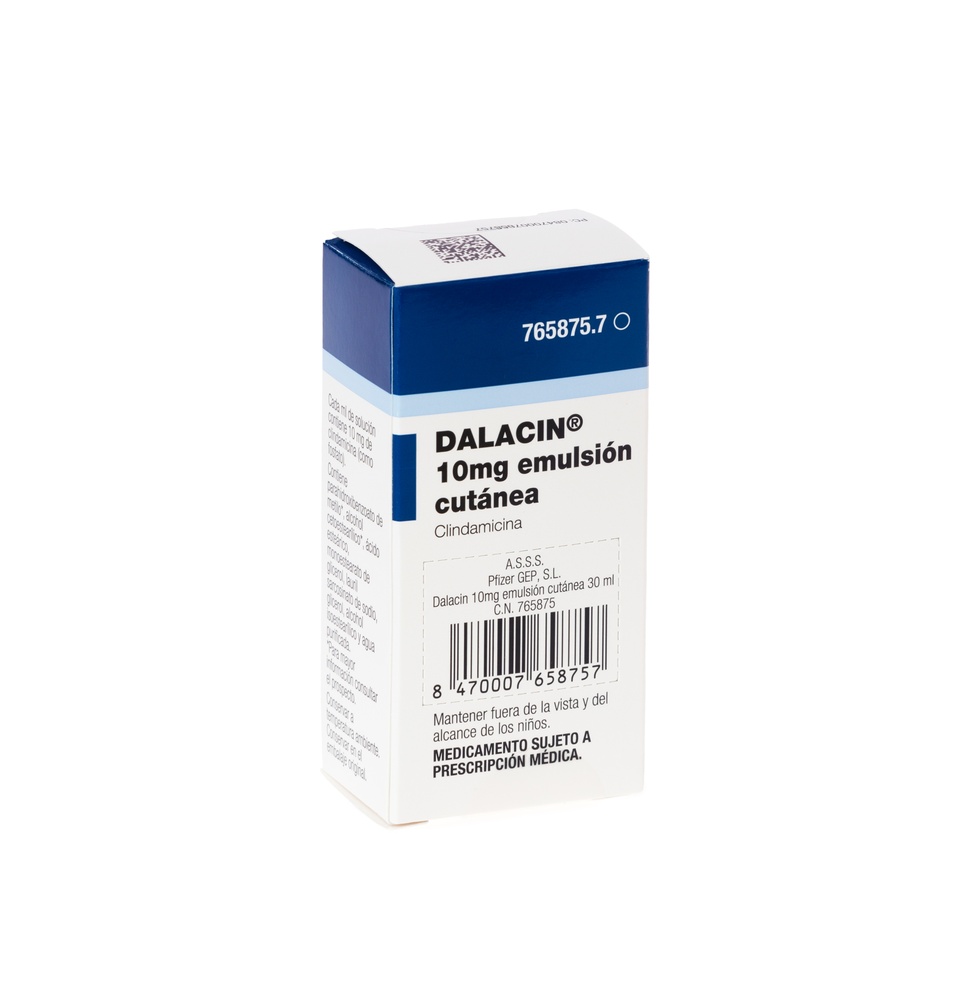
DALACIN 10 mg Emulsion

Prescription review online
A doctor will review your case and decide whether a prescription is medically appropriate.

Talk to a doctor about this medicine
Discuss your symptoms and possible next steps in a quick online consultation.



How to use DALACIN 10 MG SKIN EMULSION
Contents of the leaflet
- Introduction
- What Dalacin Cutaneous Emulsion is and What it is Used for
- What You Need to Know Before Starting to Use Dalacin Cutaneous Emulsion
- How to Use Dalacin Cutaneous Emulsion
- Possible Side Effects
- Storage of Dalacin Cutaneous Emulsion
- Package Contents and Additional Information
Introduction
Package Leaflet: Information for the User
Dalacin 10 mg Cutaneous Emulsion
Clindamycin
Read the entire package leaflet carefully before starting to use this medication because it contains important information for you.
- Keep this package leaflet, as you may need to read it again.
- If you have any questions, consult your doctor or pharmacist.
- This medication has been prescribed to you only and you should not give it to others, even if they have the same symptoms as you, as it may harm them.
- If you experience side effects, consult your doctor or pharmacist, even if they are side effects not listed in this package leaflet. See section 4.
Contents of the Package Leaflet:
- What Dalacin cutaneous emulsion is and what it is used for.
- What you need to know before starting to use Dalacin cutaneous emulsion.
- How to use Dalacin cutaneous emulsion.
- Possible side effects.
- Storage of Dalacin cutaneous emulsion.
- Package contents and additional information.
1. What Dalacin Cutaneous Emulsion is and What it is Used for
This medication belongs to a group of antibiotics called lincosamides.
Antibiotics are used to treat bacterial infections and are not effective against viral infections such as the flu or the common cold.
It is essential that you follow the instructions regarding dosage, administration, and treatment duration indicated by your doctor.
Do not store or reuse this medication. If you have any leftover antibiotic after completing treatment, return it to the pharmacy for proper disposal. Do not dispose of medications down the drain or in the trash.
It is indicated for the treatment of mild to moderate acne vulgaris, particularly in the inflammatory phase, in adults and adolescents over 12 years of age.

Not sure if this medicine is right for you?
Discuss your symptoms and treatment with a doctor online.
2. What You Need to Know Before Starting to Use Dalacin Cutaneous Emulsion
Do not use Dalacin cutaneous emulsion
- if you are allergic to clindamycin, lincomycin, or any other component of this medication (listed in section 6).
- if you have previously suffered from antibiotic-associated colitis.
Warnings and Precautions
- During treatment with this medication or after treatment, symptoms suggesting antibiotic-associated colitis (diarrhea) may appear. If this occurs, treatment should be discontinued, and your doctor will provide the necessary treatment.
- If you have an inflammatory bowel disease, such as Crohn's disease or ulcerative colitis, inform your doctor to determine if you should use this medication.
- During application, avoid contact with the eyes, mucous membranes, or eroded skin areas. This medication contains an alcoholic base that can cause stinging and irritation in these areas. In case of accidental contact, wash the area with plenty of cold water and consult an ophthalmologist if necessary.
- Do not ingest.
- Improvement with Dalacin treatment is observed between 6-8 weeks of treatment. The safety and efficacy of Dalacin have not been established for treatments exceeding 12 weeks.
- If you have been diagnosed with papulopustular acne (a type of acne), your doctor will indicate the most suitable treatment.
Children and Adolescents
This medication is indicated for adolescents over 12 years of age. For administration instructions, see "How to use Dalacin cutaneous emulsion" below.
Using Dalacin Cutaneous Emulsion with Other Medications
Inform your doctor or pharmacist if you are using or have recently used other medications, including those purchased without a prescription.
If you are being treated with neuromuscular blockers (used to produce muscle paralysis, such as pancuronium or tubocurarine), inform your doctor, as clindamycin may enhance the effect of these medications.
Pregnancy and Breastfeeding
Pregnancy
If you are pregnant or breastfeeding, think you may be pregnant, or plan to become pregnant, consult your doctor or pharmacist before using this medication.
In clinical studies with pregnant women, systemic administration of clindamycin during the second and third trimesters has not been associated with an increased frequency of congenital anomalies.
There are no adequate and well-controlled studies with pregnant women during the first trimester with this medication.
This medication should not be used during the first trimester of pregnancy unless the clinical situation of the woman requires treatment.
Breastfeeding
It is unknown whether clindamycin is excreted in breast milk after topical administration. However, it is excreted in breast milk after oral or intravenous administration.
A decision should be made to either discontinue breastfeeding or discontinue treatment, considering the benefit of breastfeeding for the child and the benefit of treatment for the mother.
Driving and Using Machines
The influence of this medication on the ability to drive or use machines is negligible.
Dalacin Cutaneous Emulsion Contains Methyl Parahydroxybenzoate and Cetostearyl Alcohol
This medication may cause allergic reactions (possibly delayed) on the skin because it contains methyl parahydroxybenzoate (E218).
This medication may cause local skin reactions (such as contact dermatitis) because it contains cetostearyl alcohol.
3. How to Use Dalacin Cutaneous Emulsion
Follow the administration instructions in this package leaflet or as indicated by your doctor. If you have any doubts, consult your doctor or pharmacist.
This medication is administered topically. For external use only.
Shake before use.
Your doctor will determine the most suitable dosage and treatment duration for you, according to your condition and response to treatment.
Adults and Children Over 12 Years
Dalacin is applied to the skin, gently applying a thin layer of the emulsion to the affected area twice a day. Your doctor will assess the clinical evolution after 6-8 weeks of treatment. This medication should be used for a maximum of 12 weeks; see "Warnings and Precautions" above.
Apply with caution to avoid contact between the medication and the eyes, nose, or mouth. If the emulsion comes into contact with the eyes, they should be rinsed immediately with plenty of water. If you continue to feel a burning sensation or pain in the eyes, consult your doctor or pharmacist.
Consult your pharmacist if you have any doubts about these instructions.
If You Use More Dalacin Cutaneous Emulsion Than You Should
No cases of overdose have been reported, although topically administered clindamycin may be absorbed in sufficient quantities to produce side effects. The symptoms in case of overdose are: nausea, vomiting, or diarrhea.
In case of overdose or accidental ingestion, consult your doctor or pharmacist immediately or call the Toxicology Information Service at 91 562 04 20, indicating the medication and the amount ingested.
Information for Healthcare Professionals
In case of overdose, peritoneal dialysis or hemodialysis is not effective in removing clindamycin from the serum. Gastric lavage may be performed. Treatment with activated charcoal and symptomatic treatment is recommended.
In case of an allergic reaction, the usual emergency treatment should be applied, including corticosteroids, adrenaline, and antihistamines.
If You Forget to Use Dalacin Cutaneous Emulsion
In case of a missed dose, use the medication as soon as possible and continue with the treatment as prescribed. However, if the next dose is near, it is better not to use the missed dose and wait for the next one. Do not use a double dose to make up for the missed dose. Continue using Dalacin as indicated by your doctor.
If You Interrupt Treatment with Dalacin Cutaneous Emulsion
If you stop treatment with Dalacin before your doctor recommends, your symptoms may worsen or reappear.
If you have any further questions about the use of this product, ask your doctor or pharmacist.

Started taking the medicine and have questions?
Discuss your symptoms and treatment with a doctor online.
4. Possible Side Effects
Like all medications, Dalacin cutaneous emulsion may cause side effects, although not everyone will experience them.
The side effects observed with this medication are listed below, classified by frequency:
Very Common: May Affect More Than 1 in 10 People
- Skin irritation, skin lesions that are red, raised, and itchy (urticaria).
Common: May Affect Up to 1 in 10 People
- Oily skin.
Frequency Not Known (Cannot be Estimated from Available Data):
- Folliculitis (inflammation of the hair follicles), eye pain, abdominal pain, a special type of colitis (pseudomembranous), contact dermatitis.
Reporting Side Effects
If you experience any side effects, consult your doctor or pharmacist, even if they are not listed in this package leaflet. You can also report them directly through the Spanish Medication Surveillance System for Human Use: www.notificaram.es.
By reporting side effects, you can help provide more information on the safety of this medication.
5. Storage of Dalacin Cutaneous Emulsion
Store at room temperature. Keep in the original packaging.
Keep out of sight and reach of children.
Do not use this medication after the expiration date stated on the packaging. The expiration date is the last day of the month indicated.
Medications should not be disposed of through wastewater or household waste. Deposit the packaging and any unused medications in the pharmacy's SIGRE collection point. If you have any doubts, ask your pharmacist how to dispose of the packaging and medications you no longer need. This will help protect the environment.
6. Package Contents and Additional Information
Composition of Dalacin Cutaneous Emulsion
- The active ingredient is clindamycin. Each ml contains 10 mg of clindamycin (as phosphate).
- The other components (excipients) are: stearic acid, cetostearyl alcohol, glycerol monostearate, methyl parahydroxybenzoate (E218), sodium laurylsarcosinate, glycerol, isostearyl alcohol, and purified water.
Appearance of the Product and Package Contents:
Dalacin is presented as a white or almost white emulsion.
The emulsion is packaged in 30 ml high-density polyethylene bottles with a white polypropylene dosing cap.
Marketing Authorization Holder and Manufacturer
Marketing Authorization Holder
Pfizer, S.L.
Avda. de Europa, 20-B. Parque Empresarial La Moraleja
28108, Alcobendas (Madrid)
Spain.
Manufacturer
Pfizer Service Company BV
Hoge Wei 10,
1930, Zaventem
Belgium.
Date of the Last Revision of this Package Leaflet: February/2017
Detailed and updated information on this medication is available on the website of the Spanish Agency for Medicines and Health Products (AEMPS) http://www.aemps.es/
- Country of registration
- Dosage formEMULSION, 1% clindamycin
- ATC codeD10AF01
- Average pharmacy price3.12 EUR
- Active substance
- Prescription requiredYes
- Manufacturer
- CompositionCETOESTEARILICO, ALCOHOL (25 mg mg), MONOESTEARATO DE GLICEROL (11,5 mg mg), METILPARABENO (E 218) (3 mg mg), LAURILSARCOSINATO SODICO (7,5 mg mg), GLICEROL (E 422) (50,0 mg mg), ALCOHOL ISOESTEARILICO (25 mg mg)
- This information is for reference only and does not constitute medical advice. Always consult a doctor before taking any medication. Oladoctor is not responsible for medical decisions based on this content.
- Alternatives to DALACIN 10 MG SKIN EMULSIONDosage form: GEL, 1.188 g clindamycin phosphate / gActive substance: clindamycinManufacturer: Chiesi España S.A.U.Prescription requiredDosage form: TOPICAL SOLUTION, 30 mlActive substance: clindamycinManufacturer: Chiesi España S.A.U.Prescription requiredDosage form: GEL, 1.2% Clindamycin PhosphateActive substance: clindamycinManufacturer: Industrial Farmaceutica Cantabria S.A.Prescription required
Online doctors for DALACIN 10 MG SKIN EMULSION
Discuss questions about DALACIN 10 MG SKIN EMULSION, including use, safety considerations and prescription review, subject to medical assessment and local regulations.



Get DALACIN 10 MG SKIN EMULSION Prescription Online
Fill in a 2-min form
Tell us your symptoms, history, and what medicine you're requesting.
Pick a doctor or let us assign
Choose a specialist or we'll match you with the next available doctor.
Doctor reviews your case
Usually within 30 minutes. They may ask follow-up questions via chat.
Collect from any pharmacy
Electronic prescription sent to your email — valid across Spain.
Frequently Asked Questions
DALACIN 10 MG SKIN EMULSION requires a prescription in Spain. You can check with a doctor online whether this medicine may be appropriate for your situation.
The active ingredient in DALACIN 10 MG SKIN EMULSION is clindamycin. This information helps identify medicines with the same composition but different brand names.
The average pharmacy price for DALACIN 10 MG SKIN EMULSION is around 3.12 EUR. Prices may vary depending on the manufacturer and dosage form.
DALACIN 10 MG SKIN EMULSION is manufactured by Pfizer S.L.. Pharmacy brands and packaging may differ depending on the distributor.
Doctors such as Family doctors, Psychiatrists, Dermatologists, Cardiologists, Endocrinologists, Gastroenterologists, Pulmonologists, Nephrologists, Rheumatologists, Hematologists, Infectious disease physicians, Allergists, Geriatricians, Paediatricians, Oncologists may assess whether DALACIN 10 MG SKIN EMULSION is appropriate, depending on your situation and local regulations. You can book an online consultation to discuss your symptoms and possible next steps.
Spain has a well-developed healthcare infrastructure across major cities such as Madrid, Barcelona, Valencia, and Seville. Pharmacies are widely available and operate under strict regulations, ensuring access to prescribed medications.
You can buy DALACIN 10 MG SKIN EMULSION in Madrid, Barcelona, Seville, or Valencia at any local pharmacy with a valid prescription.
To obtain a prescription, you can use Oladoctor:
Other medicines with the same active substance (clindamycin) include CLINWAS 10 mg/g GEL, CLINWAS 10 mg/ml CUTANEOUS SPRAY SOLUTION, ZINDACLIN 1% GEL. These may have different brand names or formulations but contain the same therapeutic ingredient. Always consult a doctor before switching or starting a new medicine.
