


Couldina With Acetylsalicylic Acid Effervescent Tablets

Prescription request online
A doctor will review your case and decide whether a prescription is medically appropriate.

Talk to a doctor about this medicine
Discuss your symptoms and possible next steps in a quick online consultation.



How to use COULDINA WITH ACETYLSALICYLIC ACID EFFERVESCENT TABLETS
Contents of the leaflet
- Introduction
- What is Couldina with Acetylsalicylic Acid and what is it used for
- What you need to know before starting to take Couldina with Acetylsalicylic Acid
- How to take Couldina with Acetylsalicylic Acid
- Possible Adverse Effects
- Conservation of Couldina with Acetylsalicylic Acid
- Container Content and Additional Information
Introduction
Package Leaflet: Information for the User
Couldina with Acetylsalicylic Acid Effervescent Tablets
Acetylsalicylic Acid/Chlorphenamine Maleate/Phenylephrine Hydrochloride
Read the entire package leaflet carefully before starting to take this medication, as it contains important information for you.
Follow the administration instructions for the medication contained in this package leaflet or as indicated by your doctor or pharmacist.
- Keep this package leaflet, as you may need to read it again.
- If you need advice or more information, consult your pharmacist.
- If you experience adverse effects, consult your doctor or pharmacist, even if they are not listed in this package leaflet.
- You should consult your doctor if your condition worsens or does not improve, or if the fever persists for more than 3 days or the pain for more than 5 days of treatment.
Contents of the Package Leaflet
- What Couldinawith Acetylsalicylic Acid is and what it is used for
- What you need to know before starting to take Couldinawith Acetylsalicylic Acid
- How to take Couldina with Acetylsalicylic Acid
- Possible adverse effects
- Storage of Couldina with Acetylsalicylic Acid
- Package Contents and Additional Information
1. What is Couldina with Acetylsalicylic Acid and what is it used for
Couldina with Acetylsalicylic Acidis an association of acetylsalicylic acid, chlorphenamine, and phenylephrine.
Acetylsalicylic acid is an anti-inflammatory that acts on pain and fever.
Chlorphenamine is an antihistamine that relieves nasal secretion.
Phenylephrine is a sympathomimetic that reduces nasal congestion.
It is indicated in adults and adolescents from 16 years of age for the relief of symptoms of colds and flu that occur with fever, mild or moderate pain, congestion, and nasal secretion.
You should consult your doctor if your condition worsens or does not improve, or if the fever persists for more than 3 days or the pain for more than 5 days.

Not sure if this medicine is right for you?
Discuss your symptoms and treatment with a doctor online.
2. What you need to know before starting to take Couldina with Acetylsalicylic Acid
Do not take Couldina with Acetylsalicylic Acid:
- If you are allergic to acetylsalicylic acid (aspirin), chlorphenamine maleate, phenylephrine hydrochloride, or any of the other components of this medication (listed in section 6).
- If you have experienced allergic reactions of an asthmatic type (difficulty breathing, shortness of breath, bronchospasm, and in some cases cough or wheezing when breathing) when taking anti-inflammatory drugs, acetylsalicylic acid (aspirin), other analgesics, or other allergy medications, as cross-hypersensitivity may occur.
- If you have a gastric ulcer, duodenal ulcer, or recurring gastric discomfort.
- If you have suffered any bleeding or perforation of the stomach caused by acetylsalicylic acid or other anti-inflammatory drugs.
- If you have hemophilia or other blood coagulation problems.
- If you have or have had asthma.
- If you have nasal polyps associated with asthma that are produced or increased by acetylsalicylic acid (aspirin).
- If you have a serious heart condition (severe coronary artery disease or angina pectoris) or any serious arterial disease.
- If you have tachycardia (rapid heartbeats).
- If you have uncontrolled high blood pressure (hypertension).
- If you have a serious kidney or liver disease (severe renal or hepatic insufficiency).
- If you have a thyroid disease (hyperthyroidism).
- If you are being treated with oral anticoagulant medications (e.g., Sintrom).
- If you have glaucoma (increased eye pressure).
- If you are taking or have taken within the last 15 days any medication for depression or Parkinson's disease that inhibits monoamine oxidase (MAOI) (see section "Taking Couldina with other medications").
- If you are being treated with beta-blocker medications (medications for the heart or to treat arterial diseases) (see section "Taking Couldina with other medications").
- If the patient is under 16 years of age, as the use of acetylsalicylic acid has been linked to Reye's syndrome, a rare but serious disease that occurs in children under 16 years of age.
- If you have diabetes mellitus.
- If you are in the third trimester of pregnancy.
Warnings and Precautions
Do not take more medication than recommended in section 3 "How to take Couldina"
While being treated with this medication, do not consume alcohol, as it may increase the risk of gastrointestinal adverse effects caused by acetylsalicylic acid. Additionally, alcohol may cause chronic irritation caused by acetylsalicylic acid and potentiate the sedative effect caused by chlorphenamine.
If during treatment with this medication you experience intense or persistent abdominal pain and/or black stools, stop taking this medication and consult your doctor immediately, as you may have developed a stomach or duodenal bleeding or perforation. This risk is higher when using high doses and prolonged treatments, in patients who have previously suffered from peptic ulcers, and in elderly individuals.
Consult your doctor or pharmacist before starting to take this medication:
- If you have obstruction of the neck of the bladder or urinary retention, as it may worsen.
- If you have a deficiency of glucose-6-phosphate dehydrogenase (a hereditary disease that causes a type of anemia).
- If you have or have had rhinitis or urticaria.
- If you have recently undergone or are scheduled to undergo surgery or dental procedures, including tooth extraction, within the next 7 days.
- If you have controlled high blood pressure.
- If you have pheochromocytoma, cardiovascular diseases such as slow heart movement, kidney, liver, or lung diseases, or if you suffer from anemia.
- If you are being treated with tricyclic antidepressants or medications with similar effects and experience gastrointestinal problems, you should stop taking this medication and consult your doctor immediately, as you may develop paralytic ileus (stoppage of normal bowel movements).
- If you are being treated with monoamine oxidase inhibitor (MAOI) medications for depression or Parkinson's disease, you should separate the intake of Couldina with Acetylsalicylic Acid from these medications by at least 15 days.
Children and Adolescents
Children under 16 years of age cannot take this medication; it is contraindicated in them.
Elderly
Elderly individuals should not take this medication without consulting their doctor, as they are more prone to its adverse effects.
Using Couldina with Acetylsalicylic Acid with other medications
Inform your doctor or pharmacist if you are using or have recently used other medications, including those purchased without a prescription, homeopathic products, herbal remedies, and other health-related products, as it may be necessary to interrupt treatment or adjust the dose of one of them.
In particular, if you are using any of the following medications, it is essential to consult your doctor before taking Couldina with Acetylsalicylic Acid, as it may be necessary to modify the dose of one of them or interrupt treatment.
- Pain relievers or non-steroidal anti-inflammatory drugs (medications used to treat pain and/or muscle inflammation, such as ibuprofen or others) and corticosteroids, as concurrent treatment may cause ulcers, intestinal bleeding, and decreased efficacy of these medications.
- Anesthetics (inhalation hydrocarbons) in case of surgery; treatment with this medication should be interrupted a few days before the procedure due to the possible risk of arrhythmias.
- Antacids may decrease the efficacy of Couldina with Acetylsalicylic Acid.
- Anticoagulants (medications used to prevent blood clot formation) such as Sintrom, heparin, or warfarin, as they increase the risk of bleeding.
- Antidepressants (medications used for depression), such as selective serotonin reuptake inhibitors, tricyclic and tetracyclic antidepressants, and monoamine oxidase inhibitors (MAOIs), as they increase the risk of bleeding and may cause decreased efficacy of some of these medications or severe adverse effects. If you are being treated with MAOI medications for depression or Parkinson's disease, you should separate the intake of Couldina from these medications by at least 15 days, as severe adverse effects may occur, manifested as severe headache, increased blood pressure, and sudden increase in temperature. If you are being treated with lithium, you should not take this medication, as it may increase lithium levels in the blood and reach toxic levels.
- Antiepileptics such as phenytoin and valproic acid, as they may decrease the efficacy or increase the adverse effects of antiepileptic medications.
- Antihypertensives (medications to lower blood pressure), as they may cause kidney failure and decreased efficacy of the antihypertensive.
- Medications used to lower blood sugar levels (oral antidiabetics, insulins, and sulfonylureas), as taking Couldina with Acetylsalicylic Acid while being treated with these medications may increase the effect of lowering blood sugar levels and cause hypoglycemia.
- Medications used to treat seizures (such as barbiturates), as concurrent use may increase the amount of barbiturates in the blood and their adverse effects.
- Cyclosporine and Tacrolimus (used to prevent transplant rejection), as taking Couldina with Acetylsalicylic Acid while being treated with cyclosporine may increase the toxicity of cyclosporine to the kidneys.
- Cimetidine and ranitidine (used for stomach acidity), as they may increase the adverse effects of Couldina with Acetylsalicylic Acid.
- Digoxin (medication for the heart), as it should not be taken with Couldina with Acetylsalicylic Acid, as digoxin may reach toxic levels in the blood.
- Interferon alpha (used to treat certain viral and tumor infections), as it may decrease the efficacy of interferon.
- Methotrexate (used to treat cancer and rheumatoid arthritis), as it may increase the toxicity of methotrexate.
- Medications used to treat gout (probenecid and sulfinpyrazone), as they may increase the toxicity of Couldina with Acetylsalicylic Acid and decrease the efficacy of medications used to treat gout.
- Medications used to lower high blood pressure (diuretics and ACE inhibitors).
- Other pain relievers or non-steroidal anti-inflammatory drugs (medications used to treat pain and/or muscle inflammation).
- The antibiotic vancomycin (used to treat infections), as taking Couldina with Acetylsalicylic Acid while being treated with vancomycin may increase the risk of vancomycin-induced ototoxicity.
- Zidovudine (used to treat patients infected with the human immunodeficiency virus, HIV, which causes AIDS), as taking Couldina with Acetylsalicylic Acid while being treated with zidovudine may decrease the elimination of zidovudine, increasing the risk of its adverse effects.
- Medications that affect heart conduction, such as antiarrhythmics: taking this medication while being treated with medications that affect heart conduction should be monitored by a doctor.
- Medications that contain thyroid hormones (used to treat thyroid diseases), as taking this medication while being treated with medications for thyroid diseases should be monitored by a doctor.
- Medications used to treat heart or digestive diseases (atropine sulfate), as taking Couldina with Acetylsalicylic Acid while being treated with these medications may decrease their efficacy and increase their adverse effects.
- Medications that cause central nervous system depression (such as those used for insomnia or anxiety or antihistamines), as they may cause symptoms of overdose of these medications.
- Ototoxic medications (which have the adverse effect of damaging the ear), as taking Couldina with Acetylsalicylic Acid while being treated with medications that may cause ototoxicity may not notice the symptoms of ototoxicity, which are ringing in the ears, dizziness, and vertigo.
- Photosensitizing medications (which have the adverse effect of causing allergy to light), as taking Couldina with Acetylsalicylic Acid with medications that cause photosensitization may increase the photosensitizing effects of these medications.
- Nasal decongestants, as they may increase the stimulating effects on the central nervous system, such as nervousness, irritability, insomnia, and possible convulsive crises. They may also increase blood pressure.
- Medications that contain caffeine, as Couldina with Acetylsalicylic Acid increases the effects of caffeine and its adverse effects.
Inform your doctor or pharmacist if you are taking, have recently taken, or may need to take any other medication.
Interference with laboratory tests:
If you are going to have any laboratory tests (including blood, urine, etc.), inform your doctor that you are taking/using this medication, as it may alter the results.
Taking Couldina with Acetylsalicylic Acid with food, beverages, and alcohol
Take this medication after meals or with some food.
While being treated with this medication, do not consume alcoholic beverages, as they may potentiate the appearance of adverse effects of this medication.
If you habitually consume alcohol (3 or more alcoholic beverages - beer, wine, liquor... - per day), taking Couldinawith Acetylsalicylic Acid may cause a stomach hemorrhage. |
Pregnancy and Breastfeeding
If you are pregnant or breastfeeding, or think you may be pregnant or plan to become pregnant, consult your doctor or pharmacist before taking this medication.
This medication is contraindicated during the third trimester of pregnancy.
Additionally, it should not be taken during the rest of pregnancy unless your doctor considers it strictly necessary.
This medication cannot be used during breastfeeding, as it may cause adverse effects in the baby.
Driving and Using Machines
This medication may cause drowsiness, altering mental or physical ability. If you experience these effects, avoid driving vehicles or using machines.
Couldina with Acetylsalicylic Acid contains sodium:
This medication contains 410 mg of sodium (the main component of table salt/cooking salt) per tablet. This is equivalent to 21% of the maximum recommended daily sodium intake for an adult.
Consult your doctor or pharmacist if you need to take 1 or more tablets per day for an extended period, especially if you have been recommended a low-salt diet (sodium).
3. How to take Couldina with Acetylsalicylic Acid
Follow the administration instructions for the medication contained in this package leaflet or as indicated by your doctor or pharmacist. In case of doubt, ask your doctor or pharmacist.
The recommended dose is:
Adults and adolescents from 16 years of age:
Take 1 tablet every 8 hours. If necessary, it can be taken every 6 hours (3 or 4 times in 24 hours).
In any case, do not take more than 4 tablets in 24 hours, and leave a minimum time of 6 hours between each intake.
Use in patients with reduced liver, kidney, or heart function
These patients should not take this medication without consulting their doctor, as the dose may need to be reduced.
Use in Children
This medication is contraindicated in children under 16 years of age.
Use in Elderly
Elderly individuals should not use this medication without consulting their doctor, as they may be more affected by some adverse effects of the medication, such as the appearance of slow heartbeats (bradycardia) or reduced cardiac output, due to the content of phenylephrine and chlorphenamine. They are also more likely to experience adverse effects such as sedation, confusion, hypotension, or excitement and may be more sensitive to effects such as dry mouth and urinary retention.
Method of Administration
Take Couldina with Acetylsalicylic Acid after meals or with some food or milk (especially if you experience gastrointestinal discomfort).
Do not take it on an empty stomach.
This medication is taken orally.
Dissolve the tablet in a little liquid, preferably half a glass of water, and wait until the bubbling or effervescence has completely disappeared before drinking.
Always use the lowest effective dose.
Administration of this medication is subject to the appearance of all symptoms, pain, or fever, congestion, and nasal secretion. As these symptoms disappear, treatment should be discontinued.
If the fever persists for more than 3 days of treatment, the pain or other symptoms for more than 5 days, or worsens or new symptoms appear, you should consult your doctor.
If you take more Couldina with Acetylsalicylic Acid than you should
The main symptoms of overdose are: headache, dizziness, ringing in the ears, blurred vision, drowsiness, sweating, rapid breathing, decreased or increased blood pressure, altered heart rhythm (cardiac arrhythmias), nervousness, hallucinations, confusion, nausea, vomiting, and occasionally diarrhea.
In case of overdose or accidental ingestion, consult your doctor or pharmacist immediately or go to a medical center immediately or call the Toxicology Information Service, phone: 91 562 04 20, indicating the medication and the amount ingested.
Started taking the medicine and have questions?
Discuss your symptoms and treatment with a doctor online.
4. Possible Adverse Effects
Like all medicines, Couldinawith Acetylsalicylic Acid can cause adverse effects, although not all people suffer from them.
During the period of use of acetylsalicylic acid, phenylephrine, chlorphenamine, and vitamin C, the following adverse effects have been reported, whose frequency has not been established with precision:
- Adverse effects that may appear more frequently are:
Mild drowsiness, dizziness, muscle weakness, these adverse effects may disappear after 2-3 days of treatment. Difficulty in facial movements, clumsiness, tremors, alterations in sensations and tingling, dryness of the mouth, nose, and throat, loss of appetite, alterations in taste or smell, gastrointestinal discomfort (which may decrease if the medication is administered with food), nausea, vomiting, diarrhea, constipation, stomach pain, thickening of mucus, sweating, blurred vision or other vision disorders, gastric ulcer, duodenal ulcer, gastrointestinal bleeding. Hypoprothrombinemia (coagulation disorder) when high doses are taken.
- Adverse effects that may appear with low frequency (rare) are:
Reye's syndrome in children under 16 years of age with febrile processes, flu, or chickenpox (see section "What you need to know before taking Couldina with Acetylsalicylic Acid"). Hepatic disorders, especially in patients with juvenile arthritis. Confusion (especially in elderly patients), euphoria, nervousness, restlessness (especially in children and elderly patients), insomnia, headache, abnormal behavior; alterations in pulse (palpitations, tachycardia), elevation of blood pressure (hypertension), which can sometimes be severe (hypertensive crises). Difficulty urinating. Anemia.
- Adverse effects that may appear with very low frequency (very rare) are: Chronic post-hemorrhagic anemia/iron deficiency (due to occult bleeding) that presents typical symptoms, such as fatigue and pallor. Cerebral hemorrhage, especially in patients with uncontrolled hypertension and who are taking anticoagulant medications at the same time. Anaphylactic shock and hyperglycemia (increased blood sugar).
If taken for a long period of time:dizziness, ringing in the ears, deafness, sweating, headache, confusion, renal insufficiency, and acute interstitial nephritis (inflammation at the kidney level).
If you observe the appearance of:
- Discomfort or stomach pain, gastric or intestinal bleeding, or black stools.
- Skin disorders, such as rashes or redness.
- Difficulty breathing.
- Unforeseen change in the amount or appearance of urine.
- Swelling of the face, feet, or legs.
- Deafness, tinnitus, or dizziness.
Stop taking the medication and consult your doctor immediately, as they may indicate the appearance of adverse effects that require urgent medical attention.
If you experience adverse effects, consult your doctor or pharmacist, even if they are adverse effects that do not appear in this prospectus.
5. Conservation of Couldina with Acetylsalicylic Acid
Keep out of sight and reach of children.
Do not store at a temperature above 25°C.
Keep the container perfectly closed. Store in the original container.
Do not use this medication after the expiration date that appears on the container after CAD. The expiration date is the last day of the month indicated.
Medicines should not be thrown away through drains or into the trash. Deposit the containers and medications you no longer need in the SIGRE Point (or any other system for collecting medicinal waste) at the pharmacy. In case of doubt, ask your pharmacist how to dispose of the containers and medications you no longer need. This way, you will help protect the environment.
6. Container Content and Additional Information
Composition of Couldina with Acetylsalicylic Acid effervescent tablets
- The active ingredients are: acetylsalicylic acid, chlorphenamine maleate, phenylephrine hydrochloride. Each tablet contains 500 mg of acetylsalicylic acid, 2 mg of chlorphenamine maleate, and 7.5 mg of phenylephrine hydrochloride.
- The other components (excipients) are: anhydrous citric acid (E-330), sodium hydrogen carbonate (E-500ii), anhydrous sodium carbonate (E-500i), sodium citrate (E-331), mannitol (E-421), povidone K 30 (E-1201), glycine (E-640), sodium docusate, and sodium saccharin (E-954ii).
Appearance of the product and container content
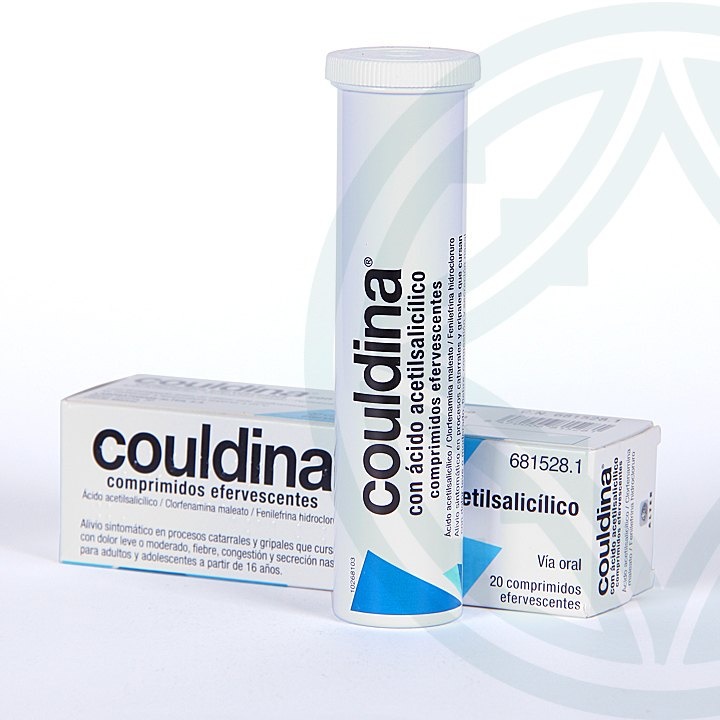
This medication is presented in the form of effervescent tablets, flat cylindrical white tablets, packaged in aluminum tubes coated with an epoxy paint layer, closed by a polyethylene plug that carries silica gel, in containers with 20 tablets.
Marketing Authorization Holder
Laboratorios Alter, S.A.
C/ Mateo Inurria, 30
28036, Madrid
Spain
Manufacturer
Laboratorios Alter, S.A.
C/ Mateo Inurria, 30
28036, Madrid
Spain
or
Laboratorios Alter, S.A.
C/ Zeus, 6
Polígono Industrial R2
28880, Meco (Madrid)
Spain
This prospectus was approved in October 2018
Detailed and updated information on this medication is available on the website of the Spanish Agency for Medicines and Health Products (AEMPS) http://www.aemps.gob.es
- Country of registration
- Dosage formEFFERVESCENT TABLET, 500 mg / 2 mg / 7.5 mg
- ATC codeN02BA51
- Active substance
- Prescription requiredNo
- Manufacturer
- CompositionHIDROGENOCARBONATO DE SODIO (999 mg mg), SACARINA SODICA (2,5 mg mg), DOCUSATO DE SODIO (0,078 mg mg), CITRATO DE SODIO (E-331) (8,5 mg mg), CARBONATO DE SODIO ANHIDRO (310 mg mg), MANITOL (E-421) (200 mg mg)
- This information is for reference only and does not constitute medical advice. Always consult a doctor before taking any medication. Oladoctor is not responsible for medical decisions based on this content.
- Alternatives to COULDINA WITH ACETYLSALICYLIC ACID EFFERVESCENT TABLETSDosage form: EFFERVESCENT TABLET, 267 mg/40 mg/133 mgActive substance: acetylsalicylic acid, combinations excl. psycholepticsManufacturer: Bayer Hispania S.L.Prescription not requiredDosage form: EFFERVESCENT TABLET, 400/240 mg/mgActive substance: acetylsalicylic acid, combinations excl. psycholepticsManufacturer: Bayer Hispania S.L.Prescription not requiredDosage form: EFFERVSCENT ORAL SOLUTION/SUSPENSION, 500 mgActive substance: acetylsalicylic acid, combinations excl. psycholepticsManufacturer: Bayer Hispania S.L.Prescription not required
Online doctors for COULDINA WITH ACETYLSALICYLIC ACID EFFERVESCENT TABLETS
Discuss questions about COULDINA WITH ACETYLSALICYLIC ACID EFFERVESCENT TABLETS, including use, safety considerations and whether a prescription is appropriate, subject to medical assessment and local regulations.









Frequently Asked Questions
COULDINA WITH ACETYLSALICYLIC ACID EFFERVESCENT TABLETS does not require a prescription in Spain. You can check with a doctor online whether this medicine may be appropriate for your situation.
The active ingredient in COULDINA WITH ACETYLSALICYLIC ACID EFFERVESCENT TABLETS is acetylsalicylic acid, combinations excl. psycholeptics. This information helps identify medicines with the same composition but different brand names.
COULDINA WITH ACETYLSALICYLIC ACID EFFERVESCENT TABLETS is manufactured by Laboratorios Alter S.A.. Pharmacy brands and packaging may differ depending on the distributor.
Doctors such as Family doctors, Psychiatrists, Dermatologists, Cardiologists, Endocrinologists, Gastroenterologists, Pulmonologists, Nephrologists, Rheumatologists, Hematologists, Infectious disease physicians, Allergists, Geriatricians, Paediatricians, Oncologists may assess whether COULDINA WITH ACETYLSALICYLIC ACID EFFERVESCENT TABLETS is appropriate, depending on your situation and local regulations. You can book an online consultation to discuss your symptoms and possible next steps.
The prescription is issued by a doctor after assessing your health. In Spain, COULDINA WITH ACETYLSALICYLIC ACID EFFERVESCENT TABLETS is then dispensed in pharmacies with that prescription. An online consultation does not guarantee that a prescription will be issued: the decision always rests with the doctor.
To request an assessment, you can use Oladoctor:
Other medicines with the same active substance (acetylsalicylic acid, combinations excl. psycholeptics) include ACTRON COMPUESTO 267 mg/133 mg/40 mg EFFERVSCENT TABLETS, ASPIRIN C 400 mg/240 mg EFFERVESCENT TABLETS, ASPIRIN COMPLEX Effervescent Granules. These may have different brand names or formulations but contain the same therapeutic ingredient. Always consult a doctor before switching or starting a new medicine.
