


Cloruro 1 mEq/ml injectable infusion

Prescription review online
A doctor will review your case and decide whether a prescription is medically appropriate.

Talk to a doctor about this medicine
Discuss your symptoms and possible next steps in a quick online consultation.



How to use POTASSIUM CHLORIDE BRAUN 1 mEq/ml CONCENTRATE FOR INFUSION SOLUTION
Contents of the leaflet
- Introduction
- Potassium Chloride Braun 1 mEq/ml Concentrate for Solution for Infusion
- What Potassium Chloride Braun 1 mEq/ml is and what it is used for
- What you need to know before you use Potassium Chloride Braun 1 mEq/ml
- How to use Potassium Chloride Braun 1 mEq/ml
- Possible side effects
- Storage of Potassium Chloride Braun 1 mEq/ml
- Contents of the pack and other information
Introduction
Package Leaflet: Information for the User
Potassium Chloride Braun 1 mEq/ml Concentrate for Solution for Infusion
Read all of this leaflet carefully before you start using this medicine, because it contains important information for you.
- Keep this leaflet, you may need to read it again.
- If you have any further questions, ask your doctor or pharmacist.
- If you experience any side effects, talk to your doctor or pharmacist, even if they are not listed in this leaflet. See section 4.
Contents of the pack
- What Potassium Chloride Braun 1 mEq/ml is and what it is used for
- What you need to know before you use Potassium Chloride Braun 1 mEq/ml
- How to use Potassium Chloride Braun 1 mEq/ml
- Possible side effects
- Storage of Potassium Chloride Braun 1 mEq/ml
- Contents of the pack and other information

Not sure if this medicine is right for you?
Discuss your symptoms and treatment with a doctor online.
1. What Potassium Chloride Braun 1 mEq/ml is and what it is used for
Potassium Chloride 1 mEq/ml is a concentrated solution of potassium chloride.
It is used to provide you with potassium:
- when you have a potassium deficiency, especially if this is accompanied by an excess of alkali and abnormally low levels of chloride in the blood (hypochloremic alkalosis)
- as part of parenteral nutrition, when you are unable to take food normally
2. What you need to know before you use Potassium Chloride Braun 1 mEq/ml
Do not use Potassium Chloride Braun 1 mEq/ml:
If you have abnormally high levels of potassium or chloride in the blood (hyperkalemia, hyperchloremia)
Warnings and precautions
Talk to your doctor before you start using Potassium Chloride 1 mEq/ml.
Special care is required with Potassium Chloride 1 mEq/ml:
? if you have heart problems
? if you have a disease in which potassium excretion in the urine is often reduced, such as renal dysfunction, Addison's disease (a specific disease of the adrenal glands), or sickle cell anemia (a hereditary disease of red blood cells) if your kidney function is severely impaired or if you are on dialysis, your doctor will consult a kidney specialist before administering this medicine to you
? if you are taking or receiving medications that reduce potassium excretion in the urine; for example, if you are taking:
- certain medications that increase urine flow (diuretics)
- certain medications for high blood pressure (angiotensin II receptor antagonists, ACE inhibitors)
? if you are taking or receiving medications that may affect kidney function (e.g., certain medications that suppress inflammatory processes)
? if you are experiencing shock (an acute clinical condition accompanied by a drop in blood pressure, cold skin, rapid heartbeat, and irregular breathing that can occur, for example, after losing a large amount of blood, suffering severe burns, or having an allergic reaction)
? if you have suffered severe tissue injury, such as burns
? if you have a disorder that causes muscle weakness and sometimes higher than normal potassium levels in the blood (familial hyperkalemic periodic paralysis)
Your doctor will take these points into account before and during your treatment with this medicine.
If you receive this medicine because you lack potassium, you will not initially receive any glucose infusion at the same time because glucose can further reduce potassium levels.
While you are receiving this medicine, your blood electrolyte levels and acid-base balance will be monitored. This will be done to check that they are normal. Additionally, your ECG may be monitored.
It will be ensured with absolute certainty that the solution is administered into a vein, to avoid tissue damage.
If you receive this medicine because you lack potassium, your doctor will administer it to you through a perfusion pump.
Elderly patients, who are more likely to suffer from heart and kidney problems, will be closely monitored during treatment, and the dosage will be carefully adjusted.
If you are severely malnourished, i.e., you have not received enough food, there is a possibility that you may suffer from a condition called "Refeeding Syndrome". Your doctor will carefully monitor you and gradually increase the administration of nutrients.
Using Potassium Chloride 1 mEq/ml with other medicines
Tell your doctor if you are taking, have recently taken, or might take any other medicines.
In particular, your doctor will pay attention to:
? Medications for the treatment of heart failure (cardiac glycosides, e.g., digoxin):
The effects of these medications decrease when the potassium level in the blood increases. They increase (possibly with an irregular heartbeat) when the potassium level in the blood decreases.
? Medications that reduce potassium excretion in the urine:
This group of medications includes:
- certain medications that increase urine flow (potassium-sparing diuretics such as triamterene, amiloride, and spironolactone)
- certain medications for the treatment of high blood pressure (angiotensin II receptor antagonists and ACE inhibitors)
- medications that suppress the immune system (tacrolimus, cyclosporine)
- certain medications used to treat pain or inflammation (non-steroidal anti-inflammatory drugs)
- anticoagulant medications (heparin)
Administration of potassium along with these medications can lead to very high levels of potassium in the blood. This could affect the heart rhythm.
? Medications that increase potassium excretion in the urine:
The following medications can increase potassium excretion in the urine:
- a specific hormone (corticotropin [ACTH])
- certain medications for treating inflammation (corticosteroids)
- certain medications that increase urine flow (loop diuretics)
Their concomitant administration with potassium may lead to you receiving an incorrect dose of potassium, as the administered potassium will be eliminated from your body faster than normal.
? Suxamethonium (a muscle relaxant used in general anesthesia):
Administration of potassium along with these medications can also lead to very high levels of potassium in the blood. This could affect the heart rhythm.
Pregnancy and breast-feeding
If you are pregnant or breast-feeding, think you may be pregnant, or are planning to have a baby, ask your doctor for advice before using this medicine.
Pregnancy
So far, there have been no reports of harmful effects or risks associated with the use of this medicine in pregnant women.
Your doctor will administer potassium chloride with caution and only when clearly necessary.
Breast-feeding
Potassium concentrates for infusion can be used during breast-feeding.
Driving and using machines
This medicine does not affect your ability to drive or use machines.

Started taking the medicine and have questions?
Discuss your symptoms and treatment with a doctor online.
3. How to use Potassium Chloride Braun 1 mEq/ml
Potassium Chloride 1 mEq/ml is administered after dilution in a suitable solution. It is administered through a cannula or small tube in a vein (intravenous infusion).
Dosage
The amount you receive will be calculated by your doctor based on your blood electrolyte values, acid-base balance, age, and individual needs.
If you use more Potassium Chloride Braun 1 mEq/ml than you should
It is unlikely that you will ever receive too much of the medicine. Your doctor or healthcare professional will monitor the administration.
Symptoms
Overdose can lead to abnormally high levels of potassium, with the adverse effects listed below. You are more likely to experience adverse effects if you have a blood deviation towards the acidic side (acidosis) or kidney disorders.
Heart and circulation:
? slow heartbeat or even cardiac arrest
? changes in the electrocardiogram
? decrease in blood pressure
? redistribution of circulating blood from the extremities to the head and trunk
Muscles and nervous system:
? weakness
? fatigue
? confusion
? heaviness of the limbs
? muscle spasms
? loss of sensation
? paralysis
Treatment
If an overdose occurs, the infusion will be stopped immediately and your doctor will provide the necessary treatment.
If you have any further questions on the use of this medicine, ask your doctor.
4. Possible side effects
Like all medicines, this medicine can cause side effects, although not everybody gets them.
The following side effects may be serious. If you experience any of the following side effects, talk to your doctor immediately.
? accumulation of acidic substances in the blood (acidosis) (frequency not known)
? abnormally high levels of chloride in the blood (hyperchloremia) (frequency not known)
? irregular heartbeat (cardiac arrhythmia, consequence of abnormally high administration rates) (frequency not known)
Other side effects
? nausea (frequency not known)
? reactions at the injection site, such as local pain, irritation, or inflammation of the veins (thrombophlebitis) and leakage of fluid into the tissue (extravasation) (frequency not known)
Reporting of side effects
If you experience any side effects, talk to your doctor or pharmacist, even if they are not listed in this leaflet. You can also report side effects directly through the Spanish Pharmacovigilance System for Human Use Medicines: www.notificaRAM.es. By reporting side effects, you can help provide more information on the safety of this medicine.
5. Storage of Potassium Chloride Braun 1 mEq/ml
Keep this medicine out of the sight and reach of children.
Do not use this medicine after the expiry date which is stated on the label and carton. The expiry date is the last day of the month stated.
No special storage conditions are required.
It should only be used if the solution is clear, colorless, and free of particles and if the container and its closure are intact.
The containers are for single use only. The container and any unused contents should be discarded after use.
6. Contents of the pack and other information
Composition of Potassium Chloride Braun 1 mEq/ml:
The active substance is potassium chloride.
1 ml of solution contains 74.5 mg of potassium chloride,
which corresponds to 1 mmol of potassium and 1 mmol of chloride
A 10 ml ampoule contains 745 mg of potassium chloride
A 20 ml ampoule contains 1.49 g of potassium chloride
The other ingredients are: water for injections.
Appearance and pack contents
Potassium Chloride Braun 1 mEq/ml is a concentrate for solution for infusion. It must be diluted before use and administered by intravenous drip.
It is a clear, colorless aqueous solution.
Potassium Chloride Braun 1 mEq/ml is available in:
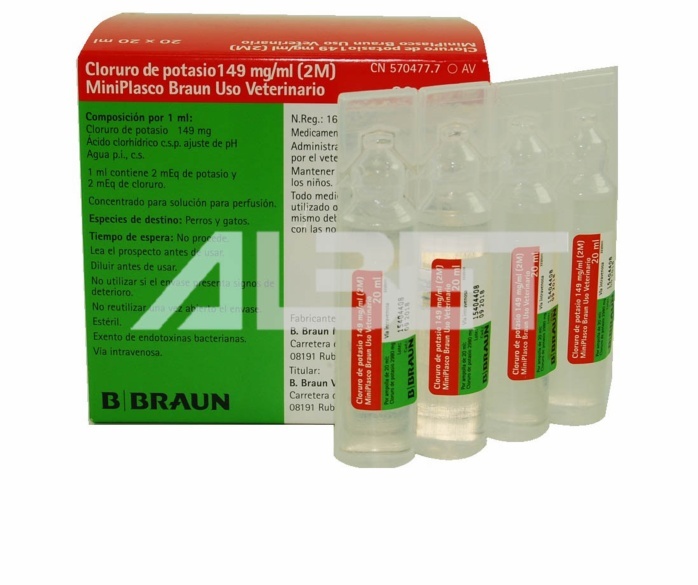
Polyethylene plastic ampoules; contents: 10 ml, 20 ml
Pack sizes:
1 x 10 ml, 20 x 10 ml, 100 x 10 ml
1 x 20 ml, 20 x 20 ml, 100 x 20 ml
Marketing authorisation holder
B|BRAUN
- Braun Medical, S.A.
Ctra. de Terrassa, 121
08191-Rubí (Barcelona)
Spain
Manufacturer
B|BRAUN
- Braun Medical, S.A.
Ctra. de Terrassa, 121
08191-Rubí (Barcelona)
Spain
or
- Braun Melsungen AG
Carl Braun Str. 1
D- 34212 Melsungen
Germany
This leaflet was approved in November 2017
Detailed information on this medicine is available on the website of the Spanish Agency for Medicines and Health Products (AEMPS) (http://www.aemps.gob.es/)
This information is intended only for healthcare professionals:
To see the complete information on this medicine, consult the Summary of Product Characteristics or the Package Leaflet.
- Country of registration
- Dosage formINJECTABLE INFUSION, -
- ATC codeB05XA01
- Active substance
- Prescription requiredYes
- Manufacturer
- This information is for reference only and does not constitute medical advice. Always consult a doctor before taking any medication. Oladoctor is not responsible for medical decisions based on this content.
- Alternatives to POTASSIUM CHLORIDE BRAUN 1 mEq/ml CONCENTRATE FOR INFUSION SOLUTIONDosage form: INJECTABLE PERFUSION, -Active substance: potassium chlorideManufacturer: B Braun Medical S.A.Prescription requiredDosage form: INJECTABLE PERFUSION, 2mEq/mlActive substance: potassium chlorideManufacturer: Fresenius Kabi España, S.A.U.Prescription requiredDosage form: INJECTABLE PERFUSION, 15% w/vActive substance: potassium chlorideManufacturer: Laboratorios Serra Pamies S.A.Prescription required
Online doctors for POTASSIUM CHLORIDE BRAUN 1 mEq/ml CONCENTRATE FOR INFUSION SOLUTION
Discuss questions about POTASSIUM CHLORIDE BRAUN 1 mEq/ml CONCENTRATE FOR INFUSION SOLUTION, including use, safety considerations and prescription review, subject to medical assessment and local regulations.









Frequently Asked Questions
POTASSIUM CHLORIDE BRAUN 1 mEq/ml CONCENTRATE FOR INFUSION SOLUTION requires a prescription in Spain. You can check with a doctor online whether this medicine may be appropriate for your situation.
The active ingredient in POTASSIUM CHLORIDE BRAUN 1 mEq/ml CONCENTRATE FOR INFUSION SOLUTION is potassium chloride. This information helps identify medicines with the same composition but different brand names.
POTASSIUM CHLORIDE BRAUN 1 mEq/ml CONCENTRATE FOR INFUSION SOLUTION is manufactured by B Braun Medical S.A.. Pharmacy brands and packaging may differ depending on the distributor.
Doctors such as Family doctors, Psychiatrists, Dermatologists, Cardiologists, Endocrinologists, Gastroenterologists, Pulmonologists, Nephrologists, Rheumatologists, Hematologists, Infectious disease physicians, Allergists, Geriatricians, Paediatricians, Oncologists may assess whether POTASSIUM CHLORIDE BRAUN 1 mEq/ml CONCENTRATE FOR INFUSION SOLUTION is appropriate, depending on your situation and local regulations. You can book an online consultation to discuss your symptoms and possible next steps.
The prescription is issued by a doctor after assessing your health. In Spain, POTASSIUM CHLORIDE BRAUN 1 mEq/ml CONCENTRATE FOR INFUSION SOLUTION is then dispensed in pharmacies with that prescription. An online consultation does not guarantee that a prescription will be issued: the decision always rests with the doctor.
To request a review, you can use Oladoctor:
Other medicines with the same active substance (potassium chloride) include POTASSIUM CHLORIDE BRAUN 2 mEq/ml CONCENTRATE FOR INFUSION SOLUTION, POTASSIUM CHLORIDE MEINSOL 2 mEq/ml CONCENTRATE FOR PERFUSION SOLUTION, POTASSIUM CHLORIDE SERRACLINICS 2 mEq/mL CONCENTRATE FOR PERFUSION SOLUTION. These may have different brand names or formulations but contain the same therapeutic ingredient. Always consult a doctor before switching or starting a new medicine.
