



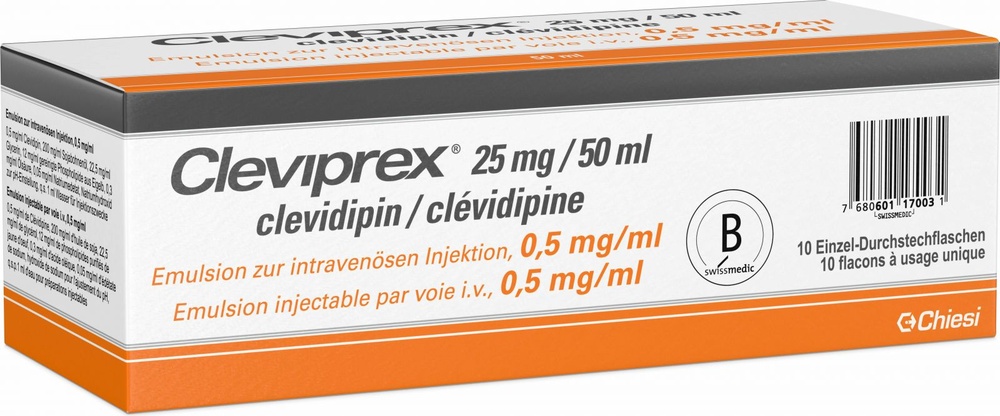
CLEVIPREX 0.5 mg/mL Injectable Emulsion

Prescription review online
A doctor will review your case and decide whether a prescription is medically appropriate.

Talk to a doctor about this medicine
Discuss your symptoms and possible next steps in a quick online consultation.



How to use CLEVIPREX 0.5mg/ml Injectable Emulsion
Contents of the leaflet
- Introduction
- What is Cleviprex and what is it used for
- What you need to know before you use Cleviprex
- How to use Cleviprex
- Possible side effects
- Storage of Cleviprex
- Contents of the pack and further information
Introduction
Package Leaflet: Information for the User
Cleviprex 0.5mg/ml injectable emulsion
Clevidipine
Read all of this leaflet carefully before you start using this medicine because it contains important information for you.
- Keep this leaflet, you may need to read it again.
- If you have any further questions, ask your doctor.
- If you experience any side effects, talk to your doctor, even if you think they may be unrelated to this medicine. See section 4.
Contents of the package leaflet
- What is Cleviprex and what is it used for
- What you need to know before you use Cleviprex
- How to use Cleviprex
- Possible side effects
- Storage of Cleviprex
- Contents of the pack and further information
1. What is Cleviprex and what is it used for
Cleviprex contains the active substance clevidipine.
Clevidipine is a calcium channel blocker. Calcium channel blockers are medicines that reduce blood pressure.
Cleviprex is used to reduce blood pressure in adult patients preparing for surgery, during surgery, or immediately after surgery.

Not sure if this medicine is right for you?
Discuss your symptoms and treatment with a doctor online.
2. What you need to know before you use Cleviprex
Do not use Cleviprex:
- if you are allergic (hypersensitive) to clevidipine, soy, soy oil, soy products, peanuts, eggs or egg products, or any of the other ingredients of this medicine (listed in section 6).
- if you have lipid metabolism disorders (difficulty processing fats), such as extremely high levels of fat in the blood (pathological hyperlipidemia), a kidney disorder that causes loss of protein in the urine (nephrotic syndrome), or pancreatitis (inflammation of the pancreas) if accompanied by high levels of fat in the blood (hyperlipidemia).
- if you have severe aortic stenosis (narrowing of one of the heart valves).
If in doubt, ask your doctor.
Warnings and precautions
Consult your doctor before starting treatment with Cleviprex:
- if you have a heart condition where the aortic valve of the heart does not open fully
- if your heart size is abnormally large due to narrowing of the blood vessels (hypertrophic cardiomyopathy)
- if you have a heart condition where there is narrowing of a valve (mitral valve stenosis)
- if you have a tear in the main artery of the body (aortic dissection)
- if you have a tumor of the gland above the kidney (adrenal gland) that produces high blood pressure (pheochromocytoma)
- if you have had a heart attack
- if you have a chronic condition where the heart cannot increase its rate to compensate for the reduction in blood pressure, such as:
- a heart electrical problem
- you have a pacemaker
Cleviprex with other medicines
Tell your doctor if you are taking, have recently taken, or might take any other medicines.
It is especially important to inform your doctor if you have been taking any medicine to reduce blood pressure.
Pregnancy and breastfeeding
You must inform your doctor if:
- you are pregnant or think you may be pregnant
- you plan to become pregnant
- you are breastfeeding
There is not enough information on the use of Cleviprex in pregnant women. Cleviprex should not be used during pregnancy unless clearly necessary. Your doctor will decide if this treatment is suitable for you.
It is not known if Cleviprex is excreted in breast milk. If you are breastfeeding, your doctor will decide if you can use Cleviprex.
Driving and using machines
Cleviprex is used to reduce blood pressure, which can make you feel dizzy or lightheaded and may affect your ability to drive or use machines.
Do not drive or use machines until the effects of Cleviprex have disappeared. If in doubt, consult your doctor before leaving the hospital.
Cleviprex contains soy oil and sodium
This medicine contains soy oil. It should not be used if you are allergic to peanuts or soy.
This medicine contains less than 23 mg of sodium (1 mmol) per vial; this is essentially "sodium-free".
3. How to use Cleviprex
Cleviprex is administered by infusion (drip) into a vein. It will be given to you by a doctor.
Treatment with Cleviprex will be supervised by a doctor since Cleviprex is administered in the hospital. The doctor will decide how much Cleviprex you will receive and prepare the medicine.
- During the entire treatment, the doctor will monitor your blood pressure.
- Before starting the infusion, the doctor will inform you about the signs of an allergic reaction.
- The dose and duration of the infusion depend on the type of treatment you are undergoing.
Dose
The infusion of Cleviprex should start at 4 ml/hour (2 mg/hour) and will be increased according to tolerability, doubling the amount (i.e., from 4 to 8, from 8 to 16, from 16 to 32, and from 32 to 64 ml/hour [2 to 4, 4 to 8, 8 to 16, and 16 to 32 mg/hour]) every 90 seconds.
Cleviprex will reduce blood pressure in most patients with doses up to 32 ml/hour (16 mg/hour).
Some patients may require a dose of up to 64 ml/hour (32 mg/hour).
If you use more Cleviprex than you should
The doctor will carefully check these doses, so it is very unlikely that an overdose will occur. If you take too much Cleviprex, the infusion will be reduced or stopped.
An overdose of Cleviprex can make you feel dizzy or lightheaded or can make your heart beat faster.
If you think you have been given too much Cleviprex, talk to your doctor or another healthcare professional immediately.
If you miss a dose of Cleviprex
Since treatment with Cleviprex is administered and supervised by a doctor, it is very unlikely that this will happen. If you think you may have missed a dose, talk to your doctor immediately.
While receiving Cleviprex
If you develop severe allergic reactions, such as swelling of the face and/or throat or fever, inform your doctor immediately.
If you have any other questions about the use of this medicine, ask your doctor.

Started taking the medicine and have questions?
Discuss your symptoms and treatment with a doctor online.
4. Possible side effects
Like all medicines, Cleviprex can cause side effects, although not everybody gets them. Side effects are usually mild and do not last long.
Cleviprex can cause atrial fibrillation (irregular heartbeat), chest discomfort, or hypoxia (lower levels of oxygen in the blood, which can make you feel dizzy or lightheaded). If this happens, consult your doctor or another healthcare professional immediately, who will decide if treatment with Cleviprex should be continued.
Frequent: may affect up to 1 in 10 people - tachycardia (fast heartbeat)
- atrial fibrillation (irregular heartbeats)
- hypoxia (lower levels of oxygen in the blood)
- chest discomfort
- hypotension (low blood pressure) - polyuria (production of a large volume of urine) - edema (swelling) at the injection site - flushing (redness of the skin) - feeling of warmth
- acute kidney failure (kidney damage)
Uncommon: may affect up to 1 in 100 people - atrial flutter (abnormal heart rhythm) - heart failure - slow heartbeat - atrioventricular block (feeling of heartbeat) - constipation - pulmonary congestion - headache - dizziness - nausea - vomiting - allergic reaction
- high levels of triglycerides in the blood
Rare: may affect up to 1 in 1,000 people - ileus (constipation; obstruction of the digestive system [intestine])
If you experience side effects, talk to your doctor, even if you think they may be unrelated to this medicine.
Reporting of side effects
If you experience any side effects, talk to your doctor, even if you think they may be unrelated to this medicine. You can also report side effects directly through the Spanish Pharmacovigilance System for Human Use https://www.notificaram.es. By reporting side effects, you can help provide more information on the safety of this medicine.
5. Storage of Cleviprex
Keep this medicine out of the sight and reach of children.
Do not use this medicine after the expiry date which is stated on the label and carton after EXP. The expiry date is the last day of the month stated.
Store and transport refrigerated (2°C – 8°C). Do not freeze.
After opening the vial, discard any unused product after 12 hours.
Keep the vial in the outer packaging to protect it from light.
The emulsion should be white and milky.
The doctor will check the emulsion and discard it if it contains particles or is discolored.
Medicines should not be disposed of via wastewater or household waste. The healthcare professional who administers Cleviprex will be responsible for ensuring that the disposal of unused medicine and all materials that have come into contact with it is carried out in accordance with local regulations. This will help protect the environment.
6. Contents of the pack and further information
Composition ofCleviprex
- The active substance is clevidipine.
1 ml of injectable emulsion contains 0.5 mg of clevidipine.
A 50 ml vial of emulsion contains 25 mg of clevidipine.
A 100 ml vial of emulsion contains 50 mg of clevidipine.
- The other ingredients are refined soy oil, glycerol, egg phospholipids, oleic acid, disodium edetate, water for injections, and sodium hydroxide (for pH adjustment).
Appearance and packaging of the product
Cleviprex is a white, milky emulsion in a glass vial.
Cleviprex is available in packs containing 10 vials of 50 ml and 10 vials of 100 ml.
Not all pack sizes may be marketed.
Marketing authorisation holder
Chiesi Spain, S.A.U.
Plaça d’Europa, 41-43, 10th floor
08908 L’Hospitalet de Llobregat
Barcelona
Spain
Manufacturer
Diapharm GmbH & CO. KG
Am Mittelhafen 56
48155 Münster
Germany
Amryt Pharmaceuticals Designated Activity Company
45 Mespil Road,
Dublin 4, D04 W2F1,
Ireland
Date of last revision of this leaflet:October 2022
-------------------------------------------------------------------------------------------------------------------------
This information is intended only for healthcare professionals:
Cleviprex 0.5mg/ml injectable emulsion
Clevidipine
Healthcare professionals should consult the Summary of Product Characteristics (SPC) or the product's characteristics for complete prescribing information.
Cleviprex is indicated for the rapid reduction of blood pressure in the perioperative setting. Safety and efficacy have not been established in children or pregnant women.
Instructions for use
For single use.
Use strict aseptic technique. Once the stopper is pierced, use within 12 hours; discard any unused product in accordance with local regulations.
Cleviprex is a sterile, white, and opaque emulsion. Inspect visually before use. Discolored or particulate solutions should not be used.
Gently invert the vial before use to ensure uniformity of the emulsion.
Cleviprex should be administered using a puncture pin with air intake and an infusion device. Do not dilute.
When administering Cleviprex, lipid filters with a pore size of 1.2 micras can be used.
Cleviprex should not be administered through the same line as other medicines, although Cleviprex can be administered with the following:
- Water for injections
- Sodium chloride (0.9%) for injections
- 5% glucose solution
- 5% glucose solution in sodium chloride (0.9%) for injections
- 5% glucose solution in Ringer's lactate for injections
- Ringer's lactate for injections
- 10% amino acid solution
Contraindications
Hypersensitivity to soy, refined soy oil, soy products, peanuts, eggs or egg products, or any of the excipients. Clevidipine should not be used in patients with lipid metabolism disorders or severe aortic stenosis (see section 4.3 of the SPC).
Special warnings and precautions
Pharmacological reductions in blood pressure can cause systemic hypotension and reflex tachycardia. If either of these phenomena occurs with clevidipine, the dose should be reduced by half or the infusion stopped. Complete recovery of blood pressure is achieved within 5-15 minutes (see section 5.1 of the SPC).
Clevidipine should be used with caution in patients who cannot compensate for the reduction in blood pressure, such as those with left bundle branch block or a ventricular pacemaker or severe aortic stenosis (see section 4.4 of the SPC).
Drug interactions:Clevidipine is metabolized by esterases. At clinical doses, there is no potential for interaction with CYP. Patients receiving oral or intravenous antihypertensives while receiving clevidipine should be closely monitored for increased antihypertensive effects.
Hepatic or renal impairment:No dose adjustment is required.
Administration
Clevidipine is administered intravenously. Adjust the dose of the medicine to achieve the desired reduction in blood pressure.
Initial dose:Start the infusion at 4 ml/h (2 mg/h); the dose can be doubled every 90 seconds. Continue adjusting the dose until the target range is reached.
Maintenance dose:In most patients, the desired therapeutic response is achieved at doses of 8-12 ml/h (4-6 mg/h).
Maximum dose:The recommended maximum dose is 64 ml/h (32 mg/h). It is recommended not to administer more than 1000 ml of clevidipine for infusion in the initial 24-hour period due to the associated lipid load. Clinical experience is limited with clevidipine infusions lasting more than 72 hours at any dose.
Transition to oral antihypertensive:Stop clevidipine or gradually reduce the dose while establishing appropriate oral therapy.
Storage
Store and transport refrigerated (2°C – 8°C).
Do not freeze. The freezing point of Cleviprex is between -1°C and 0°C.
- Country of registration
- Dosage formINJECTABLE, 0.5 mg/mL
- ATC codeC08CA16
- Active substance
- Prescription requiredYes
- Manufacturer
- CompositionACEITE DE SOJA (200 mg mg), GLICEROL (E 422) (22,5 mg mg), HIDROXIDO DE SODIO (E 524) (C.S mg mg), EDETATO DE DISODIO (0,05 mg mg)
- This information is for reference only and does not constitute medical advice. Always consult a doctor before taking any medication. Oladoctor is not responsible for medical decisions based on this content.
- Alternatives to CLEVIPREX 0.5mg/ml Injectable EmulsionDosage form: MODIFIED-RELEASE TABLET, 30 mg nifedipineActive substance: nifedipineManufacturer: Bayer Hispania S.L.Prescription requiredDosage form: TABLET, 10 mgActive substance: amlodipineManufacturer: Accord Healthcare S.L.U.Prescription requiredDosage form: TABLET, 5 mgActive substance: amlodipineManufacturer: Accord Healthcare S.L.U.Prescription required
Online doctors for CLEVIPREX 0.5mg/ml Injectable Emulsion
Discuss questions about CLEVIPREX 0.5mg/ml Injectable Emulsion, including use, safety considerations and prescription review, subject to medical assessment and local regulations.
Get CLEVIPREX 0.5mg/ml Injectable Emulsion Prescription Online
Fill in a 2-min form
Tell us your symptoms, history, and what medicine you're requesting.
Pick a doctor or let us assign
Choose a specialist or we'll match you with the next available doctor.
Doctor reviews your case
Usually within 30 minutes. They may ask follow-up questions via chat.
Collect from any pharmacy
Electronic prescription sent to your email — valid across Spain.
Frequently Asked Questions
CLEVIPREX 0.5mg/ml Injectable Emulsion requires a prescription in Spain. You can check with a doctor online whether this medicine may be appropriate for your situation.
The active ingredient in CLEVIPREX 0.5mg/ml Injectable Emulsion is clevidipine. This information helps identify medicines with the same composition but different brand names.
CLEVIPREX 0.5mg/ml Injectable Emulsion is manufactured by Chiesi España S.A.U.. Pharmacy brands and packaging may differ depending on the distributor.
Doctors such as Family doctors, Psychiatrists, Dermatologists, Cardiologists, Endocrinologists, Gastroenterologists, Pulmonologists, Nephrologists, Rheumatologists, Hematologists, Infectious disease physicians, Allergists, Geriatricians, Paediatricians, Oncologists may assess whether CLEVIPREX 0.5mg/ml Injectable Emulsion is appropriate, depending on your situation and local regulations. You can book an online consultation to discuss your symptoms and possible next steps.
Spain has a well-developed healthcare infrastructure across major cities such as Madrid, Barcelona, Valencia, and Seville. Pharmacies are widely available and operate under strict regulations, ensuring access to prescribed medications.
You can buy CLEVIPREX 0.5mg/ml Injectable Emulsion in Madrid, Barcelona, Seville, or Valencia at any local pharmacy with a valid prescription.
To obtain a prescription, you can use Oladoctor:
Other medicines with the same active substance (clevidipine) include ADALAT OROS 30 mg PROLONGED-RELEASE TABLETS, AMLODIPINE ACCORD 10 mg TABLETS, AMLODIPINE ACCORD 5 mg TABLETS. These may have different brand names or formulations but contain the same therapeutic ingredient. Always consult a doctor before switching or starting a new medicine.
