



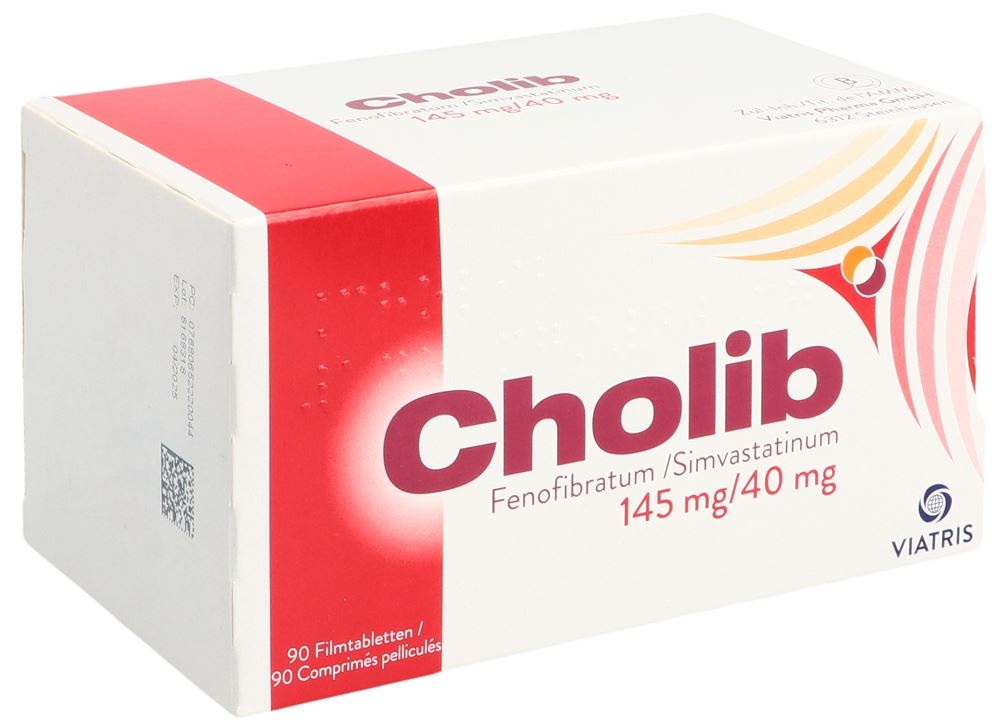
CHOLIB 145 mg/40 mg Film-Coated Tablets

Prescription review online
A doctor will review your case and decide whether a prescription is medically appropriate.

Talk to a doctor about this medicine
Discuss your symptoms and possible next steps in a quick online consultation.



How to use Cholib 145 mg/40 mg FILM-COATED TABLETS
Contents of the leaflet
- Introduction
- What Cholib is and what it is used for
- What you need to know before you take Cholib
- How to take Cholib
- Possible Adverse Effects
- Storage of Cholib
- Package Contents and Additional Information
Introduction
Package Leaflet: Information for the User Cholib 145 mg/40 mg film-coated tabletsfenofibrate/simvastatin
Read all of this leaflet carefully before you start taking this medicine, because it contains important information for you.
- Keep this leaflet, as you may need to read it again.
- If you have any further questions, ask your doctor or pharmacist.
- This medicine has been prescribed for you. Do not pass it on to others. It may harm them, even if their symptoms are the same as yours.
- If you experience any side effects, talk to your doctor or pharmacist. This includes any possible side effects not listed in this leaflet.
Contents of the pack:
- What Cholib is and what it is used for
- What you need to know before you take Cholib
- How to take Cholib
- Possible side effects
- Storage of Cholib
- Contents of the pack and further information
1. What Cholib is and what it is used for
Cholib contains two different active substances: fenofibrate (belonging to the group of so-called 'fibrates') and simvastatin (belonging to the group of so-called 'statins'). Both are used to reduce the levels of total cholesterol, "bad" cholesterol (LDL), and fatty substances called triglycerides in the blood. Both also increase the levels of "good" cholesterol (HDL).
What should I know about cholesterol and triglycerides?
Cholesterol is one of the different fats present in the blood. Total cholesterol is mainly made up of LDL cholesterol and HDL cholesterol.
LDL cholesterol is known as "bad" cholesterol because it builds up in the walls of the arteries and can form plaques. Over time, the buildup of plaques can block the arteries.
HDL cholesterol is known as "good" cholesterol because it helps prevent "bad" cholesterol from building up in the arteries and protects against heart disease.
Triglycerides are another type of fat present in the blood that can increase the risk of heart problems.
In most people, problems with cholesterol or triglycerides go unnoticed at first. Your doctor can find out your lipid levels with a simple blood test. Visit your doctor regularly to have your lipid levels checked.
Cholib is used in adults with a high risk of problems such as heart attack or stroke who have high levels of two types of fat (triglycerides and LDL cholesterol) in the blood. It is given to reduce triglycerides and increase "good" cholesterol (HDL cholesterol) in patients whose "bad" cholesterol (LDL cholesterol) has already been controlled using only simvastatin with a dose of 40 mg.
You should follow a low-fat diet or take other measures (e.g., exercise, weight loss) during treatment with Cholib.

Not sure if this medicine is right for you?
Discuss your symptoms and treatment with a doctor online.
2. What you need to know before you take Cholib
Do not take Cholib:
- if you are allergic to fenofibrate or simvastatin or any of the other ingredients of Cholib (listed in section 6)
- if you are allergic to peanuts, peanut oil, soy lecithin, or related substances
- if you have had an allergic reaction or skin lesions caused by sunlight or UV light while taking other medications (including other fibrates and an anti-inflammatory medication called "ketoprofen")
- if you have liver or gallbladder problems
- if you have pancreatitis (inflamed pancreas that causes abdominal pain), which is not caused byhigh levels of fat in the blood
- if you have moderate or severe kidney problems.
- if you have a history of muscle problems during treatment to reduce fat levels in the blood with either of the active substances of this medicine or with other statins (such as atorvastatin, pravastatin, or rosuvastatin) or fibrates (such as bezafibrate or gemfibrozil)
- if you are already taking the following medications:
- danazol (an artificial hormone used to treat endometriosis)
- cyclosporine (a medication commonly used in patients who have undergone organ transplants)
- itraconazole, ketoconazole, fluconazole, or posaconazole (medications for fungal infections)
- HIV protease inhibitors such as indinavir, nelfinavir, ritonavir, and saquinavir (medications used in HIV and AIDS infection)
- erythromycin, clarithromycin, or telithromycin (medications for bacterial infections)
- nefazodone (a medication for depression)
- amiodarone (a medication for heart rhythm disorders) or verapamil (a medication used for high blood pressure, chest pain associated with heart disease, and other heart conditions)
- antiviral agents for hepatitis C such as elbasvir, grazoprevir, glecaprevir, or pibrentasvir (used to treat hepatitis C virus infection)
- if you are already undergoing treatment and will continue treatment with:
- a fibrate (e.g., gemfibrozil)
- a statin (a medication to reduce fat levels in the blood, e.g., simvastatin, atorvastatin)
- if you are under 18 years old
- if you are pregnant or breastfeeding
Do not take Cholib if any of the above situations apply to you. If in doubt, consult your doctor or pharmacist again.
Warnings and precautions:
Consult your doctor or pharmacist before taking Cholib if:
- you have an underactive thyroid gland (hypothyroidism)
- you are scheduled to undergo surgery. You may need to stop taking Cholib for a short period.
- you drink large amounts of alcohol (more than 21 units (210 ml) of pure alcohol per week)
- you experience chest pain and difficulty breathing. These may be signs of a blood clot in the lung (pulmonary embolism)
- you have severe lung disease
- you have kidney disease
- you or a close relative have a hereditary muscle problem
- you are taking or have taken in the last 7 days a medication called fusidic acid (an antibiotic)
- you are taking antiviral agents for hepatitis C such as elbasvir or grazoprevir (used to treat hepatitis C virus infection)
If any of the above situations apply to you, consult your doctor or pharmacist before taking Cholib. If in doubt, consult your doctor or pharmacist again.
Also, inform your doctor or pharmacist if you experience persistent muscle weakness. Further tests and medication may be necessary to diagnose and treat this problem.
Your doctor will perform a blood test before you start taking Cholib to check how well your liver is working.
Your doctor may also want to perform blood tests to check how well your liver is working after you start taking Cholib.
While taking this medication, your doctor will closely monitor you if you have diabetes or are at risk of developing the disease. You are likely to be at risk of developing diabetes if you have high levels of sugar and fat in your blood, are overweight, and have high blood pressure.
Your doctor may perform a blood test to check your muscles before and after starting treatment.
Children and adolescents
Cholib should not be given to children or adolescents (under 18 years old).
Taking Cholib with other medicines:
It is especially important that you inform your doctor or pharmacist if you are taking, have recently taken, or might take other medicines. This also applies to medicines without a prescription, including herbal medicines.
Inform your doctor or pharmacist if you are taking any of the following medications:
- danazol (an artificial hormone used to treat endometriosis)
- cyclosporine (a medication commonly used in patients who have undergone organ transplants)
organs)
- itraconazole, ketoconazole, fluconazole, or posaconazole (medications for fungal infections) or HIV protease inhibitors such as indinavir, nelfinavir, ritonavir, and saquinavir
(medications used in HIV and AIDS infection)
or elbasvir, grazoprevir, glecaprevir, or pibrentasvir (used to treat hepatitis C virus infection)
or erythromycin, clarithromycin, or telithromycin (medications for bacterial infections) or nefazodone (a medication for depression)
or amiodarone (a medication for heart rhythm disorders) or verapamil (a medication used for high blood pressure, chest pain associated with heart disease, and other heart conditions)
or a fibrate (e.g., fenofibrate, gemfibrozil)
- a statin (e.g., simvastatin, atorvastatin)
Do not take Cholib if any of the above situations apply to you. If in doubt, consult your doctor or pharmacist again.
In particular, inform your doctor or pharmacist if you are taking any of the following medications (taking Cholib with any of these medications may increase the risk of muscle problems):
- high doses of at least 1 gram per day of niacin (nicotinic acid) or a treatment that contains niacin (a medication to reduce fat levels in the blood)
- colchicine (a medication used to treat gout)
Do not take fusidic acid (an antibiotic) while using this medication.
Apart from the medications mentioned above, inform your doctor or pharmacist if you are taking, have recently taken, or might take any of the following medications:
- anticoagulants such as warfarin, fluindione, phenprocoumon, or acenocoumarol (medications to prevent blood clots)
- pioglitazone (a particular class of medications for treating diabetes)
- rifampicin (a medication used to treat tuberculosis)
If any of the above situations apply to you, consult your doctor or pharmacist before taking Cholib. If in doubt, consult your doctor or pharmacist again.
Cholib with food and drinks
Grapefruit juice contains one or more components that alter the way the body uses Cholib. Do not take grapefruit juice with Cholib, as it may increase your risk of muscle problems.
Pregnancy and breastfeeding
- Do not take Cholib if you are pregnant, trying to become pregnant, or think you may be pregnant. If you become pregnant while taking Cholib, stop taking it immediately and consult your doctor.
- Do not take Cholib if you are breastfeeding or planning to breastfeed, as it is unknown whether the medication passes into breast milk.
If you are pregnant, breastfeeding, think you may be pregnant, or are planning to become pregnant, consult your doctor or pharmacist before using this medication.
Driving and using machines:
Cholib is not expected to affect your ability to drive or use tools or machines. However, you should be aware that some people may feel dizzy after taking Cholib.
Important information about some of the ingredients of Cholib
Cholib contains types of sugars called lactose and sucrose. If your doctor has told you that you have an intolerance to some sugars, talk to them before taking this medication.
Cholib contains soy lecithin. If you are allergic to peanuts, soy, or peanut oil, do not use Cholib.
3. How to take Cholib

Started taking the medicine and have questions?
Discuss your symptoms and treatment with a doctor online.
Follow the instructions for administration of this medicine exactly as prescribed by your doctor.
In case of doubt, consult your doctor or pharmacist again.
Your doctor will determine the appropriate dose for you based on your condition, current treatment, and personal risk factors.
The usual dose is one tablet per day.
You can take Cholib with or without food.
The tablets should be swallowed with a glass of water.
The tablets should not be crushed or chewed.
You should follow a low-fat diet or take other measures (e.g., exercise, weight loss) while taking Cholib.
If you take more Cholib than you should
If you have taken more Cholib than you should or if someone else has taken your medicine, inform your doctor or pharmacist or contact the nearest hospital.
If you forget to take Cholib
Do not take a double dose to make up for forgotten tablets. Take the next tablet at the usual time the next day. If you are concerned, consult your doctor or pharmacist.
If you have any further questions on the use of this medicine, ask your doctor or pharmacist.
4. Possible Adverse Effects
Like all medicines, this medicine can cause adverse effects, although not all people suffer from them.
- Any muscle pain, pain on palpation, or unexplained weakness may be a sign of muscle degradation. Therefore, if you develop any of these symptoms, inform your doctor immediately, as in rare cases, serious muscle problems have occurred, including muscle degradation that causes kidney damage; and very rare deaths have occurred. Compared to a fibrate or statin taken alone, the risk of muscle degradation increases when taking these 2 medicines together, as is the case with Cholib. It is higher in women or patients over 65 years old.
Some patients have experienced the following serious adverse effects while taking fenofibrate or simvastatin (both active ingredients of Cholib):
- hypersensitivity reactions (allergic) including: swelling of the face, tongue, and throat, which can cause difficulty breathing (angioedema) (rare)
- a severe allergic reaction that causes difficulty breathing or dizziness (anaphylactic reaction) (very rare)
- hypersensitivity reaction to Cholib with symptoms such as: pain or inflammation of the joints, inflammation of the blood vessels, unusual bruising, swelling, and skin rash, hives, skin sensitivity to sunlight, fever, hot flashes, difficulty breathing, and feeling of discomfort, symptoms of a disease similar to lupus (including rash, joint disorders, and effects on white blood cells)
- cramps or pain, discomfort, or muscle weakness, muscle rupture: these can be signs of inflammation or muscle degradation, which can cause kidney damage or even death
- stomach pain: may be a sign that your pancreas is inflamed (pancreatitis)
- chest pain and difficulty breathing: these can be signs of a blood clot in the lung (pulmonary embolism)
- pain, redness, or swelling of the legs: may be signs of a blood clot in the leg (deep vein thrombosis)
- yellow color of the skin and the whites of the eyes (jaundice) or an increase in liver enzymes: may be signs of an inflamed liver (hepatitis and liver failure)
- increased sensitivity of the skin to sunlight, sunlamps, and tanning beds
- rash that can occur on the skin or ulcers in the mouth (drug-induced lichenoid eruptions)
If you experience any of the serious adverse effects listed above, stop taking Cholib and inform your doctor immediately or go to the emergency department of the nearest hospital; you may need urgent medical treatment.
Some patients have experienced the following adverse effects while taking Cholib, fenofibrate, or simvastatin:
Very frequent adverse effects (may affect more than 1 in 10 people):
- increase in "creatinine" level in the blood (substance excreted by the kidneys)
- increase in blood levels of "homocysteine" (an excessive amount of this amino acid in the blood is related to a higher risk of coronary heart disease, stroke, and peripheral vascular disease, although a causal relationship has not been established)
Frequent adverse effects (may affect up to 1 in 10 people):
- increase in platelet count in blood
- elevations in blood tests of liver function (transaminases)
- digestive disorders (stomach pain, nausea, vomiting, diarrhea, and flatulence)
- upper respiratory tract infection
Uncommon adverse effects (may affect up to 1 in 100 people):
- muscle problems
- gallstones
- rash, itching, red spots on the skin
- headache
- sexual problems
Rare adverse effects (may affect up to 1 in 1,000 people):
- low red blood cell count (anemia)
- numbness or weakness of arms and legs
- confusion
- dizziness
- feeling of exhaustion (asthenia)
- increase in "urea" (produced by the kidneys) reflected in tests
- increase in "gamma glutamyltransferase" (produced by the liver) reflected in tests
- increase in "alkaline phosphatase" (produced by the biliary system) reflected in tests
- increase in "creatine phosphokinase" (produced by muscle) reflected in tests
- decrease in hemoglobin (which transports oxygen in the blood) and white blood cells - reflected in tests
- sleep disorders
- deficient or lost memory
- hair loss
- constipation
- dyspepsia
- blurred vision and vision deterioration
Very rare adverse effects (may affect up to 1 in 10,000 people):
- gynecomastia (breast enlargement in men)
The following adverse effects have also been reported, but their frequency cannot be estimated from the available data (frequency not known):
- severe allergic skin rash with blisters
- complications of gallstones such as colic, caused by the presence of stones in the bile duct, infection of the bile ducts or gallbladder
- diabetes mellitus
- erectile dysfunction
- feeling of depression
- sleep disorders, including nightmares
- specific lung disease with breathing difficulties (called interstitial lung disease)
- constant muscle weakness
- increase in "glycosylated hemoglobin" and blood glucose levels (markers of blood glucose control in diabetes mellitus) reflected in tests
Reporting of Adverse Effects
If you experience any type of adverse effect, consult your doctor or pharmacist, even if it is a possible adverse effect that is not listed in this prospectus. You can also report it directly through the national reporting system included in Appendix V. By reporting adverse effects, you can contribute to providing more information on the safety of this medicine.
5. Storage of Cholib
Keep this medicine out of the sight and reach of children.
Do not use Cholib after the expiration date that appears on the box and blister after CAD.
The expiration date is the last day of the month indicated.
Store below 30 °C.
Medicines should not be thrown away through wastewater or household waste. Ask your pharmacist how to dispose of medicines that are no longer needed. This will help protect the environment.
6. Package Contents and Additional Information
Composition of Cholib
The active ingredients are fenofibrate and simvastatin. Each tablet contains 145 mg of fenofibrate and 40 mg of simvastatin.
This medicine contains less than 1 mmol of sodium (23 mg) per tablet, i.e., it is essentially "sodium-free".
The other ingredients are:
Core of the tablet:
Butylhydroxyanisole (E320), lactose monohydrate, sodium lauryl sulfate, pregelatinized corn starch, sodium docusate, sucrose, citric acid monohydrate (E330), hypromellose (E464), crospovidone (E1202), magnesium stearate (E572), silicified microcrystalline cellulose (composed of microcrystalline cellulose and anhydrous colloidal silicon dioxide), ascorbic acid (E300).
Coating:
Partially hydrolyzed polyvinyl alcohol (E1203), titanium dioxide (E171), talc (E553b), soybean lecithin (E322), xanthan gum (E415), red iron oxide (E172).
Appearance of Cholib and Package Contents
Tablet coated with a film, oval, biconvex, brick-red in color, with the inscription 145/40 on one side. The diameter is approximately 19.3 x 9.3 mm and the weight of the tablet is approximately 840 mg.
The tablets are presented in cardboard boxes with blisters containing 10, 30, or 90 tablets.
Only some package sizes may be marketed.
Marketing Authorization Holder and Manufacturer
Marketing Authorization Holder:
Mylan IRE Healthcare Ltd, Unit 35/36 Grange Parade, Baldoyle Industrial Estate, Dublin 13 – Ireland.
Manufacturer:
Mylan Laboratories SAS, Route de Belleville - Lieu-dit Maillard, 01400 Châtillon-sur-Chalaronne - France.
Mylan Hungary Kft., Mylan utca 1, Komárom 2900, Hungary
You can request more information about this medicine by contacting the local representative of the marketing authorization holder.
Belgium | Ireland | Norway |
Mylan EPD | Mylan IRE Healthcare Ltd | Mylan Healthcare Norge AS |
Tel: + 32 2 658 61 00 | Tel: +44 (0) 1707 853000 | Tel: + 47 66 75 33 00 |
Bulgaria | Iceland | Austria |
Mylan Bulgaria EOOD | Icepharma hf. | Mylan Österreich GmbH |
Tel: + 359 2 4455 400 | Tel: +354 540 8000 | Tel: +43 1 89124-0 |
Czech Republic | Italy | Poland |
Mylan Healthcare CZ s.r.o. | Mylan Italia S.r.l. | Mylan Healthcare Sp. z o.o. |
Tel: +420 222 004 400 | Tel: + 39 (0) 2 61246921 | Tel: +48 22 546 64 00 |
Denmark | Cyprus | Portugal |
Mylan Denmark ApS | Varnavas Hadjipanayis Ltd | BGP Products, Unipessoal, Lda. |
Tel: + 45 28 11 69 32 | Tel: +357 22207700 | Tel: +351 214 127 256 |
Germany | Latvia | Romania |
Mylan Healthcare GmbH | Mylan Healthcare SI | BGP Products S.R.L. |
Tel: +49 511 4754 3400 | Tel: + 371 67 605 580 | Tel: +40 372 579 000 |
Estonia | Lithuania | Slovenia |
BGP Products Switzerland GmbH | Mylan Healthcare UAB | Mylan Healthcare d.o.o. |
Estonian branch | Tel: +370 52 051 288 | Tel: + 386 (0)123 63 180 |
Tel: + 372 6363052 | ||
Greece | Luxembourg | Slovak Republic |
BGP PRODUCTS Μ.Ε.Π.Ε. | Mylan EPD sprl-bvba | BGP Products s.r.o. |
Tel: +30 210 9891 777 | Tel/Tél: + 32 2 658 6100 | Tel: +421 2 40 20 38 00 |
Spain | Hungary | Finland |
Mylan pharmaceuticals S.L. | Mylan EPD Kft | Mylan Finland Oy |
Tel: +34 91 669 93 00 | Tel: +36 1 465 2100 | Tel: +358 20 720 9555 |
France | Malta | Sweden |
Mylan Medical SAS | V.J. Salomone Pharma Limited | BGP Products AB |
Tel: + 33 (0)1 56 64 10 70 | Tel: +356-22-98 31 43 | Tel: +46 8 555 227 07 |
Croatia | Netherlands | United Kingdom |
Mylan Hrvatska d.o.o. | Mylan Healthcare B.V. | Mylan Products Ltd |
Tel: + 385 (0)1 2350 599 | Tel: +31 (0)20 426 33 00 | Tel: +44 (0) 170 785 3000 |
Date of the Last Revision of this Prospectus:
Detailed information about this medicine is available on the website of the European Medicines Agency (EMA): http://www.ema.europa.eu.
- Country of registration
- Dosage formTABLET, 145 mg / 40 mg
- ATC codeC10BA04
- Active substance
- Prescription requiredYes
- Manufacturer
- CompositionLAURILSULFATO DE SODIO (10,2 mg mg), DOCUSATO DE SODIO (2,9 mg mg), SACAROSA (145 mg mg), BUTILHIDROXIANISOL (E 320) (0,08 mg mg), LACTOSA MONOHIDRATO (204,9 mg mg), LECITINA DE SOJA (0,8 mg mg)
- This information is for reference only and does not constitute medical advice. Always consult a doctor before taking any medication. Oladoctor is not responsible for medical decisions based on this content.
- Alternatives to Cholib 145 mg/40 mg FILM-COATED TABLETSDosage form: TABLET, 145 mg / 20 mgActive substance: simvastatin and fenofibrateManufacturer: Mylan Ire Healthcare LimitedPrescription requiredDosage form: TABLET, 10 mg/10 mgActive substance: rosuvastatin and ezetimibeManufacturer: Ferrer Internacional S.A.Prescription requiredDosage form: TABLET, 20 mg/10 mgActive substance: rosuvastatin and ezetimibeManufacturer: Ferrer Internacional S.A.Prescription required
Online doctors for Cholib 145 mg/40 mg FILM-COATED TABLETS
Discuss questions about Cholib 145 mg/40 mg FILM-COATED TABLETS, including use, safety considerations and prescription review, subject to medical assessment and local regulations.
Get Cholib 145 mg/40 mg FILM-COATED TABLETS Prescription Online
Fill in a 2-min form
Tell us your symptoms, history, and what medicine you're requesting.
Pick a doctor or let us assign
Choose a specialist or we'll match you with the next available doctor.
Doctor reviews your case
Usually within 30 minutes. They may ask follow-up questions via chat.
Collect from any pharmacy
Electronic prescription sent to your email — valid across Spain.
Frequently Asked Questions
Cholib 145 mg/40 mg FILM-COATED TABLETS requires a prescription in Spain. You can check with a doctor online whether this medicine may be appropriate for your situation.
The active ingredient in Cholib 145 mg/40 mg FILM-COATED TABLETS is simvastatin and fenofibrate. This information helps identify medicines with the same composition but different brand names.
Cholib 145 mg/40 mg FILM-COATED TABLETS is manufactured by Mylan Ire Healthcare Limited. Pharmacy brands and packaging may differ depending on the distributor.
Doctors such as Family doctors, Psychiatrists, Dermatologists, Cardiologists, Endocrinologists, Gastroenterologists, Pulmonologists, Nephrologists, Rheumatologists, Hematologists, Infectious disease physicians, Allergists, Geriatricians, Paediatricians, Oncologists may assess whether Cholib 145 mg/40 mg FILM-COATED TABLETS is appropriate, depending on your situation and local regulations. You can book an online consultation to discuss your symptoms and possible next steps.
Spain has a well-developed healthcare infrastructure across major cities such as Madrid, Barcelona, Valencia, and Seville. Pharmacies are widely available and operate under strict regulations, ensuring access to prescribed medications.
You can buy Cholib 145 mg/40 mg FILM-COATED TABLETS in Madrid, Barcelona, Seville, or Valencia at any local pharmacy with a valid prescription.
To obtain a prescription, you can use Oladoctor:
Other medicines with the same active substance (simvastatin and fenofibrate) include Cholib 145 mg/20 mg FILM-COATED TABLETS, ALZIL PLUS 10 mg/10 mg FILM-COATED TABLETS, ALZIL PLUS 20 MG/10 MG FILM-COATED TABLETS. These may have different brand names or formulations but contain the same therapeutic ingredient. Always consult a doctor before switching or starting a new medicine.
